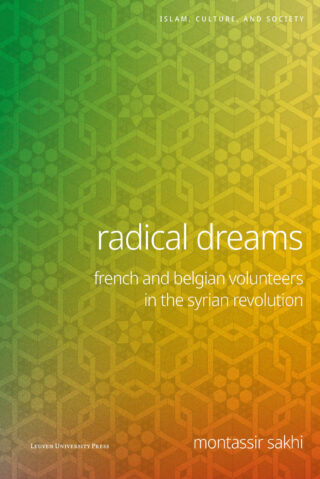

Radical Dreams
French and Belgian Volunteers in the Syrian Revolution
Montassir Sakhi (Author),

Series: Islam, Culture and Society
Category: Religion, Social Science
Language: English
ISBN: 9789462705203
Publication date: May 20, 2026
€39.50 (including 6% VAT)
Buy NowNumber of pages: 310
Size: 234 x 156 x mm

Funded by: KU Leuven Fund for Fair Open Access
Open Book Collective
Stock item: 172410
Standard delivery time for print books:
For Belgium: 5 to 8 working days
For EU: 2 to 3 weeks
For other countries: 4 to 5 weeks
Series: Islam, Culture and Society
Category: Religion, Social Science
Language: English
ISBN: 9789461667601
Publication date: May 20, 2026
Download Free EpubNumber of pages: 310
Funded by: KU Leuven Fund for Fair Open Access
Open Book Collective
Series: Islam, Culture and Society
Category: Religion, Social Science
Language: English
ISBN: 9789461667595
Publication date: May 20, 2026
Download Free PDFNumber of pages: 310
Funded by: KU Leuven Fund for Fair Open Access
Open Book Collective
An in-depth investigation of the key actors in the Syrian revolution and jihad, featuring interviews with Syrian revolutionaries and Europeans who joined the jihad.
Following the Syrian population’s uprising against the dictatorship of Bashar al-Assad in 2011, the regime’s brutal repression drove many revolutionaries to take up arms. The involvement of groups claiming political Islam, together with foreign interference, rendered the conflict increasingly opaque, culminating in the emergence of the Islamic State in 2014, which placed religion at the centre of a policy of terror. A small, misguided minority of young Europeans were drawn to join the revolution and carry out devastating suicide attacks in France and Belgium in 2015 and 2016. In seeking to make sense of these tragic events, ideological interpretations focusing on the ‘radicalisation’ of political Islam have often dominated public discourse. This is where the importance of this book lies: it draws on testimonies from key actors—Syrian revolutionaries and ‘jihad migrants’—collected by the author between 2015 and 2023 in the Middle East and Europe. The book explores how ordinary individuals experienced their commitments. These testimonies reveal the meaning they ascribed to their actions, from the initial peaceful mobilisation to revolutionary warfare. They illuminate the role of religious symbolism in the Syrian revolution and in the motives of approximately 2,500 young French and Belgian volunteers, largely from postcolonial immigrant backgrounds, who joined the revolution in the wake of the Arab Spring.
Originally published in French by Éditions La Découverte (© 2023) and very well-received in the French media, Leuven University Press is pleased to make the updated English edition available to the global reader, thanks to the collaboration with UM6P Press (University Mohammed VI Polytechnic Press) based in Ben Guerir, Morocco.
Translator: Steve Garner
Preface by Olivier Roy. Getting to the core of what motivated the francophone volunteers who joined jihadist groups in Syria
Introduction. Studying the Syrian revolution and the jihad of the Europeans involved
Chapter 1. Political and Media discourse on the jihad and the Syrian revolution
Chapter 2. Year 1 of the revolution, as narrated by its participants
Chapter 3. The regime’s repressive violence and the slide into armed struggle (2011-2012)
Chapter 4. The Free Zones: a forgotten utopia (2012-2014)
Chapter 5. The universalisation of the revolution: jihad and the uses of religion
Chapter 6. Revolutionary jihad versus neo-nationalist jihad: the Daesh era (2014-2017)
Chapter 7. Departure for jihad and welcome into the revolution
Chapter 8. The political wellsprings of millennialist and religious commitments
Chapter 9. Jihad vs revolution, the decisive ‘split’ of 2013
Chapter 10. Suicide bombings: violence and terrorist futures
Conclusion. The ever-present hopes of the Syrian revolution Epilogue. The Revolution vs. the State
Notes
References
Montassir Sakhi
Montassir Sakhi is Assistant Professor of Anthropology at UM6P in Morocco and a researcher affiliated to KU Leuven. His research focuses on the mobilisation in the Arab world since 2011, restrictive European policies on migrants, and the effects of these policies on populations in the southern Mediterranean.
Frequently Asked Questions
What is "Radical Dreams" about?
An in-depth investigation of the key actors in the Syrian revolution and jihad, featuring interviews with Syrian revolutionaries and Europeans who joined the jihad.
Following the Syrian population’s uprising against the dictatorship of Bashar al-Assad in 2011, the regime’s brutal repression drove many revolutionaries to take up arms. The involvement of groups claiming political Islam, together with foreign interference, rendered the conflict increasingly opaque, culminating in the emergence of the Islamic State in 2014, which placed religion at the centre of a policy of terror. A small, misguided minority of young Europeans were drawn to join the revolution and carry out devastating suicide attacks in France and Belgium in 2015 and 2016. In seeking to make sense of these tragic events, ideological interpretations focusing on the ‘radicalisation’ of political Islam have often dominated public discourse. This is where the importance of this book lies: it draws on testimonies from key actors—Syrian revolutionaries and ‘jihad migrants’—collected by the author between 2015 and 2023 in the Middle East and Europe. The book explores how ordinary individuals experienced their commitments. These testimonies reveal the meaning they ascribed to their actions, from the initial peaceful mobilisation to revolutionary warfare. They illuminate the role of religious symbolism in the Syrian revolution and in the motives of approximately 2,500 young French and Belgian volunteers, largely from postcolonial immigrant backgrounds, who joined the revolution in the wake of the Arab Spring.
Originally published in French by Éditions La Découverte (© 2023) and very well-received in the French media, Leuven University Press is pleased to make the updated English edition available to the global reader, thanks to the collaboration with UM6P Press (University Mohammed VI Polytechnic Press) based in Ben Guerir, Morocco.
Translator: Steve Garner
Who wrote "Radical Dreams"?
"Radical Dreams" was written by Montassir Sakhi.
Montassir Sakhi is Assistant Professor of Anthropology at UM6P in Morocco and a researcher affiliated to KU Leuven. His research focuses on the mobilisation in the Arab world since 2011, restrictive European policies on migrants, and the effects of these policies on populations in the southern Mediterranean.
Is "Radical Dreams" part of a series?
Yes, "Radical Dreams" is part of the "Islam, Culture and Society" series.

The peer-reviewed book series Islam, Culture, and Society provides a strong academic platform for national and international scholars engaged in research on Muslim societies from various perspectives and disciplines. The series promotes a multidisciplinary approach and welcomes contributions from all fields of the Humanities and Social Sciences, including theology, religious studies, history, law, philosophy, philology, literature, anthropology, sociology, social and cultural psychology, cultural studies, and the arts.
Topics of particular interest to the series include the interdisciplinary role of history, social behaviour, religious (and other) identities, local traditions, and cultural and legal systems, as well as diversity, inclusion, and tolerance in (re)shaping the plurality, changeability, diversity and global interconnectedness of Muslim cultures and societies.
All volumes in the series present cutting-edge scholarship and foster ongoing scholarly debates related to the historical and contemporary facets of Muslim societies. In doing so, Islam, Culture, and Society contributes to a more comprehensive, profound, and more nuanced understanding of the complexities of Muslim practices and perspectives in the social, cultural, psychological and religious spheres within a globalized world.
The series Islam, Culture, and Society is an initiative of the Leuven Centre for the Study of Islam, Culture, and Society (LCSICS).
The editors accept monographs and edited volumes covering a broad appeal of topics in a wide geographic range, including North Africa, the Middle East, Sub-Saharan Africa, Central Asia, South and Southeast Asia, and Muslim communities in the West.
The series welcomes contributions by established scholars as well as by promising young researchers, and embraces diversity in terms of gender, nationality, and ethnicity.
The main publication language of the series is English, although selective room is offered to titles in Dutch, French and Arabic. All books are written for an international audience of scholars. All manuscripts are subject to peer review.
Series editors
Chaïma Ahaddour (Faculty of Theology and Religious Studies, KU Leuven)
Nadia Fadil (Faculty of Social Sciences, KU Leuven)
Arjan Post (Faculty of Arts, KU Leuven)
Umar Ryad (Faculty of Arts, KU Leuven)
Editorial board
Ahmet Alibašić (University of Sarajevo)
Martijn de Koning (Radboud University – Nijmegen)
Mohammed Ghaly (University of Hamad Bin Khalifa – Doha)
Christian Lange (Utrecht University)
Jon Hoover (University of Nottingham)
Helge Daniëls (KU Leuven)
Advisory board
Albrecht Fuess (University of Marburg)
Agata S. Nalborczyk (University of Warsaw)
Jonathan Brown (Georgetown University)
John Brockopp (The Pennsylvania State University)
Annelies Moors (University of Amsterdam)
Pascal Buresi (French National Centre for Scientific Research – Paris)
Proposals
Proposals and enquiries can be sent to Umar Ryad.
Please make use of the submission form to present your manuscript or proposal to our board.
Authors interested in Open Access can consult the available funding options.
Links & Resources
Is "Radical Dreams" available Open Access?
Yes, "Radical Dreams" is published Open Access. It is available under a BY-NC-ND license.
Who funded the publication of "Radical Dreams"?
Publication of "Radical Dreams" was funded by KU Leuven Fund for Fair Open Access
Open Book Collective
.
What is the Table of Contents for "Radical Dreams"?
Preface by Olivier Roy. Getting to the core of what motivated the francophone volunteers who joined jihadist groups in Syria
Introduction. Studying the Syrian revolution and the jihad of the Europeans involved
Chapter 1. Political and Media discourse on the jihad and the Syrian revolution
Chapter 2. Year 1 of the revolution, as narrated by its participants
Chapter 3. The regime’s repressive violence and the slide into armed struggle (2011-2012)
Chapter 4. The Free Zones: a forgotten utopia (2012-2014)
Chapter 5. The universalisation of the revolution: jihad and the uses of religion
Chapter 6. Revolutionary jihad versus neo-nationalist jihad: the Daesh era (2014-2017)
Chapter 7. Departure for jihad and welcome into the revolution
Chapter 8. The political wellsprings of millennialist and religious commitments
Chapter 9. Jihad vs revolution, the decisive ‘split’ of 2013
Chapter 10. Suicide bombings: violence and terrorist futures
Conclusion. The ever-present hopes of the Syrian revolution Epilogue. The Revolution vs. the State
Notes
References
What is the DOI for "Radical Dreams"?
The Digital Object Identifier (DOI) for "Radical Dreams" is 10.11116/9789461667601.
Related titles
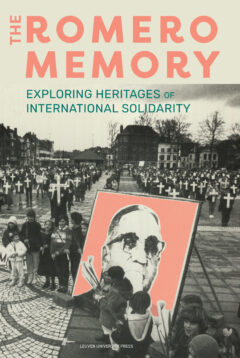 The Romero Memory
Judith Gruber (Editor), Jonas Van Mulder (Editor), Stephan Parmentier (Editor), Veerle Draulans (Editor), Joren Janssens (Editor), Jacques Haers (Editor), Kim Christiaens (Editor),
November 2026
 Infrastructuring Arrival
Karel Arnaut (Editor), Luce Beeckmans (Editor), Bruno Meeus (Editor),
November 2026
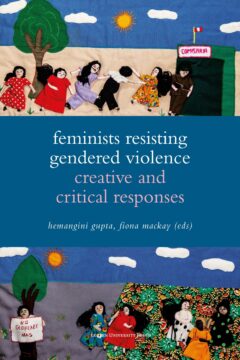 Feminists Resisting Gendered Violence
Hemangini Gupta (Editor), Fiona Mackay (Editor), Jan Breckenridge (Editor), Louise Chappell (Editor), Rachna Mehra (Editor), Rukmini Sen (Editor), Mailin Suchting (Editor),
October 2026

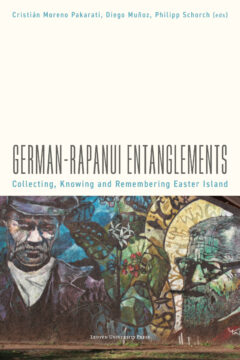 German–Rapanui Entanglements
Cristián Moreno Pakarati (Editor), Diego Muñoz (Editor), Philipp Schorch (Editor),
August 2026
 Teaching About the Violent Past
Line Kuppens (Author), Justin Sheria Nfundiko (Author),
October 2025
 Integration Otherwise Inspiration Kit
Luce Beeckmans (Author), Dounia Salamé (Author), Martina Bovo (Author), Mary Hogan (Author),
June 2025
 Christian Churches and Postwar Society
Kristien Suenens (Editor), Michael Snape (Editor), Martin Baumeister (Editor),
June 2025
 Cross-Cultural Heritage
Jonas Van Mulder (Editor), Thomas Coomans (Editor), Dries Vanysacker (Editor),
April 2025

 Geschiedenissen van de islam in Nederland en Vlaanderen
Vera Crienen (Editor), Martijn de Koning (Editor), Umar Ryad (Editor), Gerard Wiegers (Editor),
May 2024
 Newcomers Navigating the Welfare State
Hanne Vandermeerschen (Editor), Elsa Mescoli (Editor), Jean-Michel Lafleur (Editor), Peter De Cuyper (Editor),
December 2023