Catholicism and the Welfare State in Secular France
Continuities and Changes in the Catholic Mobilizations in the Social Policy Domain (1940-2017)
Fabio Bolzonar (Author),
Series: KADOC-Studies on Religion, Culture and Society 31
Category: History, History 1800-present, Religion
Language: English
ISBN: 9789462703889
Publication date: September 28, 2023
€45.00 (including 6% VAT)
Buy NowNumber of pages: 224
Size: 238 x 170 x 15 mm

Stock item: 156628
Standard delivery time for print books:
For Belgium: 5 to 8 working days
For EU: 2 to 3 weeks
For other countries: 4 to 5 weeks
Series: KADOC-Studies on Religion, Culture and Society 31
Category: History, History 1800-present, Religion
Language: English
ISBN: 9789461665331
Publication date: September 28, 2023
€38.00 (including 6% VAT)
Buy NowNumber of pages: 224
Secular France and the changing influence of Catholicism.
Even though the policy impact of Catholicism has increasingly been acknowledged, existing scholarship lacks a coherent view on its changing influence over time and in different political contexts. In this book, Fabio Bolzonar investigates the influence of Catholicism on developments in French social protection from World War II to the mid-2010s. He discusses the factors that have favoured or inhibited it and explores the hybridization between Catholic values and secular principles in the social engagement of Catholic actors in secular France. By doing so, this multidisciplinary study integrates current scholarship, which has given limited attention to the changing patterns of Catholic involvement in the social policy domain over a long period of time, and the renewed influence of Catholic values in secularized societies. Catholic mobilization has relocated from the political to the civil society sphere, making voluntary organizations and social movements, rather than political parties, the main channels for defending Catholic values in secular France. Rather than marginalizing Catholicism, this process has opened up new opportunities for Catholic actors and values to play a significant role in society and politics. Bolzonar identifies two divergent scenarios that define Catholic social engagement in contemporary France: either the strengthening of new forms of institutional collaboration between Catholic-inspired philanthropic organizations and public administrations in the interest of socially vulnerable citizens, or the emergence of new ideological conflicts on gender- and sexuality-related issues.
This publication is GPRC-labeled (Guaranteed Peer-Reviewed Content).
Preface
PART I
-
Introduction
Catholicism and the Welfare State: Beyond Christian Democracy
Studying the Role of Catholicism in Social Policy Developments
Outline of the Book -
Catholicism and the Welfare State in a Reactionary Regime (1940-1944)
Catholicism and Politics in Vichy France
Social Policies during the Vichy Regime
The Expansion of Social Protection
The Reorganization of Public Hospitals
An Authoritarian Corporatist Reform 45 A Legacy for Post-war Reformers -
Foundation and Consolidation of a Christian Democratic Welfare State (1944-1959)
The Roots of Christian Democratic Social Reformism
Foundation and Development of a Christian Democratic Welfare State
The New Institutional Organization of Social Security
Family Policies
Housing Policies
A Christian Democratic Welfare State? -
Catholicism in the Years of Gaullism and Mitterrandism (1959-1995)
The Social Reforms of Gaullist and Right-wing Governments
The Reform of 1967 78 Family Policies under the Right in Power
Moral Liberalization of Social Legislation
Decline of Family Benefits
Support for Larger Families
Support for Working Mothers
The Mitterrand Years 88 Renovating the Démocratie Sociale
Modernizing Family Policies
Moral Liberalization of Family Legislation
Increasing Family Benefits
Support for Smaller Families
Promotion of Work-family Reconciliation Policies
Great Disillusions?
PART II
-
A Period of Changes
Catholicism in Contemporary France: Some Observations
Weakening Values?
A Church in Decline?
Do Catholic Values Still Play a Role in French Politics?
Catholicism and Civil Society
Entering a Post-secular Era: Secularization, Civic Engagement, and New Social Mobilization -
Social Catholicism in an Age of Permanent Austerity
Housing Policies and Social Catholicism
Early and Contradictory Developments
Increasing Activism
Toward a New Alliance?
Evaluating Values in Action -
New Ideological Conflicts?
Against Same-sex Marriage
Troubles in the Church
The Political Support for the Anti-gay Marriage Campaign
The Opposition of Civil Society
Influence on Policy Outcomes
Abortion: A Still Open Question
New Ideological Conflicts? -
A Contribution to a Theory on the Mobilization of Catholicism in Secular Societies
Continuities and Changes in a Long Story
A Way Ahead
Concluding Remarks
Abbreviations
Bibliography
Index of Persons
Colophon
Fabio Bolzonar
Fabio Bolzonar holds a PhD from the University of Cambridge. He is currently a postdoctoral fellow of the Japan Society for the Promotion of Science and a part-time lecturer at Waseda University, as well as a scientific collaborator at the Centre d’Étude de la Vie Politique at the Université Libre de Bruxelles.
This book is well worth reading by anyone interested in the development of French social policy and civil society. It is clearly written and pleasantly reluctant to shoehorn evidence into sweeping conclusions. The most innovative and important part of the book, to my mind, comes in the second half, where Bolzonar shows how Catholicism has reinvented itself for a new political order, in which expertise and nonprofit mobilization play a key role against a general backdrop of austerity politics--an atmosphere very different from the decades of the mid-century when the French social system was born. - James Chappel, H-France Review Vol. 25 (March 2025), No. 22, https://h-france.net/vol25reviews/vol25_no22_Chappel.pdf
It provides a much-needed and methodologically well-crafted contribution that not only invites further research but also powerfully demonstrates the potential of interdisciplinary work between historical scholarship and political science—moving beyond both the secularization hypothesis and the initial waves of its critique. - Mette Buchardt, The Catholic Historical Review 111, no. 3 (2025): 586-587. https://dx.doi.org/10.1353/cat.2025.a969258.
Frequently Asked Questions
What is "Catholicism and the Welfare State in Secular France" about?
Secular France and the changing influence of Catholicism.
Even though the policy impact of Catholicism has increasingly been acknowledged, existing scholarship lacks a coherent view on its changing influence over time and in different political contexts. In this book, Fabio Bolzonar investigates the influence of Catholicism on developments in French social protection from World War II to the mid-2010s. He discusses the factors that have favoured or inhibited it and explores the hybridization between Catholic values and secular principles in the social engagement of Catholic actors in secular France. By doing so, this multidisciplinary study integrates current scholarship, which has given limited attention to the changing patterns of Catholic involvement in the social policy domain over a long period of time, and the renewed influence of Catholic values in secularized societies. Catholic mobilization has relocated from the political to the civil society sphere, making voluntary organizations and social movements, rather than political parties, the main channels for defending Catholic values in secular France. Rather than marginalizing Catholicism, this process has opened up new opportunities for Catholic actors and values to play a significant role in society and politics. Bolzonar identifies two divergent scenarios that define Catholic social engagement in contemporary France: either the strengthening of new forms of institutional collaboration between Catholic-inspired philanthropic organizations and public administrations in the interest of socially vulnerable citizens, or the emergence of new ideological conflicts on gender- and sexuality-related issues.
This publication is GPRC-labeled (Guaranteed Peer-Reviewed Content).
Who wrote "Catholicism and the Welfare State in Secular France"?
"Catholicism and the Welfare State in Secular France" was written by Fabio Bolzonar.
Fabio Bolzonar holds a PhD from the University of Cambridge. He is currently a postdoctoral fellow of the Japan Society for the Promotion of Science and a part-time lecturer at Waseda University, as well as a scientific collaborator at the Centre d’Étude de la Vie Politique at the Université Libre de Bruxelles.
Is "Catholicism and the Welfare State in Secular France" part of a series?
Yes, "Catholicism and the Welfare State in Secular France" is part of the "KADOC-Studies on Religion, Culture and Society" series. It's book 31 in the series.


The longstanding peer-reviewed book series KADOC Studies in Religion, Culture and Society is devoted to a deeper understanding of the role of religion(s) in society in Europe and the world since 1750. By means of monographs and edited volumes, the series explores thematic frontiers and embraces innovative methodological approaches in historical, sociological and anthropological scholarship on religion, culture and society. The series particularly welcomes manuscripts adopting interreligious and transnational perspectives. Taken together, KADOC Studies in Religion, Culture and Society and its companion series KADOC Artes represent a diptych featuring the immaterial and material legacies of religions in Europe and the world from the 18th century onwards.
KADOC Studies in Religion, Culture and Society is managed by an independent Editorial Board. Books are published in English. Open Access publishing is encouraged. Financial support will be examined on a case-by-case basis and in consultation with the author.
KADOC, the Interfaculty Documentation and Research Centre on Religion, Culture and Society at KU Leuven, is an internationally oriented interdisciplinary research center as well as a heritage institution recognized by the Flemish Government with particularly rich and diverse documentary holdings.
Editorial board
Elena Arigita Maza (Universidad de Granada)
Florian Bock (Ruhr Universität Bochum)
Timothy Brittain‐Catlin (University of Cambridge)
James Chappel (Duke University)
Kim Christiaens (KADOC-KU Leuven)
Kathleen James-Chakraborty (University College Dublin)
James Kennedy (Utrecht University)
Franziska Metzger (PH Luzern)
Patrick Pasture (MoSa‐KU Leuven) - chairman
Isabelle Saint‐Martin (EPHE Paris)
Thijl Sunier (VU Amsterdam)
Árpád von Klimó (Catholic University of America)
Veerle De Laet (Leuven University Press)
Peter Heyrman (KADOC-KU Leuven) - secretary
Proposals
Proposals and enquiries can be sent to Peter Heyrman. The series welcomes monographs and edited volumes. Book proposals may relate to, for example, the political impact of religion, the dynamics between religion and welfare, and missionary history. All proposals and manuscripts are subject to double blind peer review involving at least one external reviewer (proposals) or at least two (manuscripts). The editors strive towards completing the review of proposals within two months and of complete manuscripts within five months after submission.
Please make use of the submission form to present your manuscript or proposal to our board.
Authors interested in Open Access can consult the available funding options.
Links & Resources
What is the Table of Contents for "Catholicism and the Welfare State in Secular France"?
Preface
PART I
-
Introduction
Catholicism and the Welfare State: Beyond Christian Democracy
Studying the Role of Catholicism in Social Policy Developments
Outline of the Book -
Catholicism and the Welfare State in a Reactionary Regime (1940-1944)
Catholicism and Politics in Vichy France
Social Policies during the Vichy Regime
The Expansion of Social Protection
The Reorganization of Public Hospitals
An Authoritarian Corporatist Reform 45 A Legacy for Post-war Reformers -
Foundation and Consolidation of a Christian Democratic Welfare State (1944-1959)
The Roots of Christian Democratic Social Reformism
Foundation and Development of a Christian Democratic Welfare State
The New Institutional Organization of Social Security
Family Policies
Housing Policies
A Christian Democratic Welfare State? -
Catholicism in the Years of Gaullism and Mitterrandism (1959-1995)
The Social Reforms of Gaullist and Right-wing Governments
The Reform of 1967 78 Family Policies under the Right in Power
Moral Liberalization of Social Legislation
Decline of Family Benefits
Support for Larger Families
Support for Working Mothers
The Mitterrand Years 88 Renovating the Démocratie Sociale
Modernizing Family Policies
Moral Liberalization of Family Legislation
Increasing Family Benefits
Support for Smaller Families
Promotion of Work-family Reconciliation Policies
Great Disillusions?
PART II
-
A Period of Changes
Catholicism in Contemporary France: Some Observations
Weakening Values?
A Church in Decline?
Do Catholic Values Still Play a Role in French Politics?
Catholicism and Civil Society
Entering a Post-secular Era: Secularization, Civic Engagement, and New Social Mobilization -
Social Catholicism in an Age of Permanent Austerity
Housing Policies and Social Catholicism
Early and Contradictory Developments
Increasing Activism
Toward a New Alliance?
Evaluating Values in Action -
New Ideological Conflicts?
Against Same-sex Marriage
Troubles in the Church
The Political Support for the Anti-gay Marriage Campaign
The Opposition of Civil Society
Influence on Policy Outcomes
Abortion: A Still Open Question
New Ideological Conflicts? -
A Contribution to a Theory on the Mobilization of Catholicism in Secular Societies
Continuities and Changes in a Long Story
A Way Ahead
Concluding Remarks
Abbreviations
Bibliography
Index of Persons
Colophon
What is the DOI for "Catholicism and the Welfare State in Secular France"?
The Digital Object Identifier (DOI) for "Catholicism and the Welfare State in Secular France" is 10.11116/9789461665331.
Related titles
 Margarete Schütte-Lihotzky and the Architecture of Collective Dissidence, 1918–1989
S.E. Eisterer (Author),
April 2027

 The Romero Memory
Judith Gruber (Editor), Jonas Van Mulder (Editor), Kim Christiaens (Editor), Veerle Draulans (Editor), Jacques Haers (Editor), Joren Janssens (Editor), Stephan Parmentier (Editor),
December 2026

 Toekomstdromen
Maarten Van Dijck (Editor), Gerrit Verhoeven (Editor), Hans Cools (Editor),
November 2026
 German–Rapanui Entanglements
Cristián Moreno Pakarati (Editor), Diego Muñoz (Editor), Philipp Schorch (Editor),
August 2026
 Trend en toeval – vierde editie
Bruno Blondé (Author), Isabelle Devos (Author), Jord Hanus (Author), Wouter Ryckbosch (Author),
August 2026
 Cinema in Post-War Belgium
Gertjan Willems (Editor), Bjorn Gabriels (Editor), Bénédicte Rochet (Editor),
May 2026
 Performing Magnetism
Eleonora Paklons (Editor), Kristof Smeyers (Editor), Kurt Vanhoutte (Editor), Hannah Welslau (Editor),
May 2026
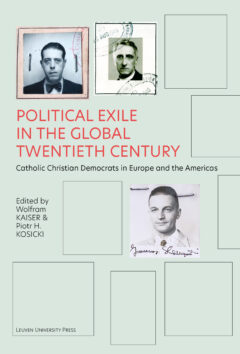 Political Exile in the Global Twentieth Century
Wolfram Kaiser (Editor), Piotr H. Kosicki (Editor),
April 2026
 Christian Democracy and the Fall of Communism
Michael Gehler (Editor), Piotr H. Kosicki (Editor), Helmut Wohnout (Editor),
April 2026
 Brusselse plaatsnamen
Iadine Degryse (Editor), Benjamin Wayens (Editor), Chantal Kesteloot (Editor), Dennis De Vriese (Editor), Matthijs Degraeve (Editor),
April 2026

 Cartographies of Catastrophes
Laura Demeter (Editor), Carmen M. Enss (Editor), Piotr Kisiel (Editor), Carol Ludwig (Editor),
February 2026