

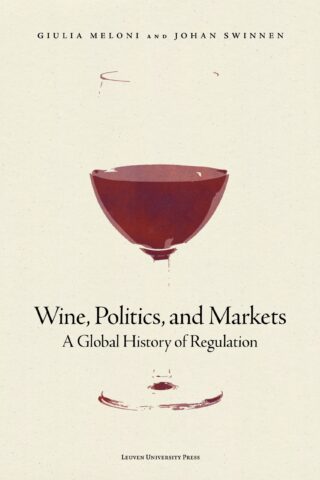

Wine, Politics, and Markets
A Global History of Regulation
Giulia Meloni (Author), Johan Swinnen (Author),

Category: Economy, History, Policy, Governance and Public Administration
Language: English
ISBN: 9789462705494
Publication date: January 14, 2027
€35.00 (including 6% VAT)
COMING SOON
Available to pre-order two weeks before date of publication.
Number of pages: 360
Size: 234 x 156 x mm
Number of illustrations: 30
Illustrations and other content description:
30 b&w illustrations

Funded by: KU Leuven Fund for Fair Open Access
Open Book Collective
Standard delivery time for print books:
For Belgium: 5 to 8 working days
For EU: 2 to 3 weeks
For other countries: 4 to 5 weeks
Category: Economy, History, Policy, Governance and Public Administration
Language: English
ISBN: 9789461668110
Publication date: January 14, 2027
COMING SOON
Number of pages: 360
Number of illustrations: 30
Illustrations and other content description:
30 b&w illustrations
Funded by: KU Leuven Fund for Fair Open Access
Open Book Collective
Category: Economy, History, Policy, Governance and Public Administration
Language: English
ISBN: 9789461668103
Publication date: January 14, 2027
COMING SOON
Number of pages: 360
Number of illustrations: 30
Illustrations and other content description:
30 b&w illustrations
Funded by: KU Leuven Fund for Fair Open Access
Open Book Collective
Comprehensive analysis of global wine regulations across history, geography, and discipline.
Wine has been at the heart of human civilization for thousands of years, and for centuries governments around the world have regulated wine production, consumption, and trade for reasons ranging from consumer protection and quality assurance to tax revenue and the protection of vineyard owners’ rents. The European Union alone has introduced more than two thousand wine regulations. Some of today’s regulations date back hundreds of years; others are more recent; and there is considerable variation over time.
The rich history of wine regulation offers fascinating insights into the political economy of public policy and the ways in which such policies persist and evolve. This book examines specific historical developments involving wines that are well known today, such as Champagne, Port, Chianti, and Burgundy. Drawing on original historical sources and multilingual archival research, it provides the first comprehensive analysis of global wine regulations from an integrated political, economic, and historical perspective.
It will appeal to a wide range of readers, including academics and students across disciplines, and anyone interested in wine and wine markets around the world.
Giulia Meloni
Giulia Meloni holds a PhD in Economics from KU Leuven and is currently a research associate at KU Leuven, a lecturer at the Université libre de Bruxelles (ULB), and a policy officer at the European Commission.
Johan Swinnen
Johan Swinnen is Director General of the International Food Policy Research Institute. He was previously Professor at KU Leuven and Director of the LICOS Centre for Institutions and Economic Performance.
A fundamental contribution to the history and political economy of government intervention in wine production and trade. It stands out for the breadth of its spatial and temporal coverage and for its in-depth analysis. It offers valuable insights into public intervention in agriculture, grounded in solid economic analysis. Highly relevant for fields such as economics, history, agricultural economics, and political science. - Vicente Pinilla, University of Zaragoza
This work provides a rich tapestry of various countries’ wine regulations spanning centuries. Both history and geography are shown to contribute to the formation, consolidation and occasional reform of complex regulations affecting grape growing plus national wine production, consumption and international trade. Anyone interested in the what, when, how or why of wine regulations will find this non-technical volume fascinating. - Kym Anderson AC, Executive Director, Wine Economics Research Centre
If terroir affects the study of wine and trade, Leuven, Belgium seems to impart the most valuable characteristics. Over the past decade, Meloni and Swinnen have established a foothold in the political economy of wine regulations. This book will be required reading for scholars and policymakers concerned about the future of wine, trade, culture, and politics. - Stephen T. Ziliak, Roosevelt University
Drawing on years of collaborative research on the economic history and political economy of wine regulation, Giulia Meloni and Jo Swinnen have produced a volume that is far greater than the sum of its parts. It is an invaluable resource for scholars and all those interested in this fascinating subject. - Julian M. Alston, Distinguished Professor Emeritus and Director of the Robert Mondavi Institute Center for Wine Economics, University of California, Davis.
Frequently Asked Questions
What is "Wine, Politics, and Markets" about?
Comprehensive analysis of global wine regulations across history, geography, and discipline.
Wine has been at the heart of human civilization for thousands of years, and for centuries governments around the world have regulated wine production, consumption, and trade for reasons ranging from consumer protection and quality assurance to tax revenue and the protection of vineyard owners’ rents. The European Union alone has introduced more than two thousand wine regulations. Some of today’s regulations date back hundreds of years; others are more recent; and there is considerable variation over time.
The rich history of wine regulation offers fascinating insights into the political economy of public policy and the ways in which such policies persist and evolve. This book examines specific historical developments involving wines that are well known today, such as Champagne, Port, Chianti, and Burgundy. Drawing on original historical sources and multilingual archival research, it provides the first comprehensive analysis of global wine regulations from an integrated political, economic, and historical perspective.
It will appeal to a wide range of readers, including academics and students across disciplines, and anyone interested in wine and wine markets around the world.
Who wrote "Wine, Politics, and Markets"?
"Wine, Politics, and Markets" was written by Giulia Meloni and Johan Swinnen.
Giulia Meloni holds a PhD in Economics from KU Leuven and is currently a research associate at KU Leuven, a lecturer at the Université libre de Bruxelles (ULB), and a policy officer at the European Commission.
Johan Swinnen is Director General of the International Food Policy Research Institute. He was previously Professor at KU Leuven and Director of the LICOS Centre for Institutions and Economic Performance.
Is "Wine, Politics, and Markets" available Open Access?
Yes, "Wine, Politics, and Markets" is published Open Access. It is available under a BY-NC-ND license.
Who funded the publication of "Wine, Politics, and Markets"?
Publication of "Wine, Politics, and Markets" was funded by KU Leuven Fund for Fair Open Access
Open Book Collective
.
What is the DOI for "Wine, Politics, and Markets"?
The Digital Object Identifier (DOI) for "Wine, Politics, and Markets" is 10.11116/9789461668110.
Related titles

 Toekomstdromen
Maarten Van Dijck (Editor), Gerrit Verhoeven (Editor), Hans Cools (Editor),
November 2026
 Digital Citizenship
Peter van Baalen (Editor), Selin Gerlek (Editor), Jakko Kemper (Editor), Halil Can Kurban (Editor), Marina Tulin (Editor),
October 2026

 Trend en toeval – vierde editie
Bruno Blondé (Author), Isabelle Devos (Author), Jord Hanus (Author), Wouter Ryckbosch (Author),
August 2026


 Christian Democracy and the Fall of Communism
Michael Gehler (Editor), Piotr H. Kosicki (Editor), Helmut Wohnout (Editor),
April 2026
 Political Exile in the Global Twentieth Century
Wolfram Kaiser (Editor), Piotr H. Kosicki (Editor),
April 2026
 Brusselse plaatsnamen
Iadine Degryse (Editor), Benjamin Wayens (Editor), Chantal Kesteloot (Editor), Dennis De Vriese (Editor), Matthijs Degraeve (Editor),
April 2026



 Cartographies of Catastrophes
Laura Demeter (Editor), Carmen M. Enss (Editor), Piotr Kisiel (Editor), Carol Ludwig (Editor),
February 2026





 Denken en dialogeren over identiteit
Karel Van Nieuwenhuyse (Author), Bauke Verbergt (Author), Greet Vermeiren (Author), Ellen Claes (Author),
October 2025
 Vroegmoderne dieren in de Nederlanden
Judith Brouwer (Editor), djoeke van Netten (Editor),
November 2025