

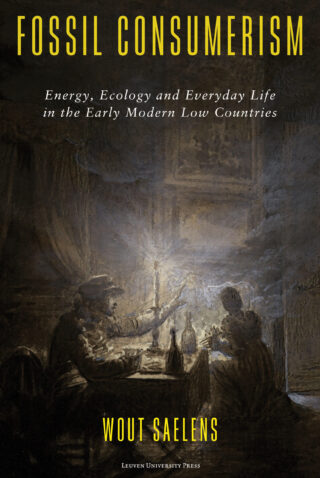

Fossil Consumerism
Energy, Ecology and Everyday Life in the Early Modern Low Countries
Wout Saelens (Author),

Category: Anthropocene Studies, Climate and Ecology, History, History 1500-1800
Language: English
ISBN: 9789462705067
Publication date: February 10, 2026
€32.00 (including 6% VAT)
Buy NowNumber of pages: 274
Size: 234 x 156 x 12 mm
Number of illustrations: 60
Illustrations and other content description:
illustrations, graphs and tables

Funded by: Universitaire Stichting
Universiteit Antwerpen
KU Leuven Fund for Fair Open Access
Open Book Collective
Stock item: 170350
Standard delivery time for print books:
For Belgium: 5 to 8 working days
For EU: 2 to 3 weeks
For other countries: 4 to 5 weeks
Category: Anthropocene Studies, Climate and Ecology, History, History 1500-1800
Language: English
ISBN: 9789461667236
Publication date: February 10, 2026
Download Free EpubNumber of pages: 274
Number of illustrations: 60
Illustrations and other content description:
illustrations, graphs and tables
Funded by: Universitaire Stichting
Universiteit Antwerpen
KU Leuven Fund for Fair Open Access
Open Book Collective
Category: Anthropocene Studies, Climate and Ecology, History, History 1500-1800
Language: English
ISBN: 9789461667229
Publication date: February 10, 2026
Download Free PDFNumber of pages: 274
Number of illustrations: 60
Illustrations and other content description:
illustrations, graphs and tables
Funded by: Universitaire Stichting
Universiteit Antwerpen
KU Leuven Fund for Fair Open Access
Open Book Collective
A groundbreaking perspective on energy history that reveals the early modern home, and not industry, as the first major driver of fossil-fuel adoption.
This book explores how the homes of ordinary city dwellers sparked our modern dependence on fossil fuels. Drawing on a rich variety of sources, including probate inventories, household manuals, personal journals, medical treatises and contemporary artwork, it reveals how households in the early modern Low Countries embraced peat and coal to fuel new standards of warmth, light and domesticity. Yet, with these new home comforts came rising indoor pollution, intensified and gendered housework and, ultimately, a quiet shift in humanity’s relationship with nature.
Bridging the histories of environments, material culture and consumption, Fossil Consumerism offers a reinterpretation of the historical roots of global warming, finding these not in the industrial mill, but in the intimate, overlooked spaces of the home. This book is essential reading for anyone interested in the everyday origins of the Anthropocene.
List of Illustrations
List of Figures
List of Tables
Preface
Introduction
Chapter 1. Energy and environment in the early modern Low Countries
Chapter 2. The energy revolution comes home
Chapter 3. The culture of the home fire
Chapter 4. Flows of energy, flows of work in the household
Chapter 5. The rise of fossil consumerism
Conclusions
Notes
Bibliography
Index
Wout Saelens
Wout Saelens is a postdoctoral researcher at the Centre for Urban History of the University of Antwerp and the Social History of Capitalism research group of the Vrije Universiteit Brussel. His research interests focus on the (early) modern histories of consumption, energy, pollution, political ecology and popular environmentalism.
In this carefully researched, historiographically alert, and smoothly written book, Saelens offers a novel look at the triumph of fossil fuels in modern history. In bringing hearths and stoves to center stage, Saelens has expanded the reach of energy history into the home, into everyday life, and into domestic divisions of labor - while injecting energy into the history of consumption. - J.R. McNeill, Georgetown University
What if the modern history of energy began not on factory floors, but on kitchen hearths—with the stove, not the steam engine, as its unlikely hero? Based on a meticulous study of household inventories, this book shifts the focus from industrial machines to everyday domestic life, revealing how fireplaces, lamps, and heating devices quietly powered a revolution. By tracing energy through the intimate spaces of the home, it uncovers a rich and often overlooked story: how ordinary households helped shape the path to the modern energy economy. - Jean-Baptiste Fressoz, Centre de Recherches Historiques
Frequently Asked Questions
What is "Fossil Consumerism" about?
A groundbreaking perspective on energy history that reveals the early modern home, and not industry, as the first major driver of fossil-fuel adoption.
This book explores how the homes of ordinary city dwellers sparked our modern dependence on fossil fuels. Drawing on a rich variety of sources, including probate inventories, household manuals, personal journals, medical treatises and contemporary artwork, it reveals how households in the early modern Low Countries embraced peat and coal to fuel new standards of warmth, light and domesticity. Yet, with these new home comforts came rising indoor pollution, intensified and gendered housework and, ultimately, a quiet shift in humanity’s relationship with nature.
Bridging the histories of environments, material culture and consumption, Fossil Consumerism offers a reinterpretation of the historical roots of global warming, finding these not in the industrial mill, but in the intimate, overlooked spaces of the home. This book is essential reading for anyone interested in the everyday origins of the Anthropocene.
Who wrote "Fossil Consumerism"?
"Fossil Consumerism" was written by Wout Saelens.
Wout Saelens is a postdoctoral researcher at the Centre for Urban History of the University of Antwerp and the Social History of Capitalism research group of the Vrije Universiteit Brussel. His research interests focus on the (early) modern histories of consumption, energy, pollution, political ecology and popular environmentalism.
Is "Fossil Consumerism" available Open Access?
Yes, "Fossil Consumerism" is published Open Access. It is available under a BY-NC-ND license.
Who funded the publication of "Fossil Consumerism"?
Publication of "Fossil Consumerism" was funded by Universitaire Stichting
Universiteit Antwerpen
KU Leuven Fund for Fair Open Access
Open Book Collective
.
What is the Table of Contents for "Fossil Consumerism"?
List of Illustrations
List of Figures
List of Tables
Preface
Introduction
Chapter 1. Energy and environment in the early modern Low Countries
Chapter 2. The energy revolution comes home
Chapter 3. The culture of the home fire
Chapter 4. Flows of energy, flows of work in the household
Chapter 5. The rise of fossil consumerism
Conclusions
Notes
Bibliography
Index
What is the DOI for "Fossil Consumerism"?
The Digital Object Identifier (DOI) for "Fossil Consumerism" is 10.11116/9789461667236.
Related titles

 Reimagining Knowledge in the Amazon Rainforest
Beatrice Bonami (Editor), Paula Helm (Editor), Roanne van Voorst (Editor), Adriano Clayton da Silva (Editor),
January 2027

 Toekomstdromen
Maarten Van Dijck (Editor), Gerrit Verhoeven (Editor), Hans Cools (Editor),
November 2026

 Ecologies of Photography in the American West
Monica Bravo (Editor), Carolin Görgen (Editor),
September 2026
 Trend en toeval – vierde editie
Bruno Blondé (Author), Isabelle Devos (Author), Jord Hanus (Author), Wouter Ryckbosch (Author),
August 2026


 Christian Democracy and the Fall of Communism
Michael Gehler (Editor), Piotr H. Kosicki (Editor), Helmut Wohnout (Editor),
April 2026
 Political Exile in the Global Twentieth Century
Wolfram Kaiser (Editor), Piotr H. Kosicki (Editor),
April 2026
 Brusselse plaatsnamen
Iadine Degryse (Editor), Benjamin Wayens (Editor), Chantal Kesteloot (Editor), Dennis De Vriese (Editor), Matthijs Degraeve (Editor),
April 2026
 Cartographies of Catastrophes
Laura Demeter (Editor), Carmen M. Enss (Editor), Piotr Kisiel (Editor), Carol Ludwig (Editor),
February 2026

 Denken en dialogeren over identiteit
Karel Van Nieuwenhuyse (Author), Bauke Verbergt (Author), Greet Vermeiren (Author), Ellen Claes (Author),
October 2025