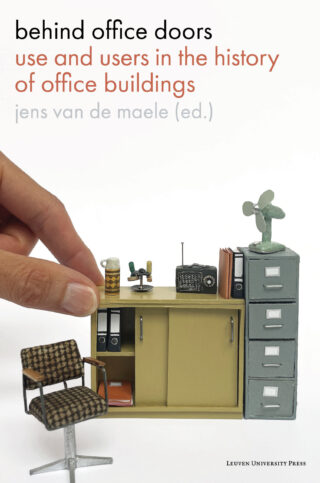

Behind Office Doors
Use and Users in the History of Office Buildings
Jens van de Maele (Editor),

Category: Architecture and Urban Planning, History, History 1800-present
Language: English
ISBN: 9789462704992
Publication date: January 15, 2026
€35.00 (including 6% VAT)
Buy NowNumber of pages: 360
Size: 234 x 156 x 12 mm
Number of illustrations: 30
Illustrations and other content description:
Illustrated b/w

Funded by: FWO
KU Leuven Fund for Fair Open Access
Luxembourg National Research Fund (FNR),
Stock item: 169840
Standard delivery time for print books:
For Belgium: 5 to 8 working days
For EU: 2 to 3 weeks
For other countries: 4 to 5 weeks
Category: Architecture and Urban Planning, History, History 1800-present
Language: English
ISBN: 9789461667113
Publication date: January 15, 2026
Download Free EpubNumber of pages: 360
Number of illustrations: 30
Illustrations and other content description:
Illustrated b/w
Funded by: FWO
KU Leuven Fund for Fair Open Access
Luxembourg National Research Fund (FNR),
Category: Architecture and Urban Planning, History, History 1800-present
Language: English
ISBN: 9789461667106
Publication date: January 15, 2026
Download Free PDFNumber of pages: 360
Number of illustrations: 30
Illustrations and other content description:
Illustrated b/w
Funded by: FWO
KU Leuven Fund for Fair Open Access
Luxembourg National Research Fund (FNR),
A transdisciplinary history of the 20th-century office, exploring how its spatial forms, technological systems and managerial ideologies were constructed, challenged and lived with.
Throughout the twentieth century, office buildings became central to the organisation of societies – yet what went on inside them has remained remarkably understudied. Behind Office Doors explores this history by focusing on users and everyday practices. It examines how office spaces were conceived by architects, designers and managers, and how they were inhabited, experienced and contested by workers. From filing cabinets and air conditioning to EU offices and colonial bureaucracies, the chapters trace how design, technology and organisational thinking shaped office life. Alongside case studies on Europe, North America, Asia and colonial Africa, the contributions reflect on how the office has been approached in historiography. Drawing on cross-disciplinary research, this book argues for the development of historical office studies, showing how the design and management of offices have shaped cultures of work.
Acknowledgements
Introduction. Retracing Use and Users in the History and Historiography of the 20th-Century Office Building
Jens van de Maele
Part 1. Categories and representations of office users
Chapter 1. What’s the Use? The Users and Usability of the Filing Cabinet
Craig Robertson
Chapter 2. The Office in Popular Culture, or the “Plight of the Clerk”
Nicola Bishop
Part 2. The impact of normativity and standardisation on the office as an “environment”
Chapter 3. Too Cold? Gendered Conflicts over Mechanical Cooling in Early Post-war Japanese Office Spaces
Tatsuya Mitsuda
Chapter 4. Thresholds of Comfort : Managing Light, Sound and Focus in the Post-War Office Environment
Joeri Bruyninckx
Chapter 5. Surviving the Office : Workplace Design, Activism and the Health of Women Workers in 20th-Century Britain
Amy Thomas
Chapter 6. Measuring, Evaluating and Configuring : The German Debate about Safe and Healthy Screen Work
Bernd Holtwick
Part 3. Office uses conceptualised by and for the managerial elite
Chapter 7. A “Facility Based on Change” (for the Worse) : Leveraging Labour Process Theory to Understand the Evolution of Herman Miller’s Action Office
Petra Seitz
Chapter 8. The European Commission’s Office Spaces in the 1950s and 1960s : Constructing a Materialised Imaginary
Marco Ninno
Part 4. Visual essays
Chapter 9. “Mimic Men” in the Office Spaces of a “Nervous State” : The Materiality of Bureaucracy in Late Colonial Congo
Johan Lagae and Jens van de Maele
Chapter 10. Between Hierarchy, Efficiency and Pragmatism : Picturing Portuguese Government Offices in Historic Buildings during the Estado Novo Dictatorship
Ana Mehnert Pascoal
Chapter 11. Office Life in Chandigarh
Ruth Baumeister (text), Shaun Fynn (photography)
Epilogue
Martin Kohlrausch and Andreas Fickers
Contributors
Index
Jens van de Maele
Jens van de Maele is a postdoctoral member of the research group Modernity and Society 1800–2000 at KU Leuven.
Ruth Baumeister
Nicola Bishop
Joeri Bruyninckx
Andreas Fickers
Shaun Fynn
Bernd Holtwick
Martin Kohlrausch
Martin Kohlrausch is professor of European Political History and head of the research unit Modernity and Society at the KU Leuven.
Johan Lagae
Johan Lagae is Professor of Architecture and Urban Planning at Ghent University.
Ana Mehnert Pascoal
Tatsuya Mitsuda
Marco Ninno
Craig Robertson
Petra Seitz
Amy Thomas
Devoted to the role of uses and users in the configuration and appropriation of the space of administrative work, this book opens up a new perspective on the history of the office, inviting us to move away from linear narratives based on the analysis of the architectural canon and on a reductionist vision of the dynamics of power and control that have often marked the historiographical tradition on the office. - Gianenrico Bernasconi, Université de Neuchâtel
Behind Office Doors brings welcome attention to the often overlooked inhabitants of architectural history: users. This interdisciplinary collection shows how office inhabitants across many contexts, from Japanese corporations to European bureaucracies to Congolese colonial administrations, navigated their environments. Each chapter opens another door on the unwritten rules, hierarchies, and adaptations that defined office life. Like the flexible workspaces it examines, the collection offers varied perspectives that together illuminate the rich terrain between architectural intention and practical adaptation that defined twentieth-century professional life. - Joseph L. Clarke, University of Toronto
Das hier besprochene Buch [...] bietet eine willkommene Ergänzung zur historischen Bürokratieforschung im deutschsprachigen Raum. [...] Der Anspruch dieses Bandes ist eine verbindende, disziplinenübergreifende Perspektive, umrissen mit ‚historical office studies‘ [...]. [...] Der Band ist als eine Sammlung einander ergänzender, origineller empirischer Studien mit einer verbindenden Forschungsperspektive angelegt, und dieses Konzept geht auf. — Therese Garstenauer, H-Soz-Kult, 20.07.2026, https://www.hsozkult.de/publicationreview/id/reb-159832
Frequently Asked Questions
What is "Behind Office Doors" about?
A transdisciplinary history of the 20th-century office, exploring how its spatial forms, technological systems and managerial ideologies were constructed, challenged and lived with.
Throughout the twentieth century, office buildings became central to the organisation of societies – yet what went on inside them has remained remarkably understudied. Behind Office Doors explores this history by focusing on users and everyday practices. It examines how office spaces were conceived by architects, designers and managers, and how they were inhabited, experienced and contested by workers. From filing cabinets and air conditioning to EU offices and colonial bureaucracies, the chapters trace how design, technology and organisational thinking shaped office life. Alongside case studies on Europe, North America, Asia and colonial Africa, the contributions reflect on how the office has been approached in historiography. Drawing on cross-disciplinary research, this book argues for the development of historical office studies, showing how the design and management of offices have shaped cultures of work.
Who wrote "Behind Office Doors"?
"Behind Office Doors" was written by Ruth Baumeister, Nicola Bishop, Joeri Bruyninckx, Andreas Fickers, Shaun Fynn, Bernd Holtwick, Martin Kohlrausch, Johan Lagae, Ana Mehnert Pascoal, Tatsuya Mitsuda, Marco Ninno, Craig Robertson, Petra Seitz and Amy Thomas.
Martin Kohlrausch is professor of European Political History and head of the research unit Modernity and Society at the KU Leuven.
Johan Lagae is Professor of Architecture and Urban Planning at Ghent University.
Who edited "Behind Office Doors"?
"Behind Office Doors" was edited by Jens van de Maele.
Jens van de Maele is a postdoctoral member of the research group Modernity and Society 1800–2000 at KU Leuven.
Is "Behind Office Doors" available Open Access?
Yes, "Behind Office Doors" is published Open Access. It is available under a BY license.
Who funded the publication of "Behind Office Doors"?
Publication of "Behind Office Doors" was funded by FWO
KU Leuven Fund for Fair Open Access
Luxembourg National Research Fund (FNR),
.
What is the Table of Contents for "Behind Office Doors"?
Acknowledgements
Introduction. Retracing Use and Users in the History and Historiography of the 20th-Century Office Building
Jens van de Maele
Part 1. Categories and representations of office users
Chapter 1. What’s the Use? The Users and Usability of the Filing Cabinet
Craig Robertson
Chapter 2. The Office in Popular Culture, or the “Plight of the Clerk”
Nicola Bishop
Part 2. The impact of normativity and standardisation on the office as an “environment”
Chapter 3. Too Cold? Gendered Conflicts over Mechanical Cooling in Early Post-war Japanese Office Spaces
Tatsuya Mitsuda
Chapter 4. Thresholds of Comfort : Managing Light, Sound and Focus in the Post-War Office Environment
Joeri Bruyninckx
Chapter 5. Surviving the Office : Workplace Design, Activism and the Health of Women Workers in 20th-Century Britain
Amy Thomas
Chapter 6. Measuring, Evaluating and Configuring : The German Debate about Safe and Healthy Screen Work
Bernd Holtwick
Part 3. Office uses conceptualised by and for the managerial elite
Chapter 7. A “Facility Based on Change” (for the Worse) : Leveraging Labour Process Theory to Understand the Evolution of Herman Miller’s Action Office
Petra Seitz
Chapter 8. The European Commission’s Office Spaces in the 1950s and 1960s : Constructing a Materialised Imaginary
Marco Ninno
Part 4. Visual essays
Chapter 9. “Mimic Men” in the Office Spaces of a “Nervous State” : The Materiality of Bureaucracy in Late Colonial Congo
Johan Lagae and Jens van de Maele
Chapter 10. Between Hierarchy, Efficiency and Pragmatism : Picturing Portuguese Government Offices in Historic Buildings during the Estado Novo Dictatorship
Ana Mehnert Pascoal
Chapter 11. Office Life in Chandigarh
Ruth Baumeister (text), Shaun Fynn (photography)
Epilogue
Martin Kohlrausch and Andreas Fickers
Contributors
Index
What is the DOI for "Behind Office Doors"?
The Digital Object Identifier (DOI) for "Behind Office Doors" is 10.11116/9789461667113.
Related titles
 Margarete Schütte-Lihotzky and the Architecture of Collective Dissidence, 1918–1989
S.E. Eisterer (Author),
April 2027
 Infrastructuring Arrival
Karel Arnaut (Editor), Luce Beeckmans (Editor), Bruno Meeus (Editor),
November 2026
 Toekomstdromen
Maarten Van Dijck (Editor), Gerrit Verhoeven (Editor), Hans Cools (Editor),
November 2026


 German–Rapanui Entanglements
Cristián Moreno Pakarati (Editor), Diego Muñoz (Editor), Philipp Schorch (Editor),
August 2026
 Trend en toeval – vierde editie
Bruno Blondé (Author), Isabelle Devos (Author), Jord Hanus (Author), Wouter Ryckbosch (Author),
August 2026
 Cinema in Post-War Belgium
Gertjan Willems (Editor), Bjorn Gabriels (Editor), Bénédicte Rochet (Editor),
May 2026

 Performing Magnetism
Eleonora Paklons (Editor), Kristof Smeyers (Editor), Kurt Vanhoutte (Editor), Hannah Welslau (Editor),
May 2026
 Christian Democracy and the Fall of Communism
Michael Gehler (Editor), Piotr H. Kosicki (Editor), Helmut Wohnout (Editor),
April 2026
 Political Exile in the Global Twentieth Century
Wolfram Kaiser (Editor), Piotr H. Kosicki (Editor),
April 2026
 Brusselse plaatsnamen
Iadine Degryse (Editor), Benjamin Wayens (Editor), Chantal Kesteloot (Editor), Dennis De Vriese (Editor), Matthijs Degraeve (Editor),
April 2026
 Cartographies of Catastrophes
Laura Demeter (Editor), Carmen M. Enss (Editor), Piotr Kisiel (Editor), Carol Ludwig (Editor),
February 2026