Margarete Schütte-Lihotzky and the Architecture of Collective Dissidence, 1918–1989
S.E. Eisterer (Author),
The extraordinary, century-spanning life and career of pioneering architect Margarete Schütte-Lihotzky.
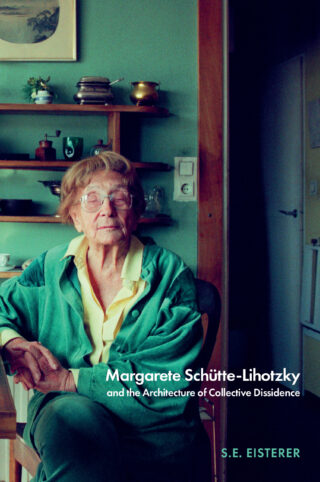
Margarete Schütte-Lihotzky (1897–2000) is widely recognized as one of the most significant women architects in the history of modern design, yet her lifelong work as an activist and dissident remains largely overlooked. Rather than offering a conventional biography, Margarete Schütte-Lihotzky and the Architecture of Collective Dissidence, 1918–1989 recasts her career through the lenses of resistance and memory studies, using her life story as a prism through which to examine the international networks of artists, politicians, and workers with whom she collaborated. The book reveals how class, gender, migration, religion, and anti-fascist organizing shaped Schütte-Lihotzky’s social and architectural commitments and how dissident collectives were strengthened, or at times fractured, through political work. Moving from the architectural imaginaries of the interwar period through resistance to fascism and postwar cultures of remembering and forgetting, the book illuminates an alternative history of modern architecture grounded in collective imagination, political struggle, and resistance to erasure.
S.E. Eisterer’s book opens many doors to the rich lives of Schütte-Lihotsky and offers a brilliant reflection on the craft of architectural history. The generous and often surprising iconography and writing move us through affects, movements, techniques, artefacts, spaces and kinships–including non-monogamy–exceeding nationalist and heteronormative disciplinary and archival frameworks. Traversing twentieth-century communism and anti-fascism informed by queer theory, the book shows how this much-needed enmeshment uncovers histories of modern architecture and anti-fascist techniques vital for the present. Echoing Schütte-Lihotsky’s own unsung position, Eisterer reminds us that the labor of collective dissidence is not solely about production but also about rest, grief, enjoyment, relationships, and dreams, and that their remainders and histories are inextricably entangled with their practice. - Janus Jacynthe Lafontaine Carboni
This book’s great achievement is to give weight to emotional bonds of love, friendship and family in architecture, alongside professional and political allegiances. In so doing, it expands how architectural history understands practice and validates material acts beyond building. It offers new perspectives on female dissident architects whose work was often small-scale or collective, and whose careers were interrupted, dispersed and, finally, remade by experiences of exile and resistance. - Barbara Penner, University College London
Moving beyond the 1920s, when the well-known “Frankfurt Kitchen” was first proposed, S.E. Eisterer’s exhaustive new study of the feminist planner and artist Grete Schütte-Lihotzky leads readers across many decades of political and artistic activism to offer an invaluable new perspective on its subject, brimming with newly published images and texts. Focusing on the practice of “collective dissidence” as expressed through a rich array of media and spatial interventions, this book establishes a new benchmark for the study of its subject and her contributions to the architecture and politics of the 20th century. - Alice Friedmann, Wellesley College
S.E. Eisterer has written a marvel of a book about the marvelous architect Margarete Schütte-Lihotzky, matching her subject's fiercely lived life with her own impassioned, deeply informed prose. Eisterer combines first-hand accounts and participants' memories of Schütte-Lihotzky's heroic resistances to Nazism and other forms of oppressions with a scholar's eye for architecture, politics, and history. Eisterer rightly insists that Schütte-Lihotzky's ambitions and dissidence transcend the individual. It was always about the collective. Now more than ever, Schütte-Lihotzky's life, achievements, struggles, and collectivism across the twentieth century can inspire new generations, energized by Eisterer's inspired book. - Daniel M. Abramson, Boston University
Frequently Asked Questions
What is "Margarete Schütte-Lihotzky and the Architecture of Collective Dissidence, 1918–1989" about?
The extraordinary, century-spanning life and career of pioneering architect Margarete Schütte-Lihotzky.
Margarete Schütte-Lihotzky (1897–2000) is widely recognized as one of the most significant women architects in the history of modern design, yet her lifelong work as an activist and dissident remains largely overlooked. Rather than offering a conventional biography, Margarete Schütte-Lihotzky and the Architecture of Collective Dissidence, 1918–1989 recasts her career through the lenses of resistance and memory studies, using her life story as a prism through which to examine the international networks of artists, politicians, and workers with whom she collaborated. The book reveals how class, gender, migration, religion, and anti-fascist organizing shaped Schütte-Lihotzky’s social and architectural commitments and how dissident collectives were strengthened, or at times fractured, through political work. Moving from the architectural imaginaries of the interwar period through resistance to fascism and postwar cultures of remembering and forgetting, the book illuminates an alternative history of modern architecture grounded in collective imagination, political struggle, and resistance to erasure.
Who wrote "Margarete Schütte-Lihotzky and the Architecture of Collective Dissidence, 1918–1989"?
"Margarete Schütte-Lihotzky and the Architecture of Collective Dissidence, 1918–1989" was written by S.E. Eisterer.
S.E. Eisterer is Assistant Professor in Architectural History at Princeton University and the Director of Research at the Princeton-Mellon Initiative on Architecture, Urbanism, and the Humanities. She is the co-founder of queer space working group and the Insurgent Domesticities group.
What is the DOI for "Margarete Schütte-Lihotzky and the Architecture of Collective Dissidence, 1918–1989"?
The Digital Object Identifier (DOI) for "Margarete Schütte-Lihotzky and the Architecture of Collective Dissidence, 1918–1989" is 10.11116/9789461668233.
Related titles



 Infrastructuring Arrival
Karel Arnaut (Editor), Luce Beeckmans (Editor), Bruno Meeus (Editor),
November 2026


 Feminists Resisting Gendered Violence
Hemangini Gupta (Editor), Fiona Mackay (Editor), Jan Breckenridge (Editor), Louise Chappell (Editor), Rachna Mehra (Editor), Rukmini Sen (Editor), Mailin Suchting (Editor),
October 2026
 A City in Practice
Aude Tournaye (Editor), Filip De Boeck (Editor), Picha Collective (Editor),
September 2026
 German–Rapanui Entanglements
Cristián Moreno Pakarati (Editor), Diego Muñoz (Editor), Philipp Schorch (Editor),
August 2026

 Cinema in Post-War Belgium
Gertjan Willems (Editor), Bjorn Gabriels (Editor), Bénédicte Rochet (Editor),
May 2026

 Performing Magnetism
Eleonora Paklons (Editor), Kristof Smeyers (Editor), Kurt Vanhoutte (Editor), Hannah Welslau (Editor),
May 2026
 Christian Democracy and the Fall of Communism
Michael Gehler (Editor), Piotr H. Kosicki (Editor), Helmut Wohnout (Editor),
April 2026

 Political Exile in the Global Twentieth Century
Wolfram Kaiser (Editor), Piotr H. Kosicki (Editor),
April 2026
 Brusselse plaatsnamen
Iadine Degryse (Editor), Benjamin Wayens (Editor), Chantal Kesteloot (Editor), Dennis De Vriese (Editor), Matthijs Degraeve (Editor),
April 2026

 Cartographies of Catastrophes
Laura Demeter (Editor), Carmen M. Enss (Editor), Piotr Kisiel (Editor), Carol Ludwig (Editor),
February 2026