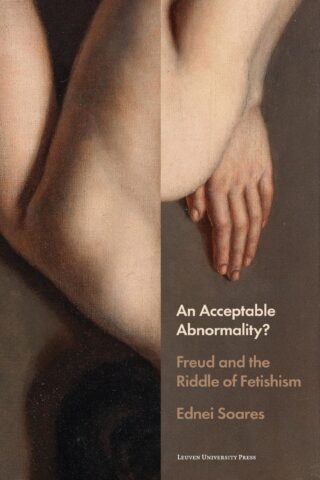
An Acceptable Abnormality?
Freud and the Riddle of Fetishism
Ednei Soares (Author),
Series: Figures of the Unconscious
Category: Gender Studies, Psychoanalysis
Language: English
ISBN: 9789462705357
Publication date: August 17, 2026
€36.00 (including 6% VAT)
Buy NowNumber of pages: 173
Size: 234 x 156 x mm

Funded by: Path to Open
Stock item: 173488
Standard delivery time for print books:
For Belgium: 5 to 8 working days
For EU: 2 to 3 weeks
For other countries: 4 to 5 weeks
Series: Figures of the Unconscious
Category: Gender Studies, Psychoanalysis
Language: English
ISBN: 9789461667946
Publication date: August 17, 2026
€31.00 (including 6% VAT)
Buy NowNumber of pages: 173
Funded by: Path to Open
Series: Figures of the Unconscious
Category: Gender Studies, Psychoanalysis
Language: English
ISBN: 9789461667939
Publication date: August 17, 2026
€31.00 (including 6% VAT)
Buy NowNumber of pages: 173
Funded by: Path to Open
Unravelling the Fetish: Freud and the Riddles of Desire.
Long regarded as a marginal phenomenon, fetishism reshaped the foundations of psychoanalysis. By tracing the evolution of Freud’s thinking on fetishism — from his early pathologisation to his later understanding of it as a source of sexual and psychic meaning — this book reveals how his attention to fetishism compelled him to rethink desire, object‑choice, and the roots of inner conflict. In this book, Ednei Soares, drawing on the influence of Alfred Binet, early neuropathology, and later debates in Lacanian theory, as well as feminist, queer, and trans theory, explains why fetishism became central to discussions that shape gender studies today and contemporary reflections on identity.
An Acceptable Abnormality? invites readers to view fetishism not as a curious anomaly but as a powerful lens through which we can understand how desire takes form. This compelling book opens new ways of thinking about human sexuality, making it essential reading for specialists while remaining accessible to a broad audience.
This book will be made open access within three years of publication thanks to Path to Open, a program developed in partnership between JSTOR, the American Council of Learned Societies (ACLS), University of Michigan Press, and The University of North Carolina Press to bring about equitable access and impact for the entire scholarly community, including authors, researchers, libraries, and university presses around the world. Learn more at https://about.jstor.org/path-to-open/
Acknowledgements
Chapter 1 Introduction
Chapter 2 Freud and His Forebears: Binet and Krafft-Ebing
1. The Riddle of Fetishism
2. Alfred Binet and the Riddle of Fetishism
Binet and Doubling
Binet’s Conceptualization of Fetishism: The Birth of a Riddle
3. Freud, Krafft-Ebing, and the Problem of Perversions
Krafft-Ebing’s Classification of Perversions
Fetishism, Masochism, and Shared Aetiology
4. Freud’s Clinical Framework: The Neurosis–Perversion Opposition
Chapter 3 The Neurotic “Negative”: Freud’s Early Perversion Theory
1. Freud’s Early Aetiology of Neurosis and Perversion
2. Inherited Concepts: Trauma, Splitting, and Defence in Freud’s 1890s Work
3. The Nascent “Riddle”: Fetishism’s Challenge to Freud’s Early Framework
Chapter 4 The Initial Confrontation: Fetishism in Freud’s Three Essays and Early Revisions (1905–8)
1. Fetishism and the Breakdown of Freud’s 1905 Framework
2. Childhood Impressions and the Turn to Fantasy
3. Infantile Theories, Castration Anxiety, and the Object
Chapter 5 Deepening the Riddle: Fetishism, Trauma, and the Oedipus Complex (1909–20)
1. On the Genesis of Fetishism (1909)
2. The Role of the Fetish in Totem and Taboo
3. Freud’s Development of Binet’s Theory of Childhood Trauma
4. The Oedipus Complex and the Aetiology of Perversions
5. Fetishism and the Riddle
Chapter 6 Freud’s Late Works on Fetishism
1. Freud on Fetishism: Early and Late
2. Fetishism (1927) and Other Works
3. Freud on Disavowal, Scotomization, and Splitting in Fetishism
4. Freud on Binet on Double-Sided Fetishes
5. Fetishism in Freud’s Works in the Late 1930s
6. Freud, Fetishism, and the Brain
7. Freud’s Psychoanalytic Theory and Fetishism
Chapter 7 “Fetishism” and Freud’s Riddle in Jacques Lacan’s Work
1. Doubling, Personality, and Perversity in Lacan’s Theorization of Fetishism
Binet’s Ideas on Paranoia as Doubling of Personality in Lacan’s Explorations
Lacan’s Initial Approach to Fetishism
Lacan’s Psychoanalytic Model of Doubling
2. Lacan’s Debate on Fetishism with Object-Relation Theory
Fetishism as an Object-Relation Phenomenon
Fetishism as a Paradigm of Perversion in Lacan’s Theory
3. The Fetish as a Model of the Object of Human Desire in Lacan’s Thinking
Conclusion
References
Ednei Soares
Ednei Soares is a psychoanalyst and holds a PhD from Radboud University. He is a Research Assistant at the Center for Contemporary European Philosophy and conducts research in Brazil and the Netherlands for the Stichting Psychoanalytische Fondsen. His academic career has included work at Radboud University's Behavioural Science Institute and teaching at universities in Brazil. He is a member of SIPP–ISPP.
By following the thread of fetishism across Sigmund Freud’s work, this book uncovers a fundamental instability within psychoanalytic thought itself. Both historically precise and conceptually bold, it transforms what Freud called a “riddle” into a powerful lens for rethinking sexuality, normativity, and desire. A significant contribution to contemporary debates in psychoanalysis, philosophy, and gender studies. - Léa Silveira, Federal University of Ceará
Soares traces the 'riddle of fetishism' with rare historical precision, showing how Freud's most unstable concept became the secret engine of psychoanalytic thought itself – and why it still unsettles our categories today. - Esther Hutfless, Sigmund Freud Private University Vienna
This book is a lucid and rigorously argued account of fetishism that brings Binet, Freud, and Lacan into a productive dialogue. Combining close readings of primary texts with sophisticated theoretical synthesis, the author illuminates the “riddle of fetishism.” Rich in archival insight and contemporary relevance, the book advances our understanding of desire and object relations and will become essential reading for scholars and students of psychoanalysis, critical theory, and cultural studies. An important contribution that both deepens and expands the conversation on fetishism. - Victor Blüml, Medical University of Vienna
Frequently Asked Questions
What is "An Acceptable Abnormality?" about?
Unravelling the Fetish: Freud and the Riddles of Desire.
Long regarded as a marginal phenomenon, fetishism reshaped the foundations of psychoanalysis. By tracing the evolution of Freud’s thinking on fetishism — from his early pathologisation to his later understanding of it as a source of sexual and psychic meaning — this book reveals how his attention to fetishism compelled him to rethink desire, object‑choice, and the roots of inner conflict. In this book, Ednei Soares, drawing on the influence of Alfred Binet, early neuropathology, and later debates in Lacanian theory, as well as feminist, queer, and trans theory, explains why fetishism became central to discussions that shape gender studies today and contemporary reflections on identity.
An Acceptable Abnormality? invites readers to view fetishism not as a curious anomaly but as a powerful lens through which we can understand how desire takes form. This compelling book opens new ways of thinking about human sexuality, making it essential reading for specialists while remaining accessible to a broad audience.
This book will be made open access within three years of publication thanks to Path to Open, a program developed in partnership between JSTOR, the American Council of Learned Societies (ACLS), University of Michigan Press, and The University of North Carolina Press to bring about equitable access and impact for the entire scholarly community, including authors, researchers, libraries, and university presses around the world. Learn more at https://about.jstor.org/path-to-open/
Who wrote "An Acceptable Abnormality?"?
"An Acceptable Abnormality?" was written by Ednei Soares.
Ednei Soares is a psychoanalyst and holds a PhD from Radboud University. He is a Research Assistant at the Center for Contemporary European Philosophy and conducts research in Brazil and the Netherlands for the Stichting Psychoanalytische Fondsen. His academic career has included work at Radboud University's Behavioural Science Institute and teaching at universities in Brazil. He is a member of SIPP–ISPP.
Is "An Acceptable Abnormality?" part of a series?
Yes, "An Acceptable Abnormality?" is part of the "Figures of the Unconscious" series.
In collaboration with the International Society for Psychoanalysis and Philosophy (SIPP-ISPP).


The peer-reviewed book series Figures of the Unconscious was founded in 2001 and provides a platform for exchange at the intersection of philosophy and psychoanalysis. Psychoanalysis occupies a crucial position within contemporary philosophical thinking and many analysts are influenced by philosophical approaches.
Both philosophy and psychoanalysis are concerned with the nature of the subject, questions of knowledge and epistemology, sexuality, life and death, ethical issues, alterity, and the subject’s manifold relationships to the other - to other human and non-human beings and to its environment.
We welcome manuscripts in the areas and at the intersections of
- the history of psychoanalysis and Freudian thought
- the exploration of psychoanalytic concepts and the development of theories
- the research and development of the psychoanalytic movement
- psychoanalytic and philosophical concepts and ideas
- psychoanalysis, gender and queer studies
- interdisciplinary approaches that combine psychoanalysis with other scientific disciplines
- current developments in psychoanalytic approaches
- ethical approaches in psychoanalysis
- epistemological debates
Editors-in-Chief
Beatriz Santos (Université de Paris)
Herman Westerink (Radboud University)
Esther Hutfless (Sigmund Freud University Linz)
Editorial board
Jeff Bloechl (Boston College)
Advisory Board
Jozef Corveleyn (KU Leuven)
Monique David-Ménard (Université de Paris)
Rodrigo De La Fabián (Universidad Diego Portales, Santiago de Chile)
Jens De Vleminck (Leuven)
Eran Dorfman (University of Tel Aviv)
Laurie Laufer (Université de Paris)
Elissa Marder (Emory University, Atlanta)
Claire Nioche (Université Paris XIII)
Vladimir Safatle (Universidade de São Paulo)
Charles Shepherdson (State University of New York at Albany)
Guillaume Silbertin Blanc (Université Paris 8)
Raluca Soreanu (University of Essex)
Celine Surprenant (Paris)
Antônio Teixeira (Universidade Federal de Minas Gerais)
Johan Van Der Walt (University of Luxemburg)
Wilfried Ver Eecke (Georgetown University)
Proposals
The board accepts manuscripts for review from both members and non-members of the SIPP-ISPP. These can be either monographs or edited volumes, provided they align with the aims and scope of the series.
Proposals and enquiries can be sent to the series editors-in-chief.
Please make use of the submission form to present your manuscript or proposal to our board.
Authors interested in Open Access can consult the available funding options.
Links & Resources
Who funded the publication of "An Acceptable Abnormality?"?
Publication of "An Acceptable Abnormality?" was funded by Path to Open
.
What is the Table of Contents for "An Acceptable Abnormality?"?
Acknowledgements
Chapter 1 Introduction
Chapter 2 Freud and His Forebears: Binet and Krafft-Ebing
1. The Riddle of Fetishism
2. Alfred Binet and the Riddle of Fetishism
Binet and Doubling
Binet’s Conceptualization of Fetishism: The Birth of a Riddle
3. Freud, Krafft-Ebing, and the Problem of Perversions
Krafft-Ebing’s Classification of Perversions
Fetishism, Masochism, and Shared Aetiology
4. Freud’s Clinical Framework: The Neurosis–Perversion Opposition
Chapter 3 The Neurotic “Negative”: Freud’s Early Perversion Theory
1. Freud’s Early Aetiology of Neurosis and Perversion
2. Inherited Concepts: Trauma, Splitting, and Defence in Freud’s 1890s Work
3. The Nascent “Riddle”: Fetishism’s Challenge to Freud’s Early Framework
Chapter 4 The Initial Confrontation: Fetishism in Freud’s Three Essays and Early Revisions (1905–8)
1. Fetishism and the Breakdown of Freud’s 1905 Framework
2. Childhood Impressions and the Turn to Fantasy
3. Infantile Theories, Castration Anxiety, and the Object
Chapter 5 Deepening the Riddle: Fetishism, Trauma, and the Oedipus Complex (1909–20)
1. On the Genesis of Fetishism (1909)
2. The Role of the Fetish in Totem and Taboo
3. Freud’s Development of Binet’s Theory of Childhood Trauma
4. The Oedipus Complex and the Aetiology of Perversions
5. Fetishism and the Riddle
Chapter 6 Freud’s Late Works on Fetishism
1. Freud on Fetishism: Early and Late
2. Fetishism (1927) and Other Works
3. Freud on Disavowal, Scotomization, and Splitting in Fetishism
4. Freud on Binet on Double-Sided Fetishes
5. Fetishism in Freud’s Works in the Late 1930s
6. Freud, Fetishism, and the Brain
7. Freud’s Psychoanalytic Theory and Fetishism
Chapter 7 “Fetishism” and Freud’s Riddle in Jacques Lacan’s Work
1. Doubling, Personality, and Perversity in Lacan’s Theorization of Fetishism
Binet’s Ideas on Paranoia as Doubling of Personality in Lacan’s Explorations
Lacan’s Initial Approach to Fetishism
Lacan’s Psychoanalytic Model of Doubling
2. Lacan’s Debate on Fetishism with Object-Relation Theory
Fetishism as an Object-Relation Phenomenon
Fetishism as a Paradigm of Perversion in Lacan’s Theory
3. The Fetish as a Model of the Object of Human Desire in Lacan’s Thinking
Conclusion
References
What is the DOI for "An Acceptable Abnormality?"?
The Digital Object Identifier (DOI) for "An Acceptable Abnormality?" is 10.11116/9789461667946.
Related titles

 Margarete Schütte-Lihotzky and the Architecture of Collective Dissidence, 1918–1989
S.E. Eisterer (Author),
April 2027

 Psychoanalysis on Borders, Limits and Beyond
Yianna Ioannou (Editor), Izzy Powis (Editor), Sinziana Ravini (Editor), Léa Silveira (Editor), Jamieson Webster (Editor),
November 2026
 Feminists Resisting Gendered Violence
Hemangini Gupta (Editor), Fiona Mackay (Editor), Jan Breckenridge (Editor), Louise Chappell (Editor), Rachna Mehra (Editor), Rukmini Sen (Editor), Mailin Suchting (Editor),
October 2026


 Architecture & Feminist Critical Theory
Hilde Heynen (Author), Lucía C. Pérez-Moreno (Editor),
November 2025

 Seduction, Drive and Repetition
Herman Westerink (Author), Philippe Van Haute (Author),
September 2025

 Urban Women
Jelle Haemers (Editor), Andrea Bardyn (Editor), Chanelle Delameillieure (Editor),
April 2025
 Thoughts for the Times on Groups and Masses
Daniela Finzi (Editor), Jeanne Wolff Bernstein (Editor),
January 2025
 The Business of Pleasure
Elwin Hofman (Editor), Magaly Rodríguez García (Editor), Pieter Vanhees (Editor),
September 2024

 Towards the Limits of Freudian Thinking
Herman Westerink (Editor), Jenny Willner (Editor), Philippe Van Haute (Editor),
August 2024
 Truth and Suffering
Paulo Beer (Author), Nelson da Silva Júnior (Preface by), Renata Takatu (Translator),
March 2024




 Ferenczi Dialogues
Raluca Soreanu (Author), Jakob Staberg (Author), Jenny Willner (Author),
January 2026
 Black Matrilineage, Photography, and Representation
Lesly Deschler Canossi (Editor), Zoraida Lopez-Diago (Editor),
September 2022