

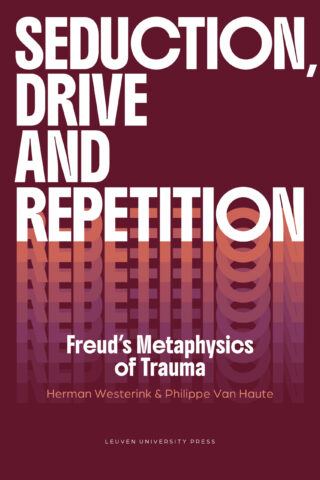
Seduction, Drive and Repetition
Freud’s Metaphysics of Trauma
Herman Westerink (Author), Philippe Van Haute (Author),
Series: Figures of the Unconscious
Category: Psychoanalysis
Language: English
ISBN: 9789462704862
Publication date: September 1, 2025
€59.50 (including 6% VAT)
Buy NowNumber of pages: 288
Size: 234 x 156 x mm

Standard delivery time for print books:
For Belgium: 5 to 8 working days
For EU: 2 to 3 weeks
For other countries: 4 to 5 weeks
Series: Figures of the Unconscious
Category: Psychoanalysis
Language: English
ISBN: 9789461666895
Publication date: September 1, 2025
€51.00 (including 6% VAT)
Buy NowNumber of pages: 288
Series: Figures of the Unconscious
Category: Psychoanalysis
Language: English
ISBN: 9789461666888
Publication date: September 1, 2025
€51.00 (including 6% VAT)
Buy NowNumber of pages: 288
A reinterpretation of Freud’s trauma theory
This book makes the compelling argument that the key to understanding Freud’s clinical writings and psychoanalytical theories lies in his trauma theory. The authors argue that Freud never truly abandoned his initial trauma theory – the seduction theory – in favour of the Oedipus complex and the primacy of fantasy. Instead, Freud progressively enriched his understanding of trauma, expanding his theory to include references to the evolution of human beings and organic life. Trauma runs as a red thread throughout Freud’s oeuvre. It occupies a central position in both his clinical case studies and his meta-psychological speculations. Freud ultimately develops a metaphysics of trauma and a tragic view of human existence – a worldview that continues to resonate within contemporary philosophy and psychoanalysis.
This book will be made open access within three years of publication thanks to Path to Open, a program developed in partnership between JSTOR, the American Council of Learned Societies (ACLS), University of Michigan Press, and The University of North Carolina Press to bring about equitable access and impact for the entire scholarly community, including authors, researchers, libraries, and university presses around the world. Learn more at https://about.jstor.org/path-to-open/
Acknowledgements
Introduction
Chapter 1 The psychologization of trauma and the origination of seduction theory
Chapter 2 Seduction and hysterical disposition: Dora
Chapter 3 Trauma, aggression and father complex: The Rat Man
Chapter 4 Seduction, primal scene and constitution: The Wolf Man
Chapter 5 Constitution, phylogeny and evolutionary biology
Chapter 6 Traumatic neurosis, compulsion to repeat and drive theory: Beyond the Pleasure Principle
Chapter 7 Trauma and character: The man Moses
Chapter 8 Freud’s metaphysics of trauma
Notes
Bibliography
Index
Written by practicing psychoanalysts and longtime Freud-scholars, this study opens new perspectives on the inside-outside interweave of trauma, the role of time and personal history in the development of its related neuroses, and a serious but critical appraisal of Freud's group psychology. - Bettina Bergo, Université de Montréal
'Seduction, Drive and Repetition' offers a bold, lucid, and impressively well-argued reexamination of the vital role that trauma plays in Freud’s understanding of psychic life. By showing how the question of trauma drives much of Freud’s thinking, Westerink and Van Haute provide a rich and precise historical account that also serves as a provocative alternative to the accepted reception of Freud. This book should be considered essential reading by anyone interested in psychoanalysis. - Elissa Marder, Emory University
Frequently Asked Questions
What is "Seduction, Drive and Repetition" about?
A reinterpretation of Freud’s trauma theory
This book makes the compelling argument that the key to understanding Freud’s clinical writings and psychoanalytical theories lies in his trauma theory. The authors argue that Freud never truly abandoned his initial trauma theory – the seduction theory – in favour of the Oedipus complex and the primacy of fantasy. Instead, Freud progressively enriched his understanding of trauma, expanding his theory to include references to the evolution of human beings and organic life. Trauma runs as a red thread throughout Freud’s oeuvre. It occupies a central position in both his clinical case studies and his meta-psychological speculations. Freud ultimately develops a metaphysics of trauma and a tragic view of human existence – a worldview that continues to resonate within contemporary philosophy and psychoanalysis.
This book will be made open access within three years of publication thanks to Path to Open, a program developed in partnership between JSTOR, the American Council of Learned Societies (ACLS), University of Michigan Press, and The University of North Carolina Press to bring about equitable access and impact for the entire scholarly community, including authors, researchers, libraries, and university presses around the world. Learn more at https://about.jstor.org/path-to-open/
Who wrote "Seduction, Drive and Repetition"?
"Seduction, Drive and Repetition" was written by Herman Westerink and Philippe Van Haute.
Herman Westerink is endowed and associate professor at the Center for Contemporary European Philosophy at Radboud University Nijmegen.
Philippe Van Haute (†) was full professor at the Center for Contemporary European Philosophy, Radboud University Nijmegen, and extraordinary professor at the University of Pretoria.
Is "Seduction, Drive and Repetition" part of a series?
Yes, "Seduction, Drive and Repetition" is part of the "Figures of the Unconscious" series.
In collaboration with the International Society for Psychoanalysis and Philosophy (SIPP-ISPP).


The peer-reviewed book series Figures of the Unconscious was founded in 2001 and provides a platform for exchange at the intersection of philosophy and psychoanalysis. Psychoanalysis occupies a crucial position within contemporary philosophical thinking and many analysts are influenced by philosophical approaches.
Both philosophy and psychoanalysis are concerned with the nature of the subject, questions of knowledge and epistemology, sexuality, life and death, ethical issues, alterity, and the subject’s manifold relationships to the other - to other human and non-human beings and to its environment.
We welcome manuscripts in the areas and at the intersections of
- the history of psychoanalysis and Freudian thought
- the exploration of psychoanalytic concepts and the development of theories
- the research and development of the psychoanalytic movement
- psychoanalytic and philosophical concepts and ideas
- psychoanalysis, gender and queer studies
- interdisciplinary approaches that combine psychoanalysis with other scientific disciplines
- current developments in psychoanalytic approaches
- ethical approaches in psychoanalysis
- epistemological debates
Editors-in-Chief
Beatriz Santos (Université de Paris)
Herman Westerink (Radboud University)
Esther Hutfless (Sigmund Freud University Linz)
Editorial board
Jeff Bloechl (Boston College)
Advisory Board
Jozef Corveleyn (KU Leuven)
Monique David-Ménard (Université de Paris)
Rodrigo De La Fabián (Universidad Diego Portales, Santiago de Chile)
Jens De Vleminck (Leuven)
Eran Dorfman (University of Tel Aviv)
Laurie Laufer (Université de Paris)
Elissa Marder (Emory University, Atlanta)
Claire Nioche (Université Paris XIII)
Vladimir Safatle (Universidade de São Paulo)
Charles Shepherdson (State University of New York at Albany)
Guillaume Silbertin Blanc (Université Paris 8)
Raluca Soreanu (University of Essex)
Celine Surprenant (Paris)
Antônio Teixeira (Universidade Federal de Minas Gerais)
Johan Van Der Walt (University of Luxemburg)
Wilfried Ver Eecke (Georgetown University)
Proposals
The board accepts manuscripts for review from both members and non-members of the SIPP-ISPP. These can be either monographs or edited volumes, provided they align with the aims and scope of the series.
Proposals and enquiries can be sent to the series editors-in-chief.
Please make use of the submission form to present your manuscript or proposal to our board.
Authors interested in Open Access can consult the available funding options.
Links & Resources
What is the Table of Contents for "Seduction, Drive and Repetition"?
Acknowledgements
Introduction
Chapter 1 The psychologization of trauma and the origination of seduction theory
Chapter 2 Seduction and hysterical disposition: Dora
Chapter 3 Trauma, aggression and father complex: The Rat Man
Chapter 4 Seduction, primal scene and constitution: The Wolf Man
Chapter 5 Constitution, phylogeny and evolutionary biology
Chapter 6 Traumatic neurosis, compulsion to repeat and drive theory: Beyond the Pleasure Principle
Chapter 7 Trauma and character: The man Moses
Chapter 8 Freud’s metaphysics of trauma
Notes
Bibliography
Index
What is the DOI for "Seduction, Drive and Repetition"?
The Digital Object Identifier (DOI) for "Seduction, Drive and Repetition" is 10.11116/ 9789461666888.
Related titles
 Psychoanalysis on Borders, Limits and Beyond
Yianna Ioannou (Editor), Izzy Powis (Editor), Sinziana Ravini (Editor), Léa Silveira (Editor), Jamieson Webster (Editor),
November 2026
 Thoughts for the Times on Groups and Masses
Daniela Finzi (Editor), Jeanne Wolff Bernstein (Editor),
January 2025
 Towards the Limits of Freudian Thinking
Herman Westerink (Editor), Jenny Willner (Editor), Philippe Van Haute (Editor),
August 2024
 Truth and Suffering
Paulo Beer (Author), Nelson da Silva Júnior (Preface by), Renata Takatu (Translator),
March 2024
 Ferenczi Dialogues
Raluca Soreanu (Author), Jakob Staberg (Author), Jenny Willner (Author),
January 2026








 Towards a Political Anthropology in the Work of Gilles Deleuze
Rockwell F. Clancy (Author),
February 2015
 Psychoanalysis, Monotheism and Morality
Wolfgang Müller Funk (Editor), Inge Scholz Strasser (Editor), Herman Westerink (Editor), Daniela Finzi (),
March 2013





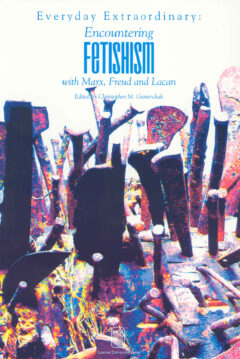 Everyday Extraordinary: Encountering Fetishism with Marx, Freud and Lacan
Christopher M. Gemerchak (Editor), Paul Moyaert (Editor),
November 2004
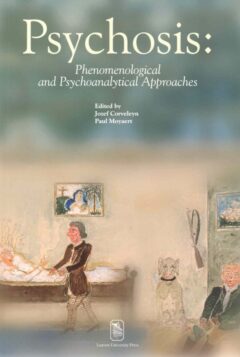 Psychosis: Phenomenological and Psychoanalytical Approaches
Jozef Corveleyn (Editor), Paul Moyaert (Editor),
February 2003
 Seduction, Suggestion, Psychoanalysis
Jozef Corveleyn (Editor), Philippe Van Haute (Editor),
May 2001