

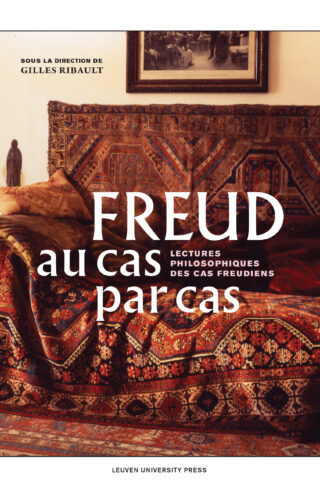
Freud au cas par cas
Lectures philosophiques des cas freudiens
Gilles Ribault (Author),
Series: Figures of the Unconscious
Category: Psychoanalysis
Language: French
ISBN: 9789462700505
Publication date: December 7, 2015
€24.90 (including 6% VAT)
Buy NowSize: 240 x 160 x mm

Stock item: 105254
Standard delivery time for print books:
For Belgium: 5 to 8 working days
For EU: 2 to 3 weeks
For other countries: 4 to 5 weeks
Series: Figures of the Unconscious
Category: Psychoanalysis
Language: French
ISBN: 9789461661876
Publication date: December 7, 2015
€19.00 (including 6% VAT)
Buy Now
Etudes philosophiques des cas freudiens Dora, l’Homme aux rats, Hans, le Président Schreber, l’Homme aux loups… les cas freudiens sont célèbres, mais que sont-ils vraiment : des aperçus biographiques ? Des récits de cure ? On y a longtemps vu des témoignages de la manière dont les théories freudiennes ont « jailli » de l’expérience clinique. Les articles de ce recueil y font voir autre chose : des échantillons d’une pensée qui s’essaie, se met à l’épreuve, se corrige et se réinvente sans cesse ; des analyses qui interrogent la tension toujours précaire entre le normal et le pathologique. Psychanalyse et philosophie se rencontrent ici : qu’est-ce que bien vivre ? Etre en bonne santé, sans doute, s’il est vrai, comme l’affirme Freud, qu’il n’y a d’âme qu’incarnée. Mais existe-t-il une santé de l’âme ? Que serait une santé qui soit autant psychique que corporelle ? Les commentaires des grands cas freudiens réunis dans ce volume circulent à travers l’oeuvre fondatrice de la psychanalyse en questionnant autant qu’en instruisant.
Philosophical analysis of Freud’s case studies
Dora, the Rat Man, Little Hans, Judge Schreber, the Wolf Man … Freud’s case studies are famous, but what are they really: biographical insights? Mere reports on therapy? They have long been considered as testimonials of how Freud’s theories originated in clinical experience. The articles in this collection, however, deal with these cases both as examples of a mode of thought that constantly examines, challenges, corrects and reinvents itself, and as examples of analyses that question the always precarious tension between the normal and the pathological. Psychoanalysis and philosophy come together here: what does ‘living well’ mean? To be healthy, no doubt, since, as stated by Freud, there is only incarnated soul. Does mental health exist? How are we to conceive health that is both psychological and corporeal? The commentaries on Freud’s best-known case studies in this volume flow through the founding work of psychoanalysis in a questioning as well as explanatory way.
This publication is GPRC-labeled (Guaranteed Peer-Reviewed Content).
Collaborateurs / Contributors Jens De Vleminck (Ghent University), Tomas Geyskens (Leuven), Elissa Marder (Emory University, Atlanta), Beatriz Santos (Paris), Patrick Vandermeersch (University of Groningen), Philippe Van Haute (Radboud Universiteit, Nijmegen), Herman Westerink (Radboud Universiteit, Nijmegen)
Introduction
Gilles Ribault
Le cas Dora, un savoir en fragments
Beatriz Santos
L’amour sur la pointe des pieds. Réflexions sur l’amour et la vie dans la Gradiva de Freud
Gilles Ribault
Le Petit Hans et la Création de Dieu dans Totem et Tabou. Projection, substitution et exaltation
Herman Westerink
Colère, jouissance et compulsion de doute. Une symptomatologie freudienne de la névrose de contrainte
Philippe Van Haute et Tomas Geyskens
Caïn contre OEdipe. L’agressivité humaine et ses enjeux
Jens De Vleminck
Le Schreber de Freud. La réponse manquée à Jung
Patrick Vandermeersch
L’Homme aux loups. L’animal sexuel et la scène primitive
Elissa Marder
Final. Pourquoi des cas ?
Gilles Ribault
Présentation des auteurs
Frequently Asked Questions
What is "Freud au cas par cas" about?
Etudes philosophiques des cas freudiens Dora, l’Homme aux rats, Hans, le Président Schreber, l’Homme aux loups… les cas freudiens sont célèbres, mais que sont-ils vraiment : des aperçus biographiques ? Des récits de cure ? On y a longtemps vu des témoignages de la manière dont les théories freudiennes ont « jailli » de l’expérience clinique. Les articles de ce recueil y font voir autre chose : des échantillons d’une pensée qui s’essaie, se met à l’épreuve, se corrige et se réinvente sans cesse ; des analyses qui interrogent la tension toujours précaire entre le normal et le pathologique. Psychanalyse et philosophie se rencontrent ici : qu’est-ce que bien vivre ? Etre en bonne santé, sans doute, s’il est vrai, comme l’affirme Freud, qu’il n’y a d’âme qu’incarnée. Mais existe-t-il une santé de l’âme ? Que serait une santé qui soit autant psychique que corporelle ? Les commentaires des grands cas freudiens réunis dans ce volume circulent à travers l'oeuvre fondatrice de la psychanalyse en questionnant autant qu'en instruisant.
Philosophical analysis of Freud’s case studies
Dora, the Rat Man, Little Hans, Judge Schreber, the Wolf Man ... Freud’s case studies are famous, but what are they really: biographical insights? Mere reports on therapy? They have long been considered as testimonials of how Freud’s theories originated in clinical experience. The articles in this collection, however, deal with these cases both as examples of a mode of thought that constantly examines, challenges, corrects and reinvents itself, and as examples of analyses that question the always precarious tension between the normal and the pathological. Psychoanalysis and philosophy come together here: what does ‘living well’ mean? To be healthy, no doubt, since, as stated by Freud, there is only incarnated soul. Does mental health exist? How are we to conceive health that is both psychological and corporeal? The commentaries on Freud’s best-known case studies in this volume flow through the founding work of psychoanalysis in a questioning as well as explanatory way.
This publication is GPRC-labeled (Guaranteed Peer-Reviewed Content).
Collaborateurs / Contributors Jens De Vleminck (Ghent University), Tomas Geyskens (Leuven), Elissa Marder (Emory University, Atlanta), Beatriz Santos (Paris), Patrick Vandermeersch (University of Groningen), Philippe Van Haute (Radboud Universiteit, Nijmegen), Herman Westerink (Radboud Universiteit, Nijmegen)
Who wrote "Freud au cas par cas"?
"Freud au cas par cas" was written by Gilles Ribault.
Gilles Ribault, ancien élève de l'Ecole Normale Supérieure (St Cloud), agrégé de philosophie et docteur en psychologie (Paris VII ), enseigne la philosophie dans le secondaire.
Is "Freud au cas par cas" part of a series?
Yes, "Freud au cas par cas" is part of the "Figures of the Unconscious" series.
In collaboration with the International Society for Psychoanalysis and Philosophy (SIPP-ISPP).


The peer-reviewed book series Figures of the Unconscious was founded in 2001 and provides a platform for exchange at the intersection of philosophy and psychoanalysis. Psychoanalysis occupies a crucial position within contemporary philosophical thinking and many analysts are influenced by philosophical approaches.
Both philosophy and psychoanalysis are concerned with the nature of the subject, questions of knowledge and epistemology, sexuality, life and death, ethical issues, alterity, and the subject’s manifold relationships to the other - to other human and non-human beings and to its environment.
We welcome manuscripts in the areas and at the intersections of
- the history of psychoanalysis and Freudian thought
- the exploration of psychoanalytic concepts and the development of theories
- the research and development of the psychoanalytic movement
- psychoanalytic and philosophical concepts and ideas
- psychoanalysis, gender and queer studies
- interdisciplinary approaches that combine psychoanalysis with other scientific disciplines
- current developments in psychoanalytic approaches
- ethical approaches in psychoanalysis
- epistemological debates
Editors-in-Chief
Beatriz Santos (Université de Paris)
Herman Westerink (Radboud University)
Esther Hutfless (Sigmund Freud University Linz)
Editorial board
Jeff Bloechl (Boston College)
Advisory Board
Jozef Corveleyn (KU Leuven)
Monique David-Ménard (Université de Paris)
Rodrigo De La Fabián (Universidad Diego Portales, Santiago de Chile)
Jens De Vleminck (Leuven)
Eran Dorfman (University of Tel Aviv)
Laurie Laufer (Université de Paris)
Elissa Marder (Emory University, Atlanta)
Claire Nioche (Université Paris XIII)
Vladimir Safatle (Universidade de São Paulo)
Charles Shepherdson (State University of New York at Albany)
Guillaume Silbertin Blanc (Université Paris 8)
Raluca Soreanu (University of Essex)
Celine Surprenant (Paris)
Antônio Teixeira (Universidade Federal de Minas Gerais)
Johan Van Der Walt (University of Luxemburg)
Wilfried Ver Eecke (Georgetown University)
Proposals
The board accepts manuscripts for review from both members and non-members of the SIPP-ISPP. These can be either monographs or edited volumes, provided they align with the aims and scope of the series.
Proposals and enquiries can be sent to the series editors-in-chief.
Please make use of the submission form to present your manuscript or proposal to our board.
Authors interested in Open Access can consult the available funding options.
Links & Resources
What is the Table of Contents for "Freud au cas par cas"?
Introduction
Gilles Ribault
Le cas Dora, un savoir en fragments
Beatriz Santos
L'amour sur la pointe des pieds. Réflexions sur l'amour et la vie dans la Gradiva de Freud
Gilles Ribault
Le Petit Hans et la Création de Dieu dans Totem et Tabou. Projection, substitution et exaltation
Herman Westerink
Colère, jouissance et compulsion de doute. Une symptomatologie freudienne de la névrose de contrainte
Philippe Van Haute et Tomas Geyskens
Caïn contre OEdipe. L'agressivité humaine et ses enjeux
Jens De Vleminck
Le Schreber de Freud. La réponse manquée à Jung
Patrick Vandermeersch
L'Homme aux loups. L'animal sexuel et la scène primitive
Elissa Marder
Final. Pourquoi des cas ?
Gilles Ribault
Présentation des auteurs
Related titles
 Psychoanalysis on Borders, Limits and Beyond
Yianna Ioannou (Editor), Izzy Powis (Editor), Sinziana Ravini (Editor), Léa Silveira (Editor), Jamieson Webster (Editor),
November 2026
 Seduction, Drive and Repetition
Herman Westerink (Author), Philippe Van Haute (Author),
September 2025
 Thoughts for the Times on Groups and Masses
Daniela Finzi (Editor), Jeanne Wolff Bernstein (Editor),
January 2025
 Towards the Limits of Freudian Thinking
Herman Westerink (Editor), Jenny Willner (Editor), Philippe Van Haute (Editor),
August 2024
 Truth and Suffering
Paulo Beer (Author), Nelson da Silva Júnior (Preface by), Renata Takatu (Translator),
March 2024
 Ferenczi Dialogues
Raluca Soreanu (Author), Jakob Staberg (Author), Jenny Willner (Author),
January 2026








 Towards a Political Anthropology in the Work of Gilles Deleuze
Rockwell F. Clancy (Author),
February 2015
 Psychoanalysis, Monotheism and Morality
Wolfgang Müller Funk (Editor), Inge Scholz Strasser (Editor), Herman Westerink (Editor), Daniela Finzi (),
March 2013





 Everyday Extraordinary: Encountering Fetishism with Marx, Freud and Lacan
Christopher M. Gemerchak (Editor), Paul Moyaert (Editor),
November 2004
 Psychosis: Phenomenological and Psychoanalytical Approaches
Jozef Corveleyn (Editor), Paul Moyaert (Editor),
February 2003
 Seduction, Suggestion, Psychoanalysis
Jozef Corveleyn (Editor), Philippe Van Haute (Editor),
May 2001