

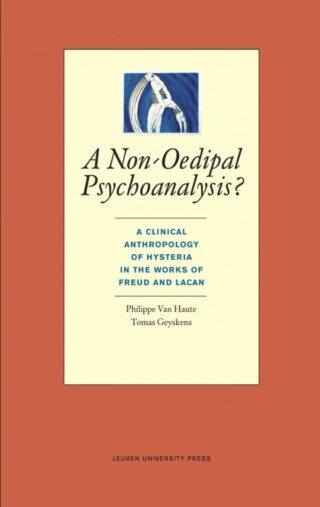
A Non-Oedipal Psychoanalysis?
A Clinical Anthropology of Hysteria in the Works of Freud and Lacan
Philippe Van Haute (Author), Tomas Geyskens (Author),
Series: Figures of the Unconscious 11
Category: Psychoanalysis
Language: English
ISBN: 9789058679116
Publication date: May 3, 2012
€34.50 (including 6% VAT)
Buy NowNumber of pages: 180
Size: 240 x 160 x 10 mm

Stock item: 66161
Standard delivery time for print books:
For Belgium: 5 to 8 working days
For EU: 2 to 3 weeks
For other countries: 4 to 5 weeks
Series: Figures of the Unconscious 11
Category: Psychoanalysis
Language: English
ISBN: 9789461660596
Publication date: March 20, 2013
€26.00 (including 6% VAT)
Buy NowNumber of pages: 180
The different psychopathologic syndromes show in an exaggerated and caricatural manner the basic structures of human existence. These structures not only characterize psychopathology, but they also determine the highest forms of culture. This is the credo of Freud’s anthropology. This anthropology implies that humans are beings of the in-between. The human being is essentially tied up between pathology and culture, and there is no ‘normal position’ that can be defined in a theoretically convincing manner. The authors of this book call this Freudian anthropology a patho-analysis of existence or a clinical anthropology. This anthropology gives a new meaning to the Nietzschean dictum that the human being is a ‘sick animal’. Freud, and later Lacan, first developed this anthropological insight in relation to hysteria (in its relation to literature). This patho-analytic perspective progressively disappears in Freud’s texts after 1905. This book reveals the crucial moments of that development. In doing so, it becomes clear not only that Freud introduced the Oedipus complex much later than is usually assumed, but also that the theory of the Oedipus complex is irreconcilable with the project of a clinical anthropology. The authors not only examine the philosophical meaning of this thesis in the work of Freud. They also examine its avatars in the texts of Jacques Lacan and show how this project of a patho-analysis of existence inevitably obliges us to formulate a non-oedipal psychoanalytic anthropology.
This publication is GPRC-labeled (Guaranteed Peer-Reviewed Content).
Table of Contents
Acknowledgements
Introduction
A Clinical Anthropology of Hysteria
Hysteria as a Philosophical Problem
Chapter 1
Between Trauma and Disposition
The Specific Aetiology of Hysteria in Freud’s Early Works
Introduction: From Real Trauma to Oedipal Phantasy?
1. Trauma and Disposition in Studies on Hysteria
2. The Seduction Theory
3. After the Theory of Seduction
Conclusion 43
Chapter 2
Dora
Symptom, Trauma and Phantasy in Freud’s Analysis of Dora
Introduction
1. Two Traumas
2. The Meaning of Dora’s Symptoms
3. The Oedipal Legend in the Case of Dora
4. Bisexuality and its Consequences
Conclusion: Dora’s un-Oedipal Desires
Chapter 3
From Day-dream to Novel
On Hysterical Phantasy and Literary Fiction
Introduction: a Disposition towards Literature?
1. Hysterical Phantasying
2. The Novel and Hysteria
3. Sources of Pleasure – the Joke and Literature
Conclusion: The Novel as Sublimation of Hysteria
Chapter 4
The Indifference of a Healthy Lesbian Bisexuality versus the Oedipus Complex
Introduction
1. From Bisexuality to the Oedipus Complex
2. From Oedipus Complex to Bisexuality
Conclusion
Chapter 5
Lacan’s Structuralist Rereading of Dora
Introduction
1. Structure versus Psychogenesis
2. The Female Oedipus Complex: Frustration and Gift
3. L acan’s Reading of Fragment of an Analysis of a Case of Hysteria (“Dora”)
4. Dora and the L-scheme
5. The Lesson of Lévi-Strauss
6. The Hysterical Desire for an Unfulfilled Desire: the Dream of the Beautiful Butcher’s Wife
7. Dora and the Dream of the Beautiful Butcher’s Wife
Conclusion
Chapter 6
Lacan and the Homosexual Young Woman: between Pathology and Poetry?
Introduction
1. Dora versus the Homosexual Young Woman
2. A Lacanian Clinical Anthropology of Hysteria and Perversion?
Conclusion
Chapter 7
Beyond Oedipus?
Introduction
1. Freud reads Sophocles
2. A Psychoanalytical Origin Tale: Totem and Taboo
3. Freud’s Dream
4. Castration as the Truth of the Oedipus Complex
5. Oedipus as Incarnation of the Master
6. Dora and the Search for a Master
Conclusion
Chapter 8
Return to Freud?
Lacan’s Pathoanalysis of Hysteria
Introduction
1. The formulas of Sexuation
2. Hysteria and the Formulas of Sexuation
3. Courtly Love and the Jouissance of the Other
Conclusion 151
Conclusion
The Project of a Psychoanalytical Anthropology in Freud and Lacan
1. Freud and Hysteria
2. Hysteria and Literature
3. The Oedipal Trap
4. Development versus Structure
5. The Human as a Being of the In-between
6. The Hysterical Subject, its Master and Female Jouissance
7. Beyond Hysteria…
8. Freud versus Lacan: the Position of Science
References
Index
Deze bijzonder heldere studie die (en dat zullen de auteurs mij, gelet op hun conclusie, wel vergeven) bijna leest als een detectiveroman, laat op toegankelijke wijze zien hoe psychopathologische symptomen de basisstructuren van het menselijk leven blootleggen die tevens de bron zijn van de hoogste vormen van cultuur. Het boek is in ieder geval aanbevelenswaardige lectuur en stimuleert tot nadenken, zowel binnen het domein van de filosofie, van de klinische praktijk als van de psychoanalytische theorie.
Mariska Christianen, Tijdschrift voor Psychoanalyse, 2012, nummer 3
A strength of the book is that Van Haute and Geyskens make Freud and Lacan accessible to those who may have only a cursory knowledge of the two thinkers and their often confusing technical terminology. Van Haute and Geyskens' careful explication of two of Freud's clinical cases (Dora and the young homosexual woman) serves as the evidential ground from which they pose theoretical claims regarding hysteria and its implications for human existence. Correspondingly, this book may serve as an excellent beginning text for philosophers to inquire into the field of psychoanalysis. Van Haute and Geyskens raise a number of points which may be fruitful to pursue in more depth and from certain philosophical perspectives (especially metaphysical), including the hysteric's relation to knowledge and the non-rapport between the symbolic and the real or language and the void.
Stephanie Swales Scalambrino, Independent Scholar, Texas, Philosophy in Review XXXIV (2014), no. 3-4
Deze bijzonder heldere studie die (en dat zullen de auteurs mij, gelet op hun conclusie, wel vergeven) bijna leest als een detectiveroman, laat op toegankelijke wijze zien hoe psychopathologische symptomen de basisstructuren van het menselijk leven blootleggen die tevens de bron zijn van de hoogste vormen van cultuur. Het boek is in ieder geval aanbevelenswaardige lectuur en stimuleert tot nadenken, zowel binnen het domein van de filosofie, van de klinische praktijk als van de psychoanalytische theorie.
Mariska Christianen, Tijdschrift voor Psychoanalyse, 2012, nummer 3
Frequently Asked Questions
What is "A Non-Oedipal Psychoanalysis?" about?
The different psychopathologic syndromes show in an exaggerated and caricatural manner the basic structures of human existence. These structures not only characterize psychopathology, but they also determine the highest forms of culture. This is the credo of Freud's anthropology. This anthropology implies that humans are beings of the in-between. The human being is essentially tied up between pathology and culture, and there is no ‘normal position' that can be defined in a theoretically convincing manner. The authors of this book call this Freudian anthropology a patho-analysis of existence or a clinical anthropology. This anthropology gives a new meaning to the Nietzschean dictum that the human being is a ‘sick animal'. Freud, and later Lacan, first developed this anthropological insight in relation to hysteria (in its relation to literature). This patho-analytic perspective progressively disappears in Freud's texts after 1905. This book reveals the crucial moments of that development. In doing so, it becomes clear not only that Freud introduced the Oedipus complex much later than is usually assumed, but also that the theory of the Oedipus complex is irreconcilable with the project of a clinical anthropology. The authors not only examine the philosophical meaning of this thesis in the work of Freud. They also examine its avatars in the texts of Jacques Lacan and show how this project of a patho-analysis of existence inevitably obliges us to formulate a non-oedipal psychoanalytic anthropology.
This publication is GPRC-labeled (Guaranteed Peer-Reviewed Content).
Who wrote "A Non-Oedipal Psychoanalysis?"?
"A Non-Oedipal Psychoanalysis?" was written by Philippe Van Haute and Tomas Geyskens.
Philippe Van Haute (†) was full professor at the Center for Contemporary European Philosophy, Radboud University Nijmegen, and extraordinary professor at the University of Pretoria.
Tomas Geyskens is doctor in philosophy and a practising psychoanalyst (Belgian School for Psychoanalysis).
Is "A Non-Oedipal Psychoanalysis?" part of a series?
Yes, "A Non-Oedipal Psychoanalysis?" is part of the "Figures of the Unconscious" series. It's book 11 in the series.
In collaboration with the International Society for Psychoanalysis and Philosophy (SIPP-ISPP).


The peer-reviewed book series Figures of the Unconscious was founded in 2001 and provides a platform for exchange at the intersection of philosophy and psychoanalysis. Psychoanalysis occupies a crucial position within contemporary philosophical thinking and many analysts are influenced by philosophical approaches.
Both philosophy and psychoanalysis are concerned with the nature of the subject, questions of knowledge and epistemology, sexuality, life and death, ethical issues, alterity, and the subject’s manifold relationships to the other - to other human and non-human beings and to its environment.
We welcome manuscripts in the areas and at the intersections of
- the history of psychoanalysis and Freudian thought
- the exploration of psychoanalytic concepts and the development of theories
- the research and development of the psychoanalytic movement
- psychoanalytic and philosophical concepts and ideas
- psychoanalysis, gender and queer studies
- interdisciplinary approaches that combine psychoanalysis with other scientific disciplines
- current developments in psychoanalytic approaches
- ethical approaches in psychoanalysis
- epistemological debates
Editors-in-Chief
Beatriz Santos (Université de Paris)
Herman Westerink (Radboud University)
Esther Hutfless (Sigmund Freud University Linz)
Editorial board
Jeff Bloechl (Boston College)
Advisory Board
Jozef Corveleyn (KU Leuven)
Monique David-Ménard (Université de Paris)
Rodrigo De La Fabián (Universidad Diego Portales, Santiago de Chile)
Jens De Vleminck (Leuven)
Eran Dorfman (University of Tel Aviv)
Laurie Laufer (Université de Paris)
Elissa Marder (Emory University, Atlanta)
Claire Nioche (Université Paris XIII)
Vladimir Safatle (Universidade de São Paulo)
Charles Shepherdson (State University of New York at Albany)
Guillaume Silbertin Blanc (Université Paris 8)
Raluca Soreanu (University of Essex)
Celine Surprenant (Paris)
Antônio Teixeira (Universidade Federal de Minas Gerais)
Johan Van Der Walt (University of Luxemburg)
Wilfried Ver Eecke (Georgetown University)
Proposals
The board accepts manuscripts for review from both members and non-members of the SIPP-ISPP. These can be either monographs or edited volumes, provided they align with the aims and scope of the series.
Proposals and enquiries can be sent to the series editors-in-chief.
Please make use of the submission form to present your manuscript or proposal to our board.
Authors interested in Open Access can consult the available funding options.
Links & Resources
What is the Table of Contents for "A Non-Oedipal Psychoanalysis?"?
Table of Contents
Acknowledgements
Introduction
A Clinical Anthropology of Hysteria
Hysteria as a Philosophical Problem
Chapter 1
Between Trauma and Disposition
The Specific Aetiology of Hysteria in Freud's Early Works
Introduction: From Real Trauma to Oedipal Phantasy?
1. Trauma and Disposition in Studies on Hysteria
2. The Seduction Theory
3. After the Theory of Seduction
Conclusion 43
Chapter 2
Dora
Symptom, Trauma and Phantasy in Freud's Analysis of Dora
Introduction
1. Two Traumas
2. The Meaning of Dora's Symptoms
3. The Oedipal Legend in the Case of Dora
4. Bisexuality and its Consequences
Conclusion: Dora's un-Oedipal Desires
Chapter 3
From Day-dream to Novel
On Hysterical Phantasy and Literary Fiction
Introduction: a Disposition towards Literature?
1. Hysterical Phantasying
2. The Novel and Hysteria
3. Sources of Pleasure - the Joke and Literature
Conclusion: The Novel as Sublimation of Hysteria
Chapter 4
The Indifference of a Healthy Lesbian Bisexuality versus the Oedipus Complex
Introduction
1. From Bisexuality to the Oedipus Complex
2. From Oedipus Complex to Bisexuality
Conclusion
Chapter 5
Lacan's Structuralist Rereading of Dora
Introduction
1. Structure versus Psychogenesis
2. The Female Oedipus Complex: Frustration and Gift
3. L acan's Reading of Fragment of an Analysis of a Case of Hysteria ("Dora")
4. Dora and the L-scheme
5. The Lesson of Lévi-Strauss
6. The Hysterical Desire for an Unfulfilled Desire: the Dream of the Beautiful Butcher's Wife
7. Dora and the Dream of the Beautiful Butcher's Wife
Conclusion
Chapter 6
Lacan and the Homosexual Young Woman: between Pathology and Poetry?
Introduction
1. Dora versus the Homosexual Young Woman
2. A Lacanian Clinical Anthropology of Hysteria and Perversion?
Conclusion
Chapter 7
Beyond Oedipus?
Introduction
1. Freud reads Sophocles
2. A Psychoanalytical Origin Tale: Totem and Taboo
3. Freud's Dream
4. Castration as the Truth of the Oedipus Complex
5. Oedipus as Incarnation of the Master
6. Dora and the Search for a Master
Conclusion
Chapter 8
Return to Freud?
Lacan's Pathoanalysis of Hysteria
Introduction
1. The formulas of Sexuation
2. Hysteria and the Formulas of Sexuation
3. Courtly Love and the Jouissance of the Other
Conclusion 151
Conclusion
The Project of a Psychoanalytical Anthropology in Freud and Lacan
1. Freud and Hysteria
2. Hysteria and Literature
3. The Oedipal Trap
4. Development versus Structure
5. The Human as a Being of the In-between
6. The Hysterical Subject, its Master and Female Jouissance
7. Beyond Hysteria...
8. Freud versus Lacan: the Position of Science
References
Index
Related titles
 Psychoanalysis on Borders, Limits and Beyond
Yianna Ioannou (Editor), Izzy Powis (Editor), Sinziana Ravini (Editor), Léa Silveira (Editor), Jamieson Webster (Editor),
November 2026
 Seduction, Drive and Repetition
Herman Westerink (Author), Philippe Van Haute (Author),
September 2025
 Thoughts for the Times on Groups and Masses
Daniela Finzi (Editor), Jeanne Wolff Bernstein (Editor),
January 2025
 Towards the Limits of Freudian Thinking
Herman Westerink (Editor), Jenny Willner (Editor), Philippe Van Haute (Editor),
August 2024
 Truth and Suffering
Paulo Beer (Author), Nelson da Silva Júnior (Preface by), Renata Takatu (Translator),
March 2024
 Ferenczi Dialogues
Raluca Soreanu (Author), Jakob Staberg (Author), Jenny Willner (Author),
January 2026



 Towards a Political Anthropology in the Work of Gilles Deleuze
Rockwell F. Clancy (Author),
February 2015
 Psychoanalysis, Monotheism and Morality
Wolfgang Müller Funk (Editor), Inge Scholz Strasser (Editor), Herman Westerink (Editor), Daniela Finzi (),
March 2013


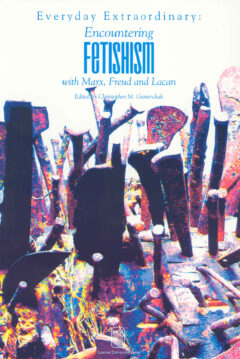 Everyday Extraordinary: Encountering Fetishism with Marx, Freud and Lacan
Christopher M. Gemerchak (Editor), Paul Moyaert (Editor),
November 2004
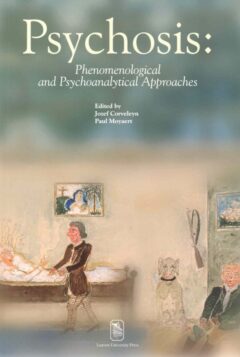 Psychosis: Phenomenological and Psychoanalytical Approaches
Jozef Corveleyn (Editor), Paul Moyaert (Editor),
February 2003
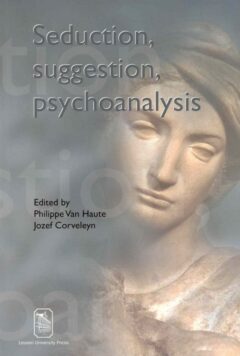 Seduction, Suggestion, Psychoanalysis
Jozef Corveleyn (Editor), Philippe Van Haute (Editor),
May 2001