

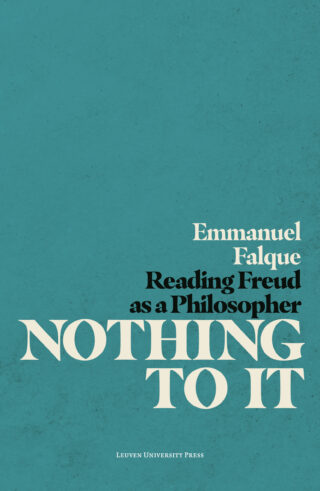
Nothing to It
Reading Freud as a Philosopher
Emmanuel Falque (Author),
Series: Figures of the Unconscious
Category: Psychoanalysis
Language: English
ISBN: 9789462702233
Publication date: February 12, 2020
€25.00 (including 6% VAT)
Buy NowNumber of pages: 136
Size: 234 x 156 x 7 mm

Stock item: 133312
Standard delivery time for print books:
For Belgium: 5 to 8 working days
For EU: 2 to 3 weeks
For other countries: 4 to 5 weeks
Series: Figures of the Unconscious
Category: Psychoanalysis
Language: English
ISBN: 9789461663214
Publication date: February 12, 2020
€19.00 (including 6% VAT)
Buy NowNumber of pages: 136
The special role of psychoanalysis in the development of phenomenology
The confrontation between philosophy and psychoanalysis has had its heyday. After the major debates between Paul Ricoeur, Maurice Merleau-Ponty, Jacques Derrida, Gilles Deleuze, and Michel Henry, this dialogue now seems to have broken down. It has therefore proven necessary and gainful to revisit these debates to explore their re-usability and the degree to which they can provide new insights from a contemporary point of view. It can be said that contemporary philosophy suffers from an ‘excess of meaning’, and this is exactly where psychoanalysis comes in and may raise key questions. This is precisely what a philosophical reading of Freud demonstrates. To say ‘Nothing to It’ indicates that the ‘It’—or Freudian Id—is not visible as it never shows itself as a ‘phenomenon’. Such a reading of Freud exemplifies how psychoanalysis has a special role to play in phenomenology’s development.
Translators: Robert Vallier (DePaul University), William L. Connelly (The Catholic University of Paris)
This publication is GPRC-labeled (Guaranteed Peer-Reviewed Content).
Foreword by Philippe Van Haute
Preface
Opening Act Philosophizing in psychoanalysis The doctrine of experience The other Rubicon The backlash
Introduction Go take a look
Chapter One Keep moving, nothing to see The end of the Enlightenment Toward another paradigm Collapse of the system
Chapter Two Beware of it Conceiving the inconceivable The disillusion of psychoanalysis Primitive man
Chapter Three It’s not nothing The drive at the frontier Rooting in the organic Presence and resistance
Chapter Four What is it? A disturbing uncanny Death and repetition The anorganic
Chapter Five It concerns me Being lived The knight of the Id Being there for something
Chapter Six It touches me Where the Id was The draining of the Zuyderzee The great cavalcade
Conclusion What’s God have to do with it? For the salvation of the Id Apart from it The realm of the Id
Epilogue Regarding all of it
Notes Bibliography Index rerum Index nominum
Frequently Asked Questions
What is "Nothing to It" about?
The special role of psychoanalysis in the development of phenomenology
The confrontation between philosophy and psychoanalysis has had its heyday. After the major debates between Paul Ricoeur, Maurice Merleau-Ponty, Jacques Derrida, Gilles Deleuze, and Michel Henry, this dialogue now seems to have broken down. It has therefore proven necessary and gainful to revisit these debates to explore their re-usability and the degree to which they can provide new insights from a contemporary point of view. It can be said that contemporary philosophy suffers from an ‘excess of meaning’, and this is exactly where psychoanalysis comes in and may raise key questions. This is precisely what a philosophical reading of Freud demonstrates. To say ‘Nothing to It’ indicates that the ‘It’—or Freudian Id—is not visible as it never shows itself as a ‘phenomenon’. Such a reading of Freud exemplifies how psychoanalysis has a special role to play in phenomenology's development.
Translators: Robert Vallier (DePaul University), William L. Connelly (The Catholic University of Paris)
This publication is GPRC-labeled (Guaranteed Peer-Reviewed Content).
Who wrote "Nothing to It"?
"Nothing to It" was written by Emmanuel Falque.
Emmanuel Falque is honorary dean of the Faculty of Philosophy at the Catholic University of Paris. He is a widely published author in the field of phenomenology and continental philosophy.
Is "Nothing to It" part of a series?
Yes, "Nothing to It" is part of the "Figures of the Unconscious" series.
In collaboration with the International Society for Psychoanalysis and Philosophy (SIPP-ISPP).


The peer-reviewed book series Figures of the Unconscious was founded in 2001 and provides a platform for exchange at the intersection of philosophy and psychoanalysis. Psychoanalysis occupies a crucial position within contemporary philosophical thinking and many analysts are influenced by philosophical approaches.
Both philosophy and psychoanalysis are concerned with the nature of the subject, questions of knowledge and epistemology, sexuality, life and death, ethical issues, alterity, and the subject’s manifold relationships to the other - to other human and non-human beings and to its environment.
We welcome manuscripts in the areas and at the intersections of
- the history of psychoanalysis and Freudian thought
- the exploration of psychoanalytic concepts and the development of theories
- the research and development of the psychoanalytic movement
- psychoanalytic and philosophical concepts and ideas
- psychoanalysis, gender and queer studies
- interdisciplinary approaches that combine psychoanalysis with other scientific disciplines
- current developments in psychoanalytic approaches
- ethical approaches in psychoanalysis
- epistemological debates
Editors-in-Chief
Beatriz Santos (Université de Paris)
Herman Westerink (Radboud University)
Esther Hutfless (Sigmund Freud University Linz)
Editorial board
Jeff Bloechl (Boston College)
Advisory Board
Jozef Corveleyn (KU Leuven)
Monique David-Ménard (Université de Paris)
Rodrigo De La Fabián (Universidad Diego Portales, Santiago de Chile)
Jens De Vleminck (Leuven)
Eran Dorfman (University of Tel Aviv)
Laurie Laufer (Université de Paris)
Elissa Marder (Emory University, Atlanta)
Claire Nioche (Université Paris XIII)
Vladimir Safatle (Universidade de São Paulo)
Charles Shepherdson (State University of New York at Albany)
Guillaume Silbertin Blanc (Université Paris 8)
Raluca Soreanu (University of Essex)
Celine Surprenant (Paris)
Antônio Teixeira (Universidade Federal de Minas Gerais)
Johan Van Der Walt (University of Luxemburg)
Wilfried Ver Eecke (Georgetown University)
Proposals
The board accepts manuscripts for review from both members and non-members of the SIPP-ISPP. These can be either monographs or edited volumes, provided they align with the aims and scope of the series.
Proposals and enquiries can be sent to the series editors-in-chief.
Please make use of the submission form to present your manuscript or proposal to our board.
Authors interested in Open Access can consult the available funding options.
Links & Resources
What is the Table of Contents for "Nothing to It"?
Foreword by Philippe Van Haute
Preface
Opening Act Philosophizing in psychoanalysis The doctrine of experience The other Rubicon The backlash
Introduction Go take a look
Chapter One Keep moving, nothing to see The end of the Enlightenment Toward another paradigm Collapse of the system
Chapter Two Beware of it Conceiving the inconceivable The disillusion of psychoanalysis Primitive man
Chapter Three It’s not nothing The drive at the frontier Rooting in the organic Presence and resistance
Chapter Four What is it? A disturbing uncanny Death and repetition The anorganic
Chapter Five It concerns me Being lived The knight of the Id Being there for something
Chapter Six It touches me Where the Id was The draining of the Zuyderzee The great cavalcade
Conclusion What’s God have to do with it? For the salvation of the Id Apart from it The realm of the Id
Epilogue Regarding all of it
Notes Bibliography Index rerum Index nominum
What is the DOI for "Nothing to It"?
The Digital Object Identifier (DOI) for "Nothing to It" is 10.11116/9789461663214.
Related titles
 Psychoanalysis on Borders, Limits and Beyond
Yianna Ioannou (Editor), Izzy Powis (Editor), Sinziana Ravini (Editor), Léa Silveira (Editor), Jamieson Webster (Editor),
November 2026
 Seduction, Drive and Repetition
Herman Westerink (Author), Philippe Van Haute (Author),
September 2025
 Thoughts for the Times on Groups and Masses
Daniela Finzi (Editor), Jeanne Wolff Bernstein (Editor),
January 2025
 Towards the Limits of Freudian Thinking
Herman Westerink (Editor), Jenny Willner (Editor), Philippe Van Haute (Editor),
August 2024
 Truth and Suffering
Paulo Beer (Author), Nelson da Silva Júnior (Preface by), Renata Takatu (Translator),
March 2024
 Ferenczi Dialogues
Raluca Soreanu (Author), Jakob Staberg (Author), Jenny Willner (Author),
January 2026







 Towards a Political Anthropology in the Work of Gilles Deleuze
Rockwell F. Clancy (Author),
February 2015
 Psychoanalysis, Monotheism and Morality
Wolfgang Müller Funk (Editor), Inge Scholz Strasser (Editor), Herman Westerink (Editor), Daniela Finzi (),
March 2013




 Everyday Extraordinary: Encountering Fetishism with Marx, Freud and Lacan
Christopher M. Gemerchak (Editor), Paul Moyaert (Editor),
November 2004
 Psychosis: Phenomenological and Psychoanalytical Approaches
Jozef Corveleyn (Editor), Paul Moyaert (Editor),
February 2003
 Seduction, Suggestion, Psychoanalysis
Jozef Corveleyn (Editor), Philippe Van Haute (Editor),
May 2001