

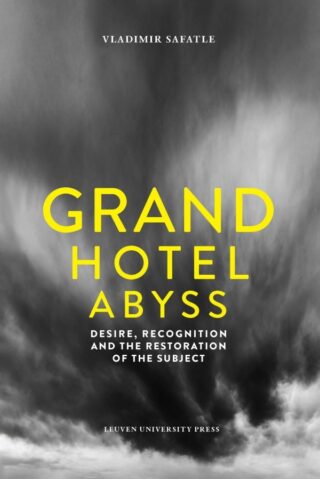
Grand Hotel Abyss
Desire, Recognition and the Restoration of the Subject
Vladimir Safatle (Author),
Series: Figures of the Unconscious 15
Category: Psychoanalysis
ISBN: 9789462700628
Publication date: February 3, 2016
€55.00 (including 6% VAT)
Buy NowSize: 240 x 160 x mm

Stock item: 106827
Standard delivery time for print books:
For Belgium: 5 to 8 working days
For EU: 2 to 3 weeks
For other countries: 4 to 5 weeks
Series: Figures of the Unconscious 15
Category: Psychoanalysis
ISBN: 9789461661937
Publication date: February 3, 2016
€41.00 (including 6% VAT)
Buy Now
Long-expected translation of the Portuguese academic bestseller Grande Hotel Abismo
In the last two decades recognition – arguably one of the most central notions of the dialectical tradition since Hegel – has once again become a crucial philosophical theme. Nevertheless, the new theories of recognition fail to provide room for reflection on transformation processes in politics and morality.
This book aims to recover the disruptive nature of the dialectical tradition by means of a severe critique of the dominance of an anthropology of the individual identity in contemporary theories of recognition. This critique implies a thorough rethinking of basic concepts such as desire, negativity, will and drive, with Hegel, Lacan and Adorno being our main guides.
The Marxist philosopher György Lukács said that the Frankfurt School (Horkheimer, Adorno, etc.) left us with nothing but negativity towards the state of the world. Their work failed to open up a concrete possibility of practical engagement in this world. All too eager to describe the impasses of reason, the Frankfurt philosphers remained trapped in a metaphorical Grand Hotel Abyss (Grand Hotel Abgrund). It was as living and being guardian of lettered civilization in a beautiful and melancholy grand hotel, of which the balconies face a gaping abyss.
But perhaps in this way Lukács gave – and no doubt without realizing it himself – a perfect definition of contemporary philosophy, namely to confront chaos, to peer into what appears to a certain rationality as an abyss and to feel good about it. Touching Hegelian dialectics, critical theory and psychoanalysis, Grand Hotel Abyss gives a new meaning to the notion of negativity as the first essential step for rethinking political and moral engagement.
This publication is GPRC-labeled (Guaranteed Peer-Reviewed Content).
Introduction. An indistinct picture
I. Desire Chapter I. Love is colder than death Chapter II. On how law becomes freedom Chapter III. Not all things are destined for transience
II. Drive and fantasy Chapter IV. The coupling of sex and death is not exclusive to decadent romantics Chapter V. An impulse toward lawlessness Chapter VI. Below zero: the “negativity deficit” in Axel Honneth
III. Action Chapter VII. Our time unlocks a multiplicity in each desire Chapter VIII. On the political power of the inhuman Chapter IX. Towards an anti-predicative concept of recognition
Conclusion
Bibliography Name index Subject index
Vladimir Safatle
Vladimir Safatle is professor of Philosophy and Psychology at the University of São Paulo, Brazil. - http://filosofia.fflch.usp.br/en/professors/safatle
He is responsible for the Portuguese edition of 'Theodor Adorno's Complete Work' and coordinator of the Laboratory of Social Theory, Philosophy and Psychoanalysis. He was invited-professor at the universities of Paris VII, Paris VIII, Toulouse, Louvain, responsible for seminars at the Collège International de Philosophy and fellow of the Stellenbosch Intitute of Advanced Studies (South Africa). He is the author of 'La passion du négatif: Lacan et la dialectique (Georg Olms, 2010)' and several books in Portuguese and Spanish about critical theory, psychoanalysis, politics and philosophy of music.
He has a weekly column in the newspaper 'Folha de São Paulo' - http://www1.folha.uol.com.br/colunas/vladimirsafatle/
Frequently Asked Questions
What is "Grand Hotel Abyss" about?
Long-expected translation of the Portuguese academic bestseller Grande Hotel Abismo
In the last two decades recognition - arguably one of the most central notions of the dialectical tradition since Hegel - has once again become a crucial philosophical theme. Nevertheless, the new theories of recognition fail to provide room for reflection on transformation processes in politics and morality.
This book aims to recover the disruptive nature of the dialectical tradition by means of a severe critique of the dominance of an anthropology of the individual identity in contemporary theories of recognition. This critique implies a thorough rethinking of basic concepts such as desire, negativity, will and drive, with Hegel, Lacan and Adorno being our main guides.
The Marxist philosopher György Lukács said that the Frankfurt School (Horkheimer, Adorno, etc.) left us with nothing but negativity towards the state of the world. Their work failed to open up a concrete possibility of practical engagement in this world. All too eager to describe the impasses of reason, the Frankfurt philosphers remained trapped in a metaphorical Grand Hotel Abyss (Grand Hotel Abgrund). It was as living and being guardian of lettered civilization in a beautiful and melancholy grand hotel, of which the balconies face a gaping abyss.
But perhaps in this way Lukács gave – and no doubt without realizing it himself – a perfect definition of contemporary philosophy, namely to confront chaos, to peer into what appears to a certain rationality as an abyss and to feel good about it. Touching Hegelian dialectics, critical theory and psychoanalysis, Grand Hotel Abyss gives a new meaning to the notion of negativity as the first essential step for rethinking political and moral engagement.
This publication is GPRC-labeled (Guaranteed Peer-Reviewed Content).
Who wrote "Grand Hotel Abyss"?
"Grand Hotel Abyss" was written by Vladimir Safatle.
Vladimir Safatle is professor of Philosophy and Psychology at the University of São Paulo, Brazil. - http://filosofia.fflch.usp.br/en/professors/safatle
He is responsible for the Portuguese edition of 'Theodor Adorno's Complete Work' and coordinator of the Laboratory of Social Theory, Philosophy and Psychoanalysis. He was invited-professor at the universities of Paris VII, Paris VIII, Toulouse, Louvain, responsible for seminars at the Collège International de Philosophy and fellow of the Stellenbosch Intitute of Advanced Studies (South Africa). He is the author of 'La passion du négatif: Lacan et la dialectique (Georg Olms, 2010)' and several books in Portuguese and Spanish about critical theory, psychoanalysis, politics and philosophy of music.
He has a weekly column in the newspaper 'Folha de São Paulo' - http://www1.folha.uol.com.br/colunas/vladimirsafatle/
Is "Grand Hotel Abyss" part of a series?
Yes, "Grand Hotel Abyss" is part of the "Figures of the Unconscious" series. It's book 15 in the series.
In collaboration with the International Society for Psychoanalysis and Philosophy (SIPP-ISPP).


The peer-reviewed book series Figures of the Unconscious was founded in 2001 and provides a platform for exchange at the intersection of philosophy and psychoanalysis. Psychoanalysis occupies a crucial position within contemporary philosophical thinking and many analysts are influenced by philosophical approaches.
Both philosophy and psychoanalysis are concerned with the nature of the subject, questions of knowledge and epistemology, sexuality, life and death, ethical issues, alterity, and the subject’s manifold relationships to the other - to other human and non-human beings and to its environment.
We welcome manuscripts in the areas and at the intersections of
- the history of psychoanalysis and Freudian thought
- the exploration of psychoanalytic concepts and the development of theories
- the research and development of the psychoanalytic movement
- psychoanalytic and philosophical concepts and ideas
- psychoanalysis, gender and queer studies
- interdisciplinary approaches that combine psychoanalysis with other scientific disciplines
- current developments in psychoanalytic approaches
- ethical approaches in psychoanalysis
- epistemological debates
Editors-in-Chief
Beatriz Santos (Université de Paris)
Herman Westerink (Radboud University)
Esther Hutfless (Sigmund Freud University Linz)
Editorial board
Jeff Bloechl (Boston College)
Advisory Board
Jozef Corveleyn (KU Leuven)
Monique David-Ménard (Université de Paris)
Rodrigo De La Fabián (Universidad Diego Portales, Santiago de Chile)
Jens De Vleminck (Leuven)
Eran Dorfman (University of Tel Aviv)
Laurie Laufer (Université de Paris)
Elissa Marder (Emory University, Atlanta)
Claire Nioche (Université Paris XIII)
Vladimir Safatle (Universidade de São Paulo)
Charles Shepherdson (State University of New York at Albany)
Guillaume Silbertin Blanc (Université Paris 8)
Raluca Soreanu (University of Essex)
Celine Surprenant (Paris)
Antônio Teixeira (Universidade Federal de Minas Gerais)
Johan Van Der Walt (University of Luxemburg)
Wilfried Ver Eecke (Georgetown University)
Proposals
The board accepts manuscripts for review from both members and non-members of the SIPP-ISPP. These can be either monographs or edited volumes, provided they align with the aims and scope of the series.
Proposals and enquiries can be sent to the series editors-in-chief.
Please make use of the submission form to present your manuscript or proposal to our board.
Authors interested in Open Access can consult the available funding options.
Links & Resources
What is the Table of Contents for "Grand Hotel Abyss"?
Introduction. An indistinct picture
I. Desire Chapter I. Love is colder than death Chapter II. On how law becomes freedom Chapter III. Not all things are destined for transience
II. Drive and fantasy Chapter IV. The coupling of sex and death is not exclusive to decadent romantics Chapter V. An impulse toward lawlessness Chapter VI. Below zero: the “negativity deficit” in Axel Honneth
III. Action Chapter VII. Our time unlocks a multiplicity in each desire Chapter VIII. On the political power of the inhuman Chapter IX. Towards an anti-predicative concept of recognition
Conclusion
Bibliography Name index Subject index
What is the DOI for "Grand Hotel Abyss"?
The Digital Object Identifier (DOI) for "Grand Hotel Abyss" is 10.11116/9789461661937.
Related titles
 Psychoanalysis on Borders, Limits and Beyond
Yianna Ioannou (Editor), Izzy Powis (Editor), Sinziana Ravini (Editor), Léa Silveira (Editor), Jamieson Webster (Editor),
November 2026
 Seduction, Drive and Repetition
Herman Westerink (Author), Philippe Van Haute (Author),
September 2025
 Thoughts for the Times on Groups and Masses
Daniela Finzi (Editor), Jeanne Wolff Bernstein (Editor),
January 2025
 Towards the Limits of Freudian Thinking
Herman Westerink (Editor), Jenny Willner (Editor), Philippe Van Haute (Editor),
August 2024
 Truth and Suffering
Paulo Beer (Author), Nelson da Silva Júnior (Preface by), Renata Takatu (Translator),
March 2024
 Ferenczi Dialogues
Raluca Soreanu (Author), Jakob Staberg (Author), Jenny Willner (Author),
January 2026







 Towards a Political Anthropology in the Work of Gilles Deleuze
Rockwell F. Clancy (Author),
February 2015
 Psychoanalysis, Monotheism and Morality
Wolfgang Müller Funk (Editor), Inge Scholz Strasser (Editor), Herman Westerink (Editor), Daniela Finzi (),
March 2013





 Everyday Extraordinary: Encountering Fetishism with Marx, Freud and Lacan
Christopher M. Gemerchak (Editor), Paul Moyaert (Editor),
November 2004
 Psychosis: Phenomenological and Psychoanalytical Approaches
Jozef Corveleyn (Editor), Paul Moyaert (Editor),
February 2003
 Seduction, Suggestion, Psychoanalysis
Jozef Corveleyn (Editor), Philippe Van Haute (Editor),
May 2001