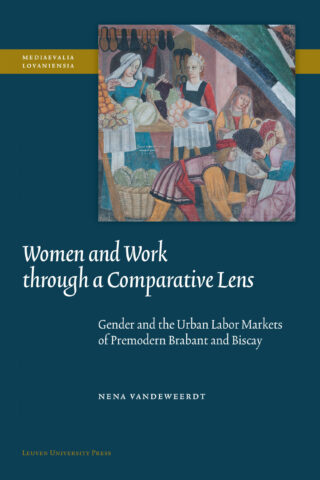

Women and Work through a Comparative Lens
Gender and the Urban Labor Markets of Premodern Brabant and Biscay
Nena Vandeweerdt (Author),

Series: Mediaevalia Lovaniensia 52
Category: Gender Studies, History 500-1500
Language: English
ISBN: 9789462704947
Publication date: December 1, 2025
€29.50 (including 6% VAT)
Buy NowNumber of pages: 250
Size: 234 x 156 x 13 mm
Number of illustrations: 10
Illustrations and other content description:
Illustrated b/w

Funded by: FWO
KU Leuven Fund for Fair Open Access
Open Book Collective
Fonds Lamberts-van Assche
Stock item: 169447
Standard delivery time for print books:
For Belgium: 5 to 8 working days
For EU: 2 to 3 weeks
For other countries: 4 to 5 weeks
Series: Mediaevalia Lovaniensia 52
Category: Gender Studies, History 500-1500
Language: English
ISBN: 9789461666970
Publication date: December 1, 2025
Download Free EpubNumber of pages: 250
Number of illustrations: 10
Illustrations and other content description:
Illustrated b/w
Funded by: FWO
KU Leuven Fund for Fair Open Access
Open Book Collective
Fonds Lamberts-van Assche
Series: Mediaevalia Lovaniensia 52
Category: Gender Studies, History 500-1500
Language: English
ISBN: 9789461666963
Publication date: December 1, 2025
Download Free PDFNumber of pages: 250
Number of illustrations: 10
Illustrations and other content description:
Illustrated b/w
Funded by: FWO
KU Leuven Fund for Fair Open Access
Open Book Collective
Fonds Lamberts-van Assche
Urban Markets and Women’s Labor: Navigating Institutional Boundaries in Premodern Europe
Women played a crucial role in medieval and early modern urban economies, yet their labor opportunities varied greatly depending on local institutions. This book compares the guild-structured labor markets of Antwerp and Mechelen in Brabant with Bilbao’s informal economy in Biscay during the fifteenth and sixteenth centuries. By analyzing these distinct institutional contexts, it offers a multifaceted understanding of women’s economic roles in premodern Europe. Drawing on a wide range of legislative and judicial sources, Vandeweerdt demonstrates how legal frameworks, socioeconomic structures, and individual strategies shaped women’s activities in small-scale trade. Bridging institutional analysis and personal agency, Women and Work through a Comparative Lens sheds new light on the interplay between labor organization and everyday practices in premodern Europe.
List of Figures
List of Tables
Acknowledgements
Abbreviations
A Note on Numbers
Introduction. Comparing Women’s Work
1. Institutions and Their Impact: The Guild Debate
2. “How Society Worked”
3. A North-South Comparison
4. Mapping the Terrain: Biscay and Brabant
Bilbao
Antwerp
Mechelen
5. Sources
6. Chapter Organization
Chapter 1. Tracing Women’s Work
1. Female Labor Sectors, Women’s Work, and Town Ordinances
Bread Trade
Fish Trade
Itinerant Informal Traders
Merchants
Artisan Workers
The Hidden Workforce
2. Women’s Financial Status
3. Conclusion
Chapter 2. Shaping the Framework
1. The Household Economy in Brabant and Biscay
Widows
Spousal Cooperation
Never-Married Household Members
Shifting Away from the Household Paradigm
2. Craft Guilds: The Stronghold of the Brabantine Urban Economy
3. Operating Informally: Main Street or Margins?
4. Conclusion
Chapter 3. Limiting Women’s Work
1. Bilbao’s Council and the “Protection of the Consumer”
2. Brabantine Guilds and Town Councils
Economic Motivations, Gendered Outcomes
The ‘Guild Effect’
3. Growing Restrictions?
4. Conclusion
Chapter 4. Wielding the Framework
1. Influencing Regulation
Wielding Authority
Direct Influence
Consent, Bargaining, and Leverage
2. Going to Court
Biscayan Tradeswomen in Court
Risk-Taking and Forum Shopping
The ‘Poverty Argument’
Group Recognition
3. Conclusion
Understanding Women’s Work
Bibliography
1. Archival sources
Biscay
Brabant
2. Printed sources
Brabant
Biscay
3. Secondary sources
4. Digital sources
Index
The book’s strength is its careful examination of the institutional structures that allowed or restricted women’s access to trade in each setting; in particular, the author exposes how guilds in the southern Netherlands helped determine women’s roles as distributors and producers, thus providing a clear contrast with the situation in Bilbao. This is a valuable contribution to the growing empirical literature concerning women’s work in premodern Europe. - Martha C. Howell, Columbia University
Nena Vandeveert’s study of women’s work in Brabant and Biscay exemplifies the benefits of a comparative approach. This deeply researched volume teases out the multiple forces that impacted women’s work, and offers a nuanced analysis of how institutions (or their absence) and cultural norms in patriarchal societies worked in tandem to constrain women’s participation in local economies. Significantly, this book compliments a growing body of scholarship challenging the longstanding assertion that women in Northern and Southern Europe had markedly different economic opportunities. This close reading of municipal ordinances, court records, and guild membership lists proposes a fresh look at the economic opportunities available to women workers and the various mechanisms that worked to limit those opportunities. - Susan McDonough, University of Maryland, Baltimore County
Vandeweerdt makes an important contribution to the study of women's labor by contrasting urban economic structures in premodern northern Iberia and Belgium. Offering a complex study of lower-class and middling level women's involvement in labor markets, she makes visible women's contributions to small-scale trade and production, especially in informal markets. Her study underscores how premodern women employed a variety of strategies to safeguard their income and could even influence and shape the very regulations that attempted to limit their economic activities. - Michelle Armstrong-Partida, Emory University
Frequently Asked Questions
What is "Women and Work through a Comparative Lens" about?
Urban Markets and Women’s Labor: Navigating Institutional Boundaries in Premodern Europe
Women played a crucial role in medieval and early modern urban economies, yet their labor opportunities varied greatly depending on local institutions. This book compares the guild-structured labor markets of Antwerp and Mechelen in Brabant with Bilbao’s informal economy in Biscay during the fifteenth and sixteenth centuries. By analyzing these distinct institutional contexts, it offers a multifaceted understanding of women’s economic roles in premodern Europe. Drawing on a wide range of legislative and judicial sources, Vandeweerdt demonstrates how legal frameworks, socioeconomic structures, and individual strategies shaped women’s activities in small-scale trade. Bridging institutional analysis and personal agency, Women and Work through a Comparative Lens sheds new light on the interplay between labor organization and everyday practices in premodern Europe.
Who wrote "Women and Work through a Comparative Lens"?
"Women and Work through a Comparative Lens" was written by Nena Vandeweerdt.
Nena Vandeweerdt is a postdoctoral researcher who studies gendered socioeconomic interactions in late medieval and early modern towns. She holds a PhD in History from the KU Leuven and the University of Cantabria. Her work focuses on urban labor markets, everyday life, and the use of digital humanities in historical research.
Is "Women and Work through a Comparative Lens" part of a series?
Yes, "Women and Work through a Comparative Lens" is part of the "Mediaevalia Lovaniensia" series. It's book 52 in the series.

The longstanding, peer-reviewed book series Mediaevalia Lovaniensia. Studies in Medieval History, Society, and Culture publishes high-quality scholarship on the history and culture of the Middle Ages (c. 500–1550). Topics of particular interest to the series include, but are not limited to, social behaviour and power relations in medieval society, processes of identity formation, religious and urban culture, medieval thought and literature, and gender history. The series focuses on Europe and the wider Mediterranean world and is particularly rich in interdisciplinary approaches. By means of monographs and edited volumes, the series explores thematic frontiers and embraces innovative methodological approaches in historical and philological scholarship that is based on an in-depth source-based study.
Mediaevalia Lovaniensia accepts monographs as well as thematically coherent volumes in English. Moreover, it offers scholars the possibility to publish critical editions of primary texts with broader relevance to the understanding of medieval culture and society. The series aspires to publish books that have the potential to become reference works in the field of Medieval Studies.
We encourage early career (postdoctoral) researchers to submit a reworked version of their PhD thesis to this series. Leuven University Press provides authors with two publishing scenarios: traditional (non-Open Access) and the option to publish in Open Access (including language editing).
Editorial Board
Jelle Haemers (KU Leuven)
Jeroen Deploige (Ghent University)
Brigitte Meijns (KU Leuven)
Chanelle Delameillieure (KU Leuven - KULAK)
Baudouin Van den Abeele (UCLouvain)
Proposals
Proposals and enquiries can be sent to one of the editorial board members. Please send a short abstract. Upon approval of the proposal, the full manuscript will be submitted to international blind peer review by two (external) experts. The editors strive towards completing the review of proposals within one month and of complete manuscripts within five months after submission. Manuscripts should preferably be (+/-) 80.000 to 120.000 words in length.
Please make use of the submission form to present your manuscript or proposal to our board.
Authors interested in Open Access can consult the available funding options.
Links & Resources
Is "Women and Work through a Comparative Lens" available Open Access?
Yes, "Women and Work through a Comparative Lens" is published Open Access. It is available under a BY-NC-ND license.
Who funded the publication of "Women and Work through a Comparative Lens"?
Publication of "Women and Work through a Comparative Lens" was funded by FWO
KU Leuven Fund for Fair Open Access
Open Book Collective
Fonds Lamberts-van Assche
.
What is the Table of Contents for "Women and Work through a Comparative Lens"?
List of Figures
List of Tables
Acknowledgements
Abbreviations
A Note on Numbers
Introduction. Comparing Women’s Work
1. Institutions and Their Impact: The Guild Debate
2. “How Society Worked”
3. A North-South Comparison
4. Mapping the Terrain: Biscay and Brabant
Bilbao
Antwerp
Mechelen
5. Sources
6. Chapter Organization
Chapter 1. Tracing Women’s Work
1. Female Labor Sectors, Women’s Work, and Town Ordinances
Bread Trade
Fish Trade
Itinerant Informal Traders
Merchants
Artisan Workers
The Hidden Workforce
2. Women’s Financial Status
3. Conclusion
Chapter 2. Shaping the Framework
1. The Household Economy in Brabant and Biscay
Widows
Spousal Cooperation
Never-Married Household Members
Shifting Away from the Household Paradigm
2. Craft Guilds: The Stronghold of the Brabantine Urban Economy
3. Operating Informally: Main Street or Margins?
4. Conclusion
Chapter 3. Limiting Women’s Work
1. Bilbao’s Council and the “Protection of the Consumer”
2. Brabantine Guilds and Town Councils
Economic Motivations, Gendered Outcomes
The ‘Guild Effect’
3. Growing Restrictions?
4. Conclusion
Chapter 4. Wielding the Framework
1. Influencing Regulation
Wielding Authority
Direct Influence
Consent, Bargaining, and Leverage
2. Going to Court
Biscayan Tradeswomen in Court
Risk-Taking and Forum Shopping
The ‘Poverty Argument’
Group Recognition
3. Conclusion
Understanding Women’s Work
Bibliography
1. Archival sources
Biscay
Brabant
2. Printed sources
Brabant
Biscay
3. Secondary sources
4. Digital sources
Index
What is the DOI for "Women and Work through a Comparative Lens"?
The Digital Object Identifier (DOI) for "Women and Work through a Comparative Lens" is 10.11116/9789461666963.
Related titles

 Margarete Schütte-Lihotzky and the Architecture of Collective Dissidence, 1918–1989
S.E. Eisterer (Author),
April 2027
 Orality and Scribal Culture in the High Middle Ages
Timothy B. Noone (Author), Mark J. Clark (Author),
November 2026
 Feminists Resisting Gendered Violence
Hemangini Gupta (Editor), Fiona Mackay (Editor), Jan Breckenridge (Editor), Louise Chappell (Editor), Rachna Mehra (Editor), Rukmini Sen (Editor), Mailin Suchting (Editor),
October 2026
 The Medieval Aristotle
Nena Bobovnik (Editor), Clelia V. Crialesi (Editor), Lisa Devriese (Editor),
August 2026


 Thomas Aquinas and Hervaeus Natalis on Concepts and Intentional Objects
Fabrizio Amerini (Author),
February 2026
 Architecture & Feminist Critical Theory
Hilde Heynen (Author), Lucía C. Pérez-Moreno (Editor),
November 2025
 Student Notes from Latin Europe (1400–1750)
Xander Feys (Editor), Maxime Maleux (Editor), Andy Peetermans (Editor), Raf Van Rooy (Editor),
May 2025
 Urban Women
Jelle Haemers (Editor), Andrea Bardyn (Editor), Chanelle Delameillieure (Editor),
April 2025
 The Business of Pleasure
Elwin Hofman (Editor), Magaly Rodríguez García (Editor), Pieter Vanhees (Editor),
September 2024




 Black Matrilineage, Photography, and Representation
Lesly Deschler Canossi (Editor), Zoraida Lopez-Diago (Editor),
September 2022