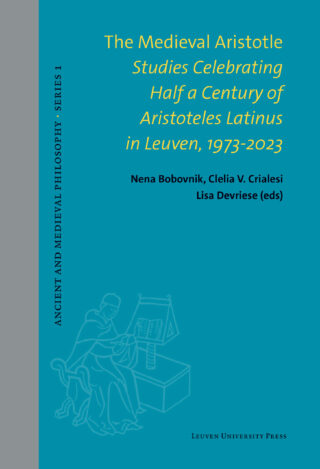

The Medieval Aristotle
Studies Celebrating Half a Century of Aristoteles Latinus in Leuven, 1973-2023
Nena Bobovnik (Editor), Clelia V. Crialesi (Editor), Lisa Devriese (Editor),

Series: Ancient and Medieval Philosophy - Series 1
Category: History 500-1500, Philosophy
Language: English
ISBN: 9789462705272
Publication date: August 17, 2026
€70.00 (including 6% VAT)
Buy NowNumber of pages: 316
Size: 234 x 156 x mm

Funded by: KU Leuven Fund for Fair Open Access
Open Book Collective
Stock item: 173986
Standard delivery time for print books:
For Belgium: 5 to 8 working days
For EU: 2 to 3 weeks
For other countries: 4 to 5 weeks
Series: Ancient and Medieval Philosophy - Series 1
Category: History 500-1500, Philosophy
Language: English
ISBN: 9789461667731
Publication date: August 17, 2026
Download Free EpubNumber of pages: 316
Funded by: KU Leuven Fund for Fair Open Access
Open Book Collective
Series: Ancient and Medieval Philosophy - Series 1
Category: History 500-1500, Philosophy
Language: English
ISBN: 9789461667724
Publication date: August 17, 2026
Download Free PDFNumber of pages: 316
Funded by: KU Leuven Fund for Fair Open Access
Open Book Collective
Inside view of fifty years of the Aristoteles Latinus project, a cornerstone of the study of medieval intellectual history.
For fifty years, the Aristoteles Latinus project has deepened our understanding of how Aristotle entered the Latin Middle Ages. Based in Leuven and rooted in early twentieth-century international collaboration, the Aristoteles Latinus project has traced the complex paths by which Aristotle’s works were translated, read, and transmitted in medieval times. This volume brings together studies first presented at a conference celebrating the fiftieth anniversary of the project’s residence in Leuven and offers leading international scholars’ perspectives on the project’s ongoing work, ranging from manuscript traditions, philology and translation to natural philosophy, logic, metaphysics, and the study of medieval manuscripts. Together, the contributions show how deeply Aristotelian thought permeated medieval intellectual culture and highlight the continued vitality and range of current research on Aristoteles Latinus. The book will be of interest to historians of philosophy, medievalists, and philologists and anyone curious about medieval intellectual life.
Introduction
Nena Bobovnik, Clelia V. Crialesi, and Lisa Devriese
Gigantum umeris insidentes: The Aristoteles Latinus and the Corpus Philosophorum Medii Aevi
Pietro B. Rossi
The Latin Translation of the De mirabilibus auscultationibus by Bartholomew of Messina: Remarks on its Manuscript Transmission and its Greek Sources
Ciro Giacomelli
Doubting Thomas: A Hesitation in Aquinas While Re-reading Aristotle
Andrea Aldo Robiglio
Exploring Aristotle’s Words: The tabulae librorum philosophorum in the ms. Pisa, Bibliotheca Cathariniana, 124 and the Aristotelian Corpus in the Mid-Thirteenth Century
Riccardo Saccenti
The Meaning of Ut excedentia et excessa and the Curious Case of William of Moerbeke’s Translation of Metaphysica 5.15 (1020b26–28)
Stephen M. Metzger
Thirteenth-Century Latin Commentators of the Metaphysica on the Relationship Between Alpha Meizon and Alpha Elatton: A Problem of Translation and Interpretation
Silvia Donati
Aristotle on Being as True in Greek, Arabic, and Latin: Metaphysics Δ.7, 1017a31–35, Across Three Philosophical Traditions
Marta Borgoa, Davide Falessib, and mostafa najafic
The Aristotelian Library of Nicholas of Cusa: The Case of the Metaphysica
Luca Burzelli and Mario Meliadò
Peter of Abano as Reader of Pseudo-Aristotle’s Physiognomonica
Elena Berti
On the Appetite of Plants: Averroean Elements in Commentaries on the De plantis (Thirteenth to Fourteenth Century)
Marilena Panarelli
Aristotelizing Pseudo-Aristotle in Medieval Hebrew Manuscripts of the Book of the Apple (Sefer ha-tapuaḥ)
Ioana Curuț
Index nominum (ante 1800)
Index codicum manu scriptorum
Nena Bobovnik
Nena Bobovnik is a doctoral candidate at the Institute of Philosophy at KU Leuven.
Clelia V. Crialesi
Clelia V. Crialesi is a Marie Skłodowska Curie Fellow at CNRS-SPHERE in Paris, and previously held an FWO postdoctoral fellowship at KU Leuven within the Aristoteles Latinus project.
Lisa Devriese
Lisa Devriese is Assistant Professor at the Institute of Philosophy at KU Leuven and Director of the Aristoteles Latinus project.
Pietro B. Rossi
Ciro Giacomelli
Andrea Aldo Robiglio
Riccardo Saccenti
Stephen M. Metzger
Silvia Donati
Marta Borgo
Davide Falessi
mostafa najafi
Luca Burzelli
Luca Burzelli is postdoctoral researcher in History of Philosophy at the Department of Philosophy of the University of Siegen, and member of the De Wulf-Mansion Centre at the KU Leuven. He received the Thomas Ricklin International Award 2024 for his book ‘Pietro Pomponazzi and the Renaissance Theory of the Elements: A Study with Editions of Unpublished Texts’.
Mario Meliadò
Elena Berti
Marilena Panarelli
Ioana Curut
This volume stands as a fitting tribute to the Aristoteles Latinus project at a pivotal moment in its history. It balances critical retrospection with forward-looking inquiry, offering philological studies and methodological reflections. The complexity of the Aristotelian tradition—transmitted across Greek, Arabic, Hebrew, and Latin—often exceeds the capacity of any single scholar to master fully. The collection is rich in detail and ambitious in scope, and will stimulate further research on the transmission and transformation of Aristotelian thought in the Middle Ages. - Péter Bara, Central European University
Frequently Asked Questions
What is "The Medieval Aristotle" about?
Inside view of fifty years of the Aristoteles Latinus project, a cornerstone of the study of medieval intellectual history.
For fifty years, the Aristoteles Latinus project has deepened our understanding of how Aristotle entered the Latin Middle Ages. Based in Leuven and rooted in early twentieth-century international collaboration, the Aristoteles Latinus project has traced the complex paths by which Aristotle’s works were translated, read, and transmitted in medieval times. This volume brings together studies first presented at a conference celebrating the fiftieth anniversary of the project's residence in Leuven and offers leading international scholars’ perspectives on the project’s ongoing work, ranging from manuscript traditions, philology and translation to natural philosophy, logic, metaphysics, and the study of medieval manuscripts. Together, the contributions show how deeply Aristotelian thought permeated medieval intellectual culture and highlight the continued vitality and range of current research on Aristoteles Latinus. The book will be of interest to historians of philosophy, medievalists, and philologists and anyone curious about medieval intellectual life.
Who wrote "The Medieval Aristotle"?
"The Medieval Aristotle" was written by Pietro B. Rossi, Ciro Giacomelli, Andrea Aldo Robiglio, Riccardo Saccenti, Stephen M. Metzger, Silvia Donati, Marta Borgo, Davide Falessi, mostafa najafi, Luca Burzelli, Mario Meliadò, Elena Berti, Marilena Panarelli and Ioana Curut.
Luca Burzelli is postdoctoral researcher in History of Philosophy at the Department of Philosophy of the University of Siegen, and member of the De Wulf-Mansion Centre at the KU Leuven. He received the Thomas Ricklin International Award 2024 for his book ‘Pietro Pomponazzi and the Renaissance Theory of the Elements: A Study with Editions of Unpublished Texts’.
Who edited "The Medieval Aristotle"?
"The Medieval Aristotle" was edited by Nena Bobovnik, Clelia V. Crialesi and Lisa Devriese.
Nena Bobovnik is a doctoral candidate at the Institute of Philosophy at KU Leuven.
Clelia V. Crialesi is a Marie Skłodowska Curie Fellow at CNRS-SPHERE in Paris, and previously held an FWO postdoctoral fellowship at KU Leuven within the Aristoteles Latinus project.
Lisa Devriese is Assistant Professor at the Institute of Philosophy at KU Leuven and Director of the Aristoteles Latinus project.
Is "The Medieval Aristotle" part of a series?
Yes, "The Medieval Aristotle" is part of the "Ancient and Medieval Philosophy - Series 1" series.
Ancient and Medieval Philosophy - Series 1 presents state-of-the-art research on the history of Western thought from its origins to the beginnings of modernity.
In association with The De Wulf-Mansion Centre.


About the Series
The series' focus lies primarily on the continuity and thematic transitions between ancient, medieval and renaissance thought, but also includes volumes on specific topics related to any of those periods. ‘Philosophy' is understood broadly to include metaphysics, ethics, natural philosophy, epistemology and philosophy of mind, and philosophical theology. Since the series is particularly devoted to making available Latin and Greek source texts, we welcome critical text editions as well as contributions that are based on philological scrutiny of those texts, without losing sight of their philosophical importance.
Ancient and Medieval Philosophy - Series 1 aims to publish at least two volumes a year and accepts monographs as well as thematically coherent edited volumes in English (without excluding the possibility of French, German, or Italian contributions to edited volumes). Manuscripts should be 80.000 to 120.000 words in length.
Readership
Researchers and graduate students in ancient, medieval and renaissance philosophy, in classics and in history.
Editorial Coordinator
Russell Friedman, KU Leuven, Belgium
Editorial Board
Pieter Beullens, KU Leuven, Belgium
Lisa Devriese, KU Leuven, Belgium
Pieter d'Hoine, KU Leuven, Belgium
Jan Opsomer, KU Leuven, Belgium
Jenny Pelletier, KU Leuven, Belgium
Andrea Robiglio, KU Leuven, Belgium
Carlos Steel, KU Leuven, Belgium
Gerd Van Riel, KU Leuven, Belgium
Advisory Board
Brad Inwood, Yale Universityo, USA
Jill Kraye, The Warburg Institute, London, United Kingdom
John Marenbon, University of Cambridge, United Kingdom
Lodi Nauta, University of Groningen, The Netherlands
Timothy Noone (†) , The Catholic University of America, USA
Robert Pasnau, University of Colorado at Boulder, USA
Martin Pickavé, University of Toronto, Canada,
Pasquale Porro, Università degli Studi di Milano, Italy
Geert Roskam, KU Leuven, Belgium
Proposals
Proposals and enquiries can be sent to editorial coordinator Russell L. Friedman. Please send a preliminary abstract (3-4 pp.) and a short bio. Upon approval of this abstract, the full manuscript will be submitted to international peer review.
Please make use of the submission form to present the full manuscript to our board.
Authors interested in Open Access can consult the available funding options.
Links & Resources
Is "The Medieval Aristotle" available Open Access?
Yes, "The Medieval Aristotle" is published Open Access. It is available under a BY-NC-ND license.
Who funded the publication of "The Medieval Aristotle"?
Publication of "The Medieval Aristotle" was funded by KU Leuven Fund for Fair Open Access
Open Book Collective
.
What is the Table of Contents for "The Medieval Aristotle"?
Introduction
Nena Bobovnik, Clelia V. Crialesi, and Lisa Devriese
Gigantum umeris insidentes: The Aristoteles Latinus and the Corpus Philosophorum Medii Aevi
Pietro B. Rossi
The Latin Translation of the De mirabilibus auscultationibus by Bartholomew of Messina: Remarks on its Manuscript Transmission and its Greek Sources
Ciro Giacomelli
Doubting Thomas: A Hesitation in Aquinas While Re-reading Aristotle
Andrea Aldo Robiglio
Exploring Aristotle’s Words: The tabulae librorum philosophorum in the ms. Pisa, Bibliotheca Cathariniana, 124 and the Aristotelian Corpus in the Mid-Thirteenth Century
Riccardo Saccenti
The Meaning of Ut excedentia et excessa and the Curious Case of William of Moerbeke’s Translation of Metaphysica 5.15 (1020b26–28)
Stephen M. Metzger
Thirteenth-Century Latin Commentators of the Metaphysica on the Relationship Between Alpha Meizon and Alpha Elatton: A Problem of Translation and Interpretation
Silvia Donati
Aristotle on Being as True in Greek, Arabic, and Latin: Metaphysics Δ.7, 1017a31–35, Across Three Philosophical Traditions
Marta Borgoa, Davide Falessib, and mostafa najafic
The Aristotelian Library of Nicholas of Cusa: The Case of the Metaphysica
Luca Burzelli and Mario Meliadò
Peter of Abano as Reader of Pseudo-Aristotle’s Physiognomonica
Elena Berti
On the Appetite of Plants: Averroean Elements in Commentaries on the De plantis (Thirteenth to Fourteenth Century)
Marilena Panarelli
Aristotelizing Pseudo-Aristotle in Medieval Hebrew Manuscripts of the Book of the Apple (Sefer ha-tapuaḥ)
Ioana Curuț
Index nominum (ante 1800)
Index codicum manu scriptorum
What is the DOI for "The Medieval Aristotle"?
The Digital Object Identifier (DOI) for "The Medieval Aristotle" is 10.11116/9789461667731.
Related titles
 Orality and Scribal Culture in the High Middle Ages
Timothy B. Noone (Author), Mark J. Clark (Author),
November 2026
 Summa (Quaestiones ordinariae) art. LXXIII – LXXV
Henry of Ghent (Author), Gordon Wilson (Editor), Juan Carlos Flores (Editor),
September 2026
 Thomas Aquinas and Hervaeus Natalis on Concepts and Intentional Objects
Fabrizio Amerini (Author),
February 2026
 Student Notes from Latin Europe (1400–1750)
Xander Feys (Editor), Maxime Maleux (Editor), Andy Peetermans (Editor), Raf Van Rooy (Editor),
May 2025
 Urban Women
Jelle Haemers (Editor), Andrea Bardyn (Editor), Chanelle Delameillieure (Editor),
April 2025
 Epicureanism and Scientific Debates. Epicurean Tradition and its Ancient Reception
Francesca Masi (Editor), Pierre-Marie Morel (Editor), Francesco Verde (Editor),
January 2025

 Quaestiones de divinis praedicamentis XXVIII-XXXII
James of Viterbo (Author), Mark D. Gossiaux (Editor), Christopher D. Schabel (Editor),
June 2024
 Summa (Quaestiones ordinariae) art. LXIII-LXVII
Henry of Ghent (Author), Gordon Wilson (Editor), Girard Etzkorn (Editor), Bernd Goehring (Editor), Linda N. Etzkorn (Assisted by),
February 2024
 Epicureanism and Scientific Debates. Antiquity and Late Reception
Francesca Masi (Editor), Pierre-Marie Morel (Editor), Francesco Verde (Editor),
August 2023
 Questiones super I-VII libros Politicorum
Peter of Auvergne (Author), Marco Toste (Editor),
December 2022