

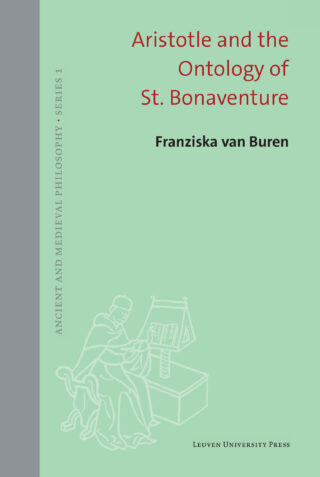

Aristotle and the Ontology of St. Bonaventure
Franziska van Buren (Author),

Series: Ancient and Medieval Philosophy - Series 1 63
Category: Philosophy
Language: English
ISBN: 9789462703568
Publication date: April 5, 2023
€49.50 (including 6% VAT)
Buy NowNumber of pages: 226
Size: 234 x 156 x 12 mm

Funded by: ERC
KU Leuven Fund for Fair Open Access
Stock item: 153776
Standard delivery time for print books:
For Belgium: 5 to 8 working days
For EU: 2 to 3 weeks
For other countries: 4 to 5 weeks
Series: Ancient and Medieval Philosophy - Series 1 63
Category: Philosophy
Language: English
ISBN: 9789461664907
Publication date: April 3, 2023
Download Free EpubNumber of pages: 226
Funded by: ERC
KU Leuven Fund for Fair Open Access
Series: Ancient and Medieval Philosophy - Series 1 63
Category: Philosophy
Language: English
ISBN: 9789461664884
Publication date: March 17, 2023
Download Free PDFNumber of pages: 226
Funded by: ERC
KU Leuven Fund for Fair Open Access
Bonaventure’s metaphysical thought and
his interpretation of Aristotle
Contemporary scholarship on Bonaventure has characterized him as the Neo-platonic foil to the Aristotelianism of his day. The present book, however, shows a Bonaventure who is highly enthusiastic about utilizing the philosophy of Aristotle and who centers much of his philosophical project around interpreting and understanding the texts of Aristotle. Two goals are central to this book. The first is to shed light on Bonaventure’s greatly understudied ontology and theory of forms, demonstrating how his philosophical system is an important and unique alternative to other medieval Aristotelian systems. The second is to establish, more broadly, how Bonaventure’s interpretation of Aristotle is a resource which should be mined for contemporary efforts in thinking about and reading Aristotle himself.
Ebook available in Open Access.
This publication is GPRC-labeled (Guaranteed Peer-Reviewed Content).
Acknowledgements
Abbreviations for Editions and Translations of Primary Texts
Introduction Chapter 1. Historical Background 1. The Neoplatonic via Proclus: The One and the Many 2. The Problem of Neoplatonism in the Christian Tradition 3. Aristotle via Avicenna and the Early Franciscan Tradition, or What Exactly Is Aristotelianism?
Chapter 2. The Theory of Forms in Thomas Aquinas 1. The Structure of Creation 2. Participation 3. Participation in the Fourth Way? 4. Participation in Exemplar Causes? 5. Conclusion
Chapter 3. The Controversy: Bonaventure and Aristotle 1. History of Scholarship on Bonaventure 2. The “Anti-Aristotelianism” of the Collationes
Chapter 4. An Aristotelian Account of Universals 1. Form, Esse, Actuality, Goodness 2. Universal Forms and Seminal Reasons 3. Universals 4. Conclusion
Chapter 5. Forms as Caused by God 1. God Beyond Being 2. Exemplar Causation 3. A Multiplicity of Ideas? 4. Conclusion
Chapter 6. Forms in the Natural World 1. Individuation 2. Light and the Question of a Plurality of Substantial Forms 3. Causation 4. Evil 5. Conclusion
Conclusion
Bibliography Primary Sources Secondary Sources
Index
Van Buren’s work makes an impressive contribution to Bonaventure scholarship, which could really reset the whole debate and narrative. It will challenge the historical norms for many a reader and interpreter of Bonaventure—perhaps, also of Aristotle! Indeed, this work will upend some deeply entrenched historical narratives that have proven a major obstacle for understanding Bonaventure as a philosopher. Christopher M. Cullen, Fordham University
The radical nature of her proposal is likely to give rise to new and fruitful exchanges on the philosophy of Saint Bonaventure. Laure Solignac, Speculum 99/1 (January 2024), https://www.journals.uchicago.edu/doi/10.1086/728179
Well written, coherently argued, and intellectually stimulating, van Buren’s study is an impressive piece of scholarship, one, it should be noted, that, on account of its lucid nature, is as accessible to students as it is to established academics. Regardless of whether one accepts her attempts to significantly reposition Bonaventure’s relationship to Aristotle, it is to be hoped that van Buren’s study will at least help generate a new wave of interest in the highly important, although much neglected, study of Bonaventure’s metaphysics and the place that he occupied in the complex landscape of thirteenth century attempts to understand and critically appropriate Peripatetic thought. - William Crozier, The Journal of Religion, Volume 104, Number 3, July 2024, https://doi.org/10.1086/730361
Frequently Asked Questions
What is "Aristotle and the Ontology of St. Bonaventure" about?
Bonaventure’s metaphysical thought and
his interpretation of Aristotle
Contemporary scholarship on Bonaventure has characterized him as the Neo-platonic foil to the Aristotelianism of his day. The present book, however, shows a Bonaventure who is highly enthusiastic about utilizing the philosophy of Aristotle and who centers much of his philosophical project around interpreting and understanding the texts of Aristotle. Two goals are central to this book. The first is to shed light on Bonaventure’s greatly understudied ontology and theory of forms, demonstrating how his philosophical system is an important and unique alternative to other medieval Aristotelian systems. The second is to establish, more broadly, how Bonaventure’s interpretation of Aristotle is a resource which should be mined for contemporary efforts in thinking about and reading Aristotle himself.
Ebook available in Open Access.
This publication is GPRC-labeled (Guaranteed Peer-Reviewed Content).
Who wrote "Aristotle and the Ontology of St. Bonaventure"?
"Aristotle and the Ontology of St. Bonaventure" was written by Franziska van Buren.
Franziska van Buren is a post-doctoral researcher in ancient philosophy at KU Leuven.
Is "Aristotle and the Ontology of St. Bonaventure" part of a series?
Yes, "Aristotle and the Ontology of St. Bonaventure" is part of the "Ancient and Medieval Philosophy - Series 1" series. It's book 63 in the series.
Ancient and Medieval Philosophy - Series 1 presents state-of-the-art research on the history of Western thought from its origins to the beginnings of modernity.
In association with The De Wulf-Mansion Centre.


About the Series
The series' focus lies primarily on the continuity and thematic transitions between ancient, medieval and renaissance thought, but also includes volumes on specific topics related to any of those periods. ‘Philosophy' is understood broadly to include metaphysics, ethics, natural philosophy, epistemology and philosophy of mind, and philosophical theology. Since the series is particularly devoted to making available Latin and Greek source texts, we welcome critical text editions as well as contributions that are based on philological scrutiny of those texts, without losing sight of their philosophical importance.
Ancient and Medieval Philosophy - Series 1 aims to publish at least two volumes a year and accepts monographs as well as thematically coherent edited volumes in English (without excluding the possibility of French, German, or Italian contributions to edited volumes). Manuscripts should be 80.000 to 120.000 words in length.
Readership
Researchers and graduate students in ancient, medieval and renaissance philosophy, in classics and in history.
Editorial Coordinator
Russell Friedman, KU Leuven, Belgium
Editorial Board
Pieter Beullens, KU Leuven, Belgium
Lisa Devriese, KU Leuven, Belgium
Pieter d'Hoine, KU Leuven, Belgium
Jan Opsomer, KU Leuven, Belgium
Jenny Pelletier, KU Leuven, Belgium
Andrea Robiglio, KU Leuven, Belgium
Carlos Steel, KU Leuven, Belgium
Gerd Van Riel, KU Leuven, Belgium
Advisory Board
Brad Inwood, Yale Universityo, USA
Jill Kraye, The Warburg Institute, London, United Kingdom
John Marenbon, University of Cambridge, United Kingdom
Lodi Nauta, University of Groningen, The Netherlands
Timothy Noone (†) , The Catholic University of America, USA
Robert Pasnau, University of Colorado at Boulder, USA
Martin Pickavé, University of Toronto, Canada,
Pasquale Porro, Università degli Studi di Milano, Italy
Geert Roskam, KU Leuven, Belgium
Proposals
Proposals and enquiries can be sent to editorial coordinator Russell L. Friedman. Please send a preliminary abstract (3-4 pp.) and a short bio. Upon approval of this abstract, the full manuscript will be submitted to international peer review.
Please make use of the submission form to present the full manuscript to our board.
Authors interested in Open Access can consult the available funding options.
Links & Resources
Is "Aristotle and the Ontology of St. Bonaventure" available Open Access?
Yes, "Aristotle and the Ontology of St. Bonaventure" is published Open Access. It is available under a BY-NC-ND license.
Who funded the publication of "Aristotle and the Ontology of St. Bonaventure"?
Publication of "Aristotle and the Ontology of St. Bonaventure" was funded by ERC
KU Leuven Fund for Fair Open Access
.
What is the Table of Contents for "Aristotle and the Ontology of St. Bonaventure"?
Acknowledgements
Abbreviations for Editions and Translations of Primary Texts
Introduction Chapter 1. Historical Background 1. The Neoplatonic via Proclus: The One and the Many 2. The Problem of Neoplatonism in the Christian Tradition 3. Aristotle via Avicenna and the Early Franciscan Tradition, or What Exactly Is Aristotelianism?
Chapter 2. The Theory of Forms in Thomas Aquinas 1. The Structure of Creation 2. Participation 3. Participation in the Fourth Way? 4. Participation in Exemplar Causes? 5. Conclusion
Chapter 3. The Controversy: Bonaventure and Aristotle 1. History of Scholarship on Bonaventure 2. The “Anti-Aristotelianism” of the Collationes
Chapter 4. An Aristotelian Account of Universals 1. Form, Esse, Actuality, Goodness 2. Universal Forms and Seminal Reasons 3. Universals 4. Conclusion
Chapter 5. Forms as Caused by God 1. God Beyond Being 2. Exemplar Causation 3. A Multiplicity of Ideas? 4. Conclusion
Chapter 6. Forms in the Natural World 1. Individuation 2. Light and the Question of a Plurality of Substantial Forms 3. Causation 4. Evil 5. Conclusion
Conclusion
Bibliography Primary Sources Secondary Sources
Index
Related titles

 Orality and Scribal Culture in the High Middle Ages
Timothy B. Noone (Author), Mark J. Clark (Author),
November 2026
 Summa (Quaestiones ordinariae) art. LXXIII – LXXV
Henry of Ghent (Author), Gordon Wilson (Editor), Juan Carlos Flores (Editor),
September 2026
 The Medieval Aristotle
Nena Bobovnik (Editor), Clelia V. Crialesi (Editor), Lisa Devriese (Editor),
August 2026
 Thomas Aquinas and Hervaeus Natalis on Concepts and Intentional Objects
Fabrizio Amerini (Author),
February 2026
 Epicureanism and Scientific Debates. Epicurean Tradition and its Ancient Reception
Francesca Masi (Editor), Pierre-Marie Morel (Editor), Francesco Verde (Editor),
January 2025

 Quaestiones de divinis praedicamentis XXVIII-XXXII
James of Viterbo (Author), Mark D. Gossiaux (Editor), Christopher D. Schabel (Editor),
June 2024
 Summa (Quaestiones ordinariae) art. LXIII-LXVII
Henry of Ghent (Author), Gordon Wilson (Editor), Girard Etzkorn (Editor), Bernd Goehring (Editor), Linda N. Etzkorn (Assisted by),
February 2024
 Epicureanism and Scientific Debates. Antiquity and Late Reception
Francesca Masi (Editor), Pierre-Marie Morel (Editor), Francesco Verde (Editor),
August 2023
 Questiones super I-VII libros Politicorum
Peter of Auvergne (Author), Marco Toste (Editor),
December 2022


 Neo-Thomism in Action
Wim Decock (Editor), Bart Raymaekers (Editor), Peter Heyrman (Editor),
December 2021