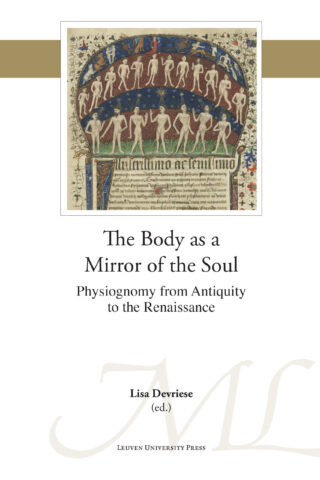
The Body as a Mirror of the Soul
Physiognomy from Antiquity to the Renaissance
Lisa Devriese (Editor),
Series: Mediaevalia Lovaniensia 50
Category: History, History 500-1500, Philosophy
Language: English
ISBN: 9789462702929
Publication date: October 5, 2021
€49.50 (including 6% VAT)
Buy NowNumber of pages: 232
Size: 234 x 156 x 12 mm
Number of illustrations: 20
Illustrations and other content description:
Illustrated b/w

Stock item: 144217
Standard delivery time for print books:
For Belgium: 5 to 8 working days
For EU: 2 to 3 weeks
For other countries: 4 to 5 weeks
Series: Mediaevalia Lovaniensia 50
Category: History, History 500-1500, Philosophy
Language: English
ISBN: 9789461664075
Publication date: October 5, 2021
€37.00 (including 6% VAT)
Buy NowNumber of pages: 232
Number of illustrations: 20
Illustrations and other content description:
Illustrated b/w
Physiognomy, the history of racial classifications, and the interplay between natural philosophy, medicine, and ethicsThe idea of the body as a mirror of the soul has fascinated mankind throughout history. Being able to see through an individual, and drawing conclusions on their character solely based on a selection of external features, is the subject of physiognomy, and has a long tradition running well into recent times. However, the pre-modern, especially medieval background of this discipline has remained underexplored. The selected case studies in this volume each contribute to a better understanding of the history of physiognomy from antiquity to the Renaissance, and offer discussions on unedited treatises and on the application, development, and reception of this field of knowledge, as well as on visual sources inspired by physiognomic theory.
Contributors: Enikő Békés (Hungarian Academy of Sciences), Joël Biard (University of Tours), Lisa Devriese (KU Leuven), Maria Fernanda Ferrini (University of Macerata), Christophe Grellard (École Pratique des Hautes Études), Luís Campos Ribeiro (University of Lisbon), Maria Michela Sassi (University of Pisa), Oleg Voskoboynikov (Higher School of Economics Moscow), Steven J. Williams (New Mexico Highlands University), Joseph Ziegler (University of Haifa), Gabriella Zuccolin (University of Pavia)
This publication is GPRC-labeled (Guaranteed Peer-Reviewed Content).
Illustrations Acknowledgements
Lisa Devriese Physiognomy from Antiquity to the Renaissance : an Introduction
Maria Michela Sassi The Beginnings of Physiognomy in Ancient Greece
Maria Fernanda Ferrini Oἰνωποί/Aἰγωποί: Manuscript Tradition and Conjecture
Enikő Békés The Physiognomy of Apostle Paul: Between Texts and Images
Steven J. Williams Some Observations on the Scholarly Reception of Physiognomy in the Thirteenth and Early Fourteenth Century: Success, and the Limits of Success
Lisa Devriese First Medieval Attestations of the Physiognomonica
Oleg Voskoboynikov Michael Scotus’ Physiognomy: Notes on Text and Context
Joël Biard and Christophe Grellard La place des Questiones circa librum de physionomia dans le système philosophique de Jean Buridan
Gabriella Zuccolin Towards a Critical Edition of Michele Savonarola’s Speculum Physionomie
Joseph Ziegler and Luís Campos Ribeiro Astral Physiognomy in the Fifteenth Century : the Case of the Illuminated Opening Folio of Rolandus Scriptoris’ Reductorium Phisonomie
Notes on Contributors Index codicum manu scriptorum Index nominum
Lisa Devriese
Lisa Devriese is Assistant Professor at the Institute of Philosophy at KU Leuven and Director of the Aristoteles Latinus project.
This careful and deeply researched volume absolutely highlights the richness of early physiognomic thought while offering methodological interventions around how to navigate limited sources. It is a robust chronological framing that combines historical, textual, and literary analysis, visual culture, anthropology, and translation studies to anchor medieval and Renaissance physiognomy both in antiquity and modern discourse. The book emerged from a conference; such an approach is often organized more around topic than theme and argument. The editor does an excellent job framing the texts in a way that is both coherent and cross-cutting, while at the same time allowing the chapters to stand alone as scholarly and pedagogical interventions, offering methodological and historical insights. Clear and cogent, this volume is accessible while remaining robust and rich; scholars will be taking up its provocations for many years to come.
Sharrona Pearl, Isis, Volume 114, Number 1, March 2023 https://doi.org/10.1086/723688
Assurément, le lecteur reste fasciné par les très nombreux aspects des cultures antique, médiévale et moderne que le sujet permet d’aborder : les contributions, tout en étant d’un niveau scientifique très élevé, restent tout à fait abordables. La force de ce recueil est d’offrir une approche chronologique qui facilite une compréhension globale des questionnements sur la physiognomonie. En effet, les AA. parviennent bien à mettre en avant tout ce que son étude peut offrir et réussissent conjointement à livrer une excellente introduction interdisciplinaire et transpériodique. Ninon Dubourg, Revue d'Histoire ecclésiastique, vol. 117/3-4, 2022
Le miroir est-il le reflet de l’âme? Depuis l’Antiquité, les auteurs spécialistes du savoir qu’on appelle physiognomonie en sont persuadés : un rapport d’expressivité unit le corps et l’âme, et laisse transparaître à travers les particularités physiques d’un individu, ses aptitudes intellectuelles et surtout son caractère. L’objet de cet ouvrage, suite de dix études réunies et préfacées par Lisa Devriese, est d’examiner la tradition textuelle propre à cette discipline jusqu’au XVIIe s. Distribuées selon la chronologie, les contributions envisagent, principalement, les textes eux-mêmes et leur réception. Deux interventions sont consacrées à l’influence ou aux reflets dans l’image, de la tradition physiognomonique. Une alternance fait se succéder des études à visées générales et d’autres plus ponctuelles : on apprécie ce parti. - N. Laneyrie-Dagen, Scriptorium 2022
Le travail de recherche a interrogé la légitimité du statut singulier de cette discipline, pour la distinguer de la philosophie, la médecine, l’éthique ou la psychologie, et éprouvé le rayonnement et l’autorité du traité pseudo-aristotélicien Physiognomonica de Bartholomée de Messine (xiiie siècle), dans l’histoire des textes et des idées, au côté de quatre autres traités physiognomoniques antérieurs influents, tout au long des périodes étudiées : l’usuel de Polémon aujourd’hui perdu, la compilation latine anonyme sur la physiognomonie synthétisant les apports de Loxus, Aristote et Polémon du ive siècle, le manuel de médecine de l’auteur arabe Rhazes (Liber ad Almansorem, ixe siècle) traduit en latin par Gérard de Crémone, et le texte arabe du Secretum secretorum (xe siècle), largement diffusé dans l’Occident latinophone médiéval. - Alice Lamy, « Comptes rendus », Le Moyen Age, 2023/2 (Tome CXXIX), p. 533a-653a. DOI : 10.3917/rma.292.0533a. URL : https://www.cairn.info/revue-le-moyen-age-2023-2-page-533a.htm
Frequently Asked Questions
What is "The Body as a Mirror of the Soul" about?
Physiognomy, the history of racial classifications, and the interplay between natural philosophy, medicine, and ethicsThe idea of the body as a mirror of the soul has fascinated mankind throughout history. Being able to see through an individual, and drawing conclusions on their character solely based on a selection of external features, is the subject of physiognomy, and has a long tradition running well into recent times. However, the pre-modern, especially medieval background of this discipline has remained underexplored. The selected case studies in this volume each contribute to a better understanding of the history of physiognomy from antiquity to the Renaissance, and offer discussions on unedited treatises and on the application, development, and reception of this field of knowledge, as well as on visual sources inspired by physiognomic theory.
Contributors: Enikő Békés (Hungarian Academy of Sciences), Joël Biard (University of Tours), Lisa Devriese (KU Leuven), Maria Fernanda Ferrini (University of Macerata), Christophe Grellard (École Pratique des Hautes Études), Luís Campos Ribeiro (University of Lisbon), Maria Michela Sassi (University of Pisa), Oleg Voskoboynikov (Higher School of Economics Moscow), Steven J. Williams (New Mexico Highlands University), Joseph Ziegler (University of Haifa), Gabriella Zuccolin (University of Pavia)
This publication is GPRC-labeled (Guaranteed Peer-Reviewed Content).
Who edited "The Body as a Mirror of the Soul"?
"The Body as a Mirror of the Soul" was edited by Lisa Devriese.
Lisa Devriese is Assistant Professor at the Institute of Philosophy at KU Leuven and Director of the Aristoteles Latinus project.
Is "The Body as a Mirror of the Soul" part of a series?
Yes, "The Body as a Mirror of the Soul" is part of the "Mediaevalia Lovaniensia" series. It's book 50 in the series.

The longstanding, peer-reviewed book series Mediaevalia Lovaniensia. Studies in Medieval History, Society, and Culture publishes high-quality scholarship on the history and culture of the Middle Ages (c. 500–1550). Topics of particular interest to the series include, but are not limited to, social behaviour and power relations in medieval society, processes of identity formation, religious and urban culture, medieval thought and literature, and gender history. The series focuses on Europe and the wider Mediterranean world and is particularly rich in interdisciplinary approaches. By means of monographs and edited volumes, the series explores thematic frontiers and embraces innovative methodological approaches in historical and philological scholarship that is based on an in-depth source-based study.
Mediaevalia Lovaniensia accepts monographs as well as thematically coherent volumes in English. Moreover, it offers scholars the possibility to publish critical editions of primary texts with broader relevance to the understanding of medieval culture and society. The series aspires to publish books that have the potential to become reference works in the field of Medieval Studies.
We encourage early career (postdoctoral) researchers to submit a reworked version of their PhD thesis to this series. Leuven University Press provides authors with two publishing scenarios: traditional (non-Open Access) and the option to publish in Open Access (including language editing).
Editorial Board
Jelle Haemers (KU Leuven)
Jeroen Deploige (Ghent University)
Brigitte Meijns (KU Leuven)
Chanelle Delameillieure (KU Leuven - KULAK)
Baudouin Van den Abeele (UCLouvain)
Proposals
Proposals and enquiries can be sent to one of the editorial board members. Please send a short abstract. Upon approval of the proposal, the full manuscript will be submitted to international blind peer review by two (external) experts. The editors strive towards completing the review of proposals within one month and of complete manuscripts within five months after submission. Manuscripts should preferably be (+/-) 80.000 to 120.000 words in length.
Please make use of the submission form to present your manuscript or proposal to our board.
Authors interested in Open Access can consult the available funding options.
Links & Resources
What is the Table of Contents for "The Body as a Mirror of the Soul"?
Illustrations Acknowledgements
Lisa Devriese Physiognomy from Antiquity to the Renaissance : an Introduction
Maria Michela Sassi The Beginnings of Physiognomy in Ancient Greece
Maria Fernanda Ferrini Oἰνωποί/Aἰγωποί: Manuscript Tradition and Conjecture
Enikő Békés The Physiognomy of Apostle Paul: Between Texts and Images
Steven J. Williams Some Observations on the Scholarly Reception of Physiognomy in the Thirteenth and Early Fourteenth Century: Success, and the Limits of Success
Lisa Devriese First Medieval Attestations of the Physiognomonica
Oleg Voskoboynikov Michael Scotus’ Physiognomy: Notes on Text and Context
Joël Biard and Christophe Grellard La place des Questiones circa librum de physionomia dans le système philosophique de Jean Buridan
Gabriella Zuccolin Towards a Critical Edition of Michele Savonarola’s Speculum Physionomie
Joseph Ziegler and Luís Campos Ribeiro Astral Physiognomy in the Fifteenth Century : the Case of the Illuminated Opening Folio of Rolandus Scriptoris’ Reductorium Phisonomie
Notes on Contributors Index codicum manu scriptorum Index nominum
Related titles


 Orality and Scribal Culture in the High Middle Ages
Timothy B. Noone (Author), Mark J. Clark (Author),
November 2026
 Toekomstdromen
Maarten Van Dijck (Editor), Gerrit Verhoeven (Editor), Hans Cools (Editor),
November 2026

 Summa (Quaestiones ordinariae) art. LXXIII – LXXV
Henry of Ghent (Author), Gordon Wilson (Editor), Juan Carlos Flores (Editor),
September 2026
 The Medieval Aristotle
Nena Bobovnik (Editor), Clelia V. Crialesi (Editor), Lisa Devriese (Editor),
August 2026

 Trend en toeval – vierde editie
Bruno Blondé (Author), Isabelle Devos (Author), Jord Hanus (Author), Wouter Ryckbosch (Author),
August 2026


 Political Exile in the Global Twentieth Century
Wolfram Kaiser (Editor), Piotr H. Kosicki (Editor),
April 2026
 Christian Democracy and the Fall of Communism
Michael Gehler (Editor), Piotr H. Kosicki (Editor), Helmut Wohnout (Editor),
April 2026
 Brusselse plaatsnamen
Iadine Degryse (Editor), Benjamin Wayens (Editor), Chantal Kesteloot (Editor), Dennis De Vriese (Editor), Matthijs Degraeve (Editor),
April 2026

 Cartographies of Catastrophes
Laura Demeter (Editor), Carmen M. Enss (Editor), Piotr Kisiel (Editor), Carol Ludwig (Editor),
February 2026
 Thomas Aquinas and Hervaeus Natalis on Concepts and Intentional Objects
Fabrizio Amerini (Author),
February 2026