

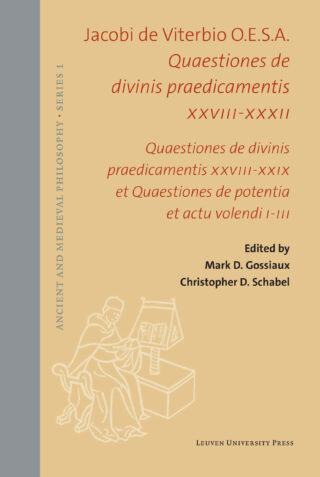
Quaestiones de divinis praedicamentis XXVIII-XXXII
Quaestiones de divinis praedicamentis XXVIII-XXIX et Quaestiones de potentia et actu volendi I-III
James of Viterbo (Author), Mark D. Gossiaux (Editor), Christopher D. Schabel (Editor),
Series: Ancient and Medieval Philosophy - Series 1 65
Category: Philosophy
Language: English
ISBN: 9789462703919
Publication date: June 10, 2024
€86.00 (including 6% VAT)
Buy NowNumber of pages: 250
Size: 234 x 156 x 17 mm

Stock item: 160709
Standard delivery time for print books:
For Belgium: 5 to 8 working days
For EU: 2 to 3 weeks
For other countries: 4 to 5 weeks
Series: Ancient and Medieval Philosophy - Series 1 65
Category: Philosophy
Language: English
ISBN: 9789461665362
Publication date: June 10, 2024
€73.00 (including 6% VAT)
Buy NowNumber of pages: 250
Critical edition of James of Viterbo’s final questions De divinis praedicamentis and his De potentia et actu volendi
James of Viterbo (ca. 1255–1307), Augustinian friar, master of theology at the University of Paris, and archbishop of Naples, was one of the leading philosophers and theologians of the late thirteenth century. This volume completes the critical edition of his academic works and presents his last two questions De divinis praedicamentis and his three annexed questions on the will (De potentia et actu volendi). These questions, deriving from disputations James held as Augustinian regent master of theology at the University of Paris (1293–1297), offer rich discussions of important topics: whether the plurality of divine persons and attributes entails an order of priority within God and how causality may be attributed to God. The questions on the will cover issues at the core of late medieval debates on human freedom: on the unity of the will as a power of the soul, whether the will is the primary agent in human action, and whether the will is free with respect to all its acts.
This publication is GPRC-labeled (Guaranteed Peer-Reviewed Content).
Preface
General Introduction (Chris Schabel)
The Life of James of Viterbo
The Date and Genre of the Questions De divinis praedicamentis
The Manuscripts
Differing Sequences of Questions
The Manuscript Tradition According to Ypma
Questions 28-29: The Last of the Original Questions De divinis praedicamentis
Questions 30-32: James of Viterbo’s Quaestiones de potentia et actu volendi
Doctrinal Introduction (Mark D. Gossiaux)
The Nature and Purpose of the Quaestiones de divinis praedicamentis
Question 28
Question 29
The Quaestiones de potentia et actu volendi
Question 30
Question 31
Question 32
Concluding Remarks
Technique of the edition
Quaestiones de divinis praedicamentis
Quaestio 28: Utrum in Deo sit prius et posterius secundum aliquem modum
Quaestio 29: Utrum causa dicatur de Deo secundum omnes eius species et modos
Quaestiones de potentia et actu volendi I-III
Quaestio 30 (1): Utrum potentia volendi dicatur tantum una res absoluta
Quaestio 31 (2): Utrum ad actum volendi voluntatis principalius operetur potentia ipsa quae est voluntas quam obiectum vel e converso
Quaestio 32 (3): Utrum voluntas sit libera respectu cuiuslibet sui actus
Bibliography
Abbreviations
Primary Sources
Secondary Literature
Indices
I. Index codicum
II. Index auctorum
III. Index nominum
This book completes the edition of James of Viterbo’s works with the publication of the five ‘Quaestiones de divinis praedicamentis’ that never appeared in print before. Questions 28 and 29 constitute the final part of the original version of the work, whereas questions 30-32, on the will, were later incorporated into the work. Mark Gossiaux and Christopher Schabel have done an excellent job in establishing the text and making the remaining part of James’s main scholastic works available to the scholarly community. Gerd Van Riel, KU Leuven
Jacques de Viterbe (v. 1255-1307), religieux augustin, maître en théologie à l’Université de Paris, archevêque de Naples, fut l’un des principaux philosophes et théologiens de la fin du XIIIe siècle. Ce volume achève l’édition critique de ses écrits universitaires commencée par E. Ypma, avec les deux dernières de vingt-neuf questions De divinis praedicamentis et trois questions supplémentaires sur la volonté (De potentia et actu volendi). - Jean-Pierre Rothschild (2024, 30 juin). Gossiaux (Mark D.), Schabel (Christopher D.) [intr. et éd.], Quid sit homo. Consulté le 3 juillet 2024, à l’adresse https://doi.org/10.58079/11wqo
Frequently Asked Questions
What is "Quaestiones de divinis praedicamentis XXVIII-XXXII" about?
Critical edition of James of Viterbo’s final questions De divinis praedicamentis and his De potentia et actu volendi
James of Viterbo (ca. 1255–1307), Augustinian friar, master of theology at the University of Paris, and archbishop of Naples, was one of the leading philosophers and theologians of the late thirteenth century. This volume completes the critical edition of his academic works and presents his last two questions De divinis praedicamentis and his three annexed questions on the will (De potentia et actu volendi). These questions, deriving from disputations James held as Augustinian regent master of theology at the University of Paris (1293–1297), offer rich discussions of important topics: whether the plurality of divine persons and attributes entails an order of priority within God and how causality may be attributed to God. The questions on the will cover issues at the core of late medieval debates on human freedom: on the unity of the will as a power of the soul, whether the will is the primary agent in human action, and whether the will is free with respect to all its acts.
This publication is GPRC-labeled (Guaranteed Peer-Reviewed Content).
Who wrote "Quaestiones de divinis praedicamentis XXVIII-XXXII"?
"Quaestiones de divinis praedicamentis XXVIII-XXXII" was written by James of Viterbo.
Who edited "Quaestiones de divinis praedicamentis XXVIII-XXXII"?
"Quaestiones de divinis praedicamentis XXVIII-XXXII" was edited by Mark D. Gossiaux and Christopher D. Schabel.
Mark D. Gossiaux is professor of philosophy at Loyola University New Orleans (USA). Specializing in medieval philosophy and classical metaphysics, he is a leading authority on James of Viterbo.
Christopher D. Schabel is a researcher at the Institut de recherche et d'histoire des textes of the CNRS, in Aubervilliers, France. He works on medieval intellectual history and the Latin East.
Is "Quaestiones de divinis praedicamentis XXVIII-XXXII" part of a series?
Yes, "Quaestiones de divinis praedicamentis XXVIII-XXXII" is part of the "Ancient and Medieval Philosophy - Series 1" series. It's book 65 in the series.
Ancient and Medieval Philosophy - Series 1 presents state-of-the-art research on the history of Western thought from its origins to the beginnings of modernity.
In association with The De Wulf-Mansion Centre.


About the Series
The series' focus lies primarily on the continuity and thematic transitions between ancient, medieval and renaissance thought, but also includes volumes on specific topics related to any of those periods. ‘Philosophy' is understood broadly to include metaphysics, ethics, natural philosophy, epistemology and philosophy of mind, and philosophical theology. Since the series is particularly devoted to making available Latin and Greek source texts, we welcome critical text editions as well as contributions that are based on philological scrutiny of those texts, without losing sight of their philosophical importance.
Ancient and Medieval Philosophy - Series 1 aims to publish at least two volumes a year and accepts monographs as well as thematically coherent edited volumes in English (without excluding the possibility of French, German, or Italian contributions to edited volumes). Manuscripts should be 80.000 to 120.000 words in length.
Readership
Researchers and graduate students in ancient, medieval and renaissance philosophy, in classics and in history.
Editorial Coordinator
Russell Friedman, KU Leuven, Belgium
Editorial Board
Pieter Beullens, KU Leuven, Belgium
Lisa Devriese, KU Leuven, Belgium
Pieter d'Hoine, KU Leuven, Belgium
Jan Opsomer, KU Leuven, Belgium
Jenny Pelletier, KU Leuven, Belgium
Andrea Robiglio, KU Leuven, Belgium
Carlos Steel, KU Leuven, Belgium
Gerd Van Riel, KU Leuven, Belgium
Advisory Board
Brad Inwood, Yale Universityo, USA
Jill Kraye, The Warburg Institute, London, United Kingdom
John Marenbon, University of Cambridge, United Kingdom
Lodi Nauta, University of Groningen, The Netherlands
Timothy Noone (†) , The Catholic University of America, USA
Robert Pasnau, University of Colorado at Boulder, USA
Martin Pickavé, University of Toronto, Canada,
Pasquale Porro, Università degli Studi di Milano, Italy
Geert Roskam, KU Leuven, Belgium
Proposals
Proposals and enquiries can be sent to editorial coordinator Russell L. Friedman. Please send a preliminary abstract (3-4 pp.) and a short bio. Upon approval of this abstract, the full manuscript will be submitted to international peer review.
Please make use of the submission form to present the full manuscript to our board.
Authors interested in Open Access can consult the available funding options.
Links & Resources
What is the Table of Contents for "Quaestiones de divinis praedicamentis XXVIII-XXXII"?
Preface
General Introduction (Chris Schabel)
The Life of James of Viterbo
The Date and Genre of the Questions De divinis praedicamentis
The Manuscripts
Differing Sequences of Questions
The Manuscript Tradition According to Ypma
Questions 28-29: The Last of the Original Questions De divinis praedicamentis
Questions 30-32: James of Viterbo’s Quaestiones de potentia et actu volendi
Doctrinal Introduction (Mark D. Gossiaux)
The Nature and Purpose of the Quaestiones de divinis praedicamentis
Question 28
Question 29
The Quaestiones de potentia et actu volendi
Question 30
Question 31
Question 32
Concluding Remarks
Technique of the edition
Quaestiones de divinis praedicamentis
Quaestio 28: Utrum in Deo sit prius et posterius secundum aliquem modum
Quaestio 29: Utrum causa dicatur de Deo secundum omnes eius species et modos
Quaestiones de potentia et actu volendi I-III
Quaestio 30 (1): Utrum potentia volendi dicatur tantum una res absoluta
Quaestio 31 (2): Utrum ad actum volendi voluntatis principalius operetur potentia ipsa quae est voluntas quam obiectum vel e converso
Quaestio 32 (3): Utrum voluntas sit libera respectu cuiuslibet sui actus
Bibliography
Abbreviations
Primary Sources
Secondary Literature
Indices
I. Index codicum
II. Index auctorum
III. Index nominum
What is the DOI for "Quaestiones de divinis praedicamentis XXVIII-XXXII"?
The Digital Object Identifier (DOI) for "Quaestiones de divinis praedicamentis XXVIII-XXXII" is 10.11116/9789461665362.
Related titles

 Orality and Scribal Culture in the High Middle Ages
Timothy B. Noone (Author), Mark J. Clark (Author),
November 2026
 Summa (Quaestiones ordinariae) art. LXXIII – LXXV
Henry of Ghent (Author), Gordon Wilson (Editor), Juan Carlos Flores (Editor),
September 2026
 The Medieval Aristotle
Nena Bobovnik (Editor), Clelia V. Crialesi (Editor), Lisa Devriese (Editor),
August 2026

 Thomas Aquinas and Hervaeus Natalis on Concepts and Intentional Objects
Fabrizio Amerini (Author),
February 2026
 Epicureanism and Scientific Debates. Epicurean Tradition and its Ancient Reception
Francesca Masi (Editor), Pierre-Marie Morel (Editor), Francesco Verde (Editor),
January 2025

 Summa (Quaestiones ordinariae) art. LXIII-LXVII
Henry of Ghent (Author), Gordon Wilson (Editor), Girard Etzkorn (Editor), Bernd Goehring (Editor), Linda N. Etzkorn (Assisted by),
February 2024
 Epicureanism and Scientific Debates. Antiquity and Late Reception
Francesca Masi (Editor), Pierre-Marie Morel (Editor), Francesco Verde (Editor),
August 2023
 Questiones super I-VII libros Politicorum
Peter of Auvergne (Author), Marco Toste (Editor),
December 2022

 Neo-Thomism in Action
Wim Decock (Editor), Bart Raymaekers (Editor), Peter Heyrman (Editor),
December 2021