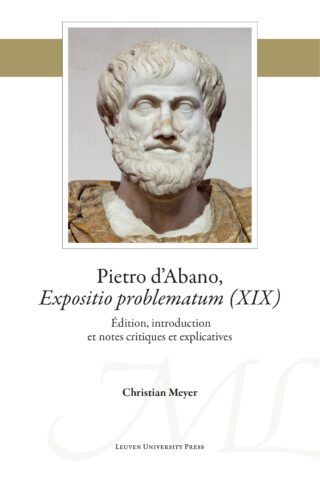
Pietro d’Abano, Expositio problematum (XIX)
Édition, introduction et notes critiques et explicatives
Christian Meyer (Editor),
Series: Mediaevalia Lovaniensia 51
Category: History, History 500-1500
Language: French
ISBN: 9789462702776
Publication date: September 14, 2022
€39.50 (including 6% VAT)
Buy NowNumber of pages: 172
Size: 234 x 156 x 12 mm

Stock item: 149971
Standard delivery time for print books:
For Belgium: 5 to 8 working days
For EU: 2 to 3 weeks
For other countries: 4 to 5 weeks
Series: Mediaevalia Lovaniensia 51
Category: History, History 500-1500
Language: French
ISBN: 9789461663894
Publication date: September 14, 2022
€29.50 (including 6% VAT)
Buy NowNumber of pages: 172
Réflexions sur le son et la musique inspirées par la philosophie de la nature
Pietro d’Abano (c. 1257-1315) est l’un des principaux commentateurs des Problemata aristotéliciens (c. 250 avant J.-Chr.) dont la section XIX traite de divers aspects du son et de la musique vocale et instrumentale. Rédigé autour de 1300 et largement diffusé aux XIVe et XVe siècles, le commentaire des cinquante problèmes de cette section développe un discours novateur sur la perception du chant et de la musique instrumentale et leurs effets. Partagé entre raison et sensibilité, il est dominé par une approche physique et psycho-physiologique du phénomène sonore et de sa perception qui rompt avec le discours philosophico-mathématique hérité de Boèce. Le texte de base de la présente édition est celui de l’édition de Venise (1519). Il a été révisé à la lumière d’un ensemble de sources manuscrites, dont les plus anciennes.
Reflections on sound and music inspired by the philosophy of naturePietro d’Abano (c. 1257-1315) is one of the principal commentators on the Aristotelian Problemata (c. 250 BC), of which section XIX deals with various aspects of sound, and vocal and instrumental music. Written around 1300 and widely distributed in the 14th and 15th centuries, the commentary on the fifty problems in this section develops an innovative discourse on the perception of singing and instrumental music and their effects. Divided between reason and sensitivity, the commentary is dominated by a physical and psycho-physiological approach to the phenomenon of sound and its perception, which breaks with the philosophical-mathematical discourse inherited from Boethius. The basic text of the present edition is the Venice edition (1519). It has been revised in the light of a collection of manuscript sources, including the oldest.
This publication is GPRC-labeled (Guaranteed Peer-Reviewed Content).
Avant-propos Introduction Petrus de Abano, Expositio Notes critiques et explicatives Références aux ouvrages Bibliographie
Frequently Asked Questions
What is "Pietro d’Abano, Expositio problematum (XIX)" about?
Réflexions sur le son et la musique inspirées par la philosophie de la nature
Pietro d’Abano (c. 1257-1315) est l’un des principaux commentateurs des Problemata aristotéliciens (c. 250 avant J.-Chr.) dont la section XIX traite de divers aspects du son et de la musique vocale et instrumentale. Rédigé autour de 1300 et largement diffusé aux XIVe et XVe siècles, le commentaire des cinquante problèmes de cette section développe un discours novateur sur la perception du chant et de la musique instrumentale et leurs effets. Partagé entre raison et sensibilité, il est dominé par une approche physique et psycho-physiologique du phénomène sonore et de sa perception qui rompt avec le discours philosophico-mathématique hérité de Boèce. Le texte de base de la présente édition est celui de l’édition de Venise (1519). Il a été révisé à la lumière d’un ensemble de sources manuscrites, dont les plus anciennes.
Reflections on sound and music inspired by the philosophy of naturePietro d'Abano (c. 1257-1315) is one of the principal commentators on the Aristotelian Problemata (c. 250 BC), of which section XIX deals with various aspects of sound, and vocal and instrumental music. Written around 1300 and widely distributed in the 14th and 15th centuries, the commentary on the fifty problems in this section develops an innovative discourse on the perception of singing and instrumental music and their effects. Divided between reason and sensitivity, the commentary is dominated by a physical and psycho-physiological approach to the phenomenon of sound and its perception, which breaks with the philosophical-mathematical discourse inherited from Boethius. The basic text of the present edition is the Venice edition (1519). It has been revised in the light of a collection of manuscript sources, including the oldest.
This publication is GPRC-labeled (Guaranteed Peer-Reviewed Content).
Who edited "Pietro d’Abano, Expositio problematum (XIX)"?
"Pietro d’Abano, Expositio problematum (XIX)" was edited by Christian Meyer.
Christian Meyer is researcher at the Centre National de la Recherche Scientifique (Tours, Centre d'Études supérieures de la Renaissance) and a member of the Institut de Recherche et d'Histoire des Textes (IRHT, Paris).
Christian Meyer est chercheur au Centre National de la Recherche Scientifique (Tours, Centre d’Études supérieures de la Renaissance) et membre correspondant de l’Institut de Recherche et d’Histoire des Textes (IRHT, Paris).
Is "Pietro d’Abano, Expositio problematum (XIX)" part of a series?
Yes, "Pietro d’Abano, Expositio problematum (XIX)" is part of the "Mediaevalia Lovaniensia" series. It's book 51 in the series.

The longstanding, peer-reviewed book series Mediaevalia Lovaniensia. Studies in Medieval History, Society, and Culture publishes high-quality scholarship on the history and culture of the Middle Ages (c. 500–1550). Topics of particular interest to the series include, but are not limited to, social behaviour and power relations in medieval society, processes of identity formation, religious and urban culture, medieval thought and literature, and gender history. The series focuses on Europe and the wider Mediterranean world and is particularly rich in interdisciplinary approaches. By means of monographs and edited volumes, the series explores thematic frontiers and embraces innovative methodological approaches in historical and philological scholarship that is based on an in-depth source-based study.
Mediaevalia Lovaniensia accepts monographs as well as thematically coherent volumes in English. Moreover, it offers scholars the possibility to publish critical editions of primary texts with broader relevance to the understanding of medieval culture and society. The series aspires to publish books that have the potential to become reference works in the field of Medieval Studies.
We encourage early career (postdoctoral) researchers to submit a reworked version of their PhD thesis to this series. Leuven University Press provides authors with two publishing scenarios: traditional (non-Open Access) and the option to publish in Open Access (including language editing).
Editorial Board
Jelle Haemers (KU Leuven)
Jeroen Deploige (Ghent University)
Brigitte Meijns (KU Leuven)
Chanelle Delameillieure (KU Leuven - KULAK)
Baudouin Van den Abeele (UCLouvain)
Proposals
Proposals and enquiries can be sent to one of the editorial board members. Please send a short abstract. Upon approval of the proposal, the full manuscript will be submitted to international blind peer review by two (external) experts. The editors strive towards completing the review of proposals within one month and of complete manuscripts within five months after submission. Manuscripts should preferably be (+/-) 80.000 to 120.000 words in length.
Please make use of the submission form to present your manuscript or proposal to our board.
Authors interested in Open Access can consult the available funding options.
Links & Resources
What is the Table of Contents for "Pietro d’Abano, Expositio problematum (XIX)"?
Avant-propos Introduction Petrus de Abano, Expositio Notes critiques et explicatives Références aux ouvrages Bibliographie
Related titles
 Orality and Scribal Culture in the High Middle Ages
Timothy B. Noone (Author), Mark J. Clark (Author),
November 2026
 Toekomstdromen
Maarten Van Dijck (Editor), Gerrit Verhoeven (Editor), Hans Cools (Editor),
November 2026
 The Medieval Aristotle
Nena Bobovnik (Editor), Clelia V. Crialesi (Editor), Lisa Devriese (Editor),
August 2026

 Trend en toeval – vierde editie
Bruno Blondé (Author), Isabelle Devos (Author), Jord Hanus (Author), Wouter Ryckbosch (Author),
August 2026
 Christian Democracy and the Fall of Communism
Michael Gehler (Editor), Piotr H. Kosicki (Editor), Helmut Wohnout (Editor),
April 2026
 Political Exile in the Global Twentieth Century
Wolfram Kaiser (Editor), Piotr H. Kosicki (Editor),
April 2026
 Brusselse plaatsnamen
Iadine Degryse (Editor), Benjamin Wayens (Editor), Chantal Kesteloot (Editor), Dennis De Vriese (Editor), Matthijs Degraeve (Editor),
April 2026
 Cartographies of Catastrophes
Laura Demeter (Editor), Carmen M. Enss (Editor), Piotr Kisiel (Editor), Carol Ludwig (Editor),
February 2026
 Thomas Aquinas and Hervaeus Natalis on Concepts and Intentional Objects
Fabrizio Amerini (Author),
February 2026