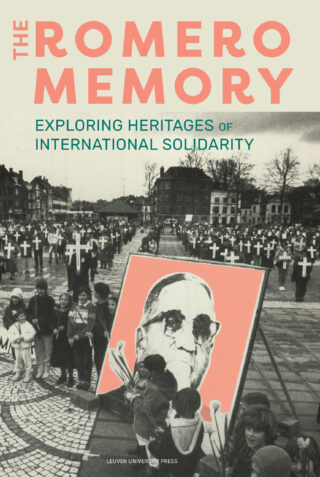

The Romero Memory
Exploring Heritages of International Solidarity
Judith Gruber (Editor), Jonas Van Mulder (Editor), Stephan Parmentier (Editor), Veerle Draulans (Editor), Joren Janssens (Editor), Jacques Haers (Editor), Kim Christiaens (Editor),

Category: Americas, Religion, Social Science
Language: English
ISBN: 9789462704176
Publication date: November 18, 2026
€49.00 (including 6% VAT)
COMING SOON
Available to pre-order two weeks before date of publication.
Number of pages: 300
Size: 244 x 170 x mm
Number of illustrations: 150

Funded by: KU Leuven Fund for Fair Open Access
Standard delivery time for print books:
For Belgium: 5 to 8 working days
For EU: 2 to 3 weeks
For other countries: 4 to 5 weeks
Category: Americas, Religion, Social Science
Language: English
ISBN: 9789461666819
Publication date: November 18, 2026
COMING SOON
Number of pages: 300
Number of illustrations: 150
Funded by: KU Leuven Fund for Fair Open Access
Category: Americas, Religion, Social Science
Language: English
ISBN: 9789461665621
Publication date: November 18, 2026
COMING SOON
Number of pages: 300
Number of illustrations: 150
Funded by: KU Leuven Fund for Fair Open Access
Óscar Romero’s continuing legacy in various societies worldwide.
On 24 March 1980, Salvadoran archbishop Óscar Romero was assassinated while celebrating mass in San Salvador. During the last years of his life, Romero had become an outspoken opponent of the oppression by El Salvador’s dictatorial regime and a beacon of peace and hope in a country torn by injustice, inequality and violence. His assassination sparked global outrage and converged with a growing international awareness of the plight of Latin America. To this day, Romero continues to inspire resistance and liberation movements in Latin America and beyond, both inside and outside the Church. Bringing together perspectives from the fields of history, theology, sociology, law, and cultural studies, The Romero Memory aims to accomplish a polyphonic understanding of the archbishop’s significance. His legacy transcends Western approaches to these disciplines and encompasses religious thought and practice, human rights activism, El Salvadoran mural iconography, Hollywood film, local social institutions and international aid, as well as transitional justice.
Judith Gruber
Judith Gruber is Research Professor in Theology at KU Leuven and a member of the Research Unit of Systematic Theology and the Study of Religions, Faculty of Theology and Religious Studies.
Jonas Van Mulder
Jonas Van Mulder is a research associate and curator at KADOC Documentation and Research Centre on Religion, Culture and Society of KU Leuven.
Stephan Parmentier
Stephan Parmentier is Full Professor in Law and Criminology at KU Leuven and a member of the Research Unit of Criminal Law and Criminology.
Veerle Draulans
Veerle Draulans is Associate Professor in Social Sciences at KU Leuven and a member of the Leuven Interdisciplinary Centre Lived Religion and Meaning.
Joren Janssens
Joren Janssens is a research associate of the Faculty of Arts at KU Leuven and library
coordinator of RoSa, the Flemish expertise center on gender and feminism.
Jacques Haers
Jacques Haers is Emeritus Professor in Theology at KU Leuven and a member of the Research Unit of Systematic Theology and the Study of Religions.
Kim Christiaens
Kim Christiaens is Associate Professor in History at KU Leuven.
A very deep work about memory in El Salvador and Monseñor Romero nationally and internationally, with a striking wide and diverse approach. - Harold Fallon, KU Leuven
Frequently Asked Questions
What is "The Romero Memory" about?
Óscar Romero’s continuing legacy in various societies worldwide.
On 24 March 1980, Salvadoran archbishop Óscar Romero was assassinated while celebrating mass in San Salvador. During the last years of his life, Romero had become an outspoken opponent of the oppression by El Salvador’s dictatorial regime and a beacon of peace and hope in a country torn by injustice, inequality and violence. His assassination sparked global outrage and converged with a growing international awareness of the plight of Latin America. To this day, Romero continues to inspire resistance and liberation movements in Latin America and beyond, both inside and outside the Church. Bringing together perspectives from the fields of history, theology, sociology, law, and cultural studies, The Romero Memory aims to accomplish a polyphonic understanding of the archbishop’s significance. His legacy transcends Western approaches to these disciplines and encompasses religious thought and practice, human rights activism, El Salvadoran mural iconography, Hollywood film, local social institutions and international aid, as well as transitional justice.
Who wrote "The Romero Memory"?
"The Romero Memory" was written by Caroline Sappia, Miguel Villela, Bradley Hilgert, Martin Maier, Sharon Erickson Nepstad, Kevin Coleman, Zachary Dehm, Rafaela Eulberg, Valeria Vegh Weis, Miryam Rivera Holguín, Adriana Hildenbrand, Jozef Corveleyn, Lucia De Haene and Rudina Jasini.
Jozef Corveleyn is klinisch psycholoog en psychoanalyticus, gewoon hoogleraar aan het departement psychologie van de K.U. Leuven en deeltijds verbonden aan de Faculteit psychologie en pedagogiek van de Vrije Universiteit Amsterdam.
Who edited "The Romero Memory"?
"The Romero Memory" was edited by Judith Gruber, Jonas Van Mulder, Stephan Parmentier, Veerle Draulans, Joren Janssens, Jacques Haers and Kim Christiaens.
Judith Gruber is Research Professor in Theology at KU Leuven and a member of the Research Unit of Systematic Theology and the Study of Religions, Faculty of Theology and Religious Studies.
Jonas Van Mulder is a research associate and curator at KADOC Documentation and Research Centre on Religion, Culture and Society of KU Leuven.
Stephan Parmentier is Full Professor in Law and Criminology at KU Leuven and a member of the Research Unit of Criminal Law and Criminology.
Veerle Draulans is Associate Professor in Social Sciences at KU Leuven and a member of the Leuven Interdisciplinary Centre Lived Religion and Meaning.
Joren Janssens is a research associate of the Faculty of Arts at KU Leuven and library
coordinator of RoSa, the Flemish expertise center on gender and feminism.
Jacques Haers is Emeritus Professor in Theology at KU Leuven and a member of the Research Unit of Systematic Theology and the Study of Religions.
Kim Christiaens is Associate Professor in History at KU Leuven.
Is "The Romero Memory" available Open Access?
Yes, "The Romero Memory" is published Open Access. It is available under a BY-NC-ND license.
Who funded the publication of "The Romero Memory"?
Publication of "The Romero Memory" was funded by KU Leuven Fund for Fair Open Access
.
What is the DOI for "The Romero Memory"?
The Digital Object Identifier (DOI) for "The Romero Memory" is 10.11116/9789461666819.
Related titles
 Infrastructuring Arrival
Karel Arnaut (Editor), Luce Beeckmans (Editor), Bruno Meeus (Editor),
November 2026
 Feminists Resisting Gendered Violence
Hemangini Gupta (Editor), Fiona Mackay (Editor), Jan Breckenridge (Editor), Louise Chappell (Editor), Rachna Mehra (Editor), Rukmini Sen (Editor), Mailin Suchting (Editor),
October 2026
 German–Rapanui Entanglements
Cristián Moreno Pakarati (Editor), Diego Muñoz (Editor), Philipp Schorch (Editor),
August 2026
 Political Exile in the Global Twentieth Century
Wolfram Kaiser (Editor), Piotr H. Kosicki (Editor),
April 2026
 Comics and the Global South
Andrea Aramburú (Editor), Dibyadyuti Roy (Editor), Joe Sutliff Sanders (Editor),
February 2026
 Teaching About the Violent Past
Line Kuppens (Author), Justin Sheria Nfundiko (Author),
October 2025
 Integration Otherwise Inspiration Kit
Luce Beeckmans (Author), Dounia Salamé (Author), Martina Bovo (Author), Mary Hogan (Author),
June 2025
 Christian Churches and Postwar Society
Kristien Suenens (Editor), Michael Snape (Editor), Martin Baumeister (Editor),
June 2025
 Cross-Cultural Heritage
Jonas Van Mulder (Editor), Thomas Coomans (Editor), Dries Vanysacker (Editor),
April 2025