

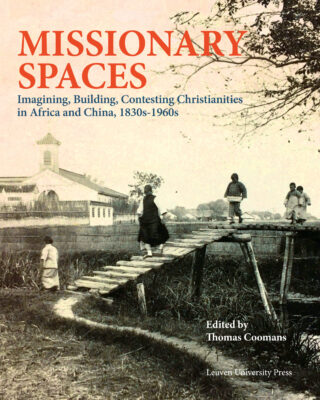
Missionary Spaces
Imagining, Building, Contesting Christianities in Africa and China, 1830s-1960s
Thomas Coomans (Editor),
Series: KADOC-Artes 17
Category: History, History 1800-present, Postcolonial Studies, Religion
Language: English
ISBN: 9789462701441
Publication date: May 2, 2024
€69.50 (including 6% VAT)
Buy NowNumber of pages: 296
Size: 280 x 225 x 25 mm
Illustrations and other content description:
Illustrated, full colour

Stock item: 160375
Standard delivery time for print books:
For Belgium: 5 to 8 working days
For EU: 2 to 3 weeks
For other countries: 4 to 5 weeks
Series: KADOC-Artes 17
Category: History, History 1800-present, Postcolonial Studies, Religion
Language: English
ISBN: 9789461666079
Publication date: July 15, 2024
€59.00 (including 6% VAT)
Buy NowNumber of pages: 296
Illustrations and other content description:
Illustrated, full colour
The ‘spatial turn’ of missionary places
Situated at the crossroads of missionary history, imperial history and colonial architecture, this volume examines the architectural staging and spatial implications of the worldwide expansion of Christianity in the nineteenth and twentieth centuries. By focusing on specific architectural fragments, analysing the intersection of Christian edifices in colonial and traditional urban settings or unravelling the social understanding of missionary places, each chapter strives to understand the agency of missionary spaces. Bringing together scholars from different disciplines and fields, this book aims to centre those missionary spaces by approaching them not merely as décor around and within which the missionary encounter was acted, but by making them part and parcel of it.
Through its approach, Missionary Spaces provides a new paradigm for scrutinising the ‘spatial turn’ for missionary histories and contributes to the increased attention across the humanities to space, place, and location since the late 1990s. Space does not occur as an historical given, but as a social construction to be analysed, while at the same time having explanatory value of its own.
This book focuses on Africa and the Chinese Region with contributions on Burundi, China, Congo, Egypt, Ghana, Kenya, and Taiwan.
Contributors: Leon Bouwmeester (KU Leuven), Lawrence Braschi (Church of England), Bram Cleys (MAS | Museum aan de Stroom), Thomas Coomans (KU Leuven), Céline Frémaux (French Guyana), Johan Lagae (UGent), Maarten Onneweer (AidEnvironment), Alexis B. Tengan (independent scholar)
This publication is GPRC-labeled (Guaranteed Peer-Reviewed Content).
INTRODUCTION
Imagining, Building, Contesting Missionary Spaces
Thomas Coomans
PART ONE – IMAGINED WORLD / ADAPTED STRATEGIES
1 Spatial Trajectories and Missionary and Colonial Movements into Northwest Ghana since 1929: Dagara Reception of Catholic Missionary Activities
Alexis B. Tengan
2 Redeeming Ukamba: Word and World, 1893-1905
Maarten Onneweer
3 Islands on the Mainland: Catholic Missions and Spatial Strategies in China, 1840s-1940s
Thomas Coomans
4 Co-authoring the City: Missionaries and the Colonial City of Luluaburg (Belgian Congo), 1930-1960
Bram Cleys
5 The Catholic Territorialization of Taiwan: Vatican Global Strategy and Franciscan Local Parishes, 1949-1960s
Leon Bouwmeester and Thomas Coomans
PART TWO – UNIVERSAL PROJECTS / LOCALIZED ARCHITECTURES
6 Gendered Spaces in Catholic Compounds of Late Qing China
Thomas Coomans
7 Gender-Designed Catholic Churches in North China, 1830s-1920s
Thomas Coomans
8 The Missionaries in the Cosmopolitan Towns of the Suez Isthmus, Egypt: Their Role in the Formation of Identity in Architecture and Urban Planning, 1860-1937
Céline Frémaux
9 Civilizing Space in West China: Re-examining the Place of the Christian University in Chengdu, 1909-1933
Lawrence Braschi
10 A Highly ‘Mediated Monument’ of Tropical Modernism in Central Africa: Unpacking the Complex Agendas behind the Design and Construction of the Collège du Saint-Esprit in Bujumbura, Burundi
Johan Lagae
Abbreviations
Index of Persons
Index of Places
Authors
Colophon
Thomas Coomans
Thomas Coomans is a full professor of architectural history and built heritage conservation at KU Leuven and director of the Advanced Master in Conservation of Monuments and Sites (RLICC), at the Faculty of Engineering Science.
En définitive, cet ouvrage est à la fois une contribution à l’architecture, à l’histoire, et à la réflexion sur les échanges entre l’Occident, l’Afrique et l’Asie. Il met en lumière les interactions qui ont accompagné l’entreprise missionnaire (et coloniale), faites souvent de petites négociations quotidiennes, lesquelles transforment profondément les acteurs engagés dans ces processus et par suite leur vision du monde. Quiconque s’intéresse aux questions de rencontres d’autres cultures et à la question missionnaire tirera profit de cet ouvrage. L’introduction est à recommander aux doctorants et jeunes chercheurs travaillant sur ces questions. - Yves VENDÉ, Mélanges de science religieuse, n° 82/1, 2025
De sterkte van de bundel ligt zowel in de diversiteit van de cases als in de vormelijke aspecten van de uitgave. Het boek levert niet alleen een bijdrage aan de missiegeschiedenis omdat het een ruimtelijke lens plaatst op deze sub-discipline, maar ook omdat het bijdragen over China en Afrika samenbrengt. Ondanks de vele overlappingen – “Westerse” missionaire gemeenschappen hadden vaak missies in zowel China als Afrika – bestudeerden historici ze tot nog toe zelden samen7. Bovendien illustreren de cases de verschillende dimensies van ruimtelijkheid, gaande van kosmologische opvattingen over tijd en ruimte tot de architectuur van specifieke gebouwen, en tonen ze hoe die met elkaar verweven zijn. De uitgave zelf is in magazineformaat en op fotopapier gedrukt, waardoor de vele afbeeldingen volledig tot hun recht komen. Dat is een meerwaarde voor de bijdragen waarin scans van archiefmateriaal, oude afbeeldingen, en foto’s genomen tijdens veldwerk als illustratie dienen, maar bewijst vooral zinvol in de paar hoofdstukken die het visuele materiaal ook echt als bronnen van analyse gebruiken. - Mick Feyaerts, Contemporanea, #01 / 2025, https://www.contemporanea.be/nl/article/thomas-coomans-ed-missionary-spaces-imagining-building-contesting-christianities-in-africa-and-china-1830s-1960s-leuven-university-press-2024/
Owing to Coomans’s exceptional collection of essays on the spacial “islands” of missionary buildings and complexes in Africa and China, scholars can better apprehend why these two regions must be viewed jointly when conducting research on the global missions of the nineteenth and twentieth centuries. This volume is an essential work to add to the shelves of anyone interested in the history of architectural and cultural exchange between the West and Africa and China. - Anthony E. Clark, The Catholic Historical Review, Volume 110, Number 4, Autumn 2024, pp. 802-804, https://dx.doi.org/10.1353/cat.2024.a945416
This is a beautiful coffee-table book, thoroughly illustrated throughout. Text and notes are attractively presented alongside color photographs of the interior and exterior of buildings and their situations in landscapes. There are maps, urban plans, sketches, and architects’ drawings that illuminate the prose. Of course, the subject matter of places and constructions demands such illustrations. Yet, in the history of missions, it is rare to see such a well-illustrated book. The extra effort of production by contributors, the editor, and the publishing house should be acknowledged, as should the extra pleasure that is afforded by perusing the book with such a splendid appearance. - Emma Wild-Wood, The Journal of Religion, volume 106, number 3, https://doi.org/10.1086/741408
Frequently Asked Questions
What is "Missionary Spaces" about?
The ‘spatial turn’ of missionary places
Situated at the crossroads of missionary history, imperial history and colonial architecture, this volume examines the architectural staging and spatial implications of the worldwide expansion of Christianity in the nineteenth and twentieth centuries. By focusing on specific architectural fragments, analysing the intersection of Christian edifices in colonial and traditional urban settings or unravelling the social understanding of missionary places, each chapter strives to understand the agency of missionary spaces. Bringing together scholars from different disciplines and fields, this book aims to centre those missionary spaces by approaching them not merely as décor around and within which the missionary encounter was acted, but by making them part and parcel of it.
Through its approach, Missionary Spaces provides a new paradigm for scrutinising the ‘spatial turn’ for missionary histories and contributes to the increased attention across the humanities to space, place, and location since the late 1990s. Space does not occur as an historical given, but as a social construction to be analysed, while at the same time having explanatory value of its own.
This book focuses on Africa and the Chinese Region with contributions on Burundi, China, Congo, Egypt, Ghana, Kenya, and Taiwan.
Contributors: Leon Bouwmeester (KU Leuven), Lawrence Braschi (Church of England), Bram Cleys (MAS | Museum aan de Stroom), Thomas Coomans (KU Leuven), Céline Frémaux (French Guyana), Johan Lagae (UGent), Maarten Onneweer (AidEnvironment), Alexis B. Tengan (independent scholar)
This publication is GPRC-labeled (Guaranteed Peer-Reviewed Content).
Who edited "Missionary Spaces"?
"Missionary Spaces" was edited by Thomas Coomans.
Thomas Coomans is a full professor of architectural history and built heritage conservation at KU Leuven and director of the Advanced Master in Conservation of Monuments and Sites (RLICC), at the Faculty of Engineering Science.
Is "Missionary Spaces" part of a series?
Yes, "Missionary Spaces" is part of the "KADOC-Artes" series. It's book 17 in the series.
The richly illustrated peer-reviewed book series KADOC Artes offers new insights into the material cultures and legacies of religions in Europe and the world since 1750 from interreligious and transnational perspectives. By means of monographs and edited volumes, the series explores thematic frontiers and embraces innovative methodological approaches in heritage studies. Taken together, KADOC Artes and its companion series KADOC Studies in Religion, Culture and Society represent a diptych featuring the material and immaterial cultures and legacies of religions in Europe and the world from the 18th century onwards.
KADOC ARTES reflects the particular expertise of KADOC – the Interfaculty Documentation and Research Centre on Religion, Culture and Society at KU Leuven – as a heritage institution with particularly rich and diverse documentary holdings, and as an interdisciplinary research center.
KADOC Artes managed by an independent Editorial Board. Books are published in English. The series welcomes monographs and edited volumes.
To submit a book proposal please go to the website of KADOC or consult LUP’s guidelines about submission. The series welcomes monographs and edited volumes. Book proposals may relate to, for example, the representation of religious diversity and the politicization of religious heritage.
All book proposals and manuscripts are subject to double blind peer review involving at least one external reviewer (proposals) or at least two (manuscripts). The editors strive towards completing the review of proposals within two months and of complete manuscripts within five months after submission.


Editorial board
Elena Arigita Maza (Universidad de Granada)
Florian Bock (Ruhr Universität Bochum)
Timothy Brittain‐Catlin (University of Cambridge)
James Chappel (Duke University)
Kim Christiaens (KADOC-KU Leuven)
Kathleen James-Chakraborty (University College Dublin)
James Kennedy (Utrecht University)
Franziska Metzger (PH Luzern)
Patrick Pasture (MoSa‐KU Leuven) - chairman
Isabelle Saint‐Martin (EPHE Paris)
Thijl Sunier (VU Amsterdam)
Árpád von Klimó (Catholic University of America)
Veerle De Laet (Leuven University Press)
Peter Heyrman (KADOC-KU Leuven) - secretary
Proposals
Proposals and enquiries can be sent to Peter Heyrman.
Please make use of the submission form to present your manuscript or proposal to our board.
Authors interested in Open Access can consult the available funding options.
Links & Resources
What is the Table of Contents for "Missionary Spaces"?
INTRODUCTION
Imagining, Building, Contesting Missionary Spaces
Thomas Coomans
PART ONE – IMAGINED WORLD / ADAPTED STRATEGIES
1 Spatial Trajectories and Missionary and Colonial Movements into Northwest Ghana since 1929: Dagara Reception of Catholic Missionary Activities
Alexis B. Tengan
2 Redeeming Ukamba: Word and World, 1893-1905
Maarten Onneweer
3 Islands on the Mainland: Catholic Missions and Spatial Strategies in China, 1840s-1940s
Thomas Coomans
4 Co-authoring the City: Missionaries and the Colonial City of Luluaburg (Belgian Congo), 1930-1960
Bram Cleys
5 The Catholic Territorialization of Taiwan: Vatican Global Strategy and Franciscan Local Parishes, 1949-1960s
Leon Bouwmeester and Thomas Coomans
PART TWO – UNIVERSAL PROJECTS / LOCALIZED ARCHITECTURES
6 Gendered Spaces in Catholic Compounds of Late Qing China
Thomas Coomans
7 Gender-Designed Catholic Churches in North China, 1830s-1920s
Thomas Coomans
8 The Missionaries in the Cosmopolitan Towns of the Suez Isthmus, Egypt: Their Role in the Formation of Identity in Architecture and Urban Planning, 1860-1937
Céline Frémaux
9 Civilizing Space in West China: Re-examining the Place of the Christian University in Chengdu, 1909-1933
Lawrence Braschi
10 A Highly ‘Mediated Monument’ of Tropical Modernism in Central Africa: Unpacking the Complex Agendas behind the Design and Construction of the Collège du Saint-Esprit in Bujumbura, Burundi
Johan Lagae
Abbreviations
Index of Persons
Index of Places
Authors
Colophon
What is the DOI for "Missionary Spaces"?
The Digital Object Identifier (DOI) for "Missionary Spaces" is 10.11116/9789461666079.
Related titles
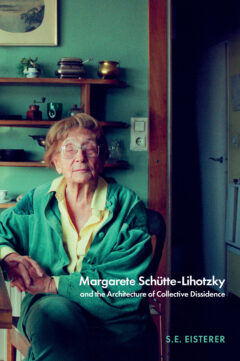 Margarete Schütte-Lihotzky and the Architecture of Collective Dissidence, 1918–1989
S.E. Eisterer (Author),
April 2027
 The Romero Memory
Judith Gruber (Editor), Jonas Van Mulder (Editor), Stephan Parmentier (Editor), Veerle Draulans (Editor), Joren Janssens (Editor), Jacques Haers (Editor), Kim Christiaens (Editor),
November 2026

 Toekomstdromen
Maarten Van Dijck (Editor), Gerrit Verhoeven (Editor), Hans Cools (Editor),
November 2026
 German–Rapanui Entanglements
Cristián Moreno Pakarati (Editor), Diego Muñoz (Editor), Philipp Schorch (Editor),
August 2026
 Trend en toeval – vierde editie
Bruno Blondé (Author), Isabelle Devos (Author), Jord Hanus (Author), Wouter Ryckbosch (Author),
August 2026
 Cinema in Post-War Belgium
Gertjan Willems (Editor), Bjorn Gabriels (Editor), Bénédicte Rochet (Editor),
May 2026
 Performing Magnetism
Eleonora Paklons (Editor), Kristof Smeyers (Editor), Kurt Vanhoutte (Editor), Hannah Welslau (Editor),
May 2026
 Political Exile in the Global Twentieth Century
Wolfram Kaiser (Editor), Piotr H. Kosicki (Editor),
April 2026
 Christian Democracy and the Fall of Communism
Michael Gehler (Editor), Piotr H. Kosicki (Editor), Helmut Wohnout (Editor),
April 2026
 Brusselse plaatsnamen
Iadine Degryse (Editor), Benjamin Wayens (Editor), Chantal Kesteloot (Editor), Dennis De Vriese (Editor), Matthijs Degraeve (Editor),
April 2026
 Cartographies of Catastrophes
Laura Demeter (Editor), Carmen M. Enss (Editor), Piotr Kisiel (Editor), Carol Ludwig (Editor),
February 2026