

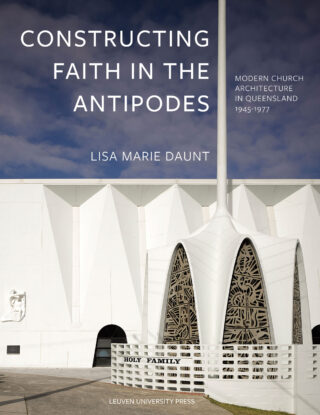
Constructing Faith in the Antipodes
Modern Church Architecture in Queensland 1945-1977
Lisa Marie Daunt (Author),
Series: KADOC-Artes 21
Category: Architecture and Urban Planning, History 1800-present, Religion
Language: English
ISBN: 9789462704848
Publication date: December 10, 2025
€65.00 (including 6% VAT)
Buy NowNumber of pages: 296
Size: 280 x 225 x 20 mm
Illustrations and other content description:
Illustrated, full colour

Stock item: 169566
Standard delivery time for print books:
For Belgium: 5 to 8 working days
For EU: 2 to 3 weeks
For other countries: 4 to 5 weeks
Series: KADOC-Artes 21
Category: Architecture and Urban Planning, History 1800-present, Religion
Language: English
ISBN: 9789461666833
Publication date: January 14, 2026
€55.00 (including 6% VAT)
Buy NowNumber of pages: 296
Illustrations and other content description:
Illustrated, full colour
Series: KADOC-Artes 21
Category: Architecture and Urban Planning, History 1800-present, Religion
Language: English
ISBN: 9789461666826
Publication date: December 10, 2025
€55.00 (including 6% VAT)
Buy NowNumber of pages: 296
Illustrations and other content description:
Illustrated, full colour
The overlooked history of modern church architecture in post-war Australia
Over 1,650 churches were built in Queensland, Australia, between 1945 and 1977. They constitute some of the most notable modern architecture in the state and reveal tensions surrounding modernism’s role in cultural expression and regional identity. While much research has focused on post-war modern church architecture in the Global North, little has been done on the Global South.
This book offers a particular perspective on modernist church architecture, differing from accounts of buildings in the northern hemisphere, as it highlights how church architecture in Queensland was shaped by its very specific time and place – a young and developing state covering a vast area of land, sparsely populated, highly multi-denominational and located in the antipodes.
Modern architectural developments and emergent religious ideas did not simply transfer to Queensland. Rather, architectural ideas were circulated globally, allowing for a global narrative. This landmark study seeks to broaden views and methods for future research, both locally and internationally. Richly illustrated, Constructing Faith in the Antipodes combines both a chronological and a thematic approach to narrate modern church architectural history and offers a fascinating glimpse into a distinct collection of modern church buildings.
Foreword by Janina Gosseye
Preface
Acknowledgements
Introduction
Part I
1. “New World, Youthful” Queensland and Early (Pre-World War II)
Modern Church Architecture
2. “Recovering” Queensland and Church Architecture:
Post-War Church Design 1945–1954, Setting the Scene
3. “Optimistic” Queensland and Church Architecture:
A Church Building Boom, 1955–1959
4. “Modernising” Queensland and Church Architecture:
Modern Church Architecture, 1960–1964
5. “Liturgically Modern” Queensland Church Architecture:
Liturgically Responsive Church Architecture, 1965–1977
Part II
6. From Hilltop Landmarks to Suburban Place Makers:
Brisbane’s Post-War Religious Territories and Communities
7. Experiments with Form:
Queensland’s Innovative and Technically Progressive Ecclesiastical Beacons
8. In Support of Liturgical Renewal:
Designing Worship Spaces and Furnishings
9. Seeking to Reinvigorate Worship:
Integrating Modern Religious Art in Queensland’s Post-War Churches
Conclusion
Abbreviations
Bibliography
Index
With a rapidly growing population in the post-war era the Australian State of Queensland built an astonishing number of churches in the modern idiom. Lisa Marie Daunt’s rigorous and comprehensive study shows how good many of these churches are and how well connected with the international architectural and liturgical discourse of their time. Daunt’s research, covering as it does every building of every denomination and every flavour of modernism, leads to powerful insights. Constructing Faith in the Antipodes is much more than a regional study; rather the size of the corpus of buildings, their high quality and Daunt’s astute analysis means that this book is an important addition to the global history of ecclesiastical architecture. - John Macarthur, The University of Queensland
Lisa Daunt’s thorough and comprehensive historical research is impressive. Her book Constructing Faith in the Antipodes is inclusive, embracing a wide range of denominations and communities, and considering church types from traditional cathedrals to modern chapels, in cities and expanding suburbs as well as remote rural settlements. The context of twentieth-century Australia is unique and distinctive in many ways, and Daunt’s book provides a fresh and original view of the broader history of church architecture. - Robert Proctor, University of Bath
For those who simply cannot see enough pictures of unfamiliar post-war churches, Lisa Marie Daunt's new book on those in Queensland will come as a delight. As well as providing an authoritative history of many international and regional aspects of church design, copious colour photographs of these buildings and their details appear almost on every page. Australian variations on all the familiar styles are here, from byzantine and concrete basilicas to modernist designs clearly inspired by the work of Liam McCormick and Ronald Weeks at Clifton. - Timothy Brittain-Catlin, C20 Magazine, Issue 2026/1
Frequently Asked Questions
What is "Constructing Faith in the Antipodes" about?
The overlooked history of modern church architecture in post-war Australia
Over 1,650 churches were built in Queensland, Australia, between 1945 and 1977. They constitute some of the most notable modern architecture in the state and reveal tensions surrounding modernism’s role in cultural expression and regional identity. While much research has focused on post-war modern church architecture in the Global North, little has been done on the Global South.
This book offers a particular perspective on modernist church architecture, differing from accounts of buildings in the northern hemisphere, as it highlights how church architecture in Queensland was shaped by its very specific time and place – a young and developing state covering a vast area of land, sparsely populated, highly multi-denominational and located in the antipodes.
Modern architectural developments and emergent religious ideas did not simply transfer to Queensland. Rather, architectural ideas were circulated globally, allowing for a global narrative. This landmark study seeks to broaden views and methods for future research, both locally and internationally. Richly illustrated, Constructing Faith in the Antipodes combines both a chronological and a thematic approach to narrate modern church architectural history and offers a fascinating glimpse into a distinct collection of modern church buildings.
Who wrote "Constructing Faith in the Antipodes"?
"Constructing Faith in the Antipodes" was written by Lisa Marie Daunt.
Lisa Marie Daunt earned her PhD in March 2021 from the University of Queensland, Australia. An architect and architectural historian, Lisa’s work combines new design, heritage conservation, research and writing.
Is "Constructing Faith in the Antipodes" part of a series?
Yes, "Constructing Faith in the Antipodes" is part of the "KADOC-Artes" series. It's book 21 in the series.
The richly illustrated peer-reviewed book series KADOC Artes offers new insights into the material cultures and legacies of religions in Europe and the world since 1750 from interreligious and transnational perspectives. By means of monographs and edited volumes, the series explores thematic frontiers and embraces innovative methodological approaches in heritage studies. Taken together, KADOC Artes and its companion series KADOC Studies in Religion, Culture and Society represent a diptych featuring the material and immaterial cultures and legacies of religions in Europe and the world from the 18th century onwards.
KADOC ARTES reflects the particular expertise of KADOC – the Interfaculty Documentation and Research Centre on Religion, Culture and Society at KU Leuven – as a heritage institution with particularly rich and diverse documentary holdings, and as an interdisciplinary research center.
KADOC Artes managed by an independent Editorial Board. Books are published in English. The series welcomes monographs and edited volumes.
To submit a book proposal please go to the website of KADOC or consult LUP’s guidelines about submission. The series welcomes monographs and edited volumes. Book proposals may relate to, for example, the representation of religious diversity and the politicization of religious heritage.
All book proposals and manuscripts are subject to double blind peer review involving at least one external reviewer (proposals) or at least two (manuscripts). The editors strive towards completing the review of proposals within two months and of complete manuscripts within five months after submission.


Editorial board
Elena Arigita Maza (Universidad de Granada)
Florian Bock (Ruhr Universität Bochum)
Timothy Brittain‐Catlin (University of Cambridge)
James Chappel (Duke University)
Kim Christiaens (KADOC-KU Leuven)
Kathleen James-Chakraborty (University College Dublin)
James Kennedy (Utrecht University)
Franziska Metzger (PH Luzern)
Patrick Pasture (MoSa‐KU Leuven) - chairman
Isabelle Saint‐Martin (EPHE Paris)
Thijl Sunier (VU Amsterdam)
Árpád von Klimó (Catholic University of America)
Veerle De Laet (Leuven University Press)
Peter Heyrman (KADOC-KU Leuven) - secretary
Proposals
Proposals and enquiries can be sent to Peter Heyrman.
Please make use of the submission form to present your manuscript or proposal to our board.
Authors interested in Open Access can consult the available funding options.
Links & Resources
What is the Table of Contents for "Constructing Faith in the Antipodes"?
Foreword by Janina Gosseye
Preface
Acknowledgements
Introduction
Part I
1. “New World, Youthful” Queensland and Early (Pre-World War II)
Modern Church Architecture
2. “Recovering” Queensland and Church Architecture:
Post-War Church Design 1945–1954, Setting the Scene
3. “Optimistic” Queensland and Church Architecture:
A Church Building Boom, 1955–1959
4. “Modernising” Queensland and Church Architecture:
Modern Church Architecture, 1960–1964
5. “Liturgically Modern” Queensland Church Architecture:
Liturgically Responsive Church Architecture, 1965–1977
Part II
6. From Hilltop Landmarks to Suburban Place Makers:
Brisbane’s Post-War Religious Territories and Communities
7. Experiments with Form:
Queensland’s Innovative and Technically Progressive Ecclesiastical Beacons
8. In Support of Liturgical Renewal:
Designing Worship Spaces and Furnishings
9. Seeking to Reinvigorate Worship:
Integrating Modern Religious Art in Queensland’s Post-War Churches
Conclusion
Abbreviations
Bibliography
Index
What is the DOI for "Constructing Faith in the Antipodes"?
The Digital Object Identifier (DOI) for "Constructing Faith in the Antipodes" is 10.11116/9789461666826.
Related titles
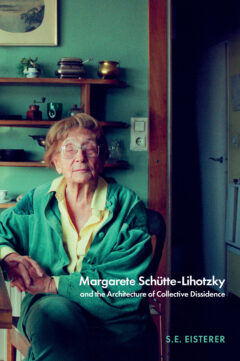 Margarete Schütte-Lihotzky and the Architecture of Collective Dissidence, 1918–1989
S.E. Eisterer (Author),
April 2027
 The Romero Memory
Judith Gruber (Editor), Jonas Van Mulder (Editor), Stephan Parmentier (Editor), Veerle Draulans (Editor), Joren Janssens (Editor), Jacques Haers (Editor), Kim Christiaens (Editor),
December 2026

 Infrastructuring Arrival
Karel Arnaut (Editor), Luce Beeckmans (Editor), Bruno Meeus (Editor),
November 2026
 German–Rapanui Entanglements
Cristián Moreno Pakarati (Editor), Diego Muñoz (Editor), Philipp Schorch (Editor),
August 2026
 Cinema in Post-War Belgium
Gertjan Willems (Editor), Bjorn Gabriels (Editor), Bénédicte Rochet (Editor),
May 2026
 Performing Magnetism
Eleonora Paklons (Editor), Kristof Smeyers (Editor), Kurt Vanhoutte (Editor), Hannah Welslau (Editor),
May 2026
 Christian Democracy and the Fall of Communism
Michael Gehler (Editor), Piotr H. Kosicki (Editor), Helmut Wohnout (Editor),
April 2026
 Political Exile in the Global Twentieth Century
Wolfram Kaiser (Editor), Piotr H. Kosicki (Editor),
April 2026
 Cartographies of Catastrophes
Laura Demeter (Editor), Carmen M. Enss (Editor), Piotr Kisiel (Editor), Carol Ludwig (Editor),
February 2026
 Architecture & Feminist Critical Theory
Hilde Heynen (Author), Lucía C. Pérez-Moreno (Editor),
November 2025