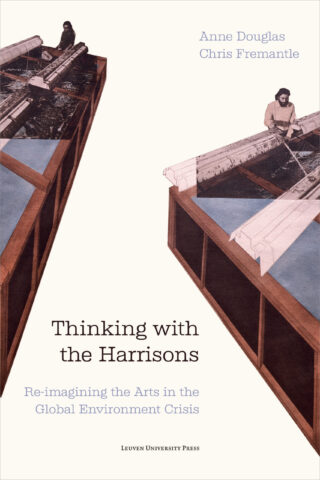
Thinking with the Harrisons
Re-imagining the Arts in the Global Environment Crisis
Anne Douglas (Author), Chris Fremantle (Author),
Category: Americas, Anthropocene Studies, Art, Artistic Practice, Climate and Ecology
Language: English
ISBN: 9789462704268
Publication date: October 9, 2024
€40.00 (including 6% VAT)
Buy NowNumber of pages: 248
Size: 285 x 195 x 15 mm
Illustrations and other content description:
richly illustrated, full colour

Stock item: 162150
Standard delivery time for print books:
For Belgium: 5 to 8 working days
For EU: 2 to 3 weeks
For other countries: 4 to 5 weeks
Category: Americas, Anthropocene Studies, Art, Artistic Practice, Climate and Ecology
Language: English
ISBN: 9789461666161
Publication date: December 5, 2024
€34.00 (including 6% VAT)
Buy NowNumber of pages: 248
Illustrations and other content description:
richly illustrated, full colour
Category: Americas, Anthropocene Studies, Art, Artistic Practice, Climate and Ecology
Language: English
ISBN: 9789461665744
Publication date: October 9, 2024
€34.00 (including 6% VAT)
Buy NowNumber of pages: 248
Illustrations and other content description:
richly illustrated, full colour
What is the role of the arts in the global environmental crisis?
Helen Mayer Harrison and Newton Harrison, known as ‘the Harrisons’, dedicated five decades to exploring and demonstrating a new approach to artistic practice, centred on “doing no work that does not attend to the wellbeing of the web of life.” Their collaborative practice pioneered a way of drawing together art and ecology. They closely observed, often with irony and humour, how human intervention disrupts the dynamics of life as a web of interrelationships. The authors of this book ‘think with’ the Harrisons, critically tracing their poetics as a reimaging and reconfiguring of the arts in response to the unfolding planetary crisis. They draw parallels between the artists’ poetics and rethinking in the philosophy of science, particularly drawing on the work of Isabelle Stengers and Alfred North Whitehead.
Thinking with the Harrisons is for anyone concerned with the implications of ecology as part of a reimagining of public life, including through the interaction of art and science. Throughout their joint practice, the Harrisons sought to engage policy makers, governments, ecologists, artists, and inhabitants of specific places, sensitizing us to the crises that emerge from grounded experiences of place and time.
This publication is GPRC-labeled (Guaranteed Peer-Reviewed Content).
This book will be made open access within three years of publication thanks to Path to Open, a program developed in partnership between JSTOR, the American Council of Learned Societies (ACLS), University of Michigan Press, and The University of North Carolina Press to bring about equitable access and impact for the entire scholarly community, including authors, researchers, libraries, and university presses around the world. Learn more at https://about.jstor.org/path-to-open/
ACKNOWLEDGEMENTS
CHAPTER 1: INTRODUCTION: SEEKING A DIFFERENT PLACE FOR THE ARTS IN SURVIVAL
CHAPTER 2: ‘THINKING WITH’ WHITEHEAD, STENGERS AND THE HARRISONS
The Bifurcation of Nature
Nature as emergent
Adventure and/as a ‘leap of the imagination’
What is ‘adventure’ in the Harrisons’ works?
Inhabiting the bifurcation of nature
CHAPTER 3: THE LAGOON CYCLE
The Poem as Visual Essay
Bifurcation of Nature: Collisions between East and West
Bifurcation of Nature: Exploitation
The Leap of the Imagination
Inventing a field
Adventure
Storytelling
In what sense is The Lagoon Cycle an event?
Conclusions
CHAPTER 4: ON IMPROVISATION
What is improvisation?
An instrument in skilled hands
A fine line between communicability and adventure, between certitude and risk
A predicament, not something freely chosen …
Creating a ‘more to life’
Generative metaphor
What does improvisation make matter?
CHAPTER 5: ON THE POETICS AND AESTHETICS OF SYSTEMS 109 Systems: A way of thinking
Artists and systems – Haacke and Ukeles
Burnham’s Proposed ‘Systems Aesthetics’
The Harrisons’ use of ‘systems’
Spoils Pile Reclamation
Reclamation for whose benefit?
Metaphor as organiser
CHAPTER 6: ON THE POLITICAL
Re-finding humanity: Arendt’s context for writing on the political
Kant’s construction of the political in aesthetics
What does it mean to develop politics based in judgement?
The Harrisons and their publics
The Art of Narrative resides in the Ability to condense the Action into an Exemplary Moment (Kristeva 2020, 17)
The Spectator is not Involved in the Act (Arendt 1992, 63)
Mortality, Communicability, Freedom
How does the political as outlined here work with codes of conduct and constitutional forms?
Otherwise the race of devils would destroy themselves (Arendt 1992, 18)
What to do?
CHAPTER 7: ARTISTS ‘THINKING WITH’ ONE ANOTHER
On questions that drive practice
Pedagogy: Curriculum Proposals
Ballengée, Bon, Goto-Collins and Collins, Sprinkle and Stephens, Wallen
A Wider Reimagining of the Role of the Arts
CONCLUSIONS
NOTES
TIMELINE
REFERENCES
INDEX
Anne Douglas
Anne Douglas is a professor emerita, Gray’s School of Art, Robert Gordon University, Scotland, who explores the changing place of the artist in public life. Her research has increasingly focused on art and the environmental crisis from a practice-led perspective. She co-produced the Harrisons’ work ‘On the Deep Wealth of this Nation: Scotland’ (2017) in collaboration with Newton Harrison and the Centre for the Study of the Force Majeure, University of California Santa Cruz.
Chris Fremantle
Chris Fremantle is a researcher and producer of award-winning projects, including the Harrisons’ project ‘Greenhouse Britain: Losing Ground, Gaining Wisdom’. He is a longstanding member of the international ecoart network and co-editor of ‘Ecoart in Action’, a collection of activities, case studies and provocations drawn from the network. He lectures at Gray’s School of Art, Robert Gordon University, Scotland.
"As pioneers of environmental art, Newton and Helen Harrison were fifty years ahead of their time. Their proposal was for nothing less than a new paradigm for research, at once earth-centred, open-ended, responsive and communal, uniting science and art around urgent questions of planetary ecology. In this book, Anne Douglas and Chris Fremantle offer the first full-length appraisal of the Harrisons’ work. In a world reeling from the destructive impacts of unfettered technoscience, its relevance has never been greater." - Tim Ingold, University of Aberdeen
“A new aesthetic, one grounded in ecology, is needed to address the daunting challenges of our time. Helen Mayer Harrison and Newton Harrison made art for over fifty years focused on the connection of living organisms with each other and their environments. The Harrisons’ oeuvre and this fine book help to recenter the arts in our global ecological crises.” - Frederick Steiner, University of Pennsylvania, Stuart Weitzman School of Design
“Through a deeply considered re-examination of the work of the Harrisons, Douglas and Fremantle remind us that many of the answers to address the crisis of climate change already exist. This book offers an enlightened framework to see a different future for the arts within the ecological solutions needed for our world today.” - Cameron Cartiere, Emily Carr University of Art + Design
The passage of time has only confirmed the prescience and centrality of the Harrison’s work for understanding our current planetary crisis, and the crucial role that art can play in addressing it. This extensive, historically and theoretically informed analysis of their work is long overdue and a real joy to read. It’s well past time for the broader art world to fully acknowledge the importance of the Harrisons’ work, and this book is an essential starting point for that process. - Grant Kester, University of California San Diego
All this said, I believe this is an immensely valuable book that needs to be studied and digested in the widest possible educational context, not simply by those involved in teaching the arts and by students on degree and masters level art and design courses. Whether or not that will happen is obviously an open question. However, if by ill-chance this book does not find its rightful place on college and university reading lists, which are still all-too-often compiled by academics sheltering behind the narrow protectionism inherent in disciplinary specialism, I can only fervently hope that it becomes an ‘underground classic’. One of those books that lively and imaginative individuals and groups will delight in sharing, discussing and acting upon.- Iain Biggs, October 2024, https://www.iainbiggs.co.uk/2024/10/thinking-with-the-harrisons-re-imagining-the-arts-in-the-global-environmental-crisis-leuven-university-press-october-9th-2024-a-review/
Frequently Asked Questions
What is "Thinking with the Harrisons" about?
What is the role of the arts in the global environmental crisis?
Helen Mayer Harrison and Newton Harrison, known as ‘the Harrisons’, dedicated five decades to exploring and demonstrating a new approach to artistic practice, centred on “doing no work that does not attend to the wellbeing of the web of life.” Their collaborative practice pioneered a way of drawing together art and ecology. They closely observed, often with irony and humour, how human intervention disrupts the dynamics of life as a web of interrelationships. The authors of this book ‘think with’ the Harrisons, critically tracing their poetics as a reimaging and reconfiguring of the arts in response to the unfolding planetary crisis. They draw parallels between the artists’ poetics and rethinking in the philosophy of science, particularly drawing on the work of Isabelle Stengers and Alfred North Whitehead.
Thinking with the Harrisons is for anyone concerned with the implications of ecology as part of a reimagining of public life, including through the interaction of art and science. Throughout their joint practice, the Harrisons sought to engage policy makers, governments, ecologists, artists, and inhabitants of specific places, sensitizing us to the crises that emerge from grounded experiences of place and time.
This publication is GPRC-labeled (Guaranteed Peer-Reviewed Content).
This book will be made open access within three years of publication thanks to Path to Open, a program developed in partnership between JSTOR, the American Council of Learned Societies (ACLS), University of Michigan Press, and The University of North Carolina Press to bring about equitable access and impact for the entire scholarly community, including authors, researchers, libraries, and university presses around the world. Learn more at https://about.jstor.org/path-to-open/
Who wrote "Thinking with the Harrisons"?
"Thinking with the Harrisons" was written by Anne Douglas and Chris Fremantle.
Anne Douglas is a professor emerita, Gray’s School of Art, Robert Gordon University, Scotland, who explores the changing place of the artist in public life. Her research has increasingly focused on art and the environmental crisis from a practice-led perspective. She co-produced the Harrisons’ work ‘On the Deep Wealth of this Nation: Scotland’ (2017) in collaboration with Newton Harrison and the Centre for the Study of the Force Majeure, University of California Santa Cruz.
Chris Fremantle is a researcher and producer of award-winning projects, including the Harrisons’ project ‘Greenhouse Britain: Losing Ground, Gaining Wisdom’. He is a longstanding member of the international ecoart network and co-editor of ‘Ecoart in Action’, a collection of activities, case studies and provocations drawn from the network. He lectures at Gray’s School of Art, Robert Gordon University, Scotland.
What is the Table of Contents for "Thinking with the Harrisons"?
ACKNOWLEDGEMENTS
CHAPTER 1: INTRODUCTION: SEEKING A DIFFERENT PLACE FOR THE ARTS IN SURVIVAL
CHAPTER 2: ‘THINKING WITH’ WHITEHEAD, STENGERS AND THE HARRISONS
The Bifurcation of Nature
Nature as emergent
Adventure and/as a ‘leap of the imagination’
What is ‘adventure’ in the Harrisons’ works?
Inhabiting the bifurcation of nature
CHAPTER 3: THE LAGOON CYCLE
The Poem as Visual Essay
Bifurcation of Nature: Collisions between East and West
Bifurcation of Nature: Exploitation
The Leap of the Imagination
Inventing a field
Adventure
Storytelling
In what sense is The Lagoon Cycle an event?
Conclusions
CHAPTER 4: ON IMPROVISATION
What is improvisation?
An instrument in skilled hands
A fine line between communicability and adventure, between certitude and risk
A predicament, not something freely chosen …
Creating a ‘more to life’
Generative metaphor
What does improvisation make matter?
CHAPTER 5: ON THE POETICS AND AESTHETICS OF SYSTEMS 109 Systems: A way of thinking
Artists and systems – Haacke and Ukeles
Burnham’s Proposed ‘Systems Aesthetics’
The Harrisons’ use of ‘systems’
Spoils Pile Reclamation
Reclamation for whose benefit?
Metaphor as organiser
CHAPTER 6: ON THE POLITICAL
Re-finding humanity: Arendt’s context for writing on the political
Kant’s construction of the political in aesthetics
What does it mean to develop politics based in judgement?
The Harrisons and their publics
The Art of Narrative resides in the Ability to condense the Action into an Exemplary Moment (Kristeva 2020, 17)
The Spectator is not Involved in the Act (Arendt 1992, 63)
Mortality, Communicability, Freedom
How does the political as outlined here work with codes of conduct and constitutional forms?
Otherwise the race of devils would destroy themselves (Arendt 1992, 18)
What to do?
CHAPTER 7: ARTISTS ‘THINKING WITH’ ONE ANOTHER
On questions that drive practice
Pedagogy: Curriculum Proposals
Ballengée, Bon, Goto-Collins and Collins, Sprinkle and Stephens, Wallen
A Wider Reimagining of the Role of the Arts
CONCLUSIONS
NOTES
TIMELINE
REFERENCES
INDEX
Related titles
 Reimagining Knowledge in the Amazon Rainforest
Beatrice Bonami (Editor), Paula Helm (Editor), Roanne van Voorst (Editor), Adriano Clayton da Silva (Editor),
January 2027

 Collective Trauma and Future Fantasies
Raika Khorshidian (Editor), Birgit Mersmann (Editor), Cathrine Bublatzky (Editor), Julia Stenzel (Editor),
November 2026
 The Romero Memory
Judith Gruber (Editor), Jonas Van Mulder (Editor), Stephan Parmentier (Editor), Veerle Draulans (Editor), Joren Janssens (Editor), Jacques Haers (Editor), Kim Christiaens (Editor),
November 2026
 Feminists Resisting Gendered Violence
Hemangini Gupta (Editor), Fiona Mackay (Editor), Jan Breckenridge (Editor), Louise Chappell (Editor), Rachna Mehra (Editor), Rukmini Sen (Editor), Mailin Suchting (Editor),
October 2026
 A City in Practice
Aude Tournaye (Editor), Filip De Boeck (Editor), Picha Collective (Editor),
September 2026
 Ecologies of Photography in the American West
Monica Bravo (Editor), Carolin Görgen (Editor),
September 2026
 Political Exile in the Global Twentieth Century
Wolfram Kaiser (Editor), Piotr H. Kosicki (Editor),
April 2026
 Jean Katambayi Mukendi
Johannes Muselaers (Editor), Stéphane Symons (Editor), Anne-Claire Schmitz (Editor), Emma Enderby (Editor),
April 2026
 Nomadic Camera
Burcu Dogramaci (Editor), Winfried Gerling (Editor), Jens Jäger (Editor), Birgit Mersmann (Editor),
March 2026
 Comics and the Global South
Andrea Aramburú (Editor), Dibyadyuti Roy (Editor), Joe Sutliff Sanders (Editor),
February 2026
 Entangled Art Histories
Valérie Mavridorakis (Editor), Alexander Streitberger (Editor), Hilde Van Gelder (Editor), Erik Verhagen (Editor),
October 2025
 Violence and Trauma in Contemporary Performance
Sofie de Smet (Editor), Marieke Breyne (Editor), Pedzisai Maedza (Editor), Christel Stalpaert (Editor),
May 2025
 Cross-Cultural Heritage
Jonas Van Mulder (Editor), Thomas Coomans (Editor), Dries Vanysacker (Editor),
April 2025