

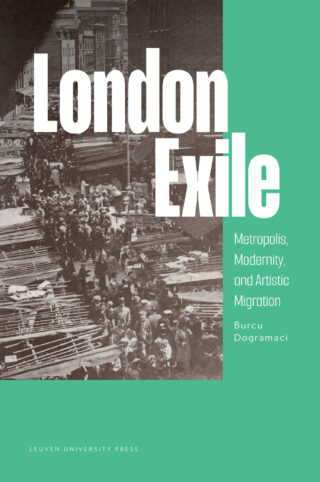

London Exile
Metropolis, Modernity, and Artistic Migration
Burcu Dogramaci (Author),

Category: Art, Artistic Practice, History 1800-present, Migration Studies, Urban Studies
Language: English
ISBN: 9789462704671
Publication date: September 1, 2025
€59.50 (including 6% VAT)
Buy NowNumber of pages: 600
Size: 234 x 156 x mm
Number of illustrations: 281
Illustrations and other content description:
Illustrated, full colour

Funded by: ERC
KU Leuven Fund for Fair Open Access
Open Book Collective
Stock item: 167536
Standard delivery time for print books:
For Belgium: 5 to 8 working days
For EU: 2 to 3 weeks
For other countries: 4 to 5 weeks
Category: Art, Artistic Practice, History 1800-present, Migration Studies, Urban Studies
Language: English
ISBN: 9789461666574
Publication date: August 18, 2025
Download Free EpubNumber of pages: 600
Number of illustrations: 281
Illustrations and other content description:
Illustrated, full colour
Funded by: ERC
KU Leuven Fund for Fair Open Access
Open Book Collective
Category: Art, Artistic Practice, History 1800-present, Migration Studies, Urban Studies
Language: English
ISBN: 9789461666567
Publication date: August 18, 2025
Download Free PDFNumber of pages: 600
Number of illustrations: 281
Illustrations and other content description:
Illustrated, full colour
Funded by: ERC
KU Leuven Fund for Fair Open Access
Open Book Collective
A new approach to modern art shaped by exile and migration.
In the 1930s and 1940s, London was a metropolis of artistic exile and a place of refuge from Nazi persecution. London Exile is the first book to look at the British capital as a sanctuary for modern artists. The city presented its new arrivals with opportunities and challenges: exiles established galleries, founded publishing houses and magazines, collaborated with local artists, organised exhibitions, published their work, and built networks. Artistic and theoretical production flourished in close dialogue with urban space.
This volume sheds light on how the arrival of exiles transformed London’s art scene and, conversely, how the experience of displacement and the city shaped the work of émigrés in fields such as art, architecture, and photography. London Exile brings art history, urban studies, and exile studies into a vibrant dialogue and contributes to a new understanding of the history of modern art.
- Prologue: London, Metropolis of Artistic Exile 9
- Arrival and Orientation: Address Books, Street Maps, and Undergrounds 23
- Neighbourhoods, Streets, and Houses: Exile History as Urban History 41
- Gendered London: Gender, Sexuality, and Exile 65
- Émigrés Build for Émigrés 83
- Transplanted Objects: Sigmund Freud’s Collection and Chair 103
- Sculpture, Modernity, and Exile: Jussuf Abbo in London 121
- From Bauhaus to the Thames: Textile Designs by Margaret Leischner 143
- In the Blitz: Helmut Gernheim’s Photographs of National Monuments 161
- Portrait of a City: Streets and Faces of Exile 179
- London Zoo: Animal, City, and Exile 203
- Storytelling in Pictures: Stefan Lorant and the Picture Post Photographers 249
- Reading Exile: Publishers and Books as Multipliers 281
- Immortal Portraits: Exile, London, and the Historiography of Early Photography 305
- Back to History: Ludwig Meidner and the British Caricature 325
- Pencil as Weapon: Richard Ziegler, Walter Trier, and Die Zeitung 337
- Exhibited Exile: Exhibitions by and with Émigrés 361
- Show It: Galleries as Places of Distribution of Modernity in Exile 381
- Allies inside Germany and English Art and the Mediterranean: Exhibitions in and outside London 413
- Beyond London: Rosa Schapire, Expressionism, and/in Leicester 441
- Epilogue: Self-descriptions of Exile – A Look Back 463
Afterword and Acknowledgements 475
Notes 479
Bibliography 537
Index of Persons, Institutions, and Periodicals 589
Burcu Dogramaci
Burcu Dogramaci is Professor of Art History and Director of the Käte Hamburger Research Centre global dis:connect at the Ludwig-Maximilians-Universität München.
Burcu Dogramaci’s London Exile constitutes the definitive history of how the cultural workers who fled Nazi Germany—from artists, photographers, designers, and sculptors to publishers and gallerists—were shaped by their emigration. It also tells the story of how these immigrants left indelible marks on their city of refuge and how their work there forever changed London, remaking it into the celebrated modern cultural metropolis that it is today. - Elizabeth Otto, University at Buffalo, The State University of New York
Frequently Asked Questions
What is "London Exile" about?
A new approach to modern art shaped by exile and migration.
In the 1930s and 1940s, London was a metropolis of artistic exile and a place of refuge from Nazi persecution. London Exile is the first book to look at the British capital as a sanctuary for modern artists. The city presented its new arrivals with opportunities and challenges: exiles established galleries, founded publishing houses and magazines, collaborated with local artists, organised exhibitions, published their work, and built networks. Artistic and theoretical production flourished in close dialogue with urban space.
This volume sheds light on how the arrival of exiles transformed London’s art scene and, conversely, how the experience of displacement and the city shaped the work of émigrés in fields such as art, architecture, and photography. London Exile brings art history, urban studies, and exile studies into a vibrant dialogue and contributes to a new understanding of the history of modern art.
Who wrote "London Exile"?
"London Exile" was written by Burcu Dogramaci.
Burcu Dogramaci is Professor of Art History and Director of the Käte Hamburger Research Centre global dis:connect at the Ludwig-Maximilians-Universität München.
Is "London Exile" available Open Access?
Yes, "London Exile" is published Open Access. It is available under a BY-NC-ND license.
Who funded the publication of "London Exile"?
Publication of "London Exile" was funded by ERC
KU Leuven Fund for Fair Open Access
Open Book Collective
.
What is the Table of Contents for "London Exile"?
- Prologue: London, Metropolis of Artistic Exile 9
- Arrival and Orientation: Address Books, Street Maps, and Undergrounds 23
- Neighbourhoods, Streets, and Houses: Exile History as Urban History 41
- Gendered London: Gender, Sexuality, and Exile 65
- Émigrés Build for Émigrés 83
- Transplanted Objects: Sigmund Freud’s Collection and Chair 103
- Sculpture, Modernity, and Exile: Jussuf Abbo in London 121
- From Bauhaus to the Thames: Textile Designs by Margaret Leischner 143
- In the Blitz: Helmut Gernheim’s Photographs of National Monuments 161
- Portrait of a City: Streets and Faces of Exile 179
- London Zoo: Animal, City, and Exile 203
- Storytelling in Pictures: Stefan Lorant and the Picture Post Photographers 249
- Reading Exile: Publishers and Books as Multipliers 281
- Immortal Portraits: Exile, London, and the Historiography of Early Photography 305
- Back to History: Ludwig Meidner and the British Caricature 325
- Pencil as Weapon: Richard Ziegler, Walter Trier, and Die Zeitung 337
- Exhibited Exile: Exhibitions by and with Émigrés 361
- Show It: Galleries as Places of Distribution of Modernity in Exile 381
- Allies inside Germany and English Art and the Mediterranean: Exhibitions in and outside London 413
- Beyond London: Rosa Schapire, Expressionism, and/in Leicester 441
- Epilogue: Self-descriptions of Exile – A Look Back 463
Afterword and Acknowledgements 475
Notes 479
Bibliography 537
Index of Persons, Institutions, and Periodicals 589
Related titles
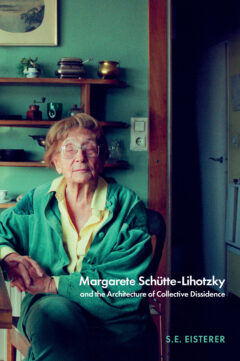 Margarete Schütte-Lihotzky and the Architecture of Collective Dissidence, 1918–1989
S.E. Eisterer (Author),
April 2027
 Collective Trauma and Future Fantasies
Raika Khorshidian (Editor), Birgit Mersmann (Editor), Cathrine Bublatzky (Editor), Julia Stenzel (Editor),
November 2026
 Infrastructuring Arrival
Karel Arnaut (Editor), Luce Beeckmans (Editor), Bruno Meeus (Editor),
November 2026
 Feminists Resisting Gendered Violence
Hemangini Gupta (Editor), Fiona Mackay (Editor), Jan Breckenridge (Editor), Louise Chappell (Editor), Rachna Mehra (Editor), Rukmini Sen (Editor), Mailin Suchting (Editor),
October 2026
 A City in Practice
Aude Tournaye (Editor), Filip De Boeck (Editor), Picha Collective (Editor),
September 2026
 Ecologies of Photography in the American West
Monica Bravo (Editor), Carolin Görgen (Editor),
September 2026
 German–Rapanui Entanglements
Cristián Moreno Pakarati (Editor), Diego Muñoz (Editor), Philipp Schorch (Editor),
August 2026
 Cinema in Post-War Belgium
Gertjan Willems (Editor), Bjorn Gabriels (Editor), Bénédicte Rochet (Editor),
May 2026
 Performing Magnetism
Eleonora Paklons (Editor), Kristof Smeyers (Editor), Kurt Vanhoutte (Editor), Hannah Welslau (Editor),
May 2026
 Jean Katambayi Mukendi
Johannes Muselaers (Editor), Stéphane Symons (Editor), Anne-Claire Schmitz (Editor), Emma Enderby (Editor),
April 2026
 Political Exile in the Global Twentieth Century
Wolfram Kaiser (Editor), Piotr H. Kosicki (Editor),
April 2026
 Christian Democracy and the Fall of Communism
Michael Gehler (Editor), Piotr H. Kosicki (Editor), Helmut Wohnout (Editor),
April 2026
 Brusselse plaatsnamen
Iadine Degryse (Editor), Benjamin Wayens (Editor), Chantal Kesteloot (Editor), Dennis De Vriese (Editor), Matthijs Degraeve (Editor),
April 2026
 Nomadic Camera
Burcu Dogramaci (Editor), Winfried Gerling (Editor), Jens Jäger (Editor), Birgit Mersmann (Editor),
March 2026