

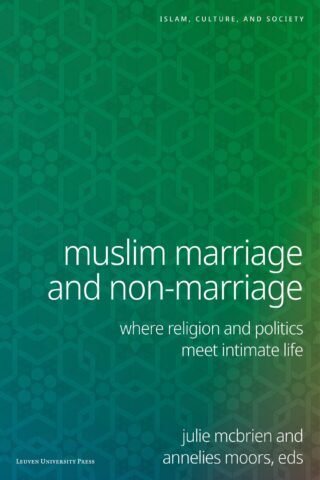

Muslim Marriage and Non-Marriage
Where Religion and Politics Meet Intimate Life
Julie McBrien (Editor), Annelies Moors (Editor),

Series: Islam, Culture and Society
Category: Social Science
Language: English
ISBN: 9789462703810
Publication date: November 9, 2023
€42.00 (including 6% VAT)
Buy NowNumber of pages: 370
Size: 234 x 156 x 18 mm

Funded by: KU Leuven Fund for Fair Open Access
University of Amsterdam
Stock item: 157471
Standard delivery time for print books:
For Belgium: 5 to 8 working days
For EU: 2 to 3 weeks
For other countries: 4 to 5 weeks
Series: Islam, Culture and Society
Category: Social Science
Language: English
ISBN: 9789461665423
Publication date: October 30, 2023
Download Free PDFNumber of pages: 370
Funded by: KU Leuven Fund for Fair Open Access
University of Amsterdam
Perspectives and practices of couples in unconventional Muslim marriages.
Unconventional Muslim marriages have been topics of heated public debate. Around the globe, religious scholars, policy makers, political actors, media personalities, and women’s activists discuss, promote, or reject unregistered, transnational, interreligious and other boundary-crossing marriages. Couples entering into such marriages, however, often have different concerns from those publicly discussed. Based on ethnographic research in Europe, the Middle East, North Africa and Asia, the chapters of this volume examine couples’ motivations for, aspirations about, and abilities to enter into these marriages. The contributions show the diverse ways in which such marriages are concluded, and inquire into how they are performed, authorized or contested as Muslim marriages. These marriages may challenge existing ties of belonging and transform boundaries between religious and other communities, but they may also, and sometimes simultaneously, reproduce and solidify them.
Building on insights from different disciplines, both from the social sciences (anthropology, political science, gender and sexuality studies) and from the humanities (history, Islamic legal studies, religious studies), the authors address a wide range of controversial Muslim marriages (unregistered, interreligious, transnational, etc.), and include the views of religious scholars, state authorities, and political actors and activists, as well as the couples themselves, their families, and their wider social circle.
Contributors: Joud Alkorani (Radboud University), Rahma Bavelaar (University of Applied Sciences Leiden), Loubna Elmorabet (University of Amsterdam), Annerienke Fioole (University of Amsterdam), Shifra Kisch (University College Utrecht), Iris Kolman (University of Amsterdam), Martijn de Koning (Radboud University), Eva F. Nisa (Australian National University), Ibtisam Sadegh (University of Malta), Samah Saleh (An-Najah National University), Vanessa Vroon-Najem (Amsterdam Museum), Dina Zbeidy (University of Applied Sciences Leiden).
Ebook available in Open Access.
This publication is GPRC-labeled (Guaranteed Peer-Reviewed Content).
Acknowledgements
Introduction
Muslim Marriage and Non-Marriage: Religion, Politics, and Intimate Life
Annelies Moors and Julie McBrien
Part I—The Politicization of Marriage: Problematization, Agency, and Activism
Troublesome Marriages and the Politics of the Future in Kyrgyzstan
Julie McBrien
Problematizing Early Marriages : Development Narratives and Refugee Experiences in Jordan
Dina Zbeidy
The Politics of Cohesion : Salafi Preachers and the Problematization of Muslim Marriages in the Netherlands
Martijn de Koning
Palestinian Women Prisoners : The Relational Politics of Incarceration, Marriage, and Separation
Samah Saleh and Annelies Moors
Part II—The Micro-politics of (Non-)marriage: Intimacy, Materiality, and Social Transformation
Cohabitation and ‘Urfi Marriages in Tunisia : Public Discourse and Personal Narratives
Iris Kolman
Exceptionally Ordinary: Singling out Single Mothers in Morocco
Annerienke Fioole
Configuring Communities: The Materialities of Dubai’s Migrant Marriages
Joud Alkorani
The Dower among Moroccan Muslims in the Netherlands : Generational and Gendered Shifts
Loubna el Morabet
When Islamic Marriage Travels to the Netherlands : Convert Muslim Women (Re)Signifying the Marriage Guardian and the Dower
Annelies Moors and Vanessa Vroon-Najem
Part III—Interfaith Marriage: Religious Difference and Multiple Positionalities
The Intimate Politics of Publicly Staging “Mixed Couples” : The Gendered Racialization of a Poster Campaign
Shifra Kisch, Rahma Bavelaar, and Annelies Moors
“We are an Example of Ceuta’s Convivencia” : Muslim–Christian Marriages at Europe’s North-African Border
Ibtisam Sadegh
Interfaith Marriages in Indonesia : Between the Law, State Ideology, and Progressive Muslim Voices
Eva F. Nisa
Contracting Coptic-Muslim Marriage in Egypt : Class, Gender, and Clerical Mediation in the Administrative Management of Religious “Crossings”
Rahma Bavelaar
About the authors
Julie McBrien
Julie McBrien is Associate Pofessor in the Department of Anthropology and Director of the Amsterdam Research Centre for Gender and Sexuality, both at the University of Amsterdam.
Annelies Moors
Annelies Moors is an anthropologist and Professor Emerita at the University of Amsterdam. Most recently she was the principal investigator of the ERC advanced grant ‘Muslim Marriages’ and held the NIAS fellowship ‘The Struggle for the Future of Ethnography’.
The focus on the agency of women and men alike resets the discussion of these marriages, much of which had positioned women as victims. The transregional theme allows the editors to make novel observations about the malleability of Muslim marriage in different cultural and social settings. The variety of cases present a wide array of voices from different genders, classes, religious groups, and geographical settings and give the reader a good sense of how this variety of voices and settings lends complexity to the discussion of Muslim marriage. Judith E. Tucker, Georgetown University
Moors and McBrien’s collection dynamically displays the global diversity of Muslim marriages. They capture what makes marriages “Muslim,” while documenting the vast array of experience, expediency, and agency of Muslim women and men, in the face of the state, religious institutions, and on the ground socio-political-cultural conditions. An ethnographically rich curation of lived realities.
Suad Joseph, University of California, Davis
A unique book that combines lucid theoretical perspectives on a variety of current "controversies" about Muslim marriages with a rich set of fine-grained ethnographic explorations of the life stories of those involved in these kinds of marriages. The intimate stories expose the very politics of "problematizing" certain marriages and marriage practices while the careful analyses unpack the stakes of those generating the controversies, whether states, political parties, religious authorities, or families. The personal experiences reveal the complex conditions of these actual marriages and let us see how individual women's personal and social circumstances, considerations, desires and even affects shape their marriage choices. Beautifully researched and sharply conceptualized, this book is sure to change the conversation. Lila Abu-Lughod, Columbia University
Muslim marriage practices have evolved and changed across the Global North and South, with problematising discourses dominating the treatment of ‘boundary-crossing’ unregistered marriages. In this volume, leading researchers in the field draw on long-term empirical projects evidencing such practices in multiple state settings from both the North and South, providing a unique insight into evolving norms and practices and state engagement. The insights of the multiple authors, and Moors and McBrien, offer a significant contribution to our understanding of the problematising discourse and the experiences of those engaging in such marriages.
Rajnaara Akhtar, University of Warwick
Overall, this edited volume is a compelling work that not only contributes to scholarly discussions on Muslim (non) marriages but also provides valuable insights for anyone interested in the ever-shifting contours of religious, political, and personal sensibilities and dispositions. Ultimately, it forces us to confront the fact that relationships, in all their forms and shapes, are never merely personal but are also very much political. - Deniz Aktaş, Marriage, Families & Spirituality, 31/2 (2025)
Frequently Asked Questions
What is "Muslim Marriage and Non-Marriage" about?
Perspectives and practices of couples in unconventional Muslim marriages.
Unconventional Muslim marriages have been topics of heated public debate. Around the globe, religious scholars, policy makers, political actors, media personalities, and women’s activists discuss, promote, or reject unregistered, transnational, interreligious and other boundary-crossing marriages. Couples entering into such marriages, however, often have different concerns from those publicly discussed. Based on ethnographic research in Europe, the Middle East, North Africa and Asia, the chapters of this volume examine couples’ motivations for, aspirations about, and abilities to enter into these marriages. The contributions show the diverse ways in which such marriages are concluded, and inquire into how they are performed, authorized or contested as Muslim marriages. These marriages may challenge existing ties of belonging and transform boundaries between religious and other communities, but they may also, and sometimes simultaneously, reproduce and solidify them.
Building on insights from different disciplines, both from the social sciences (anthropology, political science, gender and sexuality studies) and from the humanities (history, Islamic legal studies, religious studies), the authors address a wide range of controversial Muslim marriages (unregistered, interreligious, transnational, etc.), and include the views of religious scholars, state authorities, and political actors and activists, as well as the couples themselves, their families, and their wider social circle.
Contributors: Joud Alkorani (Radboud University), Rahma Bavelaar (University of Applied Sciences Leiden), Loubna Elmorabet (University of Amsterdam), Annerienke Fioole (University of Amsterdam), Shifra Kisch (University College Utrecht), Iris Kolman (University of Amsterdam), Martijn de Koning (Radboud University), Eva F. Nisa (Australian National University), Ibtisam Sadegh (University of Malta), Samah Saleh (An-Najah National University), Vanessa Vroon-Najem (Amsterdam Museum), Dina Zbeidy (University of Applied Sciences Leiden).
Ebook available in Open Access.
This publication is GPRC-labeled (Guaranteed Peer-Reviewed Content).
Who edited "Muslim Marriage and Non-Marriage"?
"Muslim Marriage and Non-Marriage" was edited by Julie McBrien and Annelies Moors.
Julie McBrien is Associate Pofessor in the Department of Anthropology and Director of the Amsterdam Research Centre for Gender and Sexuality, both at the University of Amsterdam.
Annelies Moors is an anthropologist and Professor Emerita at the University of Amsterdam. Most recently she was the principal investigator of the ERC advanced grant ‘Muslim Marriages’ and held the NIAS fellowship ‘The Struggle for the Future of Ethnography’.
Is "Muslim Marriage and Non-Marriage" part of a series?
Yes, "Muslim Marriage and Non-Marriage" is part of the "Islam, Culture and Society" series.

The peer-reviewed book series Islam, Culture, and Society provides a strong academic platform for national and international scholars engaged in research on Muslim societies from various perspectives and disciplines. The series promotes a multidisciplinary approach and welcomes contributions from all fields of the Humanities and Social Sciences, including theology, religious studies, history, law, philosophy, philology, literature, anthropology, sociology, social and cultural psychology, cultural studies, and the arts.
Topics of particular interest to the series include the interdisciplinary role of history, social behaviour, religious (and other) identities, local traditions, and cultural and legal systems, as well as diversity, inclusion, and tolerance in (re)shaping the plurality, changeability, diversity and global interconnectedness of Muslim cultures and societies.
All volumes in the series present cutting-edge scholarship and foster ongoing scholarly debates related to the historical and contemporary facets of Muslim societies. In doing so, Islam, Culture, and Society contributes to a more comprehensive, profound, and more nuanced understanding of the complexities of Muslim practices and perspectives in the social, cultural, psychological and religious spheres within a globalized world.
The series Islam, Culture, and Society is an initiative of the Leuven Centre for the Study of Islam, Culture, and Society (LCSICS).
The editors accept monographs and edited volumes covering a broad appeal of topics in a wide geographic range, including North Africa, the Middle East, Sub-Saharan Africa, Central Asia, South and Southeast Asia, and Muslim communities in the West.
The series welcomes contributions by established scholars as well as by promising young researchers, and embraces diversity in terms of gender, nationality, and ethnicity.
The main publication language of the series is English, although selective room is offered to titles in Dutch, French and Arabic. All books are written for an international audience of scholars. All manuscripts are subject to peer review.
Series editors
Chaïma Ahaddour (Faculty of Theology and Religious Studies, KU Leuven)
Nadia Fadil (Faculty of Social Sciences, KU Leuven)
Arjan Post (Faculty of Arts, KU Leuven)
Umar Ryad (Faculty of Arts, KU Leuven)
Editorial board
Ahmet Alibašić (University of Sarajevo)
Martijn de Koning (Radboud University – Nijmegen)
Mohammed Ghaly (University of Hamad Bin Khalifa – Doha)
Christian Lange (Utrecht University)
Jon Hoover (University of Nottingham)
Helge Daniëls (KU Leuven)
Advisory board
Albrecht Fuess (University of Marburg)
Agata S. Nalborczyk (University of Warsaw)
Jonathan Brown (Georgetown University)
John Brockopp (The Pennsylvania State University)
Annelies Moors (University of Amsterdam)
Pascal Buresi (French National Centre for Scientific Research – Paris)
Proposals
Proposals and enquiries can be sent to Umar Ryad.
Please make use of the submission form to present your manuscript or proposal to our board.
Authors interested in Open Access can consult the available funding options.
Links & Resources
Is "Muslim Marriage and Non-Marriage" available Open Access?
Yes, "Muslim Marriage and Non-Marriage" is published Open Access. It is available under a BY-NC-ND license.
Who funded the publication of "Muslim Marriage and Non-Marriage"?
Publication of "Muslim Marriage and Non-Marriage" was funded by KU Leuven Fund for Fair Open Access
University of Amsterdam
.
What is the Table of Contents for "Muslim Marriage and Non-Marriage"?
Acknowledgements
Introduction
Muslim Marriage and Non-Marriage: Religion, Politics, and Intimate Life
Annelies Moors and Julie McBrien
Part I—The Politicization of Marriage: Problematization, Agency, and Activism
Troublesome Marriages and the Politics of the Future in Kyrgyzstan
Julie McBrien
Problematizing Early Marriages : Development Narratives and Refugee Experiences in Jordan
Dina Zbeidy
The Politics of Cohesion : Salafi Preachers and the Problematization of Muslim Marriages in the Netherlands
Martijn de Koning
Palestinian Women Prisoners : The Relational Politics of Incarceration, Marriage, and Separation
Samah Saleh and Annelies Moors
Part II—The Micro-politics of (Non-)marriage: Intimacy, Materiality, and Social Transformation
Cohabitation and ‘Urfi Marriages in Tunisia : Public Discourse and Personal Narratives
Iris Kolman
Exceptionally Ordinary: Singling out Single Mothers in Morocco
Annerienke Fioole
Configuring Communities: The Materialities of Dubai’s Migrant Marriages
Joud Alkorani
The Dower among Moroccan Muslims in the Netherlands : Generational and Gendered Shifts
Loubna el Morabet
When Islamic Marriage Travels to the Netherlands : Convert Muslim Women (Re)Signifying the Marriage Guardian and the Dower
Annelies Moors and Vanessa Vroon-Najem
Part III—Interfaith Marriage: Religious Difference and Multiple Positionalities
The Intimate Politics of Publicly Staging “Mixed Couples” : The Gendered Racialization of a Poster Campaign
Shifra Kisch, Rahma Bavelaar, and Annelies Moors
“We are an Example of Ceuta’s Convivencia” : Muslim–Christian Marriages at Europe’s North-African Border
Ibtisam Sadegh
Interfaith Marriages in Indonesia : Between the Law, State Ideology, and Progressive Muslim Voices
Eva F. Nisa
Contracting Coptic-Muslim Marriage in Egypt : Class, Gender, and Clerical Mediation in the Administrative Management of Religious “Crossings”
Rahma Bavelaar
About the authors
What is the DOI for "Muslim Marriage and Non-Marriage"?
The Digital Object Identifier (DOI) for "Muslim Marriage and Non-Marriage" is 10.11116/9789461665423.
Related titles
 The Romero Memory
Judith Gruber (Editor), Jonas Van Mulder (Editor), Stephan Parmentier (Editor), Veerle Draulans (Editor), Joren Janssens (Editor), Jacques Haers (Editor), Kim Christiaens (Editor),
November 2026
 Infrastructuring Arrival
Karel Arnaut (Editor), Luce Beeckmans (Editor), Bruno Meeus (Editor),
November 2026
 Feminists Resisting Gendered Violence
Hemangini Gupta (Editor), Fiona Mackay (Editor), Jan Breckenridge (Editor), Louise Chappell (Editor), Rachna Mehra (Editor), Rukmini Sen (Editor), Mailin Suchting (Editor),
October 2026
 German–Rapanui Entanglements
Cristián Moreno Pakarati (Editor), Diego Muñoz (Editor), Philipp Schorch (Editor),
August 2026
 Teaching About the Violent Past
Line Kuppens (Author), Justin Sheria Nfundiko (Author),
October 2025
 Integration Otherwise Inspiration Kit
Luce Beeckmans (Author), Dounia Salamé (Author), Martina Bovo (Author), Mary Hogan (Author),
June 2025
 Newcomers Navigating the Welfare State
Hanne Vandermeerschen (Editor), Elsa Mescoli (Editor), Jean-Michel Lafleur (Editor), Peter De Cuyper (Editor),
December 2023
 Islamophobia as a Form of Radicalisation
Leen d’Haenens (Editor), Abdelwahed Mekki-Berrada (Editor),
March 2023
 Exploring the Transnational Neighbourhood
Stephan Ehrig (Editor), Britta C. Jung (Editor), Gad Schaffer (Editor),
October 2022
 Handbook for Ethiopian Public Administration Program Accreditation
Bacha Kebede Debela (Editor), Geert Bouckaert (Editor), Berhanu Temesgen Eshetu (Editor), Chala Deyessa Fita (Editor), Hailu Megersa Tola (Editor), Kiflie Worku Angaw (Editor), Shumey Berhie Teshome (Editor), Solomon Gebreyohans Gebru (Editor),
June 2022