

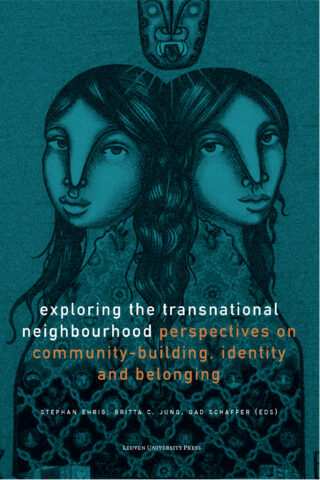

Exploring the Transnational Neighbourhood
Perspectives on Community-Building, Identity and Belonging
Stephan Ehrig (Editor), Britta C. Jung (Editor), Gad Schaffer (Editor),

Category: Americas, Anthropology, Art, Literature, Migration Studies, Social Science, Urban Studies
Language: English
ISBN: 9789462703483
Publication date: October 13, 2022
€27.00 (including 6% VAT)
Buy NowNumber of pages: 340
Size: 234 x 156 x 15 mm
Number of illustrations: 21
Illustrations and other content description:
Colour images

Funded by: KU Leuven Fund for Fair Open Access
The Institute of Modern Languages Research (University of London)
Humanities Institute, University College Dublin
Irish Research Council
Stock item: 149902
Standard delivery time for print books:
For Belgium: 5 to 8 working days
For EU: 2 to 3 weeks
For other countries: 4 to 5 weeks
Category: Americas, Anthropology, Art, Literature, Migration Studies, Social Science, Urban Studies
Language: English
ISBN: 9789461664822
Publication date: November 3, 2022
Download Free EpubNumber of pages: 340
Number of illustrations: 21
Illustrations and other content description:
Colour images
Funded by: KU Leuven Fund for Fair Open Access
The Institute of Modern Languages Research (University of London)
Humanities Institute, University College Dublin
Irish Research Council
Category: Americas, Anthropology, Art, Literature, Migration Studies, Social Science, Urban Studies
Language: English
ISBN: 9789461664815
Publication date: October 25, 2022
Download Free PDFNumber of pages: 340
Number of illustrations: 21
Illustrations and other content description:
Colour images
Funded by: KU Leuven Fund for Fair Open Access
The Institute of Modern Languages Research (University of London)
Humanities Institute, University College Dublin
Irish Research Council
Practices of community-building in a globalised context
Urban neighbourhoods have come to occupy the public imagination as a litmus test of migration, with some areas hailed as multicultural success stories while others are framed as ghettos. In an attempt to break down this dichotomy, Exploring the Transnational Neighbourhood filters these debates through the lenses of geography, anthropology, and literary and cultural studies. By establishing the interdisciplinary concept of the ‘transnational neighbourhood’, it presents these localities – whether Clichy-sous-Bois, Belfast, El Segundo Barrio or Williamsburg – as densely packed contact zones where disparate cultures meet in often highly asymmetrical relations, producing a constantly shifting local and cultural knowledge about identity, belonging, and familiarity.
Exploring the Transnational Neighbourhood offers a pivotal response to one of the key questions of our time: How do people create a sense of community within an exceedingly globalised context? By focusing on the neighbourhood as a central space of transcultural everyday experience within three different levels of discourse (i.e., the virtual, the physical local, and the transnational-global), the multidisciplinary contributions explore bottom-up practices of community-building alongside cultural, social, economic, and historical barriers.
Contributors: Christina Horvath (University of Bath), Maria Roca Lizarazu (NUI Galway), Emilio Maceda Rodriguez (Universidad Autónoma de Tlaxcala), Naomi Wells (IMLR, University of London), Anne Fuchs (University College Dublin), Gad Schaffer (Tel-Hai Academic College), Daniela Bohórquez Sheinin (University of Michigan), Anna Marta Marini (Universidad de Alcalá), Godela Weiss-Sussex (IMLR, University of London), Britta C. Jung (Maynooth University), Emma Crowley (University of Bristol), Mary Mazzilli (University of Essex)
Ebook available in Open Access.
This publication is GPRC-labeled (Guaranteed Peer-Reviewed Content).
Acknowledgements
Exploring the Transnational Neighbourhood: An Introduction Stephan Ehrig, Britta C. Jung and Gad Schaffer
Challenging Accusations of Separatism: Transnational Neighbourhood and Vernacular Cosmopolitanism in Insa Sané’s Comédie urbaine (2006–2017) Christina Horvath
SECTION I VIRTUAL NEIGHBOURHOODS
“We will be ephemeral”: Encounter, Community and Unsettled Cosmopolitanism in Senthuran Varatharajah’s Vor der Zunahme der Zeichen (2016) Maria Roca Lizarazu
All Saints Catholic Church in Williamsburg, Brooklyn, NYC: From Religious Space to Transnational Territory of Multiterritorial Mexican Immigrants Emilio Maceda Rodríguez
Networking and Representing the Transnational Neighbourhood Online: The Linguistic Landscapes of Latin Americans in London’s Seven Sisters Naomi Wells
SECTION II OVERLAPPING NEIGHBOURHOODS
The Translocalisation of Place: Sectarian Neighbourhoods, Boundaries and Transgressive Practices in Anna Burns’ Belfast Anne Fuchs
The Quiet Unification of a Divided City: Jerusalem’s Train-Track Park Gad Schaffer
Ruins and Representation: Remembering Flushing Meadows–Corona Park in Queens, New York City Daniela Bohórquez Sheinin
The Materiality of the Wall(s): Mural Art and Counterspace Appropriation in El Paso’s Chihuahuita and El Segundo Barrio Anna Marta Marini
SECTION III NEGOTIATING STRANGENESS AND MOBILE NEIGHBOURHOODS
Transnational Neighbourhoods in Barbara Honigmann’s Das überirdische Licht (2008) and Chronik meiner Straße (2016) Godela Weiss-Sussex
Territories of Otherness: Genoa’s Prè Neighbourhood as a Deviant Terrain and Exotic Counterspace in Ilja Leonard Pfeijffer’s La Superba (2013) Britta C. Jung
“Your Allah can’t see you here”: Moscow’s Subterranean Spaces and Dissimulated Life in Svetlana Alexievich’s Vremya sekond khend (2013) Emma Crowley
Transnational Neighbourhood and Theatrical Practices: The Concept of Home, Negotiating Strangeness and Familiarity, and the Experience of Migrant Communities in North Essex Mary Mazzilli
About the Authors
Frequently Asked Questions
What is "Exploring the Transnational Neighbourhood" about?
Practices of community-building in a globalised context
Urban neighbourhoods have come to occupy the public imagination as a litmus test of migration, with some areas hailed as multicultural success stories while others are framed as ghettos. In an attempt to break down this dichotomy, Exploring the Transnational Neighbourhood filters these debates through the lenses of geography, anthropology, and literary and cultural studies. By establishing the interdisciplinary concept of the 'transnational neighbourhood', it presents these localities – whether Clichy-sous-Bois, Belfast, El Segundo Barrio or Williamsburg – as densely packed contact zones where disparate cultures meet in often highly asymmetrical relations, producing a constantly shifting local and cultural knowledge about identity, belonging, and familiarity.
Exploring the Transnational Neighbourhood offers a pivotal response to one of the key questions of our time: How do people create a sense of community within an exceedingly globalised context? By focusing on the neighbourhood as a central space of transcultural everyday experience within three different levels of discourse (i.e., the virtual, the physical local, and the transnational-global), the multidisciplinary contributions explore bottom-up practices of community-building alongside cultural, social, economic, and historical barriers.
Contributors: Christina Horvath (University of Bath), Maria Roca Lizarazu (NUI Galway), Emilio Maceda Rodriguez (Universidad Autónoma de Tlaxcala), Naomi Wells (IMLR, University of London), Anne Fuchs (University College Dublin), Gad Schaffer (Tel-Hai Academic College), Daniela Bohórquez Sheinin (University of Michigan), Anna Marta Marini (Universidad de Alcalá), Godela Weiss-Sussex (IMLR, University of London), Britta C. Jung (Maynooth University), Emma Crowley (University of Bristol), Mary Mazzilli (University of Essex)
Ebook available in Open Access.
This publication is GPRC-labeled (Guaranteed Peer-Reviewed Content).
Who edited "Exploring the Transnational Neighbourhood"?
"Exploring the Transnational Neighbourhood" was edited by Stephan Ehrig, Britta C. Jung and Gad Schaffer.
Stephan Ehrig is Lecturer in German at the University of Glasgow.
Britta C. Jung is Lecturer in German at Maynooth University.
Gad Schaffer is Lecturer in Geography at Tel-Hai Academic College.
Is "Exploring the Transnational Neighbourhood" available Open Access?
Yes, "Exploring the Transnational Neighbourhood" is published Open Access. It is available under a BY-NC-ND license.
Who funded the publication of "Exploring the Transnational Neighbourhood"?
Publication of "Exploring the Transnational Neighbourhood" was funded by KU Leuven Fund for Fair Open Access
The Institute of Modern Languages Research (University of London)
Humanities Institute, University College Dublin
Irish Research Council
.
What is the Table of Contents for "Exploring the Transnational Neighbourhood"?
Acknowledgements
Exploring the Transnational Neighbourhood: An Introduction Stephan Ehrig, Britta C. Jung and Gad Schaffer
Challenging Accusations of Separatism: Transnational Neighbourhood and Vernacular Cosmopolitanism in Insa Sané’s Comédie urbaine (2006–2017) Christina Horvath
SECTION I VIRTUAL NEIGHBOURHOODS
“We will be ephemeral”: Encounter, Community and Unsettled Cosmopolitanism in Senthuran Varatharajah’s Vor der Zunahme der Zeichen (2016) Maria Roca Lizarazu
All Saints Catholic Church in Williamsburg, Brooklyn, NYC: From Religious Space to Transnational Territory of Multiterritorial Mexican Immigrants Emilio Maceda Rodríguez
Networking and Representing the Transnational Neighbourhood Online: The Linguistic Landscapes of Latin Americans in London’s Seven Sisters Naomi Wells
SECTION II OVERLAPPING NEIGHBOURHOODS
The Translocalisation of Place: Sectarian Neighbourhoods, Boundaries and Transgressive Practices in Anna Burns’ Belfast Anne Fuchs
The Quiet Unification of a Divided City: Jerusalem’s Train-Track Park Gad Schaffer
Ruins and Representation: Remembering Flushing Meadows–Corona Park in Queens, New York City Daniela Bohórquez Sheinin
The Materiality of the Wall(s): Mural Art and Counterspace Appropriation in El Paso’s Chihuahuita and El Segundo Barrio Anna Marta Marini
SECTION III NEGOTIATING STRANGENESS AND MOBILE NEIGHBOURHOODS
Transnational Neighbourhoods in Barbara Honigmann’s Das überirdische Licht (2008) and Chronik meiner Straße (2016) Godela Weiss-Sussex
Territories of Otherness: Genoa’s Prè Neighbourhood as a Deviant Terrain and Exotic Counterspace in Ilja Leonard Pfeijffer’s La Superba (2013) Britta C. Jung
“Your Allah can’t see you here”: Moscow’s Subterranean Spaces and Dissimulated Life in Svetlana Alexievich’s Vremya sekond khend (2013) Emma Crowley
Transnational Neighbourhood and Theatrical Practices: The Concept of Home, Negotiating Strangeness and Familiarity, and the Experience of Migrant Communities in North Essex Mary Mazzilli
About the Authors
Related titles
 Margarete Schütte-Lihotzky and the Architecture of Collective Dissidence, 1918–1989
S.E. Eisterer (Author),
April 2027


 Collective Trauma and Future Fantasies
Raika Khorshidian (Editor), Birgit Mersmann (Editor), Cathrine Bublatzky (Editor), Julia Stenzel (Editor),
November 2026
 The Romero Memory
Judith Gruber (Editor), Jonas Van Mulder (Editor), Stephan Parmentier (Editor), Veerle Draulans (Editor), Joren Janssens (Editor), Jacques Haers (Editor), Kim Christiaens (Editor),
November 2026
 Infrastructuring Arrival
Karel Arnaut (Editor), Luce Beeckmans (Editor), Bruno Meeus (Editor),
November 2026
 Feminists Resisting Gendered Violence
Hemangini Gupta (Editor), Fiona Mackay (Editor), Jan Breckenridge (Editor), Louise Chappell (Editor), Rachna Mehra (Editor), Rukmini Sen (Editor), Mailin Suchting (Editor),
October 2026

 A City in Practice
Aude Tournaye (Editor), Filip De Boeck (Editor), Picha Collective (Editor),
September 2026
 Ecologies of Photography in the American West
Monica Bravo (Editor), Carolin Görgen (Editor),
September 2026
 German–Rapanui Entanglements
Cristián Moreno Pakarati (Editor), Diego Muñoz (Editor), Philipp Schorch (Editor),
August 2026
 Affect in Translation and Interpreting
Sofía Monzón (Editor), Lucie Spezzatti (Editor), Elisabeth Goemans (Editor),
May 2026
 Research Methods in Literary Reception Studies
Jeroen Dera (Editor), Anne Oerlemans (Editor), Frederik Van Dam (Editor),
May 2026
 Jean Katambayi Mukendi
Johannes Muselaers (Editor), Stéphane Symons (Editor), Anne-Claire Schmitz (Editor), Emma Enderby (Editor),
April 2026
 Political Exile in the Global Twentieth Century
Wolfram Kaiser (Editor), Piotr H. Kosicki (Editor),
April 2026
 Brusselse plaatsnamen
Iadine Degryse (Editor), Benjamin Wayens (Editor), Chantal Kesteloot (Editor), Dennis De Vriese (Editor), Matthijs Degraeve (Editor),
April 2026