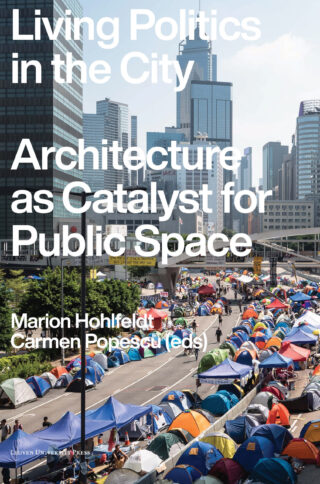

Living Politics in the City
Architecture as Catalyst for Public Space
Marion Hohlfeldt (Editor), Carmen Popescu (Editor),

Category: Americas, Architecture and Urban Planning, Political Science, Social Science, Urban Studies
Language: English
ISBN: 9789462703599
Publication date: March 10, 2023
€42.00 (including 6% VAT)
Buy NowNumber of pages: 320
Size: 234 x 156 x 15 mm
Number of illustrations: 52

Funded by: Path to Open
Stock item: 153205
Standard delivery time for print books:
For Belgium: 5 to 8 working days
For EU: 2 to 3 weeks
For other countries: 4 to 5 weeks
Category: Americas, Architecture and Urban Planning, Political Science, Social Science, Urban Studies
Language: English
ISBN: 9789461667564
Publication date: January 15, 2026
Download Free EpubNumber of pages: 320
Number of illustrations: 52
Funded by: Path to Open
Category: Americas, Architecture and Urban Planning, Political Science, Social Science, Urban Studies
Language: English
ISBN: 9789461664945
Publication date: October 2, 2023
Download Free PDFNumber of pages: 320
Number of illustrations: 52
Funded by: Path to Open
Public space and performativity from the perspective of architecture
In recent decades, architecture has been seen as a field of practice that contributes greatly to the performativity of public space. In spite of the explosion of virtual communities through social media and the limitations imposed by pandemics, architecture today still holds an active role in (literally) building our societies. Bearing in mind its acute politicisation in past years, Living Politics in the City looks at public space from the perspective of architecture and its effective contribution, not as a prop but as an actual catalyst for embodying politics. The essays gathered here span five continents, activating various disciplinary approaches to architecture and examining it in different contexts: from a Palestinian refugee camp to the most vibrant urban axis in Sao Paolo, from the numerous city squares around the world crowded with rebellious populations, to the proximal politics of housing in Australia.
Contributors: Endriana Audisho (University of Technology Sydney), Maja Babic (Charles University ), Alexandra Biehler (Ecole Nationale Supérieure d’Architecture de Marseille), Tracey Bowen (University of Toronto Mississauga), Etienne Delprat (Rennes 2 University), Angelique Edmonds (University of South Australia), Claudia Faraone (IUAV Venice School of Architecture, ETICity), Caterina Frisone (Oxford Brookes University), Catherine Grout (ENSAPL Lille), Pavel Kunysz (University of Liège), Flavia Marcello (Swinburne University of Technology), Eric Le Coguiec (University of Liège), Tova Lubinsky (University of Technology Sydney), Giovanna Muzzi (IUAV Venice School of Architecture, ETICity), Can Onaner (Ecole Nationale Supérieure d’Architecture de Bretagne), Shadi Saleh (KU Leuven), Frédéric Sotinel (Ecole Nationale Supérieure d’Architecture de Bretagne), Daniel Talesnik (University of Cambridge), (Karolina Wilczynska (Adam Mickiewicz University), Ian Woodcock (Swinburne University of Technology)
This publication is GPRC-labeled (Guaranteed Peer-Reviewed Content).
This book has been made open access within three years of publication thanks to Path to Open, a program developed in partnership between JSTOR, the American Council of Learned Societies (ACLS), University of Michigan Press, and The University of North Carolina Press to bring about equitable access and impact for the entire scholarly community, including authors, researchers, libraries, and university presses around the world. Learn more at https://about.jstor.org/path-to-open/
Acknowledgements
Introduction Marion Hohlfeldt and Carmen Popescu
PART 1. ARCHITECTURING THE POLIS Chapter 1. The Emergence of a Public Space in Ouagadougou Alexandra Biehler
Chapter 2. On Public Spaces of Palestinian Refugee Camps: The Social Production and Construction of Almarkaz ‘Taxi Station’ Shadi Saleh
Chapter 3. Negotiating the Present in the Balkans: Macedonia Square Maja Babić
Chapter 4. We Gonna Rock Down to Paulista Avenue , or the Multidimensional Protagonism of São Paulo’s Avenida Paulista Daniel Talesnik
Chapter 5. Oppositional Architecture(s): Making the Common Etienne Delprat
Chapter 6. The Crowd, Revolt and Assembly Can Onaner
PART 2. PERFORMING POLITICS OF PLACE Chapter 7. Underplaces: ‘Sky Rail’, Politics and Alternative Urban Futures for Melbourne Ian Woodcock
Chapter 8. The Long-Term Consequences of Temporary Urban Planning: Negotiating Who’s the Public in Public Spaces to Be Pavel Kunysz and Eric Le Coguiec
Chapter 9. Contest and Capital: The Gentrification of Graffiti in the Creative City of Toronto Tracey Bowen
Chapter 10. Cities Under Surveillance: Sydney and Johannesburg – Public Space as Territories in Transformation Endriana Audisho and Tova Lubinsky
Chapter 11. Rogue Poster Campaigns: Amplifying Political Discourse between Urban and Cyber Arenas Flavia Marcello
PART 3. WHO CARES? Chapter 12. Urban Space and Collective Practices as a Political Matter: The Case of the ‘Piave’ Neighbourhood in Mestre (Venice) Claudia Faraone and Giovanna Muzzi
Chapter 13. Individuals in Crowded Places Caterina Frisone
Chapter 14. How Do We Structure Relatedness? Differentiated Solidarity and the Obligations of Proximal Dwelling Angelique Edmonds
Chapter 15. Maintaining Public Space: Sanitation Actions of Mierle Laderman Ukeles Karolina Wilczyńska
Chapter 16. Common World, Place and Traces Catherine Grout
Chapter 17. A Red Rose in Berlin Frédéric Sotinel
About the Authors
Marion Hohlfeldt
Marion Hohlfeldt is associate professor of contemporary art history at Rennes 2 University and Director of the Graduate School for Creative Approaches on Public Space.
Carmen Popescu
Carmen Popescu is professor of architectural history at the Ecole Nationale Supérieure d’Architecture Paris Val-de-Seine.
'Living Politics in the City' is een boek met een grote rijkdom aan verhalen en cases en stelt, ondanks de soms wat willekeurige verzameling van artikelen, de lezer in staat om deze of vele andere verhaallijnen te ontdekken afhankelijk van de interesse en achtergrond van de lezer. ... een naslagwerk voor professionals die met deze thematiek bezig zijn of die werken aan een van de specifieke cases. - Mike Emmerik, Archined, januari 2024, https://www.archined.nl/2024/01/de-strijd-om-de-publieke-ruimte/
Frequently Asked Questions
What is "Living Politics in the City" about?
Public space and performativity from the perspective of architecture
In recent decades, architecture has been seen as a field of practice that contributes greatly to the performativity of public space. In spite of the explosion of virtual communities through social media and the limitations imposed by pandemics, architecture today still holds an active role in (literally) building our societies. Bearing in mind its acute politicisation in past years, Living Politics in the City looks at public space from the perspective of architecture and its effective contribution, not as a prop but as an actual catalyst for embodying politics. The essays gathered here span five continents, activating various disciplinary approaches to architecture and examining it in different contexts: from a Palestinian refugee camp to the most vibrant urban axis in Sao Paolo, from the numerous city squares around the world crowded with rebellious populations, to the proximal politics of housing in Australia.
Contributors: Endriana Audisho (University of Technology Sydney), Maja Babic (Charles University ), Alexandra Biehler (Ecole Nationale Supérieure d’Architecture de Marseille), Tracey Bowen (University of Toronto Mississauga), Etienne Delprat (Rennes 2 University), Angelique Edmonds (University of South Australia), Claudia Faraone (IUAV Venice School of Architecture, ETICity), Caterina Frisone (Oxford Brookes University), Catherine Grout (ENSAPL Lille), Pavel Kunysz (University of Liège), Flavia Marcello (Swinburne University of Technology), Eric Le Coguiec (University of Liège), Tova Lubinsky (University of Technology Sydney), Giovanna Muzzi (IUAV Venice School of Architecture, ETICity), Can Onaner (Ecole Nationale Supérieure d’Architecture de Bretagne), Shadi Saleh (KU Leuven), Frédéric Sotinel (Ecole Nationale Supérieure d’Architecture de Bretagne), Daniel Talesnik (University of Cambridge), (Karolina Wilczynska (Adam Mickiewicz University), Ian Woodcock (Swinburne University of Technology)
This publication is GPRC-labeled (Guaranteed Peer-Reviewed Content).
This book has been made open access within three years of publication thanks to Path to Open, a program developed in partnership between JSTOR, the American Council of Learned Societies (ACLS), University of Michigan Press, and The University of North Carolina Press to bring about equitable access and impact for the entire scholarly community, including authors, researchers, libraries, and university presses around the world. Learn more at https://about.jstor.org/path-to-open/
Who edited "Living Politics in the City"?
"Living Politics in the City" was edited by Marion Hohlfeldt and Carmen Popescu.
Marion Hohlfeldt is associate professor of contemporary art history at Rennes 2 University and Director of the Graduate School for Creative Approaches on Public Space.
Carmen Popescu is professor of architectural history at the Ecole Nationale Supérieure d’Architecture Paris Val-de-Seine.
Is "Living Politics in the City" available Open Access?
Yes, "Living Politics in the City" is published Open Access. It is available under a BY-NC-ND license.
Who funded the publication of "Living Politics in the City"?
Publication of "Living Politics in the City" was funded by Path to Open
.
What is the Table of Contents for "Living Politics in the City"?
Acknowledgements
Introduction Marion Hohlfeldt and Carmen Popescu
PART 1. ARCHITECTURING THE POLIS Chapter 1. The Emergence of a Public Space in Ouagadougou Alexandra Biehler
Chapter 2. On Public Spaces of Palestinian Refugee Camps: The Social Production and Construction of Almarkaz ‘Taxi Station’ Shadi Saleh
Chapter 3. Negotiating the Present in the Balkans: Macedonia Square Maja Babić
Chapter 4. We Gonna Rock Down to Paulista Avenue , or the Multidimensional Protagonism of São Paulo’s Avenida Paulista Daniel Talesnik
Chapter 5. Oppositional Architecture(s): Making the Common Etienne Delprat
Chapter 6. The Crowd, Revolt and Assembly Can Onaner
PART 2. PERFORMING POLITICS OF PLACE Chapter 7. Underplaces: ‘Sky Rail’, Politics and Alternative Urban Futures for Melbourne Ian Woodcock
Chapter 8. The Long-Term Consequences of Temporary Urban Planning: Negotiating Who’s the Public in Public Spaces to Be Pavel Kunysz and Eric Le Coguiec
Chapter 9. Contest and Capital: The Gentrification of Graffiti in the Creative City of Toronto Tracey Bowen
Chapter 10. Cities Under Surveillance: Sydney and Johannesburg – Public Space as Territories in Transformation Endriana Audisho and Tova Lubinsky
Chapter 11. Rogue Poster Campaigns: Amplifying Political Discourse between Urban and Cyber Arenas Flavia Marcello
PART 3. WHO CARES? Chapter 12. Urban Space and Collective Practices as a Political Matter: The Case of the ‘Piave’ Neighbourhood in Mestre (Venice) Claudia Faraone and Giovanna Muzzi
Chapter 13. Individuals in Crowded Places Caterina Frisone
Chapter 14. How Do We Structure Relatedness? Differentiated Solidarity and the Obligations of Proximal Dwelling Angelique Edmonds
Chapter 15. Maintaining Public Space: Sanitation Actions of Mierle Laderman Ukeles Karolina Wilczyńska
Chapter 16. Common World, Place and Traces Catherine Grout
Chapter 17. A Red Rose in Berlin Frédéric Sotinel
About the Authors
What is the DOI for "Living Politics in the City"?
The Digital Object Identifier (DOI) for "Living Politics in the City" is 10.11116/9789461664945.
Related titles
 Margarete Schütte-Lihotzky and the Architecture of Collective Dissidence, 1918–1989
S.E. Eisterer (Author),
April 2027

 The Romero Memory
Judith Gruber (Editor), Jonas Van Mulder (Editor), Stephan Parmentier (Editor), Veerle Draulans (Editor), Joren Janssens (Editor), Jacques Haers (Editor), Kim Christiaens (Editor),
November 2026
 Infrastructuring Arrival
Karel Arnaut (Editor), Luce Beeckmans (Editor), Bruno Meeus (Editor),
November 2026

 Feminists Resisting Gendered Violence
Hemangini Gupta (Editor), Fiona Mackay (Editor), Jan Breckenridge (Editor), Louise Chappell (Editor), Rachna Mehra (Editor), Rukmini Sen (Editor), Mailin Suchting (Editor),
October 2026
 A City in Practice
Aude Tournaye (Editor), Filip De Boeck (Editor), Picha Collective (Editor),
September 2026
 German–Rapanui Entanglements
Cristián Moreno Pakarati (Editor), Diego Muñoz (Editor), Philipp Schorch (Editor),
August 2026
 Political Exile in the Global Twentieth Century
Wolfram Kaiser (Editor), Piotr H. Kosicki (Editor),
April 2026
 Brusselse plaatsnamen
Iadine Degryse (Editor), Benjamin Wayens (Editor), Chantal Kesteloot (Editor), Dennis De Vriese (Editor), Matthijs Degraeve (Editor),
April 2026

 Comics and the Global South
Andrea Aramburú (Editor), Dibyadyuti Roy (Editor), Joe Sutliff Sanders (Editor),
February 2026
 Cartographies of Catastrophes
Laura Demeter (Editor), Carmen M. Enss (Editor), Piotr Kisiel (Editor), Carol Ludwig (Editor),
February 2026