

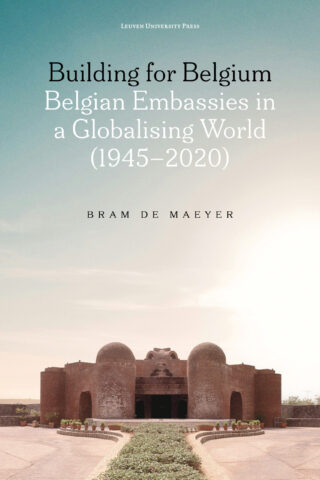

Building for Belgium
Belgian Embassies in a Globalising World (1945-2020)
Bram De Maeyer (Author),

Category: Architecture and Urban Planning, History, History 1800-present, Urban Studies
Language: English
ISBN: 9789462704817
Publication date: November 3, 2025
€45.00 (including 6% VAT)
Buy NowNumber of pages: 346
Size: 234 x 156 x 750 mm
Illustrations and other content description:
Illustrated, 30 pages in colour

Funded by: Universitaire Stichting
KU Leuven Fund for Fair Open Access
Open Book Collective
KU Leuven Faculty of Architecture
Stock item: 168840
Standard delivery time for print books:
For Belgium: 5 to 8 working days
For EU: 2 to 3 weeks
For other countries: 4 to 5 weeks
Category: Architecture and Urban Planning, History, History 1800-present, Urban Studies
Language: English
ISBN: 9789461666789
Publication date: November 26, 2025
Download Free EpubNumber of pages: 346
Illustrations and other content description:
Colour illustrations
Funded by: Universitaire Stichting
KU Leuven Fund for Fair Open Access
Open Book Collective
KU Leuven Faculty of Architecture
Category: Architecture and Urban Planning, History, History 1800-present, Urban Studies
Language: English
ISBN: 9789461666772
Publication date: November 3, 2025
Download Free PDFNumber of pages: 346
Illustrations and other content description:
Colour illustrations
Funded by: Universitaire Stichting
KU Leuven Fund for Fair Open Access
Open Book Collective
KU Leuven Faculty of Architecture
How Belgium’s decentralised embassy building programme highlights the collaborative nature and diplomatic significance of embassy architecture.
Embassy buildings are the most tangible evidence of a state’s diplomatic presence abroad. State authorities have invested in the architectural conception of purpose-built embassies to flex their diplomatic muscle and project nationhood on foreign soil. While scholars have primarily focused on purpose-built embassies of (former) world powers, Building for Belgium shifts the perspective by scrutinising the Belgian Ministry of Foreign Affairs’ embassy-building programme from 1945 to 2020.
Rather than a conventional political assessment of diplomatic relations, the book foregrounds the often-overlooked architectural lives of embassies and their social, economic, and political entanglements. By examining Belgian embassy projects across all continents, it reveals how the Belgian diplomatic corps has navigated diverse political regimes, geopolitical contexts, cultures, and building codes. More than the outcome of a deliberate policy, the embassy-building programme has been shaped by incidental decisions, private ambitions and personal tastes of Belgian diplomats, ministry officials and politicians.
Building for Belgium not only sheds light on diplomatic architecture but also connects domestic conversations about architecture in Belgium with global state-building projects. Offering fresh insights into the politics of space, it will be of value to scholars and practitioners in architecture, urban studies, international relations, cultural heritage, and Belgian and European studies.
Foreword by Mark Eyskens
Acknowledgments
Abbreviations
Notes regarding the maps and the monetary values used in the book
Introduction
Chapter I. The Ambassador’s Agency: The Head of Mission as Project Developer (1945-1957)
Chapter II. Building Embassies on Demand: The Steering Role of the Receiving State (1958-1974)
A. Building an Embassy in the Land Down Under: Diplomatic Housing as Political Leverage
B. The Reconstruction of the Mniszech Palace: The Diplomatic Cornerstone of Belgian-Polish Relations
C. Building in Brasília, Brazil: Moving Out of One’s Comfort Zone
Chapter III. “It’s the Economy, Stupid!”: Constructing Embassies as Venues for Economic Diplomacy (1980-1985)
Chapter IV. Plugging the Holes in the Federal Budget: Monetising the Belgian Embassy Patrimony (1999-2020)
A. Redeveloping the Belgian Embassy Grounds in Japan: A Public-Private Partnership
B. Diplomatic Co-housing: The Kinshasa Project
Epilogue
Notes
Bibliography
Illustration Credits
Index
Bram De Maeyer
Bram De Maeyer is an architectural historian interested in diplomatic architecture. He is a voluntary researcher at the Faculty of Architecture (KU Leuven), where he earned his PhD in 2023.
How does architecture shape diplomacy, and how does diplomacy influence architecture? Building for Belgium is a meticulously documented exploration that makes an invaluable contribution to the study of diplomatic architecture. Through its multidisciplinary lens, the book examines the interplay of diplomacy and design, navigating the tensions of form and finance within an ever-shifting geopolitical landscape. Rich in insight, it’s an essential read for those fascinated by the intersection of architecture and international relations. - Ivan Filipović, University of Belgrade
The diverse world of Belgian embassy design – 'style and class without exaggeration'
'Building for Belgium: Belgian Embassies in a Globalising World' offers a deep dive into the architecture representing the country across the globe – bringing context to diplomatic architecture., David Plaisant, Wallpaper*, 20 December 2025, https://www.wallpaper.com/architecture/belgian-embassies-book
Frequently Asked Questions
What is "Building for Belgium" about?
How Belgium's decentralised embassy building programme highlights the collaborative nature and diplomatic significance of embassy architecture.
Embassy buildings are the most tangible evidence of a state’s diplomatic presence abroad. State authorities have invested in the architectural conception of purpose-built embassies to flex their diplomatic muscle and project nationhood on foreign soil. While scholars have primarily focused on purpose-built embassies of (former) world powers, Building for Belgium shifts the perspective by scrutinising the Belgian Ministry of Foreign Affairs’ embassy-building programme from 1945 to 2020.
Rather than a conventional political assessment of diplomatic relations, the book foregrounds the often-overlooked architectural lives of embassies and their social, economic, and political entanglements. By examining Belgian embassy projects across all continents, it reveals how the Belgian diplomatic corps has navigated diverse political regimes, geopolitical contexts, cultures, and building codes. More than the outcome of a deliberate policy, the embassy-building programme has been shaped by incidental decisions, private ambitions and personal tastes of Belgian diplomats, ministry officials and politicians.
Building for Belgium not only sheds light on diplomatic architecture but also connects domestic conversations about architecture in Belgium with global state-building projects. Offering fresh insights into the politics of space, it will be of value to scholars and practitioners in architecture, urban studies, international relations, cultural heritage, and Belgian and European studies.
Who wrote "Building for Belgium"?
"Building for Belgium" was written by Bram De Maeyer.
Bram De Maeyer is an architectural historian interested in diplomatic architecture. He is a voluntary researcher at the Faculty of Architecture (KU Leuven), where he earned his PhD in 2023.
Is "Building for Belgium" available Open Access?
Yes, "Building for Belgium" is published Open Access. It is available under a BY-NC-ND license.
Who funded the publication of "Building for Belgium"?
Publication of "Building for Belgium" was funded by Universitaire Stichting
KU Leuven Fund for Fair Open Access
Open Book Collective
KU Leuven Faculty of Architecture
.
What is the Table of Contents for "Building for Belgium"?
Foreword by Mark Eyskens
Acknowledgments
Abbreviations
Notes regarding the maps and the monetary values used in the book
Introduction
Chapter I. The Ambassador’s Agency: The Head of Mission as Project Developer (1945-1957)
Chapter II. Building Embassies on Demand: The Steering Role of the Receiving State (1958-1974)
A. Building an Embassy in the Land Down Under: Diplomatic Housing as Political Leverage
B. The Reconstruction of the Mniszech Palace: The Diplomatic Cornerstone of Belgian-Polish Relations
C. Building in Brasília, Brazil: Moving Out of One’s Comfort Zone
Chapter III. “It’s the Economy, Stupid!”: Constructing Embassies as Venues for Economic Diplomacy (1980-1985)
Chapter IV. Plugging the Holes in the Federal Budget: Monetising the Belgian Embassy Patrimony (1999-2020)
A. Redeveloping the Belgian Embassy Grounds in Japan: A Public-Private Partnership
B. Diplomatic Co-housing: The Kinshasa Project
Epilogue
Notes
Bibliography
Illustration Credits
Index
What is the DOI for "Building for Belgium"?
The Digital Object Identifier (DOI) for "Building for Belgium" is 10.11116/9789461666772.
Related titles
 Margarete Schütte-Lihotzky and the Architecture of Collective Dissidence, 1918–1989
S.E. Eisterer (Author),
April 2027

 Infrastructuring Arrival
Karel Arnaut (Editor), Luce Beeckmans (Editor), Bruno Meeus (Editor),
November 2026
 Toekomstdromen
Maarten Van Dijck (Editor), Gerrit Verhoeven (Editor), Hans Cools (Editor),
November 2026


 A City in Practice
Aude Tournaye (Editor), Filip De Boeck (Editor), Picha Collective (Editor),
September 2026

 German–Rapanui Entanglements
Cristián Moreno Pakarati (Editor), Diego Muñoz (Editor), Philipp Schorch (Editor),
August 2026
 Trend en toeval – vierde editie
Bruno Blondé (Author), Isabelle Devos (Author), Jord Hanus (Author), Wouter Ryckbosch (Author),
August 2026
 Cinema in Post-War Belgium
Gertjan Willems (Editor), Bjorn Gabriels (Editor), Bénédicte Rochet (Editor),
May 2026


 Performing Magnetism
Eleonora Paklons (Editor), Kristof Smeyers (Editor), Kurt Vanhoutte (Editor), Hannah Welslau (Editor),
May 2026
 Christian Democracy and the Fall of Communism
Michael Gehler (Editor), Piotr H. Kosicki (Editor), Helmut Wohnout (Editor),
April 2026
 Political Exile in the Global Twentieth Century
Wolfram Kaiser (Editor), Piotr H. Kosicki (Editor),
April 2026
 Brusselse plaatsnamen
Iadine Degryse (Editor), Benjamin Wayens (Editor), Chantal Kesteloot (Editor), Dennis De Vriese (Editor), Matthijs Degraeve (Editor),
April 2026
 Cartographies of Catastrophes
Laura Demeter (Editor), Carmen M. Enss (Editor), Piotr Kisiel (Editor), Carol Ludwig (Editor),
February 2026