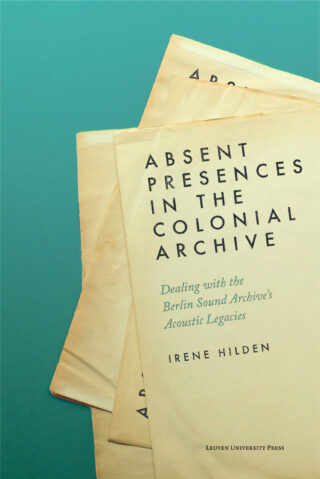

Absent Presences in the Colonial Archive
Dealing with the Berlin Sound Archive's Acoustic Legacies
Irene Hilden (Author),

Category: Anthropology, Media and Visual Culture, Museum and Heritage Studies, Postcolonial Studies, Social Science
Language: English
ISBN: 9789462703407
Publication date: October 5, 2022
€28.00 (including 6% VAT)
Buy NowNumber of pages: 300
Size: 234 x 156 x 15 mm
Number of illustrations: 11
Illustrations and other content description:
b&w images

Funded by: KU Leuven Fund for Fair Open Access
Humboldt Universität
CARMAH
Stock item: 150214
Standard delivery time for print books:
For Belgium: 5 to 8 working days
For EU: 2 to 3 weeks
For other countries: 4 to 5 weeks
Category: Anthropology, Media and Visual Culture, Museum and Heritage Studies, Postcolonial Studies, Social Science
Language: English
ISBN: 9789461664709
Publication date: October 17, 2022
Download Free EpubNumber of pages: 300
Number of illustrations: 11
Illustrations and other content description:
b&w images
Funded by: KU Leuven Fund for Fair Open Access
Humboldt Universität
CARMAH
Category: Anthropology, Media and Visual Culture, Museum and Heritage Studies, Postcolonial Studies, Social Science
Language: English
ISBN: 9789461664693
Publication date: October 5, 2022
Download Free PDFNumber of pages: 300
Number of illustrations: 11
Illustrations and other content description:
b&w images
Funded by: KU Leuven Fund for Fair Open Access
Humboldt Universität
CARMAH
The colonial past through objects of sound
The Berlin Sound Archive (Lautarchiv) consists of an extensive collection of sound recordings, compiled for scientific purposes in the first half of the 20th century. Recorded on shellac are stories and songs, personal testimonies and poems, glossaries and numbers. This book engages with the archive by consistently focusing on recordings produced under colonial conditions.
With a firm commitment to postcolonial scholarship, Absent Presences in the Colonial Archive is a historical ethnography of a metropolitan institution that participated in the production and preservation of colonial structures of power and knowledge. The book examines sound objects and listening practices that render the coloniality of knowledge fragile and inconsistent, revealing the absent presences of colonial subjects who are given little or no place in established national narratives and collective memories.
Ebook available in Open Access.
This publication is GPRC-labeled (Guaranteed Peer-Reviewed Content).
Dealing with the colonial archive entails acknowledging the inability to know everything, accounting for the archive’s limited and incomplete condition. Dealing with the colonial archive is not merely about stories of the past but also about the history of the present, and how it is interrupted by the past. — Irene Hilden, in conversation with New Books Network
Acknowledgments Abbreviations Use of Names
1 Introduction 2 THE ETHNOGRAPHIC … 3 Failed Listening 4 … THE ARCHIVAL … 5 Close Listening 6 Collective Listening 7 … THE ACOUSTIC 8 Coda
Appendix Notes Bibliography Index
A richly-detailed and warmly-written ethnography of listening, this book is poised to be a leader in the fields of archival, curatorial and museum studies, and similarly stands out as a uniquely-well blended contribution to sound ethnography, sound studies, ethnomusicology, anthropology and digital humanities. - Noel Lobley, University of Virginia
Die wegweisende Studie für den Umgang mit den Archivalien eines kolonialen Archivs bietet viele wichtige Anknüpfungspunkte für theoretische Analysekonzepte und methodische Zugänge, auf die in Zukunft unbedingt ufgebaut werden sollte. Sie gibt auch für den Aufbau gegenwärtiger Sammlungen wichtige Anstöße. So geht Hilden zum Schluss auf die Sammlungspraxis von biometrischen Daten und Stimm-Samples durch das Bundesamt für igration und Flüchtlinge ein, die gesammelt werden, um die Glaubwürdigkeit der Fluchtgeschichten zu überprüfen. Hilden bringt die aktuellen Sammelpraktiken mit denen des Lautarchivs in Verbindung und mahnt an, dass dadurch aktuell wieder ein schwieriges Erbe entsteht, das nicht nur für die Geflüchteten heute höchst problematisch ist, sondern mit dem unsere Nachkommen sich in 100 Jahren wieder kritisch auseinandersetzen müssen. - Karin Bürkert, H-Soz-Kult, 16.01.2025, https://www.hsozkult.de/publicationreview/id/reb-131287
Frequently Asked Questions
What is "Absent Presences in the Colonial Archive" about?
The colonial past through objects of sound
The Berlin Sound Archive (Lautarchiv) consists of an extensive collection of sound recordings, compiled for scientific purposes in the first half of the 20th century. Recorded on shellac are stories and songs, personal testimonies and poems, glossaries and numbers. This book engages with the archive by consistently focusing on recordings produced under colonial conditions.
With a firm commitment to postcolonial scholarship, Absent Presences in the Colonial Archive is a historical ethnography of a metropolitan institution that participated in the production and preservation of colonial structures of power and knowledge. The book examines sound objects and listening practices that render the coloniality of knowledge fragile and inconsistent, revealing the absent presences of colonial subjects who are given little or no place in established national narratives and collective memories.
Ebook available in Open Access.
This publication is GPRC-labeled (Guaranteed Peer-Reviewed Content).
Dealing with the colonial archive entails acknowledging the inability to know everything, accounting for the archive’s limited and incomplete condition. Dealing with the colonial archive is not merely about stories of the past but also about the history of the present, and how it is interrupted by the past. — Irene Hilden, in conversation with New Books Network
Who wrote "Absent Presences in the Colonial Archive"?
"Absent Presences in the Colonial Archive" was written by Irene Hilden.
Irene Hilden is a postdoctoral researcher at the Centre for Anthropological Research on Museums and Heritage (CARMAH), Humboldt-Universität zu Berlin.
Is "Absent Presences in the Colonial Archive" available Open Access?
Yes, "Absent Presences in the Colonial Archive" is published Open Access. It is available under a BY license.
Who funded the publication of "Absent Presences in the Colonial Archive"?
Publication of "Absent Presences in the Colonial Archive" was funded by KU Leuven Fund for Fair Open Access
Humboldt Universität
CARMAH
.
What is the Table of Contents for "Absent Presences in the Colonial Archive"?
Acknowledgments Abbreviations Use of Names
1 Introduction 2 THE ETHNOGRAPHIC … 3 Failed Listening 4 … THE ARCHIVAL … 5 Close Listening 6 Collective Listening 7 … THE ACOUSTIC 8 Coda
Appendix Notes Bibliography Index
What is the DOI for "Absent Presences in the Colonial Archive"?
The Digital Object Identifier (DOI) for "Absent Presences in the Colonial Archive" is 10.11116/9789461664693.
Related titles

 The Romero Memory
Judith Gruber (Editor), Jonas Van Mulder (Editor), Stephan Parmentier (Editor), Veerle Draulans (Editor), Joren Janssens (Editor), Jacques Haers (Editor), Kim Christiaens (Editor),
November 2026
 Infrastructuring Arrival
Karel Arnaut (Editor), Luce Beeckmans (Editor), Bruno Meeus (Editor),
November 2026
 Feminists Resisting Gendered Violence
Hemangini Gupta (Editor), Fiona Mackay (Editor), Jan Breckenridge (Editor), Louise Chappell (Editor), Rachna Mehra (Editor), Rukmini Sen (Editor), Mailin Suchting (Editor),
October 2026

 A City in Practice
Aude Tournaye (Editor), Filip De Boeck (Editor), Picha Collective (Editor),
September 2026
 German–Rapanui Entanglements
Cristián Moreno Pakarati (Editor), Diego Muñoz (Editor), Philipp Schorch (Editor),
August 2026
 Cinema in Post-War Belgium
Gertjan Willems (Editor), Bjorn Gabriels (Editor), Bénédicte Rochet (Editor),
May 2026

 Performing Magnetism
Eleonora Paklons (Editor), Kristof Smeyers (Editor), Kurt Vanhoutte (Editor), Hannah Welslau (Editor),
May 2026
 Comics and the Global South
Andrea Aramburú (Editor), Dibyadyuti Roy (Editor), Joe Sutliff Sanders (Editor),
February 2026