

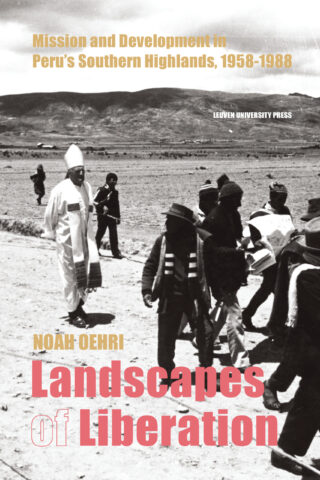

Landscapes of Liberation
Mission and Development in Peru’s Southern Highlands, 1958 – 1988
Noah Oehri (Author),

Series: Leuven Studies in Mission and Modernity 2
Language: English
ISBN: 9789462703742
Publication date: July 26, 2023
€49.50 (including 6% VAT)
Buy NowNumber of pages: 230
Size: 234 x 156 x 17 mm

Stock item: 155481
Standard delivery time for print books:
For Belgium: 5 to 8 working days
For EU: 2 to 3 weeks
For other countries: 4 to 5 weeks
Series: Leuven Studies in Mission and Modernity 2
Language: English
ISBN: 9789461665188
Publication date: July 31, 2023
Download Free EpubNumber of pages: 230
Series: Leuven Studies in Mission and Modernity 2
Language: English
ISBN: 9789461665171
Publication date: July 20, 2023
Download Free PDFNumber of pages: 230
The reception of liberation theology in
Andean America
Catholic mission from the mid-20th century onwards was complicated by geopolitical upheaval, church reform, and the emergent critique of the colonial power matrix to which the Church belonged. Missionary movements to Latin America coincided with visions for a progressive, radically transformative church.
Landscapes of Liberation expands scholarship into liberation theology’s reception in Andean America and critically examines the interplay of the Catholic Church as a global institution with parishes as local actors. Through source material from both sides of the Atlantic, this book charts how a transnational network of pastoral agents and laypeople in Peru’s southern highlands claimed mission and development as intertwined tenets of spiritual and social life throughout three decades of agrarian reform, activism, and social conflict. Ultimately, this book reveals how transformative theories for rural development yield contingent transformations: concrete change, yet contested liberation.
Ebook available in Open Access.
This publication is GPRC-labeled (Guaranteed Peer-Reviewed Content).
Acknowledgments
Introduction
PART I. MODERNIZING CATHOLICISM (1943-1968)
1 ‘Compulsive Modernization’
2 Mission in Progress
3 Pastors on Pastures
PART II: LIBERATING EVANGELIZATION (1968-1980)
4 Liberation and Revolution
5 Anthropological Concerns
6 Opting for the Peasantry
PART III: MOBILIZING FAITH (1980-1988)
7 A Third Path
8 Land of Communities
Conclusion
Bibliography
Oehri works with an impressive range of sources to present a richly layered discussion of a key era in the history of contemporary Catholicism in Peru. 'Landscapes of Liberation' tells a complex story and will serve as an important reference for scholars and students interested in understanding the liberationist Catholic Church of the time in the dynamic institutional contexts of the Peruvian Andes. - Andrew Orta, Journal of Latin American Studies. 2024;56(2):373-375. https://doi.org/10.1017/S0022216X24000415
A rigorous work and a significant scholarly achievement. Oehri's book can also be read as a tribute to the recently departed Peruvian priest and theologian Gustavo Gutiérrez, O.P., one of the founders of Liberation Theology. His life and work should continue to inspire further studies on Catholicism, liberacionismo, and the deep interconnections between the spiritual and the political in Peru, the Andes, and Latin America, and they will find in Oehri's work guidance, inspiration, and an indispensable milestone. - Javier Puente, The Catholic Historical Review, vol. 111 no. 1, 2025, https://dx.doi.org/10.1353/cat.2025.a952987
Noah Oehri’s 'Landscapes of Liberation' is an exceptionally well researched social history of liberation theology in Peru. This work is an important and welcomed contribution that focuses on the fascinating developments of the liberation theology movement in the Andean region of Puno, one of the most heavily indigenous areas of Peru. Oehri’s regional focus is of critical importance. It brings to light an oftenforgotten challenge experienced by liberationist missionaries in the Andes, namely, advancing the agenda of social justice as pastoral agents of the Catholic Church while engaging a people whose culture was decimated by the centuries-longmissionary work of Catholicism(112). 'Landscapes of Liberation' is a careful attempt to illuminate this paradox by examining how liberation theology followers had to rearticulate their ideas visà- vis the challenges of indigeneity and coloniality. - RAÚL E. ZEGARRA, The Journal of Religion, volume 105, number 4, https://www.journals.uchicago.edu/doi/abs/10.1086/737211
Oehri deserves special recognition for the incredible corpus of historical sources he has compiled to write this book. By consulting institutional documentation found in ecclesiastical archives, conducting interviews with missionaries, and drawing on pastoral journals and secular media, this book offers a comprehensive, nuanced, and integrated interpretation of the history of Liberation theology as experienced in Peru’s southern Andes. The use of such a diverse range of sources is unusual in most existing scholarship on Peruvian Catholicism, as most ecclesiastical archives have remained closed to scholars or have disappeared after the disintegration or weakening of the institutions founded by Catholic activists. For this reason, 'Landscapes of Liberation' may be one of the most exhaustive accounts of Liberationist Catholicism and how Church reforms translated into concrete pastoral experiments in Peru’s southern Andes. - Juan Miguel Espinoza Portocarrero, The American Historical Review, Volume 130, Issue 4, December 2025, Pages 1696–1697, https://doi.org/10.1093/ahr/rhaf414
Frequently Asked Questions
What is "Landscapes of Liberation" about?
The reception of liberation theology in
Andean America
Catholic mission from the mid-20th century onwards was complicated by geopolitical upheaval, church reform, and the emergent critique of the colonial power matrix to which the Church belonged. Missionary movements to Latin America coincided with visions for a progressive, radically transformative church.
Landscapes of Liberation expands scholarship into liberation theology’s reception in Andean America and critically examines the interplay of the Catholic Church as a global institution with parishes as local actors. Through source material from both sides of the Atlantic, this book charts how a transnational network of pastoral agents and laypeople in Peru’s southern highlands claimed mission and development as intertwined tenets of spiritual and social life throughout three decades of agrarian reform, activism, and social conflict. Ultimately, this book reveals how transformative theories for rural development yield contingent transformations: concrete change, yet contested liberation.
Ebook available in Open Access.
This publication is GPRC-labeled (Guaranteed Peer-Reviewed Content).
Who wrote "Landscapes of Liberation"?
"Landscapes of Liberation" was written by Noah Oehri.
Noah Oehri is an associate researcher at the Institute of History of the University of Bern.
Is "Landscapes of Liberation" part of a series?
Yes, "Landscapes of Liberation" is part of the "Leuven Studies in Mission and Modernity" series. It's book 2 in the series.

Leuven Studies in Mission and Modernity is a peer-reviewed book series which aims to showcase groundbreaking works on the history of missionaries and missionary organisations during the nineteenth and twentieth centuries. The series will steer mission history towards new thematic frontiers by exploring the multiple ways in which missionary operations have affected local societies and cultures around the globe, and how their significance is negotiated in the present. Leuven Studies in Mission and Modernity provides a forum for original contributions to the study of religious missions and how they have been embedded in broader processes of colonisation/decolonisation, globalisation, secularisation, and humanitarianism from the nineteenth century onwards.
MiMoRA
Leuven Studies in Mission and Modernity is an initiative by the Mission and Modernity Research Academy (MiMoRA). Created in 2018 by several partners within KU Leuven, MiMoRA aims to reinvigorate international research on missionaries by providing a forum for academic debate and by creating new research networks and publication possibilities for young and promising scholars across the globe. MiMoRA is coordinated by KADOC-KU Leuven, the interfaculty Documentation and Research Centre on Religion, Culture and Society associated with KU Leuven and supported by the Flemish Community.
Technical details
All books are published in English for an international audience of scholars. All manuscripts are subject to peer review.
The series welcomes contributions by established scholars as well as by promising young researchers, and embraces diversity in terms of gender, nationality, and ethnicity.
Series Board
Kim Christiaens (KADOC-KU Leuven), Carine Dujardin (KADOC-KU Leuven), Idesbald Goddeeris (KU Leuven, Faculty of Arts), Jonas Van Mulder (KADOC-KU Leuven), Dries Vanysacker (KU Leuven, Theology and Religious Studies) and Pieter Verstraete (KU Leuven, Psychology and Educational Sciences)
For more information, please visit kadoc.kuleuven.be/mimora and kadoc.kuleuven.be.
Is "Landscapes of Liberation" available Open Access?
Yes, "Landscapes of Liberation" is published Open Access. It is available under a BY-NC-ND license.
What is the Table of Contents for "Landscapes of Liberation"?
Acknowledgments
Introduction
PART I. MODERNIZING CATHOLICISM (1943-1968)
1 ‘Compulsive Modernization’
2 Mission in Progress
3 Pastors on Pastures
PART II: LIBERATING EVANGELIZATION (1968-1980)
4 Liberation and Revolution
5 Anthropological Concerns
6 Opting for the Peasantry
PART III: MOBILIZING FAITH (1980-1988)
7 A Third Path
8 Land of Communities
Conclusion
Bibliography
What is the DOI for "Landscapes of Liberation"?
The Digital Object Identifier (DOI) for "Landscapes of Liberation" is 10.11116/9789461665171.
Related titles
 The Romero Memory
Judith Gruber (Editor), Jonas Van Mulder (Editor), Kim Christiaens (Editor), Veerle Draulans (Editor), Jacques Haers (Editor), Joren Janssens (Editor), Stephan Parmentier (Editor),
December 2026

 Political Exile in the Global Twentieth Century
Wolfram Kaiser (Editor), Piotr H. Kosicki (Editor),
April 2026
 Comics and the Global South
Andrea Aramburú (Editor), Dibyadyuti Roy (Editor), Joe Sutliff Sanders (Editor),
February 2026
 Christian Churches and Postwar Society
Kristien Suenens (Editor), Michael Snape (Editor), Martin Baumeister (Editor),
June 2025
 Cross-Cultural Heritage
Jonas Van Mulder (Editor), Thomas Coomans (Editor), Dries Vanysacker (Editor),
April 2025

 Geschiedenissen van de islam in Nederland en Vlaanderen
Vera Crienen (Editor), Martijn de Koning (Editor), Umar Ryad (Editor), Gerard Wiegers (Editor),
May 2024

 Exploring the Transnational Neighbourhood
Stephan Ehrig (Editor), Britta C. Jung (Editor), Gad Schaffer (Editor),
October 2022
 Black Matrilineage, Photography, and Representation
Lesly Deschler Canossi (Editor), Zoraida Lopez-Diago (Editor),
September 2022
 Urban Andes
Viviana d’Auria (Editor), Ward Verbakel (Editor), Basil Descheemaeker (Editor),
August 2022