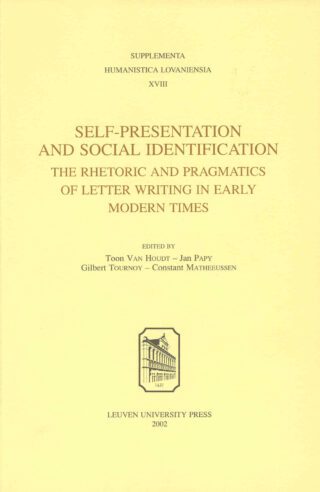
Self-Presentation and Social Identification
The Rhetoric and Pragmatics of Letter Writing in Early Modern Times
Toon Van Houdt (Editor), Jan Papy (Editor), Gilbert Tournoy (Editor), Constant Matheeussen (Editor),
More often than not, humanist, scholarly and ‘scientific’ correspondences from the early modern period have been analyzed from a rather narrow point of view. They were either exploited to reveal new biographical and historical evidence or assessed as literary achievements, as precious (or not so precious) pearls of artistic prose and composition. However legitimate such an outspokenly positivist and aesthetic approach may be, it does not exhaust the various possibilities for historical and literary study that early modern correspondences offer. It may, for instance, be doubted whether the traditional approach enables us to address, let alone to answer, one of the key questions that can and should be raised when dealing with letter writing in early modern times: how did the genre function as a social practice? This question can be reformulated as follows: who was writing, what, for whom, and why?
At first glance, many, if not most, of the correspondences seem to have functioned as a means to discuss business and family affairs, to express friendship (and, to a lesser extent, love), or to communicate scholarly information. If we scrutinize them more carefully, however, we will discover that epistolary exchange was far more signicifant and played a far more crucial role than this superficial enumeration of topics to be found in early modern correspondences would make us believe. It can indeed be argued that many humanists and other intellectuals wrote letters in order to define themselves as literators, scholars, or scientists. In other words, letters were used as a means of self-presentation and social identification. It is through letters that literators, scholars, and scientists presented a particular, quite often highly apologetic, self-image which they wanted to be divulged and perpetuated. It is through letters, moreover, that literators, scholars, and scientists defined themselves as belonging to a specific group of people who shared the same interests and ideals, and were engaged in similar endeavours.
Although these issues have not been entirely neglected by scholars in the past, this book brings together philologists, literary historians and historians of ideas to reflect upon the phenomenon of letter writing, and concentrates on four particular issues: the rhetoric of letter writing, friendship and patronage, criticism and libel, reputation and fame. Moreover, particular attention has been given to the functioning of letter writing as a means of self-presentation and social identification, linking together more closely text and context, literature and society.
Introduction
Toon Van Houdt & Jan Papy
PART I : The Rhetoric of Letter Writing
Judith Rice Henderson
Humanist Letter Writing: Private Conversation or Public Forum?
Charles Fantazzi
Vives versus Erasmus on the Art of Letter Writing
Christine Bénévent
Erasme en sa correspondance: conquête(s) et défaite(s) du langage
Tim Markey
Style and Tradition in Ben Jonson’s Verse Epistles
Kristine Haugen
Imaginary Correspondence: Epistolary Rhetoric and the Hermeneutics of Disbelief
PART II : Friendship and Patronage
Warren V. Boutcher
Literature, Thought or Fact? Past and Present Directions in the Study of the Early Modern Letter
Jacqueline Glomski
Careerism at Cracow: The Dedicatory Letters of Rudolf Agricola Junior, Valentin Eck, and Leonard Cox (1510-1530)
Mark Morford
Lipsius’ Letters of Recommendation
Elisabet Göransson
Letters, Learning and Learned Ladies. An Analysis of Otto Sperling, Jr.’s (1634-1715) Correspondence with Scandinavian Women
Part III : Exchanging Letters in the Republic of Letters
Henk J.M. Nellen
In Strict Confidence: Grotius’ Correspondence with his Socinian Friends
Corinna Vermeulen
Strategies and Slander in the Protestant Part of the Republic of Letters: Image, Friendship and Patronage in Etienne de Courcelles’ Correspondence
Antonio Iurilli
La crisi del sapere rinascimentale in un carteggio italiano di primo Settecento
PART IV : ‘Programming’, criticizing and libelling
Erika Rummel
Argumentis, non contumeliis: The Humanistic Model for Religious Debate and Erasmus’ Apologetic Letters
Jane Griffiths
The Grammarian as ‘Poeta’ and ‘Vates’: Self-Presentation in the Antibossicon
Iordan Avramov
Letter Writing and the Management of Scientific Controversy: The Correspondence of Henry Oldenburg (1661-1677)
PART V : Literary Fame and Scientific Reputation
Karl A. E. Enenkel
Die Grundlegung humanistischer Selbstpräsentation im Brief-Corpus: Francesco Petrarcas Familiarium rerum libri XXIV
Lisa Jardine
Before Clarissa: Erasmus, ‘Letters of Obscure Men’, and Epistolary Fictions
Edward V. George
Conceal or Disclose? The Limits of Self-Representation in the Letters of Juan Luis Vives
Philip J. Ford
Self-Presentation in the Published Correspondence of George Buchanan
Adam Mosley
Tycho Brahe’s Epistolae Astronomicae: A Reappraisal
Index nominum
Frequently Asked Questions
What is "Self-Presentation and Social Identification" about?
More often than not, humanist, scholarly and 'scientific' correspondences from the early modern period have been analyzed from a rather narrow point of view. They were either exploited to reveal new biographical and historical evidence or assessed as literary achievements, as precious (or not so precious) pearls of artistic prose and composition. However legitimate such an outspokenly positivist and aesthetic approach may be, it does not exhaust the various possibilities for historical and literary study that early modern correspondences offer. It may, for instance, be doubted whether the traditional approach enables us to address, let alone to answer, one of the key questions that can and should be raised when dealing with letter writing in early modern times: how did the genre function as a social practice? This question can be reformulated as follows: who was writing, what, for whom, and why?
At first glance, many, if not most, of the correspondences seem to have functioned as a means to discuss business and family affairs, to express friendship (and, to a lesser extent, love), or to communicate scholarly information. If we scrutinize them more carefully, however, we will discover that epistolary exchange was far more signicifant and played a far more crucial role than this superficial enumeration of topics to be found in early modern correspondences would make us believe. It can indeed be argued that many humanists and other intellectuals wrote letters in order to define themselves as literators, scholars, or scientists. In other words, letters were used as a means of self-presentation and social identification. It is through letters that literators, scholars, and scientists presented a particular, quite often highly apologetic, self-image which they wanted to be divulged and perpetuated. It is through letters, moreover, that literators, scholars, and scientists defined themselves as belonging to a specific group of people who shared the same interests and ideals, and were engaged in similar endeavours.
Although these issues have not been entirely neglected by scholars in the past, this book brings together philologists, literary historians and historians of ideas to reflect upon the phenomenon of letter writing, and concentrates on four particular issues: the rhetoric of letter writing, friendship and patronage, criticism and libel, reputation and fame. Moreover, particular attention has been given to the functioning of letter writing as a means of self-presentation and social identification, linking together more closely text and context, literature and society.
Who edited "Self-Presentation and Social Identification"?
"Self-Presentation and Social Identification" was edited by Toon Van Houdt, Jan Papy, Gilbert Tournoy and Constant Matheeussen.
Toon Van Houdt is associate professor of Latin at KU Leuven. His research focuses on the history of political and ethical thought in early modern times.
Jan Papy is full professor of Latin and Neo-Latin literature at KU Leuven. He publishes on Renaissance Humanism in the Low Countries, intellectual history, and Lipsius and Neo-Stoic philosophy.
Gilbert Tournoy is emeritus professor of Classical, Mediaeval and Renaissance Latin at KU Leuven.
Is "Self-Presentation and Social Identification" part of a series?
Yes, "Self-Presentation and Social Identification" is part of the "Supplementa Humanistica Lovaniensia" series. It's book 18 in the series.
The volumes published before 2000 are free available online.
What is the Table of Contents for "Self-Presentation and Social Identification"?
Introduction
Toon Van Houdt & Jan Papy
PART I : The Rhetoric of Letter Writing
Judith Rice Henderson
Humanist Letter Writing: Private Conversation or Public Forum?
Charles Fantazzi
Vives versus Erasmus on the Art of Letter Writing
Christine Bénévent
Erasme en sa correspondance: conquête(s) et défaite(s) du langage
Tim Markey
Style and Tradition in Ben Jonson's Verse Epistles
Kristine Haugen
Imaginary Correspondence: Epistolary Rhetoric and the Hermeneutics of Disbelief
PART II : Friendship and Patronage
Warren V. Boutcher
Literature, Thought or Fact? Past and Present Directions in the Study of the Early Modern Letter
Jacqueline Glomski
Careerism at Cracow: The Dedicatory Letters of Rudolf Agricola Junior, Valentin Eck, and Leonard Cox (1510-1530)
Mark Morford
Lipsius' Letters of Recommendation
Elisabet Göransson
Letters, Learning and Learned Ladies. An Analysis of Otto Sperling, Jr.'s (1634-1715) Correspondence with Scandinavian Women
Part III : Exchanging Letters in the Republic of Letters
Henk J.M. Nellen
In Strict Confidence: Grotius' Correspondence with his Socinian Friends
Corinna Vermeulen
Strategies and Slander in the Protestant Part of the Republic of Letters: Image, Friendship and Patronage in Etienne de Courcelles' Correspondence
Antonio Iurilli
La crisi del sapere rinascimentale in un carteggio italiano di primo Settecento
PART IV : 'Programming', criticizing and libelling
Erika Rummel
Argumentis, non contumeliis: The Humanistic Model for Religious Debate and Erasmus' Apologetic Letters
Jane Griffiths
The Grammarian as 'Poeta' and 'Vates': Self-Presentation in the Antibossicon
Iordan Avramov
Letter Writing and the Management of Scientific Controversy: The Correspondence of Henry Oldenburg (1661-1677)
PART V : Literary Fame and Scientific Reputation
Karl A. E. Enenkel
Die Grundlegung humanistischer Selbstpräsentation im Brief-Corpus: Francesco Petrarcas Familiarium rerum libri XXIV
Lisa Jardine
Before Clarissa: Erasmus, 'Letters of Obscure Men', and Epistolary Fictions
Edward V. George
Conceal or Disclose? The Limits of Self-Representation in the Letters of Juan Luis Vives
Philip J. Ford
Self-Presentation in the Published Correspondence of George Buchanan
Adam Mosley
Tycho Brahe's Epistolae Astronomicae: A Reappraisal
Index nominum
Related titles
 Justus Lipsius, Monita et exempla politica / Political Admonitions and Examples
Jan Papy (Editor), Toon Van Houdt (Editor), Marijke Janssens (Editor),
May 2022
 Studies in the Latin Literature and Epigraphy of Italian Fascism
Han Lamers (Editor), Bettina Reitz-Joosse (Editor), Valerio Sanzotta (Editor),
June 2020
 Una lingua morta per letterature vive: il dibattito sul latino come lingua letteraria in età moderna e contemporanea
Valerio Sanzotta (Editor),
January 2020
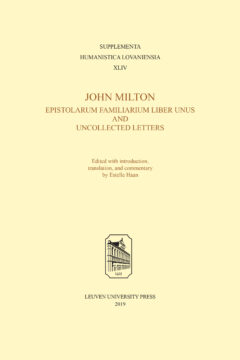 John Milton, Epistolarum Familiarium Liber Unus and Uncollected Letters
Estelle Haan (Editor),
October 2019
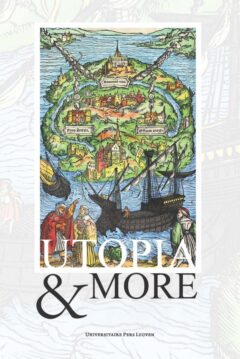 Utopia & More
Dirk Sacré (Editor), Erik De Bom (Editor), Demmy Verbeke (Editor), Gilbert Tournoy (Editor),
October 2016
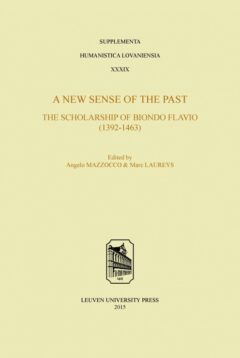 A New Sense of the Past: The Scholarship of Biondo Flavio (1392–1463)
Angelo Mazzocco (Editor), Marc Laureys (Editor),
May 2016
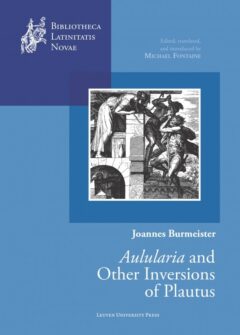 Aulularia and other Inversions of Plautus
Michael Fontaine (), Joannes Burmeister (Author),
July 2015
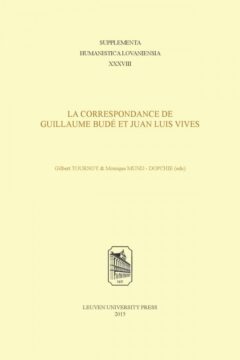 La correspondance de Guillaume Budé et Juan Luis Vives
Gilbert Tournoy (Editor), Monique Mund Dopchie (Editor),
June 2015
 Andreae Alciati Contra Vitam Monasticam Epistula – Andrea Alciato’s Letter Against Monastic Life
Dennis Drysdall (Author),
July 2014
 The Art of Arguing in the World of Renaissance Humanism
Marc Laureys (Editor), Roswitha Simons (Editor),
December 2013
 Icon Animorum or The Mirror of Minds
Mark Riley (Editor), John Barclay (Author), Thomas May (Translator),
November 2013
 Neo-Latin Commentaries and the Management of Knowledge in the Late Middle Ages and the Early Modern Period (1400 -1700)
Karl A.E. Enenkel (Editor), Henk Nellen (Editor),
July 2013
 De rationibus quibus homines docti artem Latine colloquendi et ex tempore dicendi saeculis XVI et XVII coluerunt
Terence Tunberg (Author),
March 2013
 The Early Modern Cultures of Neo-Latin Drama
Philip Ford (Editor), Andrew Taylor (Editor),
February 2013
 Scottish Latin Authors in Print up to 1700
Roger Green (Author), Philip Burton (Author), Deborah Ford (Author),
June 2012