

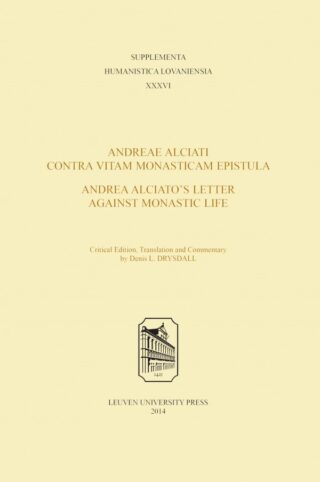
Criticism of monastic life by one of Europe’s major Renaissance figures
In his letter Against Monastic Life (1514–17) Andrea Alciato, an Italian jurist and writer famous for his Emblemata, urges his friend Bernardus Mattius to reconsider his choice of monastic life. Alciato makes his argument by criticizing religious superstition, the Church’s hierarchy, and monastic practices, particularly the Franciscans’ hypocrisy, wealth, and divisiveness. Instead, he defends a stoic, civic humanism. Due to the troubled history of this unique manuscript and the inadequacies of the two subsequent editions, Alciato’s discourse has been obscured for centuries. This edition and translation seeks to make clear the biographical importance of the text for one of the major figures of the European Renaissance.
TABLE OF CONTENTS
— Acknowledgements
— Introduction
— Appendices
— Note on the Text and Translation
— Text and Translation
— Index of Names
Drysdall's edition is very well done, and the translation is excellent and very readable. The value of the work lies in the clear influence of Erasmus. Alciato refers by name to Erasmus's 1516 New Testament, the Instrumentum novum (101), and it is the source of Alciato's biblical quotations. There are also about thirty references to and quotes from Erasmus's Adagia. Likewise, Erasmus's letters to Alciato are in his Correspondence, and Alciato is cited by Erasmus in the Adagia. This edition shows the concerns of an Italian Catholic at the time of the start of Protestantism, and the arguments are similar to those that engulfed greater figures such as Erasmus and Luther in controversies.
Bruce McNair, THE NEO-LATIN NEWS Vol. 63, Nos. 3&4
Both the introduction and the translation of the Latin letter will doubtless interest anyone concerned with Alciato himself and his emblems, but also with questions relating to religion in the early modern period. It would be impossible to write about monasticism without coming to terms with the Franciscan order.
Peter M. Daly, McGill University, The Renaissance Quarterly, Volume 69, Number 4 | Winter 2016
Frequently Asked Questions
What is "Andreae Alciati Contra Vitam Monasticam Epistula – Andrea Alciato’s Letter Against Monastic Life" about?
Criticism of monastic life by one of Europe’s major Renaissance figures
In his letter Against Monastic Life (1514–17) Andrea Alciato, an Italian jurist and writer famous for his Emblemata, urges his friend Bernardus Mattius to reconsider his choice of monastic life. Alciato makes his argument by criticizing religious superstition, the Church’s hierarchy, and monastic practices, particularly the Franciscans’ hypocrisy, wealth, and divisiveness. Instead, he defends a stoic, civic humanism. Due to the troubled history of this unique manuscript and the inadequacies of the two subsequent editions, Alciato’s discourse has been obscured for centuries. This edition and translation seeks to make clear the biographical importance of the text for one of the major figures of the European Renaissance.
Who wrote "Andreae Alciati Contra Vitam Monasticam Epistula – Andrea Alciato’s Letter Against Monastic Life"?
"Andreae Alciati Contra Vitam Monasticam Epistula – Andrea Alciato’s Letter Against Monastic Life" was written by Dennis Drysdall.
Denis Drysdall is a Research Associate and retired Associate Professor of Romance Languages of the University of Waikato, Hamilton, New Zealand.
Is "Andreae Alciati Contra Vitam Monasticam Epistula – Andrea Alciato’s Letter Against Monastic Life" part of a series?
Yes, "Andreae Alciati Contra Vitam Monasticam Epistula – Andrea Alciato’s Letter Against Monastic Life" is part of the "Supplementa Humanistica Lovaniensia" series. It's book 36 in the series.
The volumes published before 2000 are free available online.
What is the Table of Contents for "Andreae Alciati Contra Vitam Monasticam Epistula – Andrea Alciato’s Letter Against Monastic Life"?
TABLE OF CONTENTS
— Acknowledgements
— Introduction
— Appendices
— Note on the Text and Translation
— Text and Translation
— Index of Names
What is the DOI for "Andreae Alciati Contra Vitam Monasticam Epistula – Andrea Alciato’s Letter Against Monastic Life"?
The Digital Object Identifier (DOI) for "Andreae Alciati Contra Vitam Monasticam Epistula – Andrea Alciato’s Letter Against Monastic Life" is 10.11116/9789461661333.
Related titles
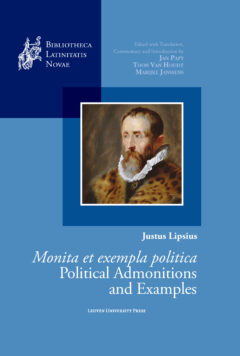 Justus Lipsius, Monita et exempla politica / Political Admonitions and Examples
Jan Papy (Editor), Toon Van Houdt (Editor), Marijke Janssens (Editor),
May 2022
 Studies in the Latin Literature and Epigraphy of Italian Fascism
Han Lamers (Editor), Bettina Reitz-Joosse (Editor), Valerio Sanzotta (Editor),
June 2020
 Una lingua morta per letterature vive: il dibattito sul latino come lingua letteraria in età moderna e contemporanea
Valerio Sanzotta (Editor),
January 2020
 John Milton, Epistolarum Familiarium Liber Unus and Uncollected Letters
Estelle Haan (Editor),
October 2019
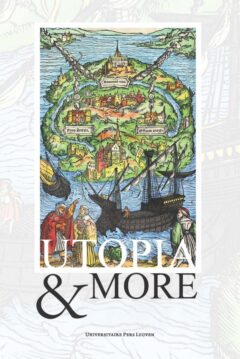 Utopia & More
Dirk Sacré (Editor), Erik De Bom (Editor), Demmy Verbeke (Editor), Gilbert Tournoy (Editor),
October 2016
 A New Sense of the Past: The Scholarship of Biondo Flavio (1392–1463)
Angelo Mazzocco (Editor), Marc Laureys (Editor),
May 2016
 Aulularia and other Inversions of Plautus
Michael Fontaine (), Joannes Burmeister (Author),
July 2015
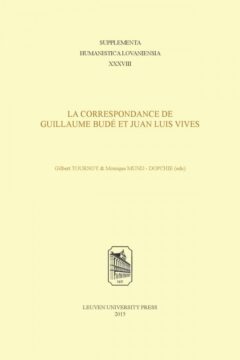 La correspondance de Guillaume Budé et Juan Luis Vives
Gilbert Tournoy (Editor), Monique Mund Dopchie (Editor),
June 2015
 The Art of Arguing in the World of Renaissance Humanism
Marc Laureys (Editor), Roswitha Simons (Editor),
December 2013
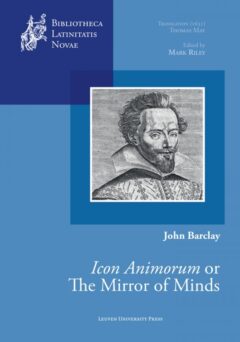 Icon Animorum or The Mirror of Minds
Mark Riley (Editor), John Barclay (Author), Thomas May (Translator),
November 2013
 Neo-Latin Commentaries and the Management of Knowledge in the Late Middle Ages and the Early Modern Period (1400 -1700)
Karl A.E. Enenkel (Editor), Henk Nellen (Editor),
July 2013
 De rationibus quibus homines docti artem Latine colloquendi et ex tempore dicendi saeculis XVI et XVII coluerunt
Terence Tunberg (Author),
March 2013
 The Early Modern Cultures of Neo-Latin Drama
Philip Ford (Editor), Andrew Taylor (Editor),
February 2013
 Scottish Latin Authors in Print up to 1700
Roger Green (Author), Philip Burton (Author), Deborah Ford (Author),
June 2012

 Humanistica Lovaniensia, Volume VIII – 2009
Dirk Sacré (Editor), Jan Papy (Editor), Lambert Isebaert (Editor), Monique Mund Dopchie (Editor), Gilbert Tournoy (Editor),
December 2009