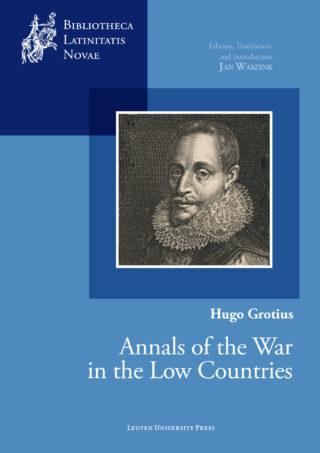
Hugo Grotius, Annals of the War in the Low Countries
Edition, Translation, and Introduction
Jan Waszink (Editor),
Series: Bibliotheca Latinitatis Novae
Category: Literature, Neo-Latin Studies
Language: English
ISBN: 9789462703513
Publication date: February 14, 2023
€120.00 (including 6% VAT)
Buy NowNumber of pages: 456
Size: 240 x 170 x 30 mm

Stock item: 152670
Standard delivery time for print books:
For Belgium: 5 to 8 working days
For EU: 2 to 3 weeks
For other countries: 4 to 5 weeks
Series: Bibliotheca Latinitatis Novae
Category: Literature, Neo-Latin Studies
Language: English
ISBN: 9789461664853
Publication date: February 14, 2023
€102.00 (including 6% VAT)
Buy NowNumber of pages: 456
Grotius on the Dutch Revolt and the
fundamentality of reason of state
The Annals of the War in the Low Countries is one of Hugo Grotius’ lesser-known works. Grotius expresses a contrarian view of the early revolt, which he presents not as a united battle for the true faith and the ancient liberties of the land but as a protracted and painful struggle, not only with the great power of Spain, but also with discord, selfishness and religious fanaticism among the Dutch. To convey this complex and controversial vision of the foundational years of the Dutch Republic, Grotius chose the worldview and the prose style of the Roman historian Cornelius Tacitus as his model. His commissioners, however – the States of Holland – did not publish the work when it was finished in 1612; it appeared in print posthumously in 1657.
This is the first edition of Grotius’ then-influential and well-known Annals of the Dutch Revolt since its initial publication. It presents a critical edition of the Latin text, a fresh modern English translation, and an introduction which covers all aspects of the work, from its conception to its modern reception, underlining the importance of reason of state for Grotius’ thought in general.
This publication is GPRC-labeled (Guaranteed Peer-Reviewed Content).
Preface vii
Introduction 1. Hugo Grotius’ Annales et Historiae 2. The AH and the States of Holland, the Revolt and the Truce Conflicts 2.1. The main setting 2.2. The publication plans for the AH in 1612–13 2.3. The States and History 2.4. The Truce Conflicts 3. Hugo Grotius 1 4. Tacitism and Reason of State in the Annales et Historiae 5. The Statesman-Historian: Grotius and the historian’s role in society 6. Controversial content and the non-publication of the AH in 1612–1613 7. Tacitism 7.1. Tacitist content and ideas 7.2. Syntax and forms of Grotius’ imitation of Tacitus’ literary style 7.3. Compositorial aspects and narrative structure 7.3.1. Is there dramatic structuring in the AH? 7.4. Conclusion: Grotius’ imitation of Tacitus 8. Some important characters in the AH 8.1. William the Silent 8.2. Philip II 8.3. Robert Dudley, Earl of Leicester 9. Other aspects 9.1. Grotius and the Twelve Years’ Truce 9.2. The AH’s relationship with Grotius’ other works 9.3. Grotius as Historian 9.4. Is there a sense of ‘Netherlands’ or ‘Dutch’ nationhood in the Annales? 10. Sources of the Annales et Historiae 11. The composition and reception of the Annales et Historiae 11.1. Original composition and manuscripts 11.2. Reception during Grotius’ lifetime 11.3. The survival of the manuscripts
11.4. The printed editions of 1657–1658 11.5. The AH and the Vatican Index of Forbidden Books 1657–1659 11.6. Translations 11.7. Further reception, 17th–21st centuries 11.8. Scholarship on the text 12. Conclusion
This edition 1. Principles of this edition 1.1. Sigla 1.2. Neo-Latin aspects 2. About this translation
Summaries of annales 1–5 Appendix 1. The extant manuscripts of the Historiae Appendix 2. The Vatican Index reports Appendix 3. Biographical epilogues on Philip II by Grotius and by Van Meteren Appendix 4. The Nijmegen copy of Pompeio Giustiniani’s Bellum Belgicum Appendix 5. Pieter Feddes van Harlingen’s ‘Monster’ print of 1619 Appendix 6. Sententiae and epigrams in Annales 1 and 2 Appendix 7. Book summaries by the editors of 1657
Bibliography Illustration credits Index to the introduction Index of names to the translation and notes
It is owing to Jan Waszink’s invaluable and indefatigable scholarship on the Annales that the obstacles to its study are now finally removed. There are no more excuses not to read Grotius the historian. - Helmer Helmers, The Seventeenth Century, https://doi.org/10.1080/0268117X.2023.2283342
Frequently Asked Questions
What is "Hugo Grotius, Annals of the War in the Low Countries" about?
Grotius on the Dutch Revolt and the
fundamentality of reason of state
The Annals of the War in the Low Countries is one of Hugo Grotius' lesser-known works. Grotius expresses a contrarian view of the early revolt, which he presents not as a united battle for the true faith and the ancient liberties of the land but as a protracted and painful struggle, not only with the great power of Spain, but also with discord, selfishness and religious fanaticism among the Dutch. To convey this complex and controversial vision of the foundational years of the Dutch Republic, Grotius chose the worldview and the prose style of the Roman historian Cornelius Tacitus as his model. His commissioners, however – the States of Holland – did not publish the work when it was finished in 1612; it appeared in print posthumously in 1657.
This is the first edition of Grotius' then-influential and well-known Annals of the Dutch Revolt since its initial publication. It presents a critical edition of the Latin text, a fresh modern English translation, and an introduction which covers all aspects of the work, from its conception to its modern reception, underlining the importance of reason of state for Grotius' thought in general.
This publication is GPRC-labeled (Guaranteed Peer-Reviewed Content).
Who edited "Hugo Grotius, Annals of the War in the Low Countries"?
"Hugo Grotius, Annals of the War in the Low Countries" was edited by Jan Waszink.
Jan Waszink is a senior researcher at the Historical Institute of the Polish Academy of Sciences.
Is "Hugo Grotius, Annals of the War in the Low Countries" part of a series?
Yes, "Hugo Grotius, Annals of the War in the Low Countries" is part of the "Bibliotheca Latinitatis Novae" series.
The series Bibliotheca Latinitatis Novae, previously published by Van Gorcum, offers Latin literature from the later Renaissance and the Early Modern period. By combining each critical Latin text with an English translation, an historical introduction, and notes, Bibliotheca Latinitatis Novae makes texts accessible to specialists and general readers alike.

This series is available on standing order. To sign up for a subscription or for more information, please contact info@lup.be.
The volumes published before 2013 in the Bibliotheca Latinitatis Novae series have been reduced in price to € 25,00 only! Order online or email your order to info@lup.be.
Free backlist ebook available via Google Books
 Politica : six books of politics or political instruction
Justus Lipsius, Jan Hendrik Waszink
2004, Van Gorcum
DOWNLOAD >
Editorial Board
Jan Waszink (editor in chief), Historical Institute of the Polish Academy of Sciences, Warsaw
Christoph Pieper, Leiden University
Grażyna Urban-Godziek, Jagiellonian University Krakow
Dirk van Miert, Huygens Institute for History and Culture of the Netherlands and Utrecht University
Johanna Luggin, Universität Innsbruck
Elena Dahlberg, University of Skövde
Benjamin Plomp, Universität Basel
Advisory board
Maurizio Campanelli, Karl Enenkel, Marianne Pade, Dirk Sacré, Florian Schaffenrath
Proposals
Proposals and enquiries can be sent to Jan Waszink.
Please make use of the submission form to present your manuscript or proposal to our board.
Links & Resources
What is the Table of Contents for "Hugo Grotius, Annals of the War in the Low Countries"?
Preface vii
Introduction 1. Hugo Grotius’ Annales et Historiae 2. The AH and the States of Holland, the Revolt and the Truce Conflicts 2.1. The main setting 2.2. The publication plans for the AH in 1612–13 2.3. The States and History 2.4. The Truce Conflicts 3. Hugo Grotius 1 4. Tacitism and Reason of State in the Annales et Historiae 5. The Statesman-Historian: Grotius and the historian’s role in society 6. Controversial content and the non-publication of the AH in 1612–1613 7. Tacitism 7.1. Tacitist content and ideas 7.2. Syntax and forms of Grotius’ imitation of Tacitus’ literary style 7.3. Compositorial aspects and narrative structure 7.3.1. Is there dramatic structuring in the AH? 7.4. Conclusion: Grotius’ imitation of Tacitus 8. Some important characters in the AH 8.1. William the Silent 8.2. Philip II 8.3. Robert Dudley, Earl of Leicester 9. Other aspects 9.1. Grotius and the Twelve Years’ Truce 9.2. The AH’s relationship with Grotius’ other works 9.3. Grotius as Historian 9.4. Is there a sense of ‘Netherlands’ or ‘Dutch’ nationhood in the Annales? 10. Sources of the Annales et Historiae 11. The composition and reception of the Annales et Historiae 11.1. Original composition and manuscripts 11.2. Reception during Grotius’ lifetime 11.3. The survival of the manuscripts
11.4. The printed editions of 1657–1658 11.5. The AH and the Vatican Index of Forbidden Books 1657–1659 11.6. Translations 11.7. Further reception, 17th–21st centuries 11.8. Scholarship on the text 12. Conclusion
This edition 1. Principles of this edition 1.1. Sigla 1.2. Neo-Latin aspects 2. About this translation
Summaries of annales 1–5 Appendix 1. The extant manuscripts of the Historiae Appendix 2. The Vatican Index reports Appendix 3. Biographical epilogues on Philip II by Grotius and by Van Meteren Appendix 4. The Nijmegen copy of Pompeio Giustiniani’s Bellum Belgicum Appendix 5. Pieter Feddes van Harlingen’s ‘Monster’ print of 1619 Appendix 6. Sententiae and epigrams in Annales 1 and 2 Appendix 7. Book summaries by the editors of 1657
Bibliography Illustration credits Index to the introduction Index of names to the translation and notes
Related titles
 Feminists Resisting Gendered Violence
Hemangini Gupta (Editor), Fiona Mackay (Editor), Jan Breckenridge (Editor), Louise Chappell (Editor), Rachna Mehra (Editor), Rukmini Sen (Editor), Mailin Suchting (Editor),
October 2026
 Affect in Translation and Interpreting
Sofía Monzón (Editor), Lucie Spezzatti (Editor), Elisabeth Goemans (Editor),
May 2026

 Research Methods in Literary Reception Studies
Jeroen Dera (Editor), Anne Oerlemans (Editor), Frederik Van Dam (Editor),
May 2026
 Comics and the Global South
Andrea Aramburú (Editor), Dibyadyuti Roy (Editor), Joe Sutliff Sanders (Editor),
February 2026
 Situatedness and Performativity
Raquel Pacheco Aguilar (Editor), Marie-France Guénette (Editor),
November 2025

 Transfer Thinking in Translation Studies
Maud Gonne (Editor), Klaartje Merrigan (Editor), Reine Meylaerts (Editor), Heleen van Gerwen (Editor),
September 2025
 The Visionary Art of Franco-Belgian Comics, 1930s to 1960s
Hugo Frey (Editor), Maaheen Ahmed (Editor),
September 2025
 Superhero Comics and Scottish Identity
David John Boyd (Author), Julie Briand-Boyd (Author),
July 2025
 European Literatures of Military Occupation
Matthias Buschmeier (Editor), Jeanne E. Glesener (Editor),
October 2024
 Beyond the Translator’s Invisibility
Peter J. Freeth (Editor), Rafael Treviño (Editor),
September 2025
 Alles verandert altijd – Herziene editie
Lieven D'hulst (Editor), Chris Van de Poel (Editor),
December 2023
 Modern Etruscans
Chiara Zampieri (Editor), Martina Piperno (Editor), Bart Van den Bossche (Editor),
October 2023