

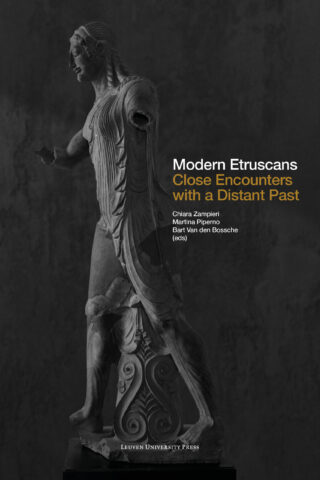

Modern Etruscans
Close Encounters with a Distant Past
Chiara Zampieri (Editor), Martina Piperno (Editor), Bart Van den Bossche (Editor),

Category: Archaeology, Art, History 1800-present, Literature, Media and Visual Culture
Language: English
ISBN: 9789462703797
Publication date: October 24, 2023
€30.00 (including 6% VAT)
Buy NowNumber of pages: 188
Size: 234 x 156 x 11 mm
Number of illustrations: 25

Funded by: KU Leuven
KU Leuven Fund for Fair Open Access
MDRN
Museo Nazionale Etrusco di Villa Giulia
Stock item: 157110
Standard delivery time for print books:
For Belgium: 5 to 8 working days
For EU: 2 to 3 weeks
For other countries: 4 to 5 weeks
Category: Archaeology, Art, History 1800-present, Literature, Media and Visual Culture
Language: English
ISBN: 9789461665232
Publication date: October 2, 2023
Download Free PDFNumber of pages: 188
Number of illustrations: 25
Funded by: KU Leuven
KU Leuven Fund for Fair Open Access
MDRN
Museo Nazionale Etrusco di Villa Giulia
New insights on the reception of Etruscan antiquity in the modernist period.
“L’Étrurie est à la mode”, French archaeologist Salomon Reinach bluntly stated in 1927. Since the beginning of the nineteenth century, Etruria had not only been attracting the attention of archaeologists and specialists of all sorts, but it had also been a fascinating and, in some cases, captivating destination for poets, novelists, painters and sculptors from all over Europe. This volume deals with the impact of the constantly expanding knowledge on the Etruscans and their mysterious civilisation on Italian, French, English, and German literature, arts and culture, with particular regard to the modernist period (1890–1950). The volume brings a distinctive point of view to the subject by approaching it from an interdisciplinary and comparative perspective, and by looking at a quite diverse range of topics and artefacts, which includes, but is not limited to, the study of drawings, art works, travel essays, novels, cooking recipes, schoolbooks, photographs, and movies.
By exploring a new paradigm to understand ancient cultures, beyond the traditional ideas and models of “reception of the classics”, and by challenging the alleged fracture between the so-called “two cultures” of humanities and natural sciences, Modern Etruscans will be of interest to scholars from various disciplines. Designed as a learning tool for university courses on the interplay between literature and science in the twentieth century, it is suited as recommended reading for students in the humanities.
Contributors: Francesca Orestano (Università degli Studi di Milano), Chiara Zampieri (KU Leuven), Bart Van den Bossche (KU Leuven), Lisa C. Pieraccini (University of California, Berkeley), Martin Miller (Italienisches Kulturinstitut Stuttgart), Marie-Laurence Haack (Université de Picardie Jules Verne), Gennaro Ambrosino (University of Warwick), Martina Piperno (Durham University), Andrea Avalli (Scuola Superiore di Studi Storici di San Marino).
Ebook available in Open Access.
This publication is GPRC-labeled (Guaranteed Peer-Reviewed Content).
9 Introduction
Chiara Zampieri, Martina Piperno and Bart Van den Bossche
23 Etruscans, Victorians, and After: The Modern Sense of Beauty
Francesca Orestano
43 The ‘Walking Apollo’: From Archaeological Dissemination to Literary Knowledge
Chiara Zampieri
63 Cooking by the Book: Travel Writing and Etruscan Food Culture in the Interwar Period
Bart Van den Bossche
81 Etruscans in Unexpected Places: Space, Temporality and Visual Agency
Lisa C. Pieraccini
97 The Demonisation of the Etruscans: From Alfred Grünwedel to German Schoolbooks
Martin Miller
115 Mr Lawrence and Lady Larthia: D. H. Lawrence as an Apprentice Etruscologist
Marie-Laurence Haack
127 Etruscan Studies and the Infernal Landscape in Vincenzo Cardarelli’s prose d’arte
Gennaro Ambrosino
147 The Problem of Distance: Giorgio Bassani, The Etruscans and the Limits of Compassion
Martina Piperno
163 A Compromised Antiquity: The Post-war Italian Rejection of the Etruscan Past
Andrea Avalli
181 About the Authors
185 Index
Chiara Zampieri
Chiara Zampieri is a junior researcher in Comparative Literature at KU Leuven and member of the MDRN Research Lab.
Martina Piperno
Martina Piperno is assistant professor of Italian Studies at Sapienza - Università di Roma and member of the MDRN Research Lab.
Bart Van den Bossche
Bart Van den Bossche is full professor of Italian Studies at KU Leuven and founding member of the MDRN Research Lab.
This book forms a very useful starting point in the field of cultural history in modern times. The scholarly content of several contributions is deeply interesting and brings fresh ideas to the discipline, inspiring new approaches. Each contribution challenges the current debate and presents new content, if to varying degrees.
Giovanna Bagnasco Gianni, Università degli Studi di Milano
As a contribution to the scholarship on receptions of Etruscan culture, however, this book takes important steps forward. The book truly presents a thorough exploration of a period mostly neglected by earlier scholarship on the afterlife of this ancient people. Its appearance will stimulate new research on the topic, as it will not only be a good starting point for the modernist period, but also help scholars with a broader focus to better grasp the longue durée reception of Etruscan culture. - Louis Verreth, Incontri. Rivista europea di studi italiani, 38(1), pp. 1–2, https://doi.org/10.18352/inc18951
Frequently Asked Questions
What is "Modern Etruscans" about?
New insights on the reception of Etruscan antiquity in the modernist period.
“L’Étrurie est à la mode”, French archaeologist Salomon Reinach bluntly stated in 1927. Since the beginning of the nineteenth century, Etruria had not only been attracting the attention of archaeologists and specialists of all sorts, but it had also been a fascinating and, in some cases, captivating destination for poets, novelists, painters and sculptors from all over Europe. This volume deals with the impact of the constantly expanding knowledge on the Etruscans and their mysterious civilisation on Italian, French, English, and German literature, arts and culture, with particular regard to the modernist period (1890–1950). The volume brings a distinctive point of view to the subject by approaching it from an interdisciplinary and comparative perspective, and by looking at a quite diverse range of topics and artefacts, which includes, but is not limited to, the study of drawings, art works, travel essays, novels, cooking recipes, schoolbooks, photographs, and movies.
By exploring a new paradigm to understand ancient cultures, beyond the traditional ideas and models of “reception of the classics”, and by challenging the alleged fracture between the so-called “two cultures” of humanities and natural sciences, Modern Etruscans will be of interest to scholars from various disciplines. Designed as a learning tool for university courses on the interplay between literature and science in the twentieth century, it is suited as recommended reading for students in the humanities.
Contributors: Francesca Orestano (Università degli Studi di Milano), Chiara Zampieri (KU Leuven), Bart Van den Bossche (KU Leuven), Lisa C. Pieraccini (University of California, Berkeley), Martin Miller (Italienisches Kulturinstitut Stuttgart), Marie-Laurence Haack (Université de Picardie Jules Verne), Gennaro Ambrosino (University of Warwick), Martina Piperno (Durham University), Andrea Avalli (Scuola Superiore di Studi Storici di San Marino).
Ebook available in Open Access.
This publication is GPRC-labeled (Guaranteed Peer-Reviewed Content).
Who edited "Modern Etruscans"?
"Modern Etruscans" was edited by Chiara Zampieri, Martina Piperno and Bart Van den Bossche.
Chiara Zampieri is a junior researcher in Comparative Literature at KU Leuven and member of the MDRN Research Lab.
Martina Piperno is assistant professor of Italian Studies at Sapienza - Università di Roma and member of the MDRN Research Lab.
Bart Van den Bossche is full professor of Italian Studies at KU Leuven and founding member of the MDRN Research Lab.
Is "Modern Etruscans" available Open Access?
Yes, "Modern Etruscans" is published Open Access. It is available under a BY-NC-ND license.
Who funded the publication of "Modern Etruscans"?
Publication of "Modern Etruscans" was funded by KU Leuven
KU Leuven Fund for Fair Open Access
MDRN
Museo Nazionale Etrusco di Villa Giulia
.
What is the Table of Contents for "Modern Etruscans"?
9 Introduction
Chiara Zampieri, Martina Piperno and Bart Van den Bossche
23 Etruscans, Victorians, and After: The Modern Sense of Beauty
Francesca Orestano
43 The ‘Walking Apollo’: From Archaeological Dissemination to Literary Knowledge
Chiara Zampieri
63 Cooking by the Book: Travel Writing and Etruscan Food Culture in the Interwar Period
Bart Van den Bossche
81 Etruscans in Unexpected Places: Space, Temporality and Visual Agency
Lisa C. Pieraccini
97 The Demonisation of the Etruscans: From Alfred Grünwedel to German Schoolbooks
Martin Miller
115 Mr Lawrence and Lady Larthia: D. H. Lawrence as an Apprentice Etruscologist
Marie-Laurence Haack
127 Etruscan Studies and the Infernal Landscape in Vincenzo Cardarelli’s prose d’arte
Gennaro Ambrosino
147 The Problem of Distance: Giorgio Bassani, The Etruscans and the Limits of Compassion
Martina Piperno
163 A Compromised Antiquity: The Post-war Italian Rejection of the Etruscan Past
Andrea Avalli
181 About the Authors
185 Index
What is the DOI for "Modern Etruscans"?
The Digital Object Identifier (DOI) for "Modern Etruscans" is 10.11116/9789461665232.
Related titles
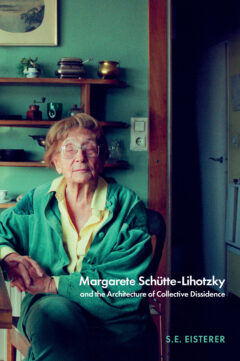 Margarete Schütte-Lihotzky and the Architecture of Collective Dissidence, 1918–1989
S.E. Eisterer (Author),
April 2027
 Collective Trauma and Future Fantasies
Raika Khorshidian (Editor), Birgit Mersmann (Editor), Cathrine Bublatzky (Editor), Julia Stenzel (Editor),
November 2026
 Feminists Resisting Gendered Violence
Hemangini Gupta (Editor), Fiona Mackay (Editor), Jan Breckenridge (Editor), Louise Chappell (Editor), Rachna Mehra (Editor), Rukmini Sen (Editor), Mailin Suchting (Editor),
October 2026

 A City in Practice
Aude Tournaye (Editor), Filip De Boeck (Editor), Picha Collective (Editor),
September 2026
 Ecologies of Photography in the American West
Monica Bravo (Editor), Carolin Görgen (Editor),
September 2026
 German–Rapanui Entanglements
Cristián Moreno Pakarati (Editor), Diego Muñoz (Editor), Philipp Schorch (Editor),
August 2026
 Affect in Translation and Interpreting
Sofía Monzón (Editor), Lucie Spezzatti (Editor), Elisabeth Goemans (Editor),
May 2026
 Cinema in Post-War Belgium
Gertjan Willems (Editor), Bjorn Gabriels (Editor), Bénédicte Rochet (Editor),
May 2026
 Research Methods in Literary Reception Studies
Jeroen Dera (Editor), Anne Oerlemans (Editor), Frederik Van Dam (Editor),
May 2026

 Performing Magnetism
Eleonora Paklons (Editor), Kristof Smeyers (Editor), Kurt Vanhoutte (Editor), Hannah Welslau (Editor),
May 2026
 Political Exile in the Global Twentieth Century
Wolfram Kaiser (Editor), Piotr H. Kosicki (Editor),
April 2026
 Jean Katambayi Mukendi
Johannes Muselaers (Editor), Stéphane Symons (Editor), Anne-Claire Schmitz (Editor), Emma Enderby (Editor),
April 2026
 Christian Democracy and the Fall of Communism
Michael Gehler (Editor), Piotr H. Kosicki (Editor), Helmut Wohnout (Editor),
April 2026
 Nomadic Camera
Burcu Dogramaci (Editor), Winfried Gerling (Editor), Jens Jäger (Editor), Birgit Mersmann (Editor),
March 2026