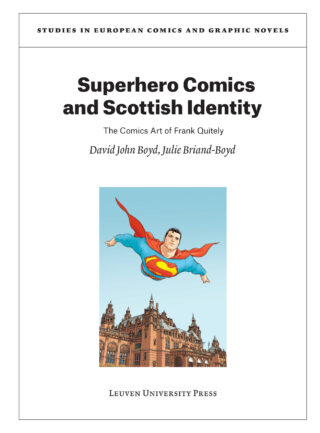
Superhero Comics and Scottish Identity
The Comics Art of Frank Quitely
David John Boyd (Author), Julie Briand-Boyd (Author),
Series: Studies in European Comics and Graphic Novels
Category: Literature
Language: English
ISBN: 9789462704664
Publication date: June 25, 2025
€59.50 (including 6% VAT)
Buy NowNumber of pages: 302
Size: 230 x 170 x 12 mm
Number of illustrations: 70
Illustrations and other content description:
Illustrated, 40 pages in colour

Stock item: 166589
Standard delivery time for print books:
For Belgium: 5 to 8 working days
For EU: 2 to 3 weeks
For other countries: 4 to 5 weeks
Series: Studies in European Comics and Graphic Novels
Category: Literature
Language: English
ISBN: 9789461666536
Publication date: July 15, 2025
€51.00 (including 6% VAT)
Buy NowNumber of pages: 302
Number of illustrations: 70
Illustrations and other content description:
Illustrated, 40 pages in colour
Series: Studies in European Comics and Graphic Novels
Category: Literature
Language: English
ISBN: 9789461666529
Publication date: June 25, 2025
€51.00 (including 6% VAT)
Buy NowNumber of pages: 302
Number of illustrations: 70
Illustrations and other content description:
Illustrated, 40 pages in colour
The work of Frank Quitely and the role of comics art in contemporary Scottish culture, politics and society.
Superhero Comics and Scottish Identity explores the life and career of Glasgow-born, Eisner Award-winning, and internationally acclaimed Marvel, DC, and Image Comics artist Frank Quitely. With a prolific career spanning more than three decades, Quitely played a pivotal role in the British superhero renaissance of the 1990s and 2000s and in the explosive emergence of the Scottish new wave of comics, a movement that included peers like Alan Grant, Mark Millar, and Grant Morrison, but has been underrepresented in both comics studies and Scottish studies. This work investigates questions of historical and contemporary expressions of Scottishness in transcultural comics genres such as superhero, science fiction, and fantasy. Framed through the lens of comics and literary genres, as well as their British and American editors, Quitely’s approach to Scottishness is oblique and self-reflexive; his expressions of Scottishness are tensely bound to current nuanced examinations of Scottish national, literary and historical subjectivity. His work oscillates between two axiomatic antipodes: the regional, provincial, and local versus the transnational, cosmopolitan, and global.
This comprehensive study also features an in-depth interview with Quitely, as well as unearthed archives, sketchbooks, notes, and donated or personal artworks not available elsewhere.
This book will be made open access within three years of publication thanks to Path to Open, a program developed in partnership between JSTOR, the American Council of Learned Societies (ACLS), University of Michigan Press, and The University of North Carolina Press to bring about equitable access and impact for the entire scholarly community, including authors, researchers, libraries, and university presses around the world. Learn more at https://about.jstor.org/path-to-open/
Acknowledgements
Part 1—Sketching Scotland
Introduction. The Scottish Connection
Chapter 1. Frank Quitely’s Portraits of Scottishness
Chapter 2. Frank Quitely’s Landscapes of Scottishness
Part 2—The Garden of Two Glasgows
Chapter 3. Frank Quitely’s Angelic Doubles
Chapter 4. Frank Quitely’s Devilish Derivations
Part 3—The Bottled City of Glasgow
Chapter 5. Frank Quitely as Global Artist
Chapter 6. Frank Quitely as Local Artist
Conclusion. From Glasgow to Gotham
The Glasgow Interviews. A Conversation with Frank Quitely
Bibliography
Index
David John Boyd
David John Boyd is a post-doctoral research fellow at the Stirling Maxwell Centre of the University of Glasgow.
Julie Briand-Boyd
Julie Briand-Boyd is a post-doctoral research fellow at the Stirling Maxwell Centre of the University of Glasgow.
Frequently Asked Questions
What is "Superhero Comics and Scottish Identity" about?
The work of Frank Quitely and the role of comics art in contemporary Scottish culture, politics and society.
Superhero Comics and Scottish Identity explores the life and career of Glasgow-born, Eisner Award-winning, and internationally acclaimed Marvel, DC, and Image Comics artist Frank Quitely. With a prolific career spanning more than three decades, Quitely played a pivotal role in the British superhero renaissance of the 1990s and 2000s and in the explosive emergence of the Scottish new wave of comics, a movement that included peers like Alan Grant, Mark Millar, and Grant Morrison, but has been underrepresented in both comics studies and Scottish studies. This work investigates questions of historical and contemporary expressions of Scottishness in transcultural comics genres such as superhero, science fiction, and fantasy. Framed through the lens of comics and literary genres, as well as their British and American editors, Quitely’s approach to Scottishness is oblique and self-reflexive; his expressions of Scottishness are tensely bound to current nuanced examinations of Scottish national, literary and historical subjectivity. His work oscillates between two axiomatic antipodes: the regional, provincial, and local versus the transnational, cosmopolitan, and global.
This comprehensive study also features an in-depth interview with Quitely, as well as unearthed archives, sketchbooks, notes, and donated or personal artworks not available elsewhere.
This book will be made open access within three years of publication thanks to Path to Open, a program developed in partnership between JSTOR, the American Council of Learned Societies (ACLS), University of Michigan Press, and The University of North Carolina Press to bring about equitable access and impact for the entire scholarly community, including authors, researchers, libraries, and university presses around the world. Learn more at https://about.jstor.org/path-to-open/
Who wrote "Superhero Comics and Scottish Identity"?
"Superhero Comics and Scottish Identity" was written by David John Boyd and Julie Briand-Boyd.
David John Boyd is a post-doctoral research fellow at the Stirling Maxwell Centre of the University of Glasgow.
Julie Briand-Boyd is a post-doctoral research fellow at the Stirling Maxwell Centre of the University of Glasgow.
Is "Superhero Comics and Scottish Identity" part of a series?
Yes, "Superhero Comics and Scottish Identity" is part of the "Studies in European Comics and Graphic Novels" series.
Studies in European Comics and Graphic Novels presents state-of-the-art contributions on comics and graphic novels. The series publishes research on European comics and graphic novels and aims at stimulating scholarship on European BDs. It includes titles from scholars working in different disciplines, such as history, literary criticism, literary theory, art history, and visual studies. Typical themes to be addressed will comprise European graphic novels and comics in historical context; gender and other social identity analysis; theorizations; and detailed case studies or wider surveys. The series publishes monographs and collections for university-level researchers and ambitions to advance knowledge of this still relatively under-discussed subject.

All volumes will be published in English, but the comics and graphic novels under investigation will be of any European language and from any European culture. Like graphic novels and comics, Europe itself is hard to define, and the approach for the series will be open and not overly prescriptive.
Series editors
Jan Baetens, KU Leuven
Hugo Frey, University of Chichester
Maaheen Ahmed, Ghent University
Editorial Board
The editorial board is composed of leading scholars from literature, visual arts, and historical studies:
Bart Beaty (University of Calgary)
Christopher Pizzino (University of Georgia)
Ann Miller (University of Leicester).
Proposals
Proposals and enquiries can be sent to the series editors.
Please make use of the submission form to present your manuscript or proposal to our board.
Authors interested in Open Access can consult the available funding options.
Links & Resources
What is the Table of Contents for "Superhero Comics and Scottish Identity"?
Acknowledgements
Part 1—Sketching Scotland
Introduction. The Scottish Connection
Chapter 1. Frank Quitely’s Portraits of Scottishness
Chapter 2. Frank Quitely’s Landscapes of Scottishness
Part 2—The Garden of Two Glasgows
Chapter 3. Frank Quitely’s Angelic Doubles
Chapter 4. Frank Quitely’s Devilish Derivations
Part 3—The Bottled City of Glasgow
Chapter 5. Frank Quitely as Global Artist
Chapter 6. Frank Quitely as Local Artist
Conclusion. From Glasgow to Gotham
The Glasgow Interviews. A Conversation with Frank Quitely
Bibliography
Index
What is the DOI for "Superhero Comics and Scottish Identity"?
The Digital Object Identifier (DOI) for "Superhero Comics and Scottish Identity" is 10.11116/9789461666529.
Related titles
 Feminists Resisting Gendered Violence
Hemangini Gupta (Editor), Fiona Mackay (Editor), Jan Breckenridge (Editor), Louise Chappell (Editor), Rachna Mehra (Editor), Rukmini Sen (Editor), Mailin Suchting (Editor),
October 2026
 Affect in Translation and Interpreting
Sofía Monzón (Editor), Lucie Spezzatti (Editor), Elisabeth Goemans (Editor),
May 2026

 Research Methods in Literary Reception Studies
Jeroen Dera (Editor), Anne Oerlemans (Editor), Frederik Van Dam (Editor),
May 2026
 Comics and the Global South
Andrea Aramburú (Editor), Dibyadyuti Roy (Editor), Joe Sutliff Sanders (Editor),
February 2026
 Situatedness and Performativity
Raquel Pacheco Aguilar (Editor), Marie-France Guénette (Editor),
November 2025
 Transfer Thinking in Translation Studies
Maud Gonne (Editor), Klaartje Merrigan (Editor), Reine Meylaerts (Editor), Heleen van Gerwen (Editor),
September 2025
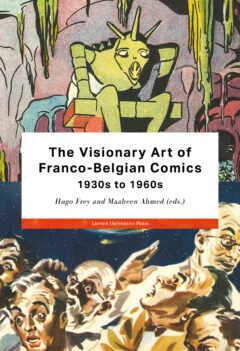 The Visionary Art of Franco-Belgian Comics, 1930s to 1960s
Hugo Frey (Editor), Maaheen Ahmed (Editor),
September 2025
 European Literatures of Military Occupation
Matthias Buschmeier (Editor), Jeanne E. Glesener (Editor),
October 2024
 Beyond the Translator’s Invisibility
Peter J. Freeth (Editor), Rafael Treviño (Editor),
September 2025
 Alles verandert altijd – Herziene editie
Lieven D'hulst (Editor), Chris Van de Poel (Editor),
December 2023
 Modern Etruscans
Chiara Zampieri (Editor), Martina Piperno (Editor), Bart Van den Bossche (Editor),
October 2023