
Postcolonialism and Migration in French Comics
Mark McKinney (Author),

Series: Studies in European Comics and Graphic Novels 8
Category: Diversity and Equity Studies, History 1800-present, Literature, Media and Visual Culture, Postcolonial Studies
Language: English
ISBN: 9789462702417
Publication date: January 14, 2021
€65.00 (including 6% VAT)
Buy NowNumber of pages: 400
Size: 230 x 170 x 23 mm
Number of illustrations: 79
Illustrations and other content description:
colour images

Funded by: Open Book Collective
Stock item: 139431
Standard delivery time for print books:
For Belgium: 5 to 8 working days
For EU: 2 to 3 weeks
For other countries: 4 to 5 weeks
Series: Studies in European Comics and Graphic Novels 8
Category: Diversity and Equity Studies, History 1800-present, Literature, Media and Visual Culture, Postcolonial Studies
Language: English
ISBN: 9789461667335
Publication date: September 30, 2025
Download Free PDFNumber of pages: 400
Number of illustrations: 79
Illustrations and other content description:
colour images
Funded by: Open Book Collective
Profound analysis of French comics through a postcolonial lens
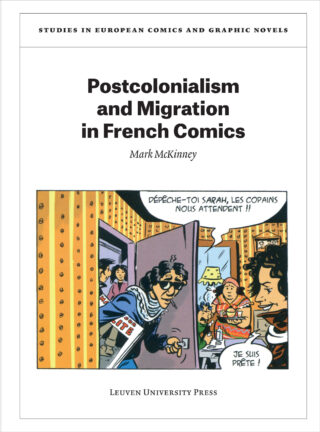
Postcolonialism and migration are major themes in contemporary French comics and have roots in the Algerian War (1954–62), antiracist struggle, and mass migration to France. This volume studies comics from the end of the formal dismantling of French colonial empire in 1962 up to the present. French cartoonists of ethnic-minority and immigrant heritage are a major focus, including Zeina Abirached (Lebanon), Yvan Alagbé (Benin), Baru (Italy), Enki Bilal (former Yugoslavia), Farid Boudjellal (Algeria and Armenia), José Jover (Spain), Larbi Mechkour (Algeria), and Roland Monpierre (Guadeloupe). The author analyzes comics representing a gamut of perspectives on immigration and postcolonial ethnic minorities, ranging from staunch defense to violent rejection. Individual chapters are dedicated to specific artists, artistic collectives, comics, or themes, including avant-gardism, undocumented migrants in comics, and racism in far-right comics.
This publication is GPRC-labeled (Guaranteed Peer-Reviewed Content).
Listen to an interview with Mark McKinney at New Books Network: https://newbooksnetwork.com/postcolonialism-and-migration-in-french-comics
Acknowledgments Note on translations and terminology 1. Introduction: three postcolonial turning points in French comics 2. Postcolonialism and migration in comics after “Cauchemar blanc” 3. Farid Boudjellal’s realist comics 4. The voyage in through Baru’s pastiches 5. “Citadel culture” in French comics 6. Comics from the far right through the 1990s 7. Comics from the far right from the 2000s to the present 8. Avant-gardism, migration and postcolonialism in Alagbé’s comics 9. Across the affrontier with Abirached 10. Sans-papiers in comics 11. Coda: postcolonialism and beyond Works cited Index
Dans une analyse nuancée, McKinney démontre comment les artistes « ont redessiné l’histoire et la culture impériale pour représenter la France postcoloniale », et ce « de nombreuses manières, et parfois contradictoires » . Il génère des pistes d’analyse pertinentes, en adaptant des concepts formels à une analyse socio-littéraire autour du postcolonial et de la migration. Sa conclusion invite, par ailleurs, à réfléchir au paradigme du postcolonial, et à la possibilité de l’étendre à de nouvelles formes néocoloniales (continuation de l’exploitation impérialiste, tourisme occidental en Afrique, soutien de régimes autoritaires, migrations climatiques…). [...] Cet ouvrage prouve, néanmoins, l’immensité d’un champ de recherche qui permet de mieux comprendre les représentations d’une société postcoloniale interculturelle, et l’urgence de l’étudier.Alicia Lambert, French Studies in Southern Africa No. 52 (2022): 194-250
Bandes dessinées and graphic novels are essential texts in university French courses, and McKinney’s insightful study is a welcome addition to the critical literature on these works. His book traces the shifting portrayals of migration and transculturation in postcolonial France. [...] This expansive and erudite study of BD shows how the genre creates new spaces for representation and dialogue on postcolonial migration in France.Patricia Geesey,The French Review, vol. 96 no. 1, 2022, p. 202-202, doi:10.1353/tfr.2022.0182
Along with McKinney’s previous publications, the present monograph is the fruit of nearly three
decades of research. As such, 'Postcolonialism and Migration in French Comics' makes several
noteworthy contributions to the field. Among its many positive aspects, this study refers to wellknown and previously un(der)studied works; identifies areas of further inquiry such as the
developing role of female artists; provides a well-documented historical context that draws
important parallels between French (post)colonial history and the evolution of French comics;
and establishes a constructive dialogue between the author’s own research and that of recognized
experts and emerging scholars. Not only does McKinney trace the history of postcolonial themes
in French comics, but he also provides a summative overview of past and current scholarship,
which will undoubtedly serve undergraduates, graduates, and academics in future years.Jennifer Howell, H-France Review, vol. 21, no. 168, September 2021
Extremely well researched and well explained,
alternating explanation of concepts and application
of these concepts to many diverse examples, the
volume mixes some well-known authors with
others much less famous (and actually many out of print) and still others simply unknown (at least new to
me). This is the best book one can write about comics. [...] The cherry on the French cake [or if you don’t like cakes, the dressing on the fresh mixed salad]: as usual,
this publisher (Leuven U.P.) provides high quality paper and binding, and beautiful reproductions of
pictures, some in color, and in this case also a full precise index of 20p. and an extraordinary rich and
diverse bibliography of 35p. What else can a humanist fan scholar could wish for? Again, this is the type of
books that we see once a decade.Christian Reyns-Chikuma, IMAGE [&] NARRATIVE Vol. 22, No.3 (2021)
McKinney has made an important contribution to several fields and makes a persuasive argument for value of comics to the study of contemporary French history. - Michael G. Vann, The Journal of Modern History, Volume 96, Number 1, March 2024, https://doi.org/10.1086/728546
Generously illustrated with colour images and complemented by a glossary, McKinney’s latest book is essential for scholars working on postcolonialism, race, and/or comics, within and beyond francophone cultures. Also suitable for classroom use through its accessible, sensitive, and rich analyses, this is an exemplary work of comics scholarship. - Maaheen Ahmed, French Studies, Volume 78, Issue 3, July 2024, Page 548, https://doi.org/10.1093/fs/knae048
Frequently Asked Questions
What is "Postcolonialism and Migration in French Comics" about?
Profound analysis of French comics through a postcolonial lens
Postcolonialism and migration are major themes in contemporary French comics and have roots in the Algerian War (1954–62), antiracist struggle, and mass migration to France. This volume studies comics from the end of the formal dismantling of French colonial empire in 1962 up to the present. French cartoonists of ethnic-minority and immigrant heritage are a major focus, including Zeina Abirached (Lebanon), Yvan Alagbé (Benin), Baru (Italy), Enki Bilal (former Yugoslavia), Farid Boudjellal (Algeria and Armenia), José Jover (Spain), Larbi Mechkour (Algeria), and Roland Monpierre (Guadeloupe). The author analyzes comics representing a gamut of perspectives on immigration and postcolonial ethnic minorities, ranging from staunch defense to violent rejection. Individual chapters are dedicated to specific artists, artistic collectives, comics, or themes, including avant-gardism, undocumented migrants in comics, and racism in far-right comics.
This publication is GPRC-labeled (Guaranteed Peer-Reviewed Content).
Listen to an interview with Mark McKinney at New Books Network: https://newbooksnetwork.com/postcolonialism-and-migration-in-french-comics
Who wrote "Postcolonialism and Migration in French Comics"?
"Postcolonialism and Migration in French Comics" was written by Mark McKinney.
Mark McKinney is Professor of French at Miami University in Oxford, Ohio, USA. He has written 'The Colonial Heritage of French Comics' (Liverpool University Press, 2011) and 'Redrawing French Empire in Comics' (2013). He coedited 'Post-Colonial Cultures in France' (Routledge, 1997) with Alec G. Hargreaves. He edited 'History and Politics in French-Language Comics and Graphic Novels' (University Press of Mississippi, 2008). He cofounded and coedited the journal 'European Comic Art' with Laurence Grove and Ann Miller.
Is "Postcolonialism and Migration in French Comics" part of a series?
Yes, "Postcolonialism and Migration in French Comics" is part of the "Studies in European Comics and Graphic Novels" series. It's book 8 in the series.
Studies in European Comics and Graphic Novels presents state-of-the-art contributions on comics and graphic novels. The series publishes research on European comics and graphic novels and aims at stimulating scholarship on European BDs. It includes titles from scholars working in different disciplines, such as history, literary criticism, literary theory, art history, and visual studies. Typical themes to be addressed will comprise European graphic novels and comics in historical context; gender and other social identity analysis; theorizations; and detailed case studies or wider surveys. The series publishes monographs and collections for university-level researchers and ambitions to advance knowledge of this still relatively under-discussed subject.

All volumes will be published in English, but the comics and graphic novels under investigation will be of any European language and from any European culture. Like graphic novels and comics, Europe itself is hard to define, and the approach for the series will be open and not overly prescriptive.
Series editors
Jan Baetens, KU Leuven
Hugo Frey, University of Chichester
Maaheen Ahmed, Ghent University
Editorial Board
The editorial board is composed of leading scholars from literature, visual arts, and historical studies:
Bart Beaty (University of Calgary)
Christopher Pizzino (University of Georgia)
Ann Miller (University of Leicester).
Proposals
Proposals and enquiries can be sent to the series editors.
Please make use of the submission form to present your manuscript or proposal to our board.
Authors interested in Open Access can consult the available funding options.
Links & Resources
Is "Postcolonialism and Migration in French Comics" available Open Access?
Yes, "Postcolonialism and Migration in French Comics" is published Open Access. It is available under a BY-NC-ND license.
Who funded the publication of "Postcolonialism and Migration in French Comics"?
Publication of "Postcolonialism and Migration in French Comics" was funded by Open Book Collective
.
What is the Table of Contents for "Postcolonialism and Migration in French Comics"?
Acknowledgments Note on translations and terminology 1. Introduction: three postcolonial turning points in French comics 2. Postcolonialism and migration in comics after “Cauchemar blanc” 3. Farid Boudjellal’s realist comics 4. The voyage in through Baru’s pastiches 5. “Citadel culture” in French comics 6. Comics from the far right through the 1990s 7. Comics from the far right from the 2000s to the present 8. Avant-gardism, migration and postcolonialism in Alagbé’s comics 9. Across the affrontier with Abirached 10. Sans-papiers in comics 11. Coda: postcolonialism and beyond Works cited Index
What is the DOI for "Postcolonialism and Migration in French Comics"?
The Digital Object Identifier (DOI) for "Postcolonialism and Migration in French Comics" is 10.11116/9789461667335.
Related titles

 Margarete Schütte-Lihotzky and the Architecture of Collective Dissidence, 1918–1989
S.E. Eisterer (Author),
April 2027



 Feminists Resisting Gendered Violence
Hemangini Gupta (Editor), Fiona Mackay (Editor), Jan Breckenridge (Editor), Louise Chappell (Editor), Rachna Mehra (Editor), Rukmini Sen (Editor), Mailin Suchting (Editor),
October 2026

 German–Rapanui Entanglements
Cristián Moreno Pakarati (Editor), Diego Muñoz (Editor), Philipp Schorch (Editor),
August 2026
 Affect in Translation and Interpreting
Sofía Monzón (Editor), Lucie Spezzatti (Editor), Elisabeth Goemans (Editor),
May 2026
 Research Methods in Literary Reception Studies
Jeroen Dera (Editor), Anne Oerlemans (Editor), Frederik Van Dam (Editor),
May 2026
 Cinema in Post-War Belgium
Gertjan Willems (Editor), Bjorn Gabriels (Editor), Bénédicte Rochet (Editor),
May 2026

 Performing Magnetism
Eleonora Paklons (Editor), Kristof Smeyers (Editor), Kurt Vanhoutte (Editor), Hannah Welslau (Editor),
May 2026
 Political Exile in the Global Twentieth Century
Wolfram Kaiser (Editor), Piotr H. Kosicki (Editor),
April 2026
 Christian Democracy and the Fall of Communism
Michael Gehler (Editor), Piotr H. Kosicki (Editor), Helmut Wohnout (Editor),
April 2026


 Cartographies of Catastrophes
Laura Demeter (Editor), Carmen M. Enss (Editor), Piotr Kisiel (Editor), Carol Ludwig (Editor),
February 2026
 Comics and the Global South
Andrea Aramburú (Editor), Dibyadyuti Roy (Editor), Joe Sutliff Sanders (Editor),
February 2026