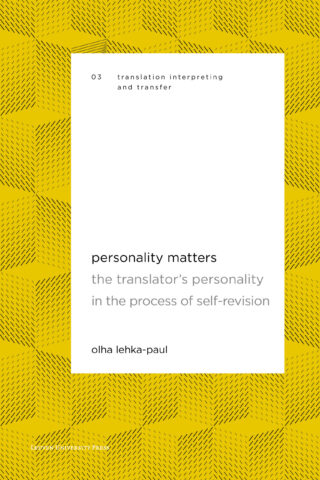

Personality Matters
The Translator’s Personality in the Process of Self-Revision
Olha Lehka-Paul (Author),

Series: Translation, Interpreting and Mediation
Category: Literature, Translation Studies
Language: English
ISBN: 9789462702394
Publication date: November 26, 2020
€61.50 (including 6% VAT)
Buy NowNumber of pages: 277
Size: 234 x 156 x 15 mm
Number of illustrations: 27
Illustrations and other content description:
27 b&w images

Funded by: Open Book Collective
Stock item: 138542
Standard delivery time for print books:
For Belgium: 5 to 8 working days
For EU: 2 to 3 weeks
For other countries: 4 to 5 weeks
Series: Translation, Interpreting and Mediation
Category: Literature, Translation Studies
Language: English
ISBN: 9789461667328
Publication date: September 30, 2025
Download Free PDFNumber of pages: 277
Number of illustrations: 27
Illustrations and other content description:
27 b&w images
Funded by: Open Book Collective
Unique interaction between personality traits and translation process
The analysis of translated texts and investigations into the cognitive mechanisms involved in the process of translation are burgeoning areas of research in translation studies. Personality Matters ventures into a previously uncharted territory in its exploration of the psychological and cognitive characteristics of a translator. Combining psychology and translation process research, this groundbreaking study identifies personality traits that distinguish translators from non-translators, and shows that the translator’s personality matters in translation, especially in the process of self-revision. The individual translator thus stands central in Personality Matters – making this book a topical contribution to translation studies as it continues to evolve in taking account of the people behind the ubiquity of translation in the modern globalized world.
This publication is GPRC-labeled (Guaranteed Peer-Reviewed Content).
List of tables
List of figures
Acknowledgements
Introduction
Chapter 1: Personality perspectives: From psychology to Translation Studies
1.1. Introduction
1.2. The concept of personality in psychology
1.3. The trait approach: the quantitative studies of personality
1.3.1. Allport’s pioneering study of traits
1.3.2. Cattell’s application of factor analysis to trait studies
1.3.3. Eysenck’s three personality dimensions
1.3.4. Costa and McCrae’s Big Fivefactors
1.3.5. Ashton and Lee’s six personality dimensions
1.4. Jung’s personality typology: the qualitative studies of personality
1.5. Combining quantitative and qualitative approaches to the description of personality
1.6. Personality stability and change
1.7. From pure to applied psychology: relevant implementations of personality research
1.7.1. The impact of personality on academic performance
1.7.2. The role of personality in industrial and organizational psychology
1.7.3. The impact of personality on occupational performance
1.8. Review of research into the psychological aspects of the translator’s personality
1.8.1. Early conceptual views on the translator’s personality: 1960s–1970s
1.8.2. First empirical insights into the translator’s personality: 1980s–1990s
1.8.3. Interdisciplinary studies into the translator’s personality using the multi-method approach: since 2000
1.9. Conclusions
Chapter 2: The translator’s personality in translation process research
2.1. Introduction
2.2. Major research orientations in Translation Studies
2.3. The translator as the main agent in the translation process
2.4. Selected models of the translation process
2.4.1. Bell’s translation process model
2.4.2. Hönig’s translation process model
2.4.3. Kiraly’s translation process model
2.4.4. Wilss’s translation process model
2.4.5. Hansen’s translation process model
2.5. Evolution of methodology in translation process research
2.5.1. The first phase: explorations with think-aloud protocols
2.5.2. The second phase: narrowing the focus with keylogging and triangulation
2.5.3. The third phase: methodological integration and the introduction of eye-tracking
2.5.4. The fourth phase: embodied cognition and further dialogue between disciplines and methodologies
2.6. The role of the translator’s personality in translation competence and expertise development
2.6.1. The PACTE project: holistic research into translation competence and its acquisition
2.6.2. The TransComp project: longitudinal study into translation competence and its acquisition
2.6.3. Muñoz Martín’s situated construct of translation expertise
2.7. Conclusions
Chapter 3: Self-revision as a product-shaping stage of the translation process
3.1. Introduction
3.2. The concept of revision in writing process research
3.3. The concept of self-revision in translation process research
3.3.1. Why does self-revision occur?
3.3.2. How does self-revision occur?
3.3.3. When does self-revision occur?
3.3.4. What type of self-revision occurs?
3.4. The role of self-revision in translator profiling
Conclusions
Chapter 4: Relationship between the translator’s personality, translation process and product
4.1. Introduction
4.2. The aims of the study
4.3. Hypotheses
4.4. Methodological basis
4.5. Research design
4.6. Variables
4.6.1. Independent variables
4.6.2. Dependent variables
4.7. Participants
4.8. Tools and materials
4.8.1. Tools and materials related to the translation task
4.8.2. Tools and materials related to personality measurement
4.8.3. Self-report questionnaires
4.9. Experimental procedure
4.10. Data analysis
4.10.1. Translation process data analysis
4.10.2. Translation quality assessment
4.10.3. Personality data analysis
4.10.4. Statistical data analyses
4.11. Results of the experiment
4.11.1. Hypothesis 1
4.11.2. Hypothesis 2
4.11.3. Hypothesis 3
4.11.4. Hypothesis 4
4.11.5. Hypothesis 5
4.12. Results of the self-report questionnaires
4.12.1. Questions related to Hypothesis 1
4.12.2. Questions related to Hypotheses 2–4
4.12.3. Questions related to Hypothesis 5
4.13. General discussion of results
4.13.1. Limitations of the study and further research avenues
4.13.2. Didactic implications
Concluding remarks
Appendix A
Appendix B
Appendix C
Appendix D
Appendix E
Appendix F
Abstract
References
Index
Frequently Asked Questions
What is "Personality Matters" about?
Unique interaction between personality traits and translation process
The analysis of translated texts and investigations into the cognitive mechanisms involved in the process of translation are burgeoning areas of research in translation studies. Personality Matters ventures into a previously uncharted territory in its exploration of the psychological and cognitive characteristics of a translator. Combining psychology and translation process research, this groundbreaking study identifies personality traits that distinguish translators from non-translators, and shows that the translator’s personality matters in translation, especially in the process of self-revision. The individual translator thus stands central in Personality Matters – making this book a topical contribution to translation studies as it continues to evolve in taking account of the people behind the ubiquity of translation in the modern globalized world.
This publication is GPRC-labeled (Guaranteed Peer-Reviewed Content).
Who wrote "Personality Matters"?
"Personality Matters" was written by Olha Lehka-Paul.
Olha Lehka-Paul is assistant professor at the Faculty of English, Department of Psycholinguistic Studies, Adam Mickiewicz University, Poznań, Poland.
Is "Personality Matters" part of a series?
Yes, "Personality Matters" is part of the "Translation, Interpreting and Mediation" series.

Translation, Interpreting and Mediation
Mission statement
Championing a broad and transversal approach to the study of translational phenomena, Translation, Interpreting and Mediation (TIME) is a book series for monographs and edited volumes that explore translation as a pervasive social practice connecting spaces and collectivities through complex forms of resemiotization and mediation. The series transcends traditional notions of translation as the decoding and recoding of semantic invariants and embraces an expansive understanding of translational agency. It aims to provide a venue for theoretical and methodological innovations at the disciplinary frontiers where translation is pervasive and essential but seldom fully understood or acknowledged. The series welcomes different perspectives on translation, interpreting and mediation, interfacing with a variety of areas of study, including sociology, literature, linguistics, cognition, politics, law, history, communication, multimodality, ecology, technology, cultural production and digital humanities (among others). The series draws inspiration from the collective expertise of CETRA (Centre for Translation Studies), its institutional home at KU Leuven.
All volumes in the series are double peer reviewed.
For questions, please contact the series editors.
Series editors
Jack McMartin (KU Leuven)
Sara Ramos Pinto (University of Leeds)
Peter J. Freeth (University of Warwick)
Editorial board
Núria Codina Solà (KU Leuven)
Lieven D’hulst (KU Leuven)
Deborah Giustini (Hamad Bin Khalifa University)
Gabriel González Núñez (University of Texas Rio Grande Valley)
Bei Hu (National University of Singapore)
Akiko Sakamoto (Kansai University)
Advisory board
Brian Baer (Kent State University)
Pieter Boulogne (KU Leuven)
Lynne Bowker (University of Laval)
Elke Brems (KU Leuven)
Leo Tak-hung Chan (Lingnan University, Hong Kong)
Antoon Cox (KU Leuven)
Michael Cronin (Trinity College Dublin)
Dilek Dizdar (Johannes Gutenberg-Universität Mainz)
Yves Gambier (University of Turku)
Maud Gonne (University of Liège)
Arnt Lykke Jakobsen (Copenhagen Business School)
Haidee Kotze (Utrecht University)
Kaisa Koskinen (Tampere University)
Kobus Marais (University of the Free State)
Reine Meylaerts (KU Leuven)
Joss Moorkens (Dublin City University)
Jemina Napier (Heriot-Watt University)
Franz Pöchhacker (University of Vienna)
Hanna Risku (University of Vienna)
Diana Roig Sanz (Universitat Oberta de Catalunya)
Heidi Salaets (KU Leuven)
Christina Schäffner (Aston University)
Luc van Doorslaer (University of Tartu / KU Leuven)
Proposals
Proposals and enquiries can be sent to the series editors.
Please make use of the submission form to present the full manuscript to our board.
Authors interested in Open Access can consult the available funding options.
Links & Resources
Is "Personality Matters" available Open Access?
Yes, "Personality Matters" is published Open Access. It is available under a BY-NC-ND license.
Who funded the publication of "Personality Matters"?
Publication of "Personality Matters" was funded by Open Book Collective
.
What is the Table of Contents for "Personality Matters"?
List of tables
List of figures
Acknowledgements
Introduction
Chapter 1: Personality perspectives: From psychology to Translation Studies
1.1. Introduction
1.2. The concept of personality in psychology
1.3. The trait approach: the quantitative studies of personality
1.3.1. Allport’s pioneering study of traits
1.3.2. Cattell’s application of factor analysis to trait studies
1.3.3. Eysenck’s three personality dimensions
1.3.4. Costa and McCrae’s Big Fivefactors
1.3.5. Ashton and Lee’s six personality dimensions
1.4. Jung’s personality typology: the qualitative studies of personality
1.5. Combining quantitative and qualitative approaches to the description of personality
1.6. Personality stability and change
1.7. From pure to applied psychology: relevant implementations of personality research
1.7.1. The impact of personality on academic performance
1.7.2. The role of personality in industrial and organizational psychology
1.7.3. The impact of personality on occupational performance
1.8. Review of research into the psychological aspects of the translator’s personality
1.8.1. Early conceptual views on the translator’s personality: 1960s–1970s
1.8.2. First empirical insights into the translator’s personality: 1980s–1990s
1.8.3. Interdisciplinary studies into the translator’s personality using the multi-method approach: since 2000
1.9. Conclusions
Chapter 2: The translator’s personality in translation process research
2.1. Introduction
2.2. Major research orientations in Translation Studies
2.3. The translator as the main agent in the translation process
2.4. Selected models of the translation process
2.4.1. Bell’s translation process model
2.4.2. Hönig’s translation process model
2.4.3. Kiraly’s translation process model
2.4.4. Wilss’s translation process model
2.4.5. Hansen’s translation process model
2.5. Evolution of methodology in translation process research
2.5.1. The first phase: explorations with think-aloud protocols
2.5.2. The second phase: narrowing the focus with keylogging and triangulation
2.5.3. The third phase: methodological integration and the introduction of eye-tracking
2.5.4. The fourth phase: embodied cognition and further dialogue between disciplines and methodologies
2.6. The role of the translator’s personality in translation competence and expertise development
2.6.1. The PACTE project: holistic research into translation competence and its acquisition
2.6.2. The TransComp project: longitudinal study into translation competence and its acquisition
2.6.3. Muñoz Martín’s situated construct of translation expertise
2.7. Conclusions
Chapter 3: Self-revision as a product-shaping stage of the translation process
3.1. Introduction
3.2. The concept of revision in writing process research
3.3. The concept of self-revision in translation process research
3.3.1. Why does self-revision occur?
3.3.2. How does self-revision occur?
3.3.3. When does self-revision occur?
3.3.4. What type of self-revision occurs?
3.4. The role of self-revision in translator profiling
Conclusions
Chapter 4: Relationship between the translator’s personality, translation process and product
4.1. Introduction
4.2. The aims of the study
4.3. Hypotheses
4.4. Methodological basis
4.5. Research design
4.6. Variables
4.6.1. Independent variables
4.6.2. Dependent variables
4.7. Participants
4.8. Tools and materials
4.8.1. Tools and materials related to the translation task
4.8.2. Tools and materials related to personality measurement
4.8.3. Self-report questionnaires
4.9. Experimental procedure
4.10. Data analysis
4.10.1. Translation process data analysis
4.10.2. Translation quality assessment
4.10.3. Personality data analysis
4.10.4. Statistical data analyses
4.11. Results of the experiment
4.11.1. Hypothesis 1
4.11.2. Hypothesis 2
4.11.3. Hypothesis 3
4.11.4. Hypothesis 4
4.11.5. Hypothesis 5
4.12. Results of the self-report questionnaires
4.12.1. Questions related to Hypothesis 1
4.12.2. Questions related to Hypotheses 2–4
4.12.3. Questions related to Hypothesis 5
4.13. General discussion of results
4.13.1. Limitations of the study and further research avenues
4.13.2. Didactic implications
Concluding remarks
Appendix A
Appendix B
Appendix C
Appendix D
Appendix E
Appendix F
Abstract
References
Index
What is the DOI for "Personality Matters"?
The Digital Object Identifier (DOI) for "Personality Matters" is 10.11116/9789461667328.
Related titles


 Feminists Resisting Gendered Violence
Hemangini Gupta (Editor), Fiona Mackay (Editor), Jan Breckenridge (Editor), Louise Chappell (Editor), Rachna Mehra (Editor), Rukmini Sen (Editor), Mailin Suchting (Editor),
October 2026
 Affect in Translation and Interpreting
Sofía Monzón (Editor), Lucie Spezzatti (Editor), Elisabeth Goemans (Editor),
May 2026
 Research Methods in Literary Reception Studies
Jeroen Dera (Editor), Anne Oerlemans (Editor), Frederik Van Dam (Editor),
May 2026
 Comics and the Global South
Andrea Aramburú (Editor), Dibyadyuti Roy (Editor), Joe Sutliff Sanders (Editor),
February 2026
 Situatedness and Performativity
Raquel Pacheco Aguilar (Editor), Marie-France Guénette (Editor),
November 2025
 Transfer Thinking in Translation Studies
Maud Gonne (Editor), Klaartje Merrigan (Editor), Reine Meylaerts (Editor), Heleen van Gerwen (Editor),
September 2025
 The Visionary Art of Franco-Belgian Comics, 1930s to 1960s
Hugo Frey (Editor), Maaheen Ahmed (Editor),
September 2025
 Superhero Comics and Scottish Identity
David John Boyd (Author), Julie Briand-Boyd (Author),
July 2025
 Retranslating the Bible and the Qur’an
Pieter Boulogne (Editor), Marijke H. de Lang (Editor), Joseph Verheyden (Editor),
December 2024
 European Literatures of Military Occupation
Matthias Buschmeier (Editor), Jeanne E. Glesener (Editor),
October 2024
 Beyond the Translator’s Invisibility
Peter J. Freeth (Editor), Rafael Treviño (Editor),
September 2025
 Alles verandert altijd – Herziene editie
Lieven D'hulst (Editor), Chris Van de Poel (Editor),
December 2023
 Modern Etruscans
Chiara Zampieri (Editor), Martina Piperno (Editor), Bart Van den Bossche (Editor),
October 2023