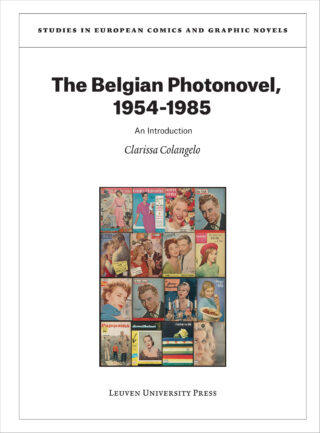

The Belgian Photonovel, 1954-1985
An Introduction
Clarissa Colangelo (Author),

Series: Studies in European Comics and Graphic Novels
Category: Literature, Media and Visual Culture
Language: English
ISBN: 9789462703704
Publication date: August 30, 2023
€45.00 (including 6% VAT)
Buy NowNumber of pages: 250
Size: 230 x 170 x 15 mm
Illustrations and other content description:
Illustrated, with colour section

Funded by: KU Leuven Fund for Fair Open Access
Stock item: 155810
Standard delivery time for print books:
For Belgium: 5 to 8 working days
For EU: 2 to 3 weeks
For other countries: 4 to 5 weeks
Series: Studies in European Comics and Graphic Novels
Category: Literature, Media and Visual Culture
Language: English
ISBN: 9789461665126
Publication date: September 1, 2023
Download Free EpubNumber of pages: 250
Illustrations and other content description:
Illustrated, with colour section
Funded by: KU Leuven Fund for Fair Open Access
Series: Studies in European Comics and Graphic Novels
Category: Literature, Media and Visual Culture
Language: English
ISBN: 9789461665119
Publication date: August 16, 2023
Download Free PDFNumber of pages: 250
Illustrations and other content description:
Illustrated, with colour section
Funded by: KU Leuven Fund for Fair Open Access
The importance of the Belgian contribution to the history of the photonovel.
The Belgian photonovel is the missing link in the amazing history of the photonovel, a comics-inspired form of visual narrative that combines elements from very different genres and media, ranging from literary melodrama, cinema, and of course comics. This monograph discloses the specific Belgian contribution to the genre, in close connection with the singularities of the Belgian women’s and general magazines where these photonovels appeared. If the photonovel is generally considered a typically French or Italian genre, this study demonstrates the importance of a different tradition, which appropriated the foreign models in a very original way. Belgian photonovels are distinct, not only because they tell other kinds of stories, but also because they interact with other types of magazines in ways that are very different from the mainstream forms of the genre in Italy and France. Finally, this lavishly illustrated study is also the first in scrutinizing the technical aspects of magazine printing techniques in the development of the photonovel.
Ebook available in Open Access. This publication is GPRC-labeled (Guaranteed Peer-Reviewed Content).
Foreword: Time-traveling in a lost world
Introduction
Chapter 1. A brief history of the photonovel
1.1 A working definition
1.2 Origins, evolution and decline
1.3 Fame versus shame
1.4 Photonovels: between tradition and emancipation
Chapter 2. Belgian editorial context: a language divide
Chapter 3. Popular Belgian women’s magazines with photonovels
3.1 Lectures d’Aujourd’hui / Lectuur voor Allen
3.2 Mon Copain
3.3 Chez Nous / Ons Volk
3.4 Femmes d’Aujourd’hui / Het Rijk der Vrouw
3.5 Bonnes Soirées / Mimosa
3.6 Piccolo and Tiptop
3.7 Vrouw en Huis
3.8 Panorama
3.9 Rosita
3.10 Ons Land met Iris
3.11 Madame
3.12 Joepie
3.13 Other magazines
3.13.1 Roman Film complet, Sandra / Katia and Sérenade
3.13.2 HUMO and Sportif ’68 / Sport ’68
Chapter 4. Making photonovels
4.1 Creating a photonovel
4.1.1 Subject
4.1.2 Script and plot
4.1.3 Director
4.1.4 Photographer
4.1.5 Actors
4.1.6 Layout
4.1.7 Translations
4.2 Print process
4.2.1 Photomechanical processes
4.2.2 The evolution of rotogravure
4.2.3 Color printing
4.2.4 Press printed photographs
Chapter 5. Photonovels inside the magazines
5.1 Photonovels and advertisement
Conclusion
Appendix: Complete list of all the photonovels published in Belgian magazines
Bibliography
Acknowledgments
With 'The Belgian Photonovel, 1954-1985 An Introduction', Clarissa Colangelo has given us a fine, thorough, yet readable chronicle of this area of publishing history. - Mike Mosher, Leonardo, June 2024, https://leonardo.info/review/2024/06/the-belgian-photonovel-1954-1985
"One of the great lessons of contemporary Cultural Studies is that some of the most important ideological and political work in society is done by overlooked, undervalued or otherwise marginalised cultural forms. It's the old(ish) argument that 'Paris Match' or 'Hello!' are as culturally significant in their way as 'A la recherche du temps perdu'. Photonovels fall squarely into that category, as Clarissa Colangelo demonstrates in her absorbing study of the genre.", Edward Welch, Source Photographic Review, Issue 115 — Summer 2024
Richement et intelligemment illustrée, cette étude devrait aider à rouvrir le dossier du roman-photo comme médium de presse et interroger l’importance du contexte éditorial, et plus largement commercial, de la photographie populaire. - Jan Baetens, Focales, 9 | 2025, DOI : https://doi.org/10.4000/141fs
Au-delà d’une analyse historique et sociétale des romans-photo belges, Clarissa Colangelo les décortique à tous les niveaux : des techniques d’impression et de photographie jusqu’à leur édition. Elle propose également un inventaire détaillé de tous les romans-photo belges digitalisés dans le cadre du projet Photo-Lit, que ce livre accompagne en donnant toutes les clefs de lecture. En cela, cet ouvrage constitue un point d’entrée idéal, autant pour de futures recherches que pour un public plus large, comme un agréable voyage dans le temps, l’ouverture d’une capsule temporelle. - Owen Le Gonidec, Critique d’art, 01 juin 2025, DOI : https://doi.org/10.4000/11qog
Frequently Asked Questions
What is "The Belgian Photonovel, 1954-1985" about?
The importance of the Belgian contribution to the history of the photonovel.
The Belgian photonovel is the missing link in the amazing history of the photonovel, a comics-inspired form of visual narrative that combines elements from very different genres and media, ranging from literary melodrama, cinema, and of course comics. This monograph discloses the specific Belgian contribution to the genre, in close connection with the singularities of the Belgian women’s and general magazines where these photonovels appeared. If the photonovel is generally considered a typically French or Italian genre, this study demonstrates the importance of a different tradition, which appropriated the foreign models in a very original way. Belgian photonovels are distinct, not only because they tell other kinds of stories, but also because they interact with other types of magazines in ways that are very different from the mainstream forms of the genre in Italy and France. Finally, this lavishly illustrated study is also the first in scrutinizing the technical aspects of magazine printing techniques in the development of the photonovel.
Ebook available in Open Access. This publication is GPRC-labeled (Guaranteed Peer-Reviewed Content).
Who wrote "The Belgian Photonovel, 1954-1985"?
"The Belgian Photonovel, 1954-1985" was written by Clarissa Colangelo.
Clarissa Colangelo holds a PhD in Cultural Studies and is affiliated with KU Leuven, where she is conducting research on the visual aspects of magazine culture in collaboration with the Belgian National Library (KBR).
Is "The Belgian Photonovel, 1954-1985" part of a series?
Yes, "The Belgian Photonovel, 1954-1985" is part of the "Studies in European Comics and Graphic Novels" series.
Studies in European Comics and Graphic Novels presents state-of-the-art contributions on comics and graphic novels. The series publishes research on European comics and graphic novels and aims at stimulating scholarship on European BDs. It includes titles from scholars working in different disciplines, such as history, literary criticism, literary theory, art history, and visual studies. Typical themes to be addressed will comprise European graphic novels and comics in historical context; gender and other social identity analysis; theorizations; and detailed case studies or wider surveys. The series publishes monographs and collections for university-level researchers and ambitions to advance knowledge of this still relatively under-discussed subject.

All volumes will be published in English, but the comics and graphic novels under investigation will be of any European language and from any European culture. Like graphic novels and comics, Europe itself is hard to define, and the approach for the series will be open and not overly prescriptive.
Series editors
Jan Baetens, KU Leuven
Hugo Frey, University of Chichester
Maaheen Ahmed, Ghent University
Editorial Board
The editorial board is composed of leading scholars from literature, visual arts, and historical studies:
Bart Beaty (University of Calgary)
Christopher Pizzino (University of Georgia)
Ann Miller (University of Leicester).
Proposals
Proposals and enquiries can be sent to the series editors.
Please make use of the submission form to present your manuscript or proposal to our board.
Authors interested in Open Access can consult the available funding options.
Links & Resources
Is "The Belgian Photonovel, 1954-1985" available Open Access?
Yes, "The Belgian Photonovel, 1954-1985" is published Open Access. It is available under a BY-NC-ND license.
Who funded the publication of "The Belgian Photonovel, 1954-1985"?
Publication of "The Belgian Photonovel, 1954-1985" was funded by KU Leuven Fund for Fair Open Access
.
What is the Table of Contents for "The Belgian Photonovel, 1954-1985"?
Foreword: Time-traveling in a lost world
Introduction
Chapter 1. A brief history of the photonovel
1.1 A working definition
1.2 Origins, evolution and decline
1.3 Fame versus shame
1.4 Photonovels: between tradition and emancipation
Chapter 2. Belgian editorial context: a language divide
Chapter 3. Popular Belgian women’s magazines with photonovels
3.1 Lectures d’Aujourd’hui / Lectuur voor Allen
3.2 Mon Copain
3.3 Chez Nous / Ons Volk
3.4 Femmes d’Aujourd’hui / Het Rijk der Vrouw
3.5 Bonnes Soirées / Mimosa
3.6 Piccolo and Tiptop
3.7 Vrouw en Huis
3.8 Panorama
3.9 Rosita
3.10 Ons Land met Iris
3.11 Madame
3.12 Joepie
3.13 Other magazines
3.13.1 Roman Film complet, Sandra / Katia and Sérenade
3.13.2 HUMO and Sportif ’68 / Sport ’68
Chapter 4. Making photonovels
4.1 Creating a photonovel
4.1.1 Subject
4.1.2 Script and plot
4.1.3 Director
4.1.4 Photographer
4.1.5 Actors
4.1.6 Layout
4.1.7 Translations
4.2 Print process
4.2.1 Photomechanical processes
4.2.2 The evolution of rotogravure
4.2.3 Color printing
4.2.4 Press printed photographs
Chapter 5. Photonovels inside the magazines
5.1 Photonovels and advertisement
Conclusion
Appendix: Complete list of all the photonovels published in Belgian magazines
Bibliography
Acknowledgments
What is the DOI for "The Belgian Photonovel, 1954-1985"?
The Digital Object Identifier (DOI) for "The Belgian Photonovel, 1954-1985" is 10.11116/9789461665119.
Related titles
 Feminists Resisting Gendered Violence
Hemangini Gupta (Editor), Fiona Mackay (Editor), Jan Breckenridge (Editor), Louise Chappell (Editor), Rachna Mehra (Editor), Rukmini Sen (Editor), Mailin Suchting (Editor),
October 2026

 Affect in Translation and Interpreting
Sofía Monzón (Editor), Lucie Spezzatti (Editor), Elisabeth Goemans (Editor),
May 2026
 Research Methods in Literary Reception Studies
Jeroen Dera (Editor), Anne Oerlemans (Editor), Frederik Van Dam (Editor),
May 2026
 Cinema in Post-War Belgium
Gertjan Willems (Editor), Bjorn Gabriels (Editor), Bénédicte Rochet (Editor),
May 2026
 Performing Magnetism
Eleonora Paklons (Editor), Kristof Smeyers (Editor), Kurt Vanhoutte (Editor), Hannah Welslau (Editor),
May 2026
 Comics and the Global South
Andrea Aramburú (Editor), Dibyadyuti Roy (Editor), Joe Sutliff Sanders (Editor),
February 2026
 Situatedness and Performativity
Raquel Pacheco Aguilar (Editor), Marie-France Guénette (Editor),
November 2025
 Transfer Thinking in Translation Studies
Maud Gonne (Editor), Klaartje Merrigan (Editor), Reine Meylaerts (Editor), Heleen van Gerwen (Editor),
September 2025
 The Visionary Art of Franco-Belgian Comics, 1930s to 1960s
Hugo Frey (Editor), Maaheen Ahmed (Editor),
September 2025
 Superhero Comics and Scottish Identity
David John Boyd (Author), Julie Briand-Boyd (Author),
July 2025
 Violence and Trauma in Contemporary Performance
Sofie de Smet (Editor), Marieke Breyne (Editor), Pedzisai Maedza (Editor), Christel Stalpaert (Editor),
May 2025