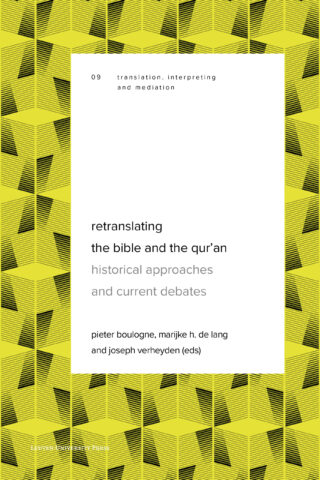

Retranslating the Bible and the Qur’an
Historical Approaches and Current Debates
Pieter Boulogne (Editor), Marijke H. de Lang (Editor), Joseph Verheyden (Editor),

Series: Translation, Interpreting and Mediation 9
Category: Linguistics, Translation Studies
Language: English
ISBN: 9789462704367
Publication date: November 29, 2024
€50.00 (including 6% VAT)
Buy NowNumber of pages: 400
Size: 234 x 156 x mm

Funded by: KU Leuven Fund for Fair Open Access
Stock item: 163540
Standard delivery time for print books:
For Belgium: 5 to 8 working days
For EU: 2 to 3 weeks
For other countries: 4 to 5 weeks
Series: Translation, Interpreting and Mediation 9
Category: Linguistics, Translation Studies
Language: English
ISBN: 9789461665836
Publication date: December 16, 2024
Download Free EpubNumber of pages: 400
Funded by: KU Leuven Fund for Fair Open Access
Series: Translation, Interpreting and Mediation 9
Category: Linguistics, Translation Studies
Language: English
ISBN: 9789461665829
Publication date: December 5, 2024
Download Free PDFNumber of pages: 400
Funded by: KU Leuven Fund for Fair Open Access
Significant contribution to the retranslation studies of religious texts.
Despite the lively scholarly discourse on retranslation and its manifest value for uncovering dynamics of cultural change, interpretation, and reception, the retranslation of religious texts has received only fragmented attention in recent years. By spanning both historical and current aspects, and by treating the Bible and the Qur’an together, this book breaks new ground and paves the way for future research on the myriad discursive and religious aspects of retranslation.
This carefully curated collection of articles compellingly argues that the retranslation of canonical religious texts is a multi-faceted phenomenon. With cases ranging in time from the early Reformation to the present, and traversing linguistic contexts from Russia to Sweden, Slovenia to Saudi Arabia, the essays capture diverse dimensions of retranslation work. The collection demonstrates that retranslations of such texts manifest in different forms, depending on the religious, political and societal circumstances, the targeted audiences, and the status of existing translations. Their reception too may vary greatly, depending on those same circumstances. Authored by specialists in the different fields of retranslation of the Bible and the Qur’an, each contribution illustrates this complexity and offers a fresh perspective and insight that help lay the groundwork for future research in this area of study.
Contributors
Note on transliteration
Introduction
Pieter Boulogne, Marijke H. de Lang and Joseph Verheyden
Part 1 Historical approaches to retranslating the Bible
Revision and retranslation in the Early Reformation
Marijke H. de Lang
The authority of the old for producing the new: the thorny path towards a new authoritative Russian Bible translation
Alexey B. Somov
Retranslation and negotiating authority in Bible translation: a sociological perspective of the Protestant Arabic translation of the Bible (1865)
Sameh Hanna
Part 2 Historical approaches to retranslating the Qur’an
The hybridity of a Hebrew retranslation of the Qur’an from Dutch by a Jewish convert
Naima Afif
In the Shadow of Orientalism: Tracing the Legacy of Ignatiĭ Krachkovskiĭ in Russian Salafi Qur’an Translations
Elvira Kulieva
Traversing and transcending the empire on which the sun never sets: the colonial and postcolonial afterlives of Muhammad Ali’s Qur’an translation
Johanna Pink
Part 3 Current debates about retranslating the Bible
Printed Modern Hebrew Bibles for the Jewish Publics: Shades of Translation
Hilla Karas
Between expectations and effect: public reactions to a retranslation of the Lord’s Prayer (Matthew 6:9–13) in Swedish
Richard Pleijel
Retranslation of the Bible in Muslim idiom
Andy Warren-Rothlin
Part 4 Current debates about retranslating the Qur’an
Retranslations of the Qur’an by women: motives, strategies and distinctive features
Rim Hassen
The Untranslated Qur’an: Retelling the Surah of Joseph
Sohaib Saeed
Retranslating the Qur’an in Saudi Arabia
Yazid Haroun
Negotiating a Slovene Qur’an: Retranslating for a dual readership
Marija Zlatnar Moe and Christian Moe
Allah’s and Muhammad’s co-author: Kader Abdolah and his ‘novelizing’ translation of the Qur’an
Helge Daniels
Pieter Boulogne
Pieter Boulogne holds a PhD in Slavonic Studies from KU Leuven and is Assistant Professor of Russian Studies and Translation Studies at KU Leuven. He is a former director and current board member of the Centre for Translation Studies (CETRA) at KU Leuven.
Marijke H. de Lang
Marijke H. de Lang holds a PhD in Theology from Leiden University. She works as a translation consultant on projects of the United Bible Societies and is executive editor of the journal 'The Bible Translator'.
Joseph Verheyden
Joseph Verheyden is Professor Emeritus of New Testament Studies at KU Leuven, director of the Leuven Centre for the Study of the Gospels (LCSG), the Louvain Centre for Eastern and Oriental Christianity (LOCEOC), Polemikos – The Centre for Religious Polemics, and a former member of the steering committee of CETRA.
Naima Afif
Helge Daniëls
Sameh Hanna
Yazid Haroun
Rim Hassen
Hilla Karas
Elvira Kulieva
Christian Moe
Johanna Pink
Richard Pleijel
Sohaib Saeed
Alexey B. Somov
Andy Warren-Rothlin
Marija Zlatnar Moe
Pieter Boulogne
Marijke H. de Lang
Joseph Verheyden
50-odd years after Eugene Nida, this volume forms a welcome update on the conceptual and practical complexities that arise when sacred texts are interpreted for diverse audiences, in various translations. The volume auspiciously extends its views to Qur’an translations, including in the West, and Bible translations in the Muslim world, combining historical approaches with contemporary issues, while interrogating the traditional dichotomies of translation and untranslatability, verbum e verbo and sensum de sensu, formal equivalence and dynamic equivalence, authority and modernity. Whereas its focus on retranslation brings new approaches to the study of canonicity in Christian, Hebrew and Islamic traditions, sacred texts have remained largely unexplored in retranslation studies. A must-read for anyone interested in the translation and interpretation of religious texts and / or the relationship between retranslation and canonicity. - Kris Peeters, University of Antwerp
This high quality volume offers a fascinating range of perspectives on constructing and challenging authority in the triangle of tensions between sacred source texts, their translations and retranslations, as these tensions play out in Jewish, Christian and Islamic communities in various times and places, from the undermining of the authority of the Holy Vulgate in early Humanism and Reformation to Kader Abdollah’s retranslation of the Holy Qur’an as a literary masterpiece. - Lourens de Vries, Vrije Universiteit Amsterdam
Frequently Asked Questions
What is "Retranslating the Bible and the Qur’an" about?
Significant contribution to the retranslation studies of religious texts.
Despite the lively scholarly discourse on retranslation and its manifest value for uncovering dynamics of cultural change, interpretation, and reception, the retranslation of religious texts has received only fragmented attention in recent years. By spanning both historical and current aspects, and by treating the Bible and the Qur’an together, this book breaks new ground and paves the way for future research on the myriad discursive and religious aspects of retranslation.
This carefully curated collection of articles compellingly argues that the retranslation of canonical religious texts is a multi-faceted phenomenon. With cases ranging in time from the early Reformation to the present, and traversing linguistic contexts from Russia to Sweden, Slovenia to Saudi Arabia, the essays capture diverse dimensions of retranslation work. The collection demonstrates that retranslations of such texts manifest in different forms, depending on the religious, political and societal circumstances, the targeted audiences, and the status of existing translations. Their reception too may vary greatly, depending on those same circumstances. Authored by specialists in the different fields of retranslation of the Bible and the Qur’an, each contribution illustrates this complexity and offers a fresh perspective and insight that help lay the groundwork for future research in this area of study.
Who wrote "Retranslating the Bible and the Qur’an"?
"Retranslating the Bible and the Qur’an" was written by Naima Afif, Helge Daniëls, Sameh Hanna, Yazid Haroun, Rim Hassen, Hilla Karas, Elvira Kulieva, Christian Moe, Johanna Pink, Richard Pleijel, Sohaib Saeed, Alexey B. Somov, Andy Warren-Rothlin and Marija Zlatnar Moe.
Who edited "Retranslating the Bible and the Qur’an"?
"Retranslating the Bible and the Qur’an" was edited by Pieter Boulogne, Marijke H. de Lang and Joseph Verheyden.
Pieter Boulogne holds a PhD in Slavonic Studies from KU Leuven and is Assistant Professor of Russian Studies and Translation Studies at KU Leuven. He is a former director and current board member of the Centre for Translation Studies (CETRA) at KU Leuven.
Marijke H. de Lang holds a PhD in Theology from Leiden University. She works as a translation consultant on projects of the United Bible Societies and is executive editor of the journal 'The Bible Translator'.
Joseph Verheyden is Professor Emeritus of New Testament Studies at KU Leuven, director of the Leuven Centre for the Study of the Gospels (LCSG), the Louvain Centre for Eastern and Oriental Christianity (LOCEOC), Polemikos – The Centre for Religious Polemics, and a former member of the steering committee of CETRA.
Is "Retranslating the Bible and the Qur’an" part of a series?
Yes, "Retranslating the Bible and the Qur’an" is part of the "Translation, Interpreting and Mediation" series. It's book 9 in the series.

Translation, Interpreting and Mediation
Mission statement
Championing a broad and transversal approach to the study of translational phenomena, Translation, Interpreting and Mediation (TIME) is a book series for monographs and edited volumes that explore translation as a pervasive social practice connecting spaces and collectivities through complex forms of resemiotization and mediation. The series transcends traditional notions of translation as the decoding and recoding of semantic invariants and embraces an expansive understanding of translational agency. It aims to provide a venue for theoretical and methodological innovations at the disciplinary frontiers where translation is pervasive and essential but seldom fully understood or acknowledged. The series welcomes different perspectives on translation, interpreting and mediation, interfacing with a variety of areas of study, including sociology, literature, linguistics, cognition, politics, law, history, communication, multimodality, ecology, technology, cultural production and digital humanities (among others). The series draws inspiration from the collective expertise of CETRA (Centre for Translation Studies), its institutional home at KU Leuven.
All volumes in the series are double peer reviewed.
For questions, please contact the series editors.
Series editors
Jack McMartin (KU Leuven)
Sara Ramos Pinto (University of Leeds)
Editorial board
Núria Codina Solà (KU Leuven)
Lieven D’hulst (KU Leuven)
Peter J. Freeth (London Metropolitan University)
Deborah Giustini (Hamad Bin Khalifa University)
Gabriel González Núñez (University of Texas Rio Grande Valley)
Bei Hu (National University of Singapore)
Akiko Sakamoto (Kansai University)
Advisory board
Brian Baer (Kent State University)
Pieter Boulogne (KU Leuven)
Lynne Bowker (University of Laval)
Elke Brems (KU Leuven)
Leo Tak-hung Chan (Lingnan University, Hong Kong)
Antoon Cox (KU Leuven)
Michael Cronin (Trinity College Dublin)
Dilek Dizdar (Johannes Gutenberg-Universität Mainz)
Yves Gambier (University of Turku)
Maud Gonne (University of Liège)
Arnt Lykke Jakobsen (Copenhagen Business School)
Haidee Kotze (Utrecht University)
Kaisa Koskinen (Tampere University)
Kobus Marais (University of the Free State)
Reine Meylaerts (KU Leuven)
Joss Moorkens (Dublin City University)
Jemina Napier (Heriot-Watt University)
Franz Pöchhacker (University of Vienna)
Hanna Risku (University of Vienna)
Diana Roig Sanz (Universitat Oberta de Catalunya)
Heidi Salaets (KU Leuven)
Christina Schäffner (Aston University)
Luc van Doorslaer (University of Tartu / KU Leuven)
Proposals
Proposals and enquiries can be sent to the series editors.
Please make use of the submission form to present the full manuscript to our board.
Authors interested in Open Access can consult the available funding options.
Links & Resources
Is "Retranslating the Bible and the Qur’an" available Open Access?
Yes, "Retranslating the Bible and the Qur’an" is published Open Access. It is available under a BY-NC-ND license.
Who funded the publication of "Retranslating the Bible and the Qur’an"?
Publication of "Retranslating the Bible and the Qur’an" was funded by KU Leuven Fund for Fair Open Access
.
What is the Table of Contents for "Retranslating the Bible and the Qur’an"?
Contributors
Note on transliteration
Introduction
Pieter Boulogne, Marijke H. de Lang and Joseph Verheyden
Part 1 Historical approaches to retranslating the Bible
Revision and retranslation in the Early Reformation
Marijke H. de Lang
The authority of the old for producing the new: the thorny path towards a new authoritative Russian Bible translation
Alexey B. Somov
Retranslation and negotiating authority in Bible translation: a sociological perspective of the Protestant Arabic translation of the Bible (1865)
Sameh Hanna
Part 2 Historical approaches to retranslating the Qur’an
The hybridity of a Hebrew retranslation of the Qur’an from Dutch by a Jewish convert
Naima Afif
In the Shadow of Orientalism: Tracing the Legacy of Ignatiĭ Krachkovskiĭ in Russian Salafi Qur’an Translations
Elvira Kulieva
Traversing and transcending the empire on which the sun never sets: the colonial and postcolonial afterlives of Muhammad Ali’s Qur’an translation
Johanna Pink
Part 3 Current debates about retranslating the Bible
Printed Modern Hebrew Bibles for the Jewish Publics: Shades of Translation
Hilla Karas
Between expectations and effect: public reactions to a retranslation of the Lord’s Prayer (Matthew 6:9–13) in Swedish
Richard Pleijel
Retranslation of the Bible in Muslim idiom
Andy Warren-Rothlin
Part 4 Current debates about retranslating the Qur’an
Retranslations of the Qur’an by women: motives, strategies and distinctive features
Rim Hassen
The Untranslated Qur’an: Retelling the Surah of Joseph
Sohaib Saeed
Retranslating the Qur’an in Saudi Arabia
Yazid Haroun
Negotiating a Slovene Qur’an: Retranslating for a dual readership
Marija Zlatnar Moe and Christian Moe
Allah’s and Muhammad’s co-author: Kader Abdolah and his ‘novelizing’ translation of the Qur’an
Helge Daniels
Related titles
 Affect in Translation and Interpreting
Sofía Monzón (Editor), Lucie Spezzatti (Editor), Elisabeth Goemans (Editor),
May 2026
 Situatedness and Performativity
Raquel Pacheco Aguilar (Editor), Marie-France Guénette (Editor),
November 2025
 Transfer Thinking in Translation Studies
Maud Gonne (Editor), Klaartje Merrigan (Editor), Reine Meylaerts (Editor), Heleen van Gerwen (Editor),
September 2025
 Beyond the Translator’s Invisibility
Peter J. Freeth (Editor), Rafael Treviño (Editor),
September 2025
 Alles verandert altijd – Herziene editie
Lieven D'hulst (Editor), Chris Van de Poel (Editor),
December 2023
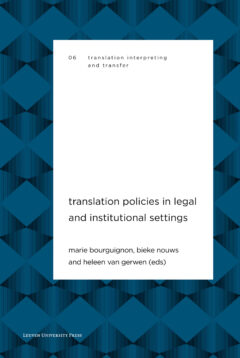 Translation Policies in Legal and Institutional Settings
Marie Bourguignon (Editor), Bieke Nouws (Editor), Heleen van Gerwen (Editor),
November 2021
 Cultural Mediation in Europe, 1800-1950
Reine Meylaerts (Editor), Lieven D'hulst (Editor), Tom Verschaffel (Editor),
December 2017
 Doing Double Dutch
Elke Brems (Editor), Orsolya Réthelyi (Editor), Ton Van Kalmthout (Editor),
March 2017
 Patroon en argument
Freek Van De Velde (Editor), Hans Smessaert (Editor), Frank Van Eynde (Editor), Sara Verbrugge (Editor),
October 2014