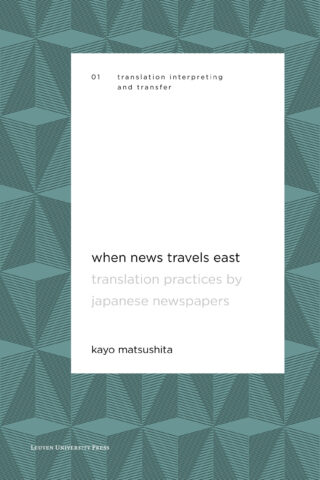
When News Travels East
Translation Practices by Japanese Newspapers
Kayo Matsushita (Author),
Series: Translation, Interpreting and Mediation 1
Category: Asian Studies, Linguistics, Literature, Translation Studies
Language: English
ISBN: 9789462701946
Publication date: November 13, 2019
€20.00 (including 6% VAT)
Buy NowNumber of pages: 208
Size: 234 x 156 x 13 mm

Stock item: 131818
Standard delivery time for print books:
For Belgium: 5 to 8 working days
For EU: 2 to 3 weeks
For other countries: 4 to 5 weeks
Series: Translation, Interpreting and Mediation 1
Category: Asian Studies, Linguistics, Literature, Translation Studies
Language: English
ISBN: 9789461663047
Publication date: November 13, 2019
€29.50 (including 6% VAT)
Buy NowNumber of pages: 208
Journalism and unique translation practices by Japanese media today
International news stories provided to the public basically rely on translation. Most of this translation is done not by translators, but by journalists with practically no training in translation. What happens when the norms of journalism and those of translation clash? In this book, the author, a trained conference interpreter and former international journalist, investigates translator decisions in the practice of Japanese news translation. Her extensive analysis of texts from six major Japanese newspapers and interviews with Japanese “journalators” focuses on direct quotations, where accuracy is a journalistic priority but can generate loss of communication impact if implemented rigidly. She argues that many shifts from accuracy can be explained as risk management strategies. When News Travels East provides invaluable insight from an insider about news translation in Japan and beyond and paves the way for further research in the field.
This publication is GPRC-labeled (Guaranteed Peer-Reviewed Content).
List of Tables
List of Figures
Preface
Chapter 1. Introduction1.1 Everywhere and Nowhere: Defining the Boundaries of News Translation
1.2 Scope and Purpose
1.3 Case and Framework
Chapter 2. What is News Translation?2.1 Journalism and Translation
2.1.1 Gatekeeping and Transediting
2.1.1.1 Gatekeeping
2.1.1.2 Transediting
2.1.2 Research by Insiders
2.1.3 Warwick’s “Translation in Global News” Project
2.1.4 News Translation Research in Japan
2.2 Journalism and Speech Events
2.2.1 Direct Quotations
2.2.2 Translation of Speech Events
Chapter 3. Japanese Journalism and Translation3.1 Historical Development
3.2 The Current Media Landscape
3.2.1 Newspapers
3.2.1.1 The Yomiuri Shimbun (読売新聞)
3.2.1.2 The Asahi Shimbun (朝日新聞)
3.2.1.3 The Mainichi Shimbun (毎日新聞)
3.2.1.4 The Nikkei (日本経済新聞)
3.2.1.5 The Sankei Shimbun (産経新聞)
3.2.1.6 The Chunichi Shimbun (中日新聞)
3.2.2 Magazines
3.2.3 TV Broadcasting
3.2.4 Radio Broadcasting
3.2.5 Online Media
3.3 Japanese Journalators
3.3.1 Overview
3.3.2 Typical Profiles
3.4 The News Translation Process
Chapter 4. Risk Management in Translation4.1 What is Risk in Translation?
4.2 Pym’s Concept of Risk Management
4.2.1 Uncertainty and Translation
4.2.2 The Nature of Risk
4.2.3 Effort and Risk
4.2.4 Ethics and Risk
4.2.5 Translation Strategies as Risk Management
4.3 Particular Risks in News Translation
Chapter 5. Analyzing the Effect of Risks on Translation5.1 Methodologies in News Translation Research
5.2 Risk Analysis
5.2.1 Designing the Method
5.2.2 Categorizing the Risks
5.2.3 A Model for the Analysis of Risk in News Translation
5.2.3.1 Step One: Selecting the Target
5.2.3.2 Step Two: Identifying the Translation Strategies
5.2.3.3 Step Three: Analyzing the Strategy and Effort
5.2.3.4 Step Four: Identifying and Analyzing Risk Management
Chapter 6. Case Study: 2012 U.S. Presidential Election6.1 Difference in Quoting Obama and Trump
6.2 Targeted Speech Events
6.2.1 Victory Speech
6.2.2 Inaugural Address
6.2.3 Journalators’ Roles 9
6.3 Text Analysis
6.3.1 Types of Strategies
6.3.1.1 Omission
6.3.1.2 Addition
6.3.1.3 Substitution
6.3.1.4 Distribution of Omission, Addition, and Substitution
6.3.2 Qualitative Analysis
6.3.2.1 Omission as a Key Strategy
6.3.2.2 Examples of Addition
6.3.2.3 Examples of Substitution
Chapter 7. News Translation Practices in Various Genres7.1 Unethical and Non-Standard Practices
7.1.1 Comparing Interlingual and Intralingual Practices
7.1.2 Applying a New Concept
7.2 How Risk Affects the Translator’s Decision-Making Process
7.2.1 Journalator Profile: Keiichi Shirato
7.2.2 Accuracy in Translation
7.2.3 Time and Space Limitations
7.2.4 Effects of Risk
7.3 Preliminary Conclusion
Chapter 8. News Translation and the Changing Media Environment8.1 New Types of Risks and Coping Methods
8.1.1 Managing Risk in a Press Conference
8.1.2 Managing Risk through Double-Presentation
8.1.3 Managing Risk through Increased Visibility
8.2 News Translation Research in an Advanced Information Society
Afterword
AppendicesA. The White House Transcript of President Obama’s Remarks on Election Night delivered November 7, 2012
B. The White House Transcript of President Obama’s Inaugural Address delivered January 21, 2013
NotesReferencesIndex
Blog article - Rethinking the role of news translation in the face of the pandemic'While the role of translation in the global dissemination of news can be viewed positively in terms of information equality, it has also been criticized for bringing about an infodemic (i.e., an overabundance of information including false, erroneous, or unfounded claims).'
Kayo Matsushita, https://www.federationhss.ca/en/blog/rethinking-role-news-translation-face-pandemic
Frequently Asked Questions
What is "When News Travels East" about?
Journalism and unique translation practices by Japanese media today
International news stories provided to the public basically rely on translation. Most of this translation is done not by translators, but by journalists with practically no training in translation. What happens when the norms of journalism and those of translation clash? In this book, the author, a trained conference interpreter and former international journalist, investigates translator decisions in the practice of Japanese news translation. Her extensive analysis of texts from six major Japanese newspapers and interviews with Japanese “journalators” focuses on direct quotations, where accuracy is a journalistic priority but can generate loss of communication impact if implemented rigidly. She argues that many shifts from accuracy can be explained as risk management strategies. When News Travels East provides invaluable insight from an insider about news translation in Japan and beyond and paves the way for further research in the field.
This publication is GPRC-labeled (Guaranteed Peer-Reviewed Content).
Who wrote "When News Travels East"?
"When News Travels East" was written by Kayo Matsushita.
Kayo Matsushita is associate professor of Interpreting and Translation Studies at Rikkyo University and board member of The Japan Association for Interpreting and Translation Studies.
Is "When News Travels East" part of a series?
Yes, "When News Travels East" is part of the "Translation, Interpreting and Mediation" series. It's book 1 in the series.

Translation, Interpreting and Mediation
Mission statement
Championing a broad and transversal approach to the study of translational phenomena, Translation, Interpreting and Mediation (TIME) is a book series for monographs and edited volumes that explore translation as a pervasive social practice connecting spaces and collectivities through complex forms of resemiotization and mediation. The series transcends traditional notions of translation as the decoding and recoding of semantic invariants and embraces an expansive understanding of translational agency. It aims to provide a venue for theoretical and methodological innovations at the disciplinary frontiers where translation is pervasive and essential but seldom fully understood or acknowledged. The series welcomes different perspectives on translation, interpreting and mediation, interfacing with a variety of areas of study, including sociology, literature, linguistics, cognition, politics, law, history, communication, multimodality, ecology, technology, cultural production and digital humanities (among others). The series draws inspiration from the collective expertise of CETRA (Centre for Translation Studies), its institutional home at KU Leuven.
All volumes in the series are double peer reviewed.
For questions, please contact the series editors.
Series editors
Jack McMartin (KU Leuven)
Sara Ramos Pinto (University of Leeds)
Peter J. Freeth (University of Warwick)
Editorial board
Núria Codina Solà (KU Leuven)
Lieven D’hulst (KU Leuven)
Deborah Giustini (Hamad Bin Khalifa University)
Gabriel González Núñez (University of Texas Rio Grande Valley)
Bei Hu (National University of Singapore)
Akiko Sakamoto (Kansai University)
Advisory board
Brian Baer (Kent State University)
Pieter Boulogne (KU Leuven)
Lynne Bowker (University of Laval)
Elke Brems (KU Leuven)
Leo Tak-hung Chan (Lingnan University, Hong Kong)
Antoon Cox (KU Leuven)
Michael Cronin (Trinity College Dublin)
Dilek Dizdar (Johannes Gutenberg-Universität Mainz)
Yves Gambier (University of Turku)
Maud Gonne (University of Liège)
Arnt Lykke Jakobsen (Copenhagen Business School)
Haidee Kotze (Utrecht University)
Kaisa Koskinen (Tampere University)
Kobus Marais (University of the Free State)
Reine Meylaerts (KU Leuven)
Joss Moorkens (Dublin City University)
Jemina Napier (Heriot-Watt University)
Franz Pöchhacker (University of Vienna)
Hanna Risku (University of Vienna)
Diana Roig Sanz (Universitat Oberta de Catalunya)
Heidi Salaets (KU Leuven)
Christina Schäffner (Aston University)
Luc van Doorslaer (University of Tartu / KU Leuven)
Proposals
Proposals and enquiries can be sent to the series editors.
Please make use of the submission form to present the full manuscript to our board.
Authors interested in Open Access can consult the available funding options.
Links & Resources
What is the Table of Contents for "When News Travels East"?
List of Tables
List of Figures
Preface
Chapter 1. Introduction1.1 Everywhere and Nowhere: Defining the Boundaries of News Translation
1.2 Scope and Purpose
1.3 Case and Framework
Chapter 2. What is News Translation?2.1 Journalism and Translation
2.1.1 Gatekeeping and Transediting
2.1.1.1 Gatekeeping
2.1.1.2 Transediting
2.1.2 Research by Insiders
2.1.3 Warwick’s “Translation in Global News” Project
2.1.4 News Translation Research in Japan
2.2 Journalism and Speech Events
2.2.1 Direct Quotations
2.2.2 Translation of Speech Events
Chapter 3. Japanese Journalism and Translation3.1 Historical Development
3.2 The Current Media Landscape
3.2.1 Newspapers
3.2.1.1 The Yomiuri Shimbun (読売新聞)
3.2.1.2 The Asahi Shimbun (朝日新聞)
3.2.1.3 The Mainichi Shimbun (毎日新聞)
3.2.1.4 The Nikkei (日本経済新聞)
3.2.1.5 The Sankei Shimbun (産経新聞)
3.2.1.6 The Chunichi Shimbun (中日新聞)
3.2.2 Magazines
3.2.3 TV Broadcasting
3.2.4 Radio Broadcasting
3.2.5 Online Media
3.3 Japanese Journalators
3.3.1 Overview
3.3.2 Typical Profiles
3.4 The News Translation Process
Chapter 4. Risk Management in Translation4.1 What is Risk in Translation?
4.2 Pym’s Concept of Risk Management
4.2.1 Uncertainty and Translation
4.2.2 The Nature of Risk
4.2.3 Effort and Risk
4.2.4 Ethics and Risk
4.2.5 Translation Strategies as Risk Management
4.3 Particular Risks in News Translation
Chapter 5. Analyzing the Effect of Risks on Translation5.1 Methodologies in News Translation Research
5.2 Risk Analysis
5.2.1 Designing the Method
5.2.2 Categorizing the Risks
5.2.3 A Model for the Analysis of Risk in News Translation
5.2.3.1 Step One: Selecting the Target
5.2.3.2 Step Two: Identifying the Translation Strategies
5.2.3.3 Step Three: Analyzing the Strategy and Effort
5.2.3.4 Step Four: Identifying and Analyzing Risk Management
Chapter 6. Case Study: 2012 U.S. Presidential Election6.1 Difference in Quoting Obama and Trump
6.2 Targeted Speech Events
6.2.1 Victory Speech
6.2.2 Inaugural Address
6.2.3 Journalators’ Roles 9
6.3 Text Analysis
6.3.1 Types of Strategies
6.3.1.1 Omission
6.3.1.2 Addition
6.3.1.3 Substitution
6.3.1.4 Distribution of Omission, Addition, and Substitution
6.3.2 Qualitative Analysis
6.3.2.1 Omission as a Key Strategy
6.3.2.2 Examples of Addition
6.3.2.3 Examples of Substitution
Chapter 7. News Translation Practices in Various Genres7.1 Unethical and Non-Standard Practices
7.1.1 Comparing Interlingual and Intralingual Practices
7.1.2 Applying a New Concept
7.2 How Risk Affects the Translator’s Decision-Making Process
7.2.1 Journalator Profile: Keiichi Shirato
7.2.2 Accuracy in Translation
7.2.3 Time and Space Limitations
7.2.4 Effects of Risk
7.3 Preliminary Conclusion
Chapter 8. News Translation and the Changing Media Environment8.1 New Types of Risks and Coping Methods
8.1.1 Managing Risk in a Press Conference
8.1.2 Managing Risk through Double-Presentation
8.1.3 Managing Risk through Increased Visibility
8.2 News Translation Research in an Advanced Information Society
Afterword
AppendicesA. The White House Transcript of President Obama’s Remarks on Election Night delivered November 7, 2012
B. The White House Transcript of President Obama’s Inaugural Address delivered January 21, 2013
NotesReferencesIndex
What is the DOI for "When News Travels East"?
The Digital Object Identifier (DOI) for "When News Travels East" is 10.11116/9789461663047.
Related titles



 Collective Trauma and Future Fantasies
Raika Khorshidian (Editor), Birgit Mersmann (Editor), Cathrine Bublatzky (Editor), Julia Stenzel (Editor),
November 2026


 Feminists Resisting Gendered Violence
Hemangini Gupta (Editor), Fiona Mackay (Editor), Jan Breckenridge (Editor), Louise Chappell (Editor), Rachna Mehra (Editor), Rukmini Sen (Editor), Mailin Suchting (Editor),
October 2026
 Affect in Translation and Interpreting
Sofía Monzón (Editor), Lucie Spezzatti (Editor), Elisabeth Goemans (Editor),
May 2026
 Research Methods in Literary Reception Studies
Jeroen Dera (Editor), Anne Oerlemans (Editor), Frederik Van Dam (Editor),
May 2026
 Comics and the Global South
Andrea Aramburú (Editor), Dibyadyuti Roy (Editor), Joe Sutliff Sanders (Editor),
February 2026
 Situatedness and Performativity
Raquel Pacheco Aguilar (Editor), Marie-France Guénette (Editor),
November 2025

 Transfer Thinking in Translation Studies
Maud Gonne (Editor), Klaartje Merrigan (Editor), Reine Meylaerts (Editor), Heleen van Gerwen (Editor),
September 2025


 The Visionary Art of Franco-Belgian Comics, 1930s to 1960s
Hugo Frey (Editor), Maaheen Ahmed (Editor),
September 2025
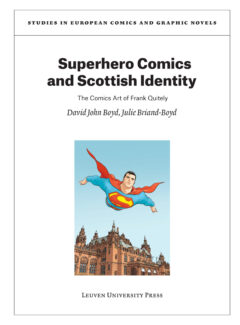 Superhero Comics and Scottish Identity
David John Boyd (Author), Julie Briand-Boyd (Author),
July 2025
 Retranslating the Bible and the Qur’an
Pieter Boulogne (Editor), Marijke H. de Lang (Editor), Joseph Verheyden (Editor),
December 2024

 European Literatures of Military Occupation
Matthias Buschmeier (Editor), Jeanne E. Glesener (Editor),
October 2024