

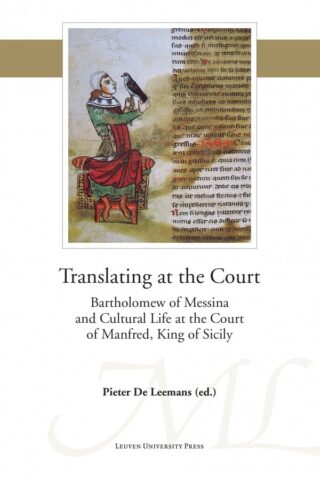
Translating at the Court
Bartholomew of Messina and Cultural Life at the Court of Manfred, King of Sicily
Pieter De Leemans (Editor),
Series: Mediaevalia Lovaniensia 45
Category: History, History 500-1500, Literature, Translation Studies
Language: English
ISBN: 9789058679864
Publication date: September 26, 2014
€51.50 (including 6% VAT)
Buy NowSize: 240 x 160 x mm

Stock item: 93794
Standard delivery time for print books:
For Belgium: 5 to 8 working days
For EU: 2 to 3 weeks
For other countries: 4 to 5 weeks
Series: Mediaevalia Lovaniensia 45
Category: History, History 500-1500, Literature, Translation Studies
Language: English
ISBN: 9789461661654
Publication date: September 26, 2014
€44.00 (including 6% VAT)
Buy Now
The importance of Bartholomew’s oeuvre and cultural life under the reign of Manfred.
An important chapter in the rediscovery of Aristotle in the Middle Ages is the oeuvre of Bartholomew of Messina (Bartholomaeus de Messana), a translator at the court of Manfred, King of Sicily (1258–1266). However, the impact of both Bartholomew and Manfred on the cultural and intellectual life of their time remains understudied, especially in comparison to the attention received by the translator’s contemporary, William of Moerbeke, and by the King’s father, Frederick II of Hohenstaufen. This volume contributes to the exploration of this field of research in a twofold way. It discusses the nature and importance of Bartholomew’s oeuvre (and especially his translations of Aristotle). Moreover, by situating Bartholomew’s activity in a broader context ‘Translating at the Court’ pays special attention to cultural life under the reign of Manfred.
This publication is GPRC-labeled (Guaranteed Peer-Reviewed Content).
CONTENTS Notes about the contributors
Pieter De Leemans Bartholomew of Messina, Translator at the Court of Manfred, King of Sicily
Steven J. Williams Like Father, Like Son? The Life and Reign of Manfred, King of Sicily
Fulvio Dell e Donne The Sapientia of Manfred and the Studium of Naples
Michael W. Dunne Dubitauit Rex Manfridus … King Manfred and the Determinatio Magistralis of Peter of Ireland
Paraskevi Kotzia De Hebrea lingua transtulimus in Latinam: Manfred of Sicily and the pseudo-Aristotelian Liber de pomo
Alessandra Perriccioli Saggese Fra la corte e l’università : manoscritti miniati di età manfrediana
Mauro Zonta Jewish Philosophy and Translations of Philosophical Texts into Hebrew in 13th-Century Southern Italy, Including Sicily:Some Observations
Charles Burnett Stephen of Messina and the Translation of Astrological Texts from Greek in the Time of Manfred
Giacinta Spinosa Barthélemy de Messine, traducteur du Ps.-Aristote, De mundo: la diffusion de néologismes métaphysiques, astrologiques et cosmologiques (influentia, inalterabilis) du XIIe au XIVe siècle
Pieter Beullens True Colours: the Medieval Latin Translations of De Coloribus Gudrun Vuillemin-Diem Revision der Translatio Bartholomaei oder Neuübersetzung? Zu dem Fragment von De coloribus des Wilhelm von Moerbeke
Élisabeth Dévière Le vocabulaire médical de Barthélemy de Messine et sa réception par Pietro d’Abano
Charles Burnett The Latin Versions of Pseudo-Aristotle’s De signis
Pieter Beullens Facilius sit Nili Caput Invenire: Towards an Attribution and Reconstruction of the Aristotelian Treatise De inundatione Nili
Dimitri Gutas The Translation of De Principiis (Theophrastus) by Bartholomew of Messina
Valérie Cordonier La version latine des Magna moralia par Barthélemy de Messine et son modèle grec: le ms. Wien, à–NB, phil. gr. 315 (V)
Index codicum manu scriptorum Index nominum
Il s'agit d'un recueil de quinze études, toutes de très haut niveau, précédées par une belle introduction, claire et bien agencée, signée par l'éditeur du volume, Pieter DE LEEMANS. [...] Ce beau volume constitue donc une sorte d'état des recherches sur Bartholomée de Messine. Mais se limiter à cette description signifierait l'amoindrir : les différents chapitres portent bien au-delà d'un travail ponctuel sur les textes, que pourtant ils supposent ; y sont aussi proposées beaucoup de thèses nouvelles relatives à des questions générales, d'intérêt historique et littéraire.
Revue des Sciences philosophiques et théologiques 99 (2015), p. 689
Auch wenn der zweite Teil sich eher an Philologen wendet und Grundkenntnisse in der Aristotelesüberlieferung und Scholastik voraussetzt, kann die Veröffentlichung auch von Historikern mit groBem Gewinn konsultiert werden. àœbersetzungen stellten und stellen (von der Antike bis heute) einen wichtigen Faktor der Kulturvermittlung dar, der in einer immer stärker bildlastigen Zeit leicht übersehen wird.
Thomas Hofmann, QFIAB 95 (2015)
In drawing attention to such deep structures of court life while acknowledging the flurry of politics, diplomacy and ceremonial, this collection makes an important contribution to our advancing understanding of the early modern court.
Steven Gunn, Tijdschrift voor Geschiedenis, Volume 129, Number 3, August 2016, pp. 447-500(54)
'Translating at the Court' is een werk dat zich voornamelijk tot specialisten richt, maar van grote waarde is, omdat het vele facetten belicht van de omgeving en persoon van Bartholomeus van Messina, een figuur die tot op heden onmiskenbaar te weinig aandacht kreeg.
Tijdschrift voor Filosofie 78, nr. 4 (2016)
Frequently Asked Questions
What is "Translating at the Court" about?
The importance of Bartholomew’s oeuvre and cultural life under the reign of Manfred.
An important chapter in the rediscovery of Aristotle in the Middle Ages is the oeuvre of Bartholomew of Messina (Bartholomaeus de Messana), a translator at the court of Manfred, King of Sicily (1258–1266). However, the impact of both Bartholomew and Manfred on the cultural and intellectual life of their time remains understudied, especially in comparison to the attention received by the translator’s contemporary, William of Moerbeke, and by the King’s father, Frederick II of Hohenstaufen. This volume contributes to the exploration of this field of research in a twofold way. It discusses the nature and importance of Bartholomew’s oeuvre (and especially his translations of Aristotle). Moreover, by situating Bartholomew’s activity in a broader context ‘Translating at the Court’ pays special attention to cultural life under the reign of Manfred.
This publication is GPRC-labeled (Guaranteed Peer-Reviewed Content).
Who edited "Translating at the Court"?
"Translating at the Court" was edited by Pieter De Leemans.
Pieter De Leemans is professor at the De Wulf-Mansion Centre for Ancient, Medieval, and Renaissance Philosophy (KU Leuven) and academic secretary of the Aristotles Latinus. - Hoger Instituut van Wijsbegeerte, KU Leuven
Is "Translating at the Court" part of a series?
Yes, "Translating at the Court" is part of the "Mediaevalia Lovaniensia" series. It's book 45 in the series.

The longstanding, peer-reviewed book series Mediaevalia Lovaniensia. Studies in Medieval History, Society, and Culture publishes high-quality scholarship on the history and culture of the Middle Ages (c. 500–1550). Topics of particular interest to the series include, but are not limited to, social behaviour and power relations in medieval society, processes of identity formation, religious and urban culture, medieval thought and literature, and gender history. The series focuses on Europe and the wider Mediterranean world and is particularly rich in interdisciplinary approaches. By means of monographs and edited volumes, the series explores thematic frontiers and embraces innovative methodological approaches in historical and philological scholarship that is based on an in-depth source-based study.
Mediaevalia Lovaniensia accepts monographs as well as thematically coherent volumes in English. Moreover, it offers scholars the possibility to publish critical editions of primary texts with broader relevance to the understanding of medieval culture and society. The series aspires to publish books that have the potential to become reference works in the field of Medieval Studies.
We encourage early career (postdoctoral) researchers to submit a reworked version of their PhD thesis to this series. Leuven University Press provides authors with two publishing scenarios: traditional (non-Open Access) and the option to publish in Open Access (including language editing).
Editorial Board
Jelle Haemers (KU Leuven)
Jeroen Deploige (Ghent University)
Brigitte Meijns (KU Leuven)
Chanelle Delameillieure (KU Leuven - KULAK)
Baudouin Van den Abeele (UCLouvain)
Proposals
Proposals and enquiries can be sent to one of the editorial board members. Please send a short abstract. Upon approval of the proposal, the full manuscript will be submitted to international blind peer review by two (external) experts. The editors strive towards completing the review of proposals within one month and of complete manuscripts within five months after submission. Manuscripts should preferably be (+/-) 80.000 to 120.000 words in length.
Please make use of the submission form to present your manuscript or proposal to our board.
Authors interested in Open Access can consult the available funding options.
Links & Resources
What is the Table of Contents for "Translating at the Court"?
CONTENTS Notes about the contributors
Pieter De Leemans Bartholomew of Messina, Translator at the Court of Manfred, King of Sicily
Steven J. Williams Like Father, Like Son? The Life and Reign of Manfred, King of Sicily
Fulvio Dell e Donne The Sapientia of Manfred and the Studium of Naples
Michael W. Dunne Dubitauit Rex Manfridus ... King Manfred and the Determinatio Magistralis of Peter of Ireland
Paraskevi Kotzia De Hebrea lingua transtulimus in Latinam: Manfred of Sicily and the pseudo-Aristotelian Liber de pomo
Alessandra Perriccioli Saggese Fra la corte e l'università : manoscritti miniati di età manfrediana
Mauro Zonta Jewish Philosophy and Translations of Philosophical Texts into Hebrew in 13th-Century Southern Italy, Including Sicily:Some Observations
Charles Burnett Stephen of Messina and the Translation of Astrological Texts from Greek in the Time of Manfred
Giacinta Spinosa Barthélemy de Messine, traducteur du Ps.-Aristote, De mundo: la diffusion de néologismes métaphysiques, astrologiques et cosmologiques (influentia, inalterabilis) du XIIe au XIVe siècle
Pieter Beullens True Colours: the Medieval Latin Translations of De Coloribus Gudrun Vuillemin-Diem Revision der Translatio Bartholomaei oder Neuübersetzung? Zu dem Fragment von De coloribus des Wilhelm von Moerbeke
Élisabeth Dévière Le vocabulaire médical de Barthélemy de Messine et sa réception par Pietro d'Abano
Charles Burnett The Latin Versions of Pseudo-Aristotle's De signis
Pieter Beullens Facilius sit Nili Caput Invenire: Towards an Attribution and Reconstruction of the Aristotelian Treatise De inundatione Nili
Dimitri Gutas The Translation of De Principiis (Theophrastus) by Bartholomew of Messina
Valérie Cordonier La version latine des Magna moralia par Barthélemy de Messine et son modèle grec: le ms. Wien, à–NB, phil. gr. 315 (V)
Index codicum manu scriptorum Index nominum
What is the DOI for "Translating at the Court"?
The Digital Object Identifier (DOI) for "Translating at the Court" is 10.11116/9789461661654.
Related titles



 Orality and Scribal Culture in the High Middle Ages
Timothy B. Noone (Author), Mark J. Clark (Author),
November 2026

 Toekomstdromen
Maarten Van Dijck (Editor), Gerrit Verhoeven (Editor), Hans Cools (Editor),
November 2026
 Feminists Resisting Gendered Violence
Hemangini Gupta (Editor), Fiona Mackay (Editor), Jan Breckenridge (Editor), Louise Chappell (Editor), Rachna Mehra (Editor), Rukmini Sen (Editor), Mailin Suchting (Editor),
October 2026

 The Medieval Aristotle
Nena Bobovnik (Editor), Clelia V. Crialesi (Editor), Lisa Devriese (Editor),
August 2026

 Trend en toeval – vierde editie
Bruno Blondé (Author), Isabelle Devos (Author), Jord Hanus (Author), Wouter Ryckbosch (Author),
August 2026
 Affect in Translation and Interpreting
Sofía Monzón (Editor), Lucie Spezzatti (Editor), Elisabeth Goemans (Editor),
May 2026
 Research Methods in Literary Reception Studies
Jeroen Dera (Editor), Anne Oerlemans (Editor), Frederik Van Dam (Editor),
May 2026


 Political Exile in the Global Twentieth Century
Wolfram Kaiser (Editor), Piotr H. Kosicki (Editor),
April 2026
 Christian Democracy and the Fall of Communism
Michael Gehler (Editor), Piotr H. Kosicki (Editor), Helmut Wohnout (Editor),
April 2026
 Brusselse plaatsnamen
Iadine Degryse (Editor), Benjamin Wayens (Editor), Chantal Kesteloot (Editor), Dennis De Vriese (Editor), Matthijs Degraeve (Editor),
April 2026



 Cartographies of Catastrophes
Laura Demeter (Editor), Carmen M. Enss (Editor), Piotr Kisiel (Editor), Carol Ludwig (Editor),
February 2026