

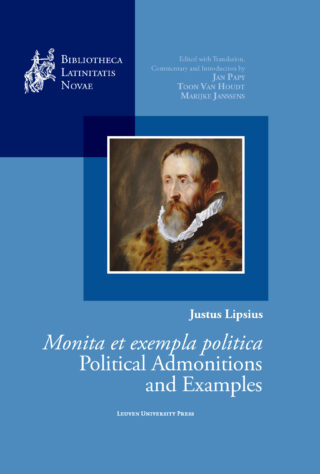
Justus Lipsius, Monita et exempla politica / Political Admonitions and Examples
Edited with Translation, Commentary, and Introduction
Jan Papy (Editor), Toon Van Houdt (Editor), Marijke Janssens (Editor),
Series: Bibliotheca Latinitatis Novae
Category: Neo-Latin Studies
ISBN: 9789462703056
Publication date: May 30, 2022
€84.00 (including 6% VAT)
Buy NowNumber of pages: 696
Size: 240 x 170 x 45 mm

Stock item: 148388
Standard delivery time for print books:
For Belgium: 5 to 8 working days
For EU: 2 to 3 weeks
For other countries: 4 to 5 weeks
Series: Bibliotheca Latinitatis Novae
Category: Neo-Latin Studies
ISBN: 9789461664204
Publication date: May 30, 2022
€90.00 (including 6% VAT)
Buy NowNumber of pages: 696
Political thought and philosophy in 17th-century Europe
In 17th-century intellectual life, the ideas of the Renaissance humanist Justus Lipsius (1547–1606) were omnipresent. The publication of his Politica in 1589 had made Lipsius’ name as an original and controversial political thinker. The sequel, the Monita et exempla politica (Political admonitions and examples), published in 1605, was meant as an illustration of Lipsius political thought as expounded in the Politica. Its aim was to offer concrete models of behavior for rulers against the background of Habsburg politics.
Lipsius’ later political treatise also forms an indispensable key to interpret the place and function of the Politica in Lipsius’ political discourse and in early modern political thought. The Political admonitions and examples – widely read, edited, and translated in the 17th and 18th centuries – show Lipsius’ pivotal role in the genesis of modern political philosophy.
This publication is GPRC-labeled (Guaranteed Peer-Reviewed Content).
Preface
Introduction Section 1. Lipsius and the Monita: General Introduction Section 2. The Monita and Early Modern Political Writing: Genre and Form Section 3. The Monita in the Context of Lipsius’ Oeuvre Section 4. Towards a Reassessment of Lipsius’ Political Views Section 5. The Humanist at Work: Invention, Disposition, and Elocution Section 6. The History of the Printed Text: Early Modern Editions
Text and Translation I. Principles of this Edition II. The English Translation Monita et exempla politica
Commentary I. Preliminary Remarks II. Commentary on Book I III. Commentary on Book 2 Appendix: Tables of contents of the Monita and the Politica
Bibliography General index
Frequently Asked Questions
What is "Justus Lipsius, Monita et exempla politica / Political Admonitions and Examples" about?
Political thought and philosophy in 17th-century Europe
In 17th-century intellectual life, the ideas of the Renaissance humanist Justus Lipsius (1547–1606) were omnipresent. The publication of his Politica in 1589 had made Lipsius' name as an original and controversial political thinker. The sequel, the Monita et exempla politica (Political admonitions and examples), published in 1605, was meant as an illustration of Lipsius political thought as expounded in the Politica. Its aim was to offer concrete models of behavior for rulers against the background of Habsburg politics.
Lipsius' later political treatise also forms an indispensable key to interpret the place and function of the Politica in Lipsius’ political discourse and in early modern political thought. The Political admonitions and examples – widely read, edited, and translated in the 17th and 18th centuries – show Lipsius’ pivotal role in the genesis of modern political philosophy.
This publication is GPRC-labeled (Guaranteed Peer-Reviewed Content).
Who edited "Justus Lipsius, Monita et exempla politica / Political Admonitions and Examples"?
"Justus Lipsius, Monita et exempla politica / Political Admonitions and Examples" was edited by Jan Papy, Toon Van Houdt and Marijke Janssens.
Jan Papy is full professor of Latin and Neo-Latin literature at KU Leuven. He publishes on Renaissance Humanism in the Low Countries, intellectual history, and Lipsius and Neo-Stoic philosophy.
Toon Van Houdt is associate professor of Latin at KU Leuven. His research focuses on the history of political and ethical thought in early modern times.
Marijke Janssens earned her PhD from KU Leuven with a dissertation on Lipsius’ 'Monita et exempla politica' and has published several articles on Lipsius and his political views.
Is "Justus Lipsius, Monita et exempla politica / Political Admonitions and Examples" part of a series?
Yes, "Justus Lipsius, Monita et exempla politica / Political Admonitions and Examples" is part of the "Bibliotheca Latinitatis Novae" series.
The series Bibliotheca Latinitatis Novae, previously published by Van Gorcum, offers Latin literature from the later Renaissance and the Early Modern period. By combining each critical Latin text with an English translation, an historical introduction, and notes, Bibliotheca Latinitatis Novae makes texts accessible to specialists and general readers alike.

This series is available on standing order. To sign up for a subscription or for more information, please contact info@lup.be.
The volumes published before 2013 in the Bibliotheca Latinitatis Novae series have been reduced in price to € 25,00 only! Order online or email your order to info@lup.be.
Free backlist ebook available via Google Books
 Politica : six books of politics or political instruction
Justus Lipsius, Jan Hendrik Waszink
2004, Van Gorcum
DOWNLOAD >
Editorial Board
Jan Waszink (editor in chief), Historical Institute of the Polish Academy of Sciences, Warsaw
Christoph Pieper, Leiden University
Grażyna Urban-Godziek, Jagiellonian University Krakow
Dirk van Miert, Huygens Institute for History and Culture of the Netherlands and Utrecht University
Johanna Luggin, Universität Innsbruck
Elena Dahlberg, University of Skövde
Benjamin Plomp, Universität Basel
Advisory board
Maurizio Campanelli, Karl Enenkel, Marianne Pade, Dirk Sacré, Florian Schaffenrath
Proposals
Proposals and enquiries can be sent to Jan Waszink.
Please make use of the submission form to present your manuscript or proposal to our board.
Links & Resources
What is the Table of Contents for "Justus Lipsius, Monita et exempla politica / Political Admonitions and Examples"?
Preface
Introduction Section 1. Lipsius and the Monita: General Introduction Section 2. The Monita and Early Modern Political Writing: Genre and Form Section 3. The Monita in the Context of Lipsius’ Oeuvre Section 4. Towards a Reassessment of Lipsius’ Political Views Section 5. The Humanist at Work: Invention, Disposition, and Elocution Section 6. The History of the Printed Text: Early Modern Editions
Text and Translation I. Principles of this Edition II. The English Translation Monita et exempla politica
Commentary I. Preliminary Remarks II. Commentary on Book I III. Commentary on Book 2 Appendix: Tables of contents of the Monita and the Politica
Bibliography General index
Related titles
 Studies in the Latin Literature and Epigraphy of Italian Fascism
Han Lamers (Editor), Bettina Reitz-Joosse (Editor), Valerio Sanzotta (Editor),
June 2020
 Una lingua morta per letterature vive: il dibattito sul latino come lingua letteraria in età moderna e contemporanea
Valerio Sanzotta (Editor),
January 2020
 John Milton, Epistolarum Familiarium Liber Unus and Uncollected Letters
Estelle Haan (Editor),
October 2019
 Utopia & More
Dirk Sacré (Editor), Erik De Bom (Editor), Demmy Verbeke (Editor), Gilbert Tournoy (Editor),
October 2016
 A New Sense of the Past: The Scholarship of Biondo Flavio (1392–1463)
Angelo Mazzocco (Editor), Marc Laureys (Editor),
May 2016
 Aulularia and other Inversions of Plautus
Michael Fontaine (), Joannes Burmeister (Author),
July 2015
 La correspondance de Guillaume Budé et Juan Luis Vives
Gilbert Tournoy (Editor), Monique Mund Dopchie (Editor),
June 2015
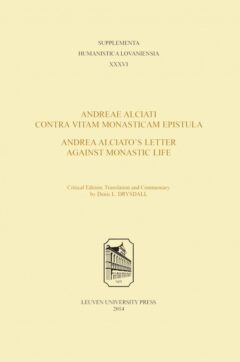 Andreae Alciati Contra Vitam Monasticam Epistula – Andrea Alciato’s Letter Against Monastic Life
Dennis Drysdall (Author),
July 2014
 The Art of Arguing in the World of Renaissance Humanism
Marc Laureys (Editor), Roswitha Simons (Editor),
December 2013
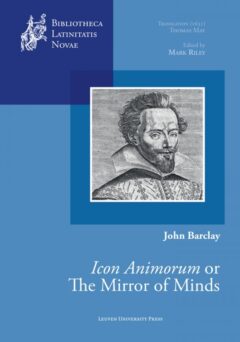 Icon Animorum or The Mirror of Minds
Mark Riley (Editor), John Barclay (Author), Thomas May (Translator),
November 2013
 Neo-Latin Commentaries and the Management of Knowledge in the Late Middle Ages and the Early Modern Period (1400 -1700)
Karl A.E. Enenkel (Editor), Henk Nellen (Editor),
July 2013
 De rationibus quibus homines docti artem Latine colloquendi et ex tempore dicendi saeculis XVI et XVII coluerunt
Terence Tunberg (Author),
March 2013
 The Early Modern Cultures of Neo-Latin Drama
Philip Ford (Editor), Andrew Taylor (Editor),
February 2013
 Scottish Latin Authors in Print up to 1700
Roger Green (Author), Philip Burton (Author), Deborah Ford (Author),
June 2012

 Humanistica Lovaniensia, Volume VIII – 2009
Dirk Sacré (Editor), Jan Papy (Editor), Lambert Isebaert (Editor), Monique Mund Dopchie (Editor), Gilbert Tournoy (Editor),
December 2009