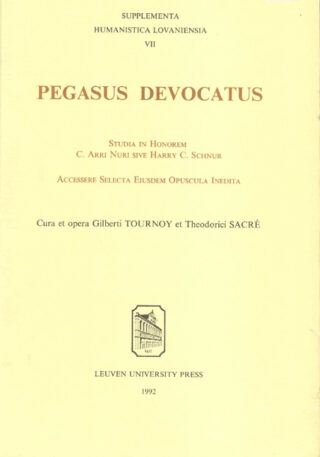
Pegasus Devocatus
Studia in Honorem C. Arri Nuri sive Harry C. Schnur Accessere Selecta Eiusdem Opuscula Inedita
Dirk Sacré (Author), Gilbert Tournoy (Author),
Back in 1963, when a conference on Horace was organised at Oudpelgeest (The Netherlands), Harry C. Schnur chose to comment upon Horace’s famous poem Exegi monumentum aere perennius. Not unlike the Roman poet, Schnur was driven by one of mankind’s strongest stimuli, the craving for immortality. No doubt the same attitude of mind made him meticulously keep together every possible line written by, or concerning, himself: copies of articles, books, translations, notes for his courses, poems, letters to editors of newspapers, files with clippings, were all for him more treasured than incunabula, rare books or precious furniture. Wartime conditions and a great many removals from Germany to England, thence to Holland, back again to England, thence to the U.S.A., back to Germany and then finally to the safe harbour of Switzerland, caused the loss of some book-cases, which left his collection incomplete, but still very impressive.
Gilbert Tournoy, Preface
I. GENERALIA
Jozef IJsewijn, C. Arri Nuri Vita
Gilbert Tournoy – K.L. Weitzel, Harry C. Schnur: a Bibliography
Dirk Sacré, Schnur’s Latin Poetry: an Introduction
II. PETRONIANA
Haiim B. Rosén, ‘Having’ in Petronius
Hannah Rosén, ‘Staminatas duxi’. Petron. 41.12
Dirk Sacré, Arri Nuri Supplementum Petronianum
H.C. Schnur, De aliquibus apud Petronium locis obscurioribus
III. PARALIPOMENA NURIANA
Gilbert Tournoy, Parerga Latina et vernacula
Dirk Sacré, C. Arri Nuri et Ioannis Baptistae Pigatti epistulae mutuae
Index nominum selectorum
Frequently Asked Questions
What is "Pegasus Devocatus" about?
Back in 1963, when a conference on Horace was organised at Oudpelgeest (The Netherlands), Harry C. Schnur chose to comment upon Horace's famous poem Exegi monumentum aere perennius. Not unlike the Roman poet, Schnur was driven by one of mankind's strongest stimuli, the craving for immortality. No doubt the same attitude of mind made him meticulously keep together every possible line written by, or concerning, himself: copies of articles, books, translations, notes for his courses, poems, letters to editors of newspapers, files with clippings, were all for him more treasured than incunabula, rare books or precious furniture. Wartime conditions and a great many removals from Germany to England, thence to Holland, back again to England, thence to the U.S.A., back to Germany and then finally to the safe harbour of Switzerland, caused the loss of some book-cases, which left his collection incomplete, but still very impressive.
Who wrote "Pegasus Devocatus"?
"Pegasus Devocatus" was written by Dirk Sacré and Gilbert Tournoy.
Dirk Sacré is professor of Latin and Neo-Latin at KU Leuven.
Gilbert Tournoy is emeritus professor of Classical, Mediaeval and Renaissance Latin at KU Leuven.
Is "Pegasus Devocatus" part of a series?
Yes, "Pegasus Devocatus" is part of the "Supplementa Humanistica Lovaniensia" series. It's book 7 in the series.
The volumes published before 2000 are free available online.
What is the Table of Contents for "Pegasus Devocatus"?
Gilbert Tournoy, Preface
I. GENERALIA
Jozef IJsewijn, C. Arri Nuri Vita
Gilbert Tournoy - K.L. Weitzel, Harry C. Schnur: a Bibliography
Dirk Sacré, Schnur's Latin Poetry: an Introduction
II. PETRONIANA
Haiim B. Rosén, 'Having' in Petronius
Hannah Rosén, 'Staminatas duxi'. Petron. 41.12
Dirk Sacré, Arri Nuri Supplementum Petronianum
H.C. Schnur, De aliquibus apud Petronium locis obscurioribus
III. PARALIPOMENA NURIANA
Gilbert Tournoy, Parerga Latina et vernacula
Dirk Sacré, C. Arri Nuri et Ioannis Baptistae Pigatti epistulae mutuae
Index nominum selectorum
Related titles
 Justus Lipsius, Monita et exempla politica / Political Admonitions and Examples
Jan Papy (Editor), Toon Van Houdt (Editor), Marijke Janssens (Editor),
May 2022
 Studies in the Latin Literature and Epigraphy of Italian Fascism
Han Lamers (Editor), Bettina Reitz-Joosse (Editor), Valerio Sanzotta (Editor),
June 2020
 Una lingua morta per letterature vive: il dibattito sul latino come lingua letteraria in età moderna e contemporanea
Valerio Sanzotta (Editor),
January 2020
 John Milton, Epistolarum Familiarium Liber Unus and Uncollected Letters
Estelle Haan (Editor),
October 2019
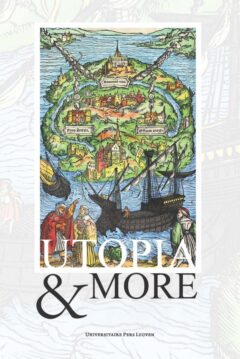 Utopia & More
Dirk Sacré (Editor), Erik De Bom (Editor), Demmy Verbeke (Editor), Gilbert Tournoy (Editor),
October 2016
 A New Sense of the Past: The Scholarship of Biondo Flavio (1392–1463)
Angelo Mazzocco (Editor), Marc Laureys (Editor),
May 2016
 Aulularia and other Inversions of Plautus
Michael Fontaine (), Joannes Burmeister (Author),
July 2015
 La correspondance de Guillaume Budé et Juan Luis Vives
Gilbert Tournoy (Editor), Monique Mund Dopchie (Editor),
June 2015
 Andreae Alciati Contra Vitam Monasticam Epistula – Andrea Alciato’s Letter Against Monastic Life
Dennis Drysdall (Author),
July 2014
 The Art of Arguing in the World of Renaissance Humanism
Marc Laureys (Editor), Roswitha Simons (Editor),
December 2013
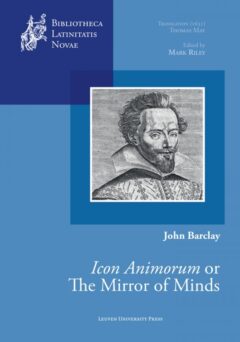 Icon Animorum or The Mirror of Minds
Mark Riley (Editor), John Barclay (Author), Thomas May (Translator),
November 2013
 Neo-Latin Commentaries and the Management of Knowledge in the Late Middle Ages and the Early Modern Period (1400 -1700)
Karl A.E. Enenkel (Editor), Henk Nellen (Editor),
July 2013
 De rationibus quibus homines docti artem Latine colloquendi et ex tempore dicendi saeculis XVI et XVII coluerunt
Terence Tunberg (Author),
March 2013
 The Early Modern Cultures of Neo-Latin Drama
Philip Ford (Editor), Andrew Taylor (Editor),
February 2013
 Scottish Latin Authors in Print up to 1700
Roger Green (Author), Philip Burton (Author), Deborah Ford (Author),
June 2012