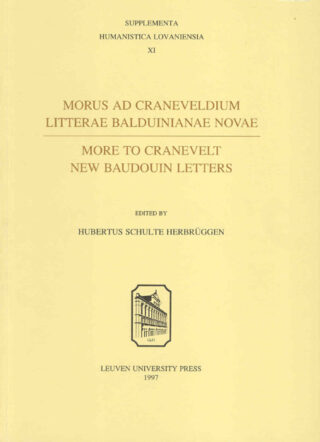
Morus ad Craneveldium literae Balduinianae novae
Hubertus Schulte Herbruggen (Author),
The collection of original humanist letters to Frans van Cranevelt, discovered and acquired for K.U.Leuven in 1989, covers the years between 1520 and 1523, thus preceding the two collections edited by De Vocht in 1928. The new letters are litterae amicales too, written by Cranevelt’s friends, distinguished foreigners as Erasmus, Morus and Vives or familiar Netherlandish humanists like Fevinus, Laurinus, Geldenhouwer, or Clodius.
The present edition selects from the collection seven new letters from Sir Thomas More. In order to keep them in perspective, a detailed introduction is provided. Besides offering many illustrations, the introduction deals with the historical background (the rise of the National State, the Reformation, the international brotherhood of humanists); it sketches out the correspondents’ lives (including a genealogy of Cranevelt’s German ancestry, the Freiherrn von Kranefeld of Ilmenau, Thuringia) and the origin and early years of his friendship with More; it gives a general survey of the new bundle and draws a picture of More as emerging from the new letters (the diplomat, the humanist friend, the lover of art); it tries to reconstruct the provenance and tradition of their known correspondence; it confirms the authenticity of More’s letters (his hand and signatures, seals, paper and watermarks), shows the interlinking of the ‘old’ and ‘new’ letters, and discusses the problem of dating.
The edition proper offers a short introduction to each letter, a critical text placed opposite facsimile photographs of the original manuscripts, and critical textual and historical notes.
Appendices, a bibliography and an index are added for the reader’s convenience.
Historical Background 1519-1522: An age of Transition
- The Correspondents
- The New Litterae ad Craneveldium Baluinianae
- The Correspondence between More and Cranevelt
- More’s Letters
- Editorial Note
Frequently Asked Questions
What is "Morus ad Craneveldium literae Balduinianae novae" about?
The collection of original humanist letters to Frans van Cranevelt, discovered and acquired for K.U.Leuven in 1989, covers the years between 1520 and 1523, thus preceding the two collections edited by De Vocht in 1928. The new letters are litterae amicales too, written by Cranevelt’s friends, distinguished foreigners as Erasmus, Morus and Vives or familiar Netherlandish humanists like Fevinus, Laurinus, Geldenhouwer, or Clodius.
The present edition selects from the collection seven new letters from Sir Thomas More. In order to keep them in perspective, a detailed introduction is provided. Besides offering many illustrations, the introduction deals with the historical background (the rise of the National State, the Reformation, the international brotherhood of humanists); it sketches out the correspondents’ lives (including a genealogy of Cranevelt’s German ancestry, the Freiherrn von Kranefeld of Ilmenau, Thuringia) and the origin and early years of his friendship with More; it gives a general survey of the new bundle and draws a picture of More as emerging from the new letters (the diplomat, the humanist friend, the lover of art); it tries to reconstruct the provenance and tradition of their known correspondence; it confirms the authenticity of More’s letters (his hand and signatures, seals, paper and watermarks), shows the interlinking of the ‘old’ and ‘new’ letters, and discusses the problem of dating.
The edition proper offers a short introduction to each letter, a critical text placed opposite facsimile photographs of the original manuscripts, and critical textual and historical notes.
Appendices, a bibliography and an index are added for the reader’s convenience.
Who wrote "Morus ad Craneveldium literae Balduinianae novae"?
"Morus ad Craneveldium literae Balduinianae novae" was written by Hubertus Schulte Herbruggen.
Is "Morus ad Craneveldium literae Balduinianae novae" part of a series?
Yes, "Morus ad Craneveldium literae Balduinianae novae" is part of the "Supplementa Humanistica Lovaniensia" series. It's book 11 in the series.
The volumes published before 2000 are free available online.
What is the Table of Contents for "Morus ad Craneveldium literae Balduinianae novae"?
Historical Background 1519-1522: An age of Transition
- The Correspondents
- The New Litterae ad Craneveldium Baluinianae
- The Correspondence between More and Cranevelt
- More's Letters
- Editorial Note
Related titles
 Justus Lipsius, Monita et exempla politica / Political Admonitions and Examples
Jan Papy (Editor), Toon Van Houdt (Editor), Marijke Janssens (Editor),
May 2022
 Studies in the Latin Literature and Epigraphy of Italian Fascism
Han Lamers (Editor), Bettina Reitz-Joosse (Editor), Valerio Sanzotta (Editor),
June 2020
 Una lingua morta per letterature vive: il dibattito sul latino come lingua letteraria in età moderna e contemporanea
Valerio Sanzotta (Editor),
January 2020
 John Milton, Epistolarum Familiarium Liber Unus and Uncollected Letters
Estelle Haan (Editor),
October 2019
 Utopia & More
Dirk Sacré (Editor), Erik De Bom (Editor), Demmy Verbeke (Editor), Gilbert Tournoy (Editor),
October 2016
 A New Sense of the Past: The Scholarship of Biondo Flavio (1392–1463)
Angelo Mazzocco (Editor), Marc Laureys (Editor),
May 2016
 Aulularia and other Inversions of Plautus
Michael Fontaine (), Joannes Burmeister (Author),
July 2015
 La correspondance de Guillaume Budé et Juan Luis Vives
Gilbert Tournoy (Editor), Monique Mund Dopchie (Editor),
June 2015
 Andreae Alciati Contra Vitam Monasticam Epistula – Andrea Alciato’s Letter Against Monastic Life
Dennis Drysdall (Author),
July 2014
 The Art of Arguing in the World of Renaissance Humanism
Marc Laureys (Editor), Roswitha Simons (Editor),
December 2013
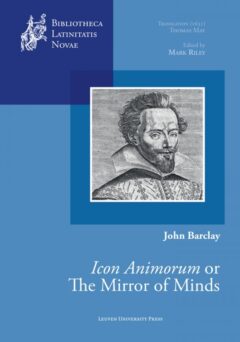 Icon Animorum or The Mirror of Minds
Mark Riley (Editor), John Barclay (Author), Thomas May (Translator),
November 2013
 Neo-Latin Commentaries and the Management of Knowledge in the Late Middle Ages and the Early Modern Period (1400 -1700)
Karl A.E. Enenkel (Editor), Henk Nellen (Editor),
July 2013
 De rationibus quibus homines docti artem Latine colloquendi et ex tempore dicendi saeculis XVI et XVII coluerunt
Terence Tunberg (Author),
March 2013
 The Early Modern Cultures of Neo-Latin Drama
Philip Ford (Editor), Andrew Taylor (Editor),
February 2013
 Scottish Latin Authors in Print up to 1700
Roger Green (Author), Philip Burton (Author), Deborah Ford (Author),
June 2012