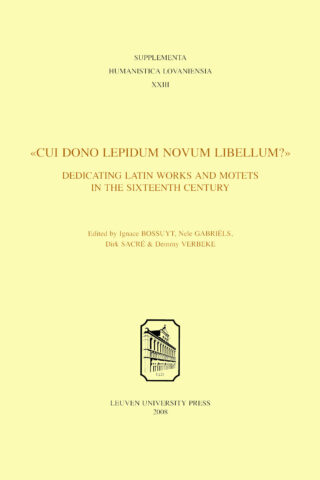
During the sixteenth century, the traditional act of dedicating a text took on a new meaning due to the wider dissemination of the printed book. As the dedication and other paratexts thus became an almost indispensable part of the publication, they merit careful examination by those who study the presentation and impact of any printed work in its context. Paratexts bridge the gap between the outside World of the reading public and the enclosed world of the book, and often present biographical information concerning the persons involved in the making of the book. In the present volume, general reflections as well as case studies in the field of paratexts to Latin works and to musical compositions on Latin texts consider and exemplify these as well as other aspects of paratexts. The multidisciplinary perspective further enriches the insight in form, function and nature of the dedicatory act in the sixteenth century. A synthesis of the nature of the sixteenth-century dedication is thus presented, relevant not only to Neo-Latinists and musicologists, but also to (book) historians, philologists, and others.
- Harm-Jan VAN DAM, “Vobis pagina nostra dedicatur”: Dedication in Classical Antiquity
- Karl ENENKEL, Reciprocal Authorisation: The Function of Dedications and Dedicatory Prefaces in the 15th and 16th Century ‘Artes antiquitatis’
- Demmy VERBEKE, “Ergo cape et canta sanctos quos fecimus hymnos”: Preliminaries in Sixteenth-Century Motet Editions by Composers from the Low Countries
- Nele GABRIà‹LS, Reading (Between) the Lines: What Dedications Can Tell Us
- Thomas SCHMIDT-BESTE, Dedicating Music Manuscripts: On Function and Form of Paratexts in Fifteenth- and Sixteenth-Century Sources
- Jan BLOEMENDAL, “To the Benevolent Reader …”: Dedications Attached to Editions of Neo-Latin Plays in the Netherlands of the 16th and 17th Century -; Forms, Functions and Religious Standpoints
- Victoria PANAGL, “Aequabit laudes nulla Camena tuas”: Poetry and Music in Latin Laudatory Motets
- Farkas Gábor KISS, Constructing the Image of a Humanist Scholar -; Latin Dedications in Hungary and the Use of Adages (1460- 1525)
- Walter Kurt KREYSZIG, Beyond the Music-Theoretical Discourse in Franchino Gaffurio’s Trilogy: The Significance of the Paratexts in Contemplating the Magic Triangle Between Author, Opus, and Audience
- Brigitte GAUVIN, “Accipe non noti praeclara uolumina mundi”: les dédicaces du De Orbe Nouo de Pierre Martyr d’Anghiera
- Paloma OTAOLA GONZàLEZ, Dédicaces et inscriptions latines dans les livres de musique pour vihuela (1536-1576)
- Jeanine DE LANDTSHEER, “Per patronos, non per merita gradus est emergendi”: Lipsius’s Careful Choice of patroni as a Way of Career Planning
- Emilie CORSWAREM, Les dédicaces latines des livres de motets de René del Mel (ca. 1554-ca. 1598)
- Peter S. POULOS, Dedication and Devotion in Simone Molinaro’s Motectorum quinis, et missae denis vocibus, liber primus (1597)
Frequently Asked Questions
What is "Cui dono lepidum novum libellum" about?
During the sixteenth century, the traditional act of dedicating a text took on a new meaning due to the wider dissemination of the printed book. As the dedication and other paratexts thus became an almost indispensable part of the publication, they merit careful examination by those who study the presentation and impact of any printed work in its context. Paratexts bridge the gap between the outside World of the reading public and the enclosed world of the book, and often present biographical information concerning the persons involved in the making of the book. In the present volume, general reflections as well as case studies in the field of paratexts to Latin works and to musical compositions on Latin texts consider and exemplify these as well as other aspects of paratexts. The multidisciplinary perspective further enriches the insight in form, function and nature of the dedicatory act in the sixteenth century. A synthesis of the nature of the sixteenth-century dedication is thus presented, relevant not only to Neo-Latinists and musicologists, but also to (book) historians, philologists, and others.
Who wrote "Cui dono lepidum novum libellum"?
"Cui dono lepidum novum libellum" was written by Ignace Bossuyt.
Ignace Bossuyt is emeritus gewoon hoogleraar van de Onderzoeksgroep Musicologie van de KU Leuven.
Who edited "Cui dono lepidum novum libellum"?
"Cui dono lepidum novum libellum" was edited by Nele Gabriëls, Demmy Verbeke and Dirk Sacré.
Nele Gabriëls is a Research Fellow at the Department of Musicology, KU Leuven, and collaborator of the Alamire Foundation.
Demmy Verbeke is hoofd van Artes, de bibliotheek die vooral het onderzoek en onderwijs aan de Faculteit Letteren van de KU Leuven ondersteunt.
Dirk Sacré is professor of Latin and Neo-Latin at KU Leuven.
Is "Cui dono lepidum novum libellum" part of a series?
Yes, "Cui dono lepidum novum libellum" is part of the "Supplementa Humanistica Lovaniensia" series. It's book 23 in the series.
The volumes published before 2000 are free available online.
What is the Table of Contents for "Cui dono lepidum novum libellum"?
- Harm-Jan VAN DAM, “Vobis pagina nostra dedicatur”: Dedication in Classical Antiquity
- Karl ENENKEL, Reciprocal Authorisation: The Function of Dedications and Dedicatory Prefaces in the 15th and 16th Century 'Artes antiquitatis'
- Demmy VERBEKE, “Ergo cape et canta sanctos quos fecimus hymnos”: Preliminaries in Sixteenth-Century Motet Editions by Composers from the Low Countries
- Nele GABRIà‹LS, Reading (Between) the Lines: What Dedications Can Tell Us
- Thomas SCHMIDT-BESTE, Dedicating Music Manuscripts: On Function and Form of Paratexts in Fifteenth- and Sixteenth-Century Sources
- Jan BLOEMENDAL, “To the Benevolent Reader …”: Dedications Attached to Editions of Neo-Latin Plays in the Netherlands of the 16th and 17th Century -; Forms, Functions and Religious Standpoints
- Victoria PANAGL, “Aequabit laudes nulla Camena tuas”: Poetry and Music in Latin Laudatory Motets
- Farkas Gábor KISS, Constructing the Image of a Humanist Scholar -; Latin Dedications in Hungary and the Use of Adages (1460- 1525)
- Walter Kurt KREYSZIG, Beyond the Music-Theoretical Discourse in Franchino Gaffurio's Trilogy: The Significance of the Paratexts in Contemplating the Magic Triangle Between Author, Opus, and Audience
- Brigitte GAUVIN, “Accipe non noti praeclara uolumina mundi”: les dédicaces du De Orbe Nouo de Pierre Martyr d'Anghiera
- Paloma OTAOLA GONZàLEZ, Dédicaces et inscriptions latines dans les livres de musique pour vihuela (1536-1576)
- Jeanine DE LANDTSHEER, “Per patronos, non per merita gradus est emergendi”: Lipsius's Careful Choice of patroni as a Way of Career Planning
- Emilie CORSWAREM, Les dédicaces latines des livres de motets de René del Mel (ca. 1554-ca. 1598)
- Peter S. POULOS, Dedication and Devotion in Simone Molinaro's Motectorum quinis, et missae denis vocibus, liber primus (1597)
What is the DOI for "Cui dono lepidum novum libellum"?
The Digital Object Identifier (DOI) for "Cui dono lepidum novum libellum" is 10.11116/9789461660541.
Related titles
 Justus Lipsius, Monita et exempla politica / Political Admonitions and Examples
Jan Papy (Editor), Toon Van Houdt (Editor), Marijke Janssens (Editor),
May 2022
 Studies in the Latin Literature and Epigraphy of Italian Fascism
Han Lamers (Editor), Bettina Reitz-Joosse (Editor), Valerio Sanzotta (Editor),
June 2020
 Una lingua morta per letterature vive: il dibattito sul latino come lingua letteraria in età moderna e contemporanea
Valerio Sanzotta (Editor),
January 2020
 John Milton, Epistolarum Familiarium Liber Unus and Uncollected Letters
Estelle Haan (Editor),
October 2019
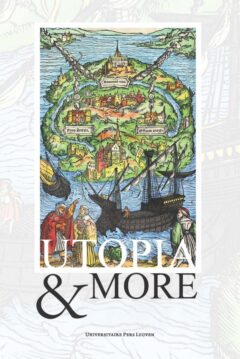 Utopia & More
Dirk Sacré (Editor), Erik De Bom (Editor), Demmy Verbeke (Editor), Gilbert Tournoy (Editor),
October 2016
 A New Sense of the Past: The Scholarship of Biondo Flavio (1392–1463)
Angelo Mazzocco (Editor), Marc Laureys (Editor),
May 2016
 Aulularia and other Inversions of Plautus
Michael Fontaine (), Joannes Burmeister (Author),
July 2015
 La correspondance de Guillaume Budé et Juan Luis Vives
Gilbert Tournoy (Editor), Monique Mund Dopchie (Editor),
June 2015
 Andreae Alciati Contra Vitam Monasticam Epistula – Andrea Alciato’s Letter Against Monastic Life
Dennis Drysdall (Author),
July 2014
 The Art of Arguing in the World of Renaissance Humanism
Marc Laureys (Editor), Roswitha Simons (Editor),
December 2013
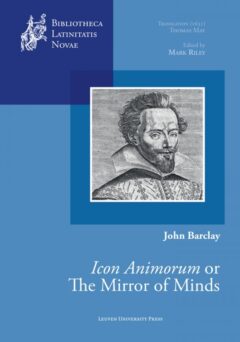 Icon Animorum or The Mirror of Minds
Mark Riley (Editor), John Barclay (Author), Thomas May (Translator),
November 2013
 Neo-Latin Commentaries and the Management of Knowledge in the Late Middle Ages and the Early Modern Period (1400 -1700)
Karl A.E. Enenkel (Editor), Henk Nellen (Editor),
July 2013
 De rationibus quibus homines docti artem Latine colloquendi et ex tempore dicendi saeculis XVI et XVII coluerunt
Terence Tunberg (Author),
March 2013
 The Early Modern Cultures of Neo-Latin Drama
Philip Ford (Editor), Andrew Taylor (Editor),
February 2013
 Scottish Latin Authors in Print up to 1700
Roger Green (Author), Philip Burton (Author), Deborah Ford (Author),
June 2012