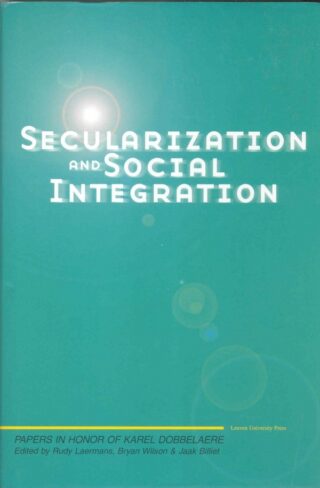
Secularization and Social Integration
Papers in honor of Karel Dobbelaere
Rudi Laermans (Author),
At the end of the 1997-1998 academic year, Professor Karel Dobbelaere was awarded emeritus status by the Catholic University of Leuven. For four decades, he contributed and gave shape to academic sociology in Flanders. During this period, he showed students how to find their way into general sociology and sociological research at the Catholic University of Leuven and the University of Antwerp. At the same time, he brought the sociology of religion in Flanders to maturity. With indefatigable dedication, he defended the autonomy and the necessity of a scientific, empirical study of churches, denominations, sects, and religious beliefs from a sociological perspective.
Karel Dobbelaere managed to reconcile harmoniously a permanent presence in Flemish sociology with an international scientific career. He enjoys great recognition within the world community of sociologists of religion and within its representative organization, the Société Internationale de Sociologie des Religions/International Society for the Sociology of Religion (SISR/ISSR). Particularly on the themes of pillarization and secularization, he did pioneering theoretical and empirical work. His often renewing insights have been expressed in several studies and numerous articles in scientific books and international journals.
Given that Karel Dobbelaere gained world-wide respect as a sociologist of religion, it seemed appropriate to honour him at the end of his academic career with an international Festschrift. Many of his colleagues and friends within the field of the sociology of religion contributed to this volume, whose title, Secularization and Social Integration, refers, of course, to one of the main themes in Dobbelaere’s work.
Introduction
Karel Dobbelaere, sociologist of religion
Rudi Laermans
Part I. Karel Dobbelaere and the secularization thesis
In appreciation of Karel Dobbelaere on secularization
Mark Chaves
Secularization disproved or displaced?
N.J. Demerath III
Secularization: Karel Dobbelaere and Japanese sociology
Yoshiya Abe
From the classics to Luhmann and back again? Notes on Karel Dobbelaere’s sociology of religion
Rudi Laermans
Part II. Religion and secularization: theoretical perspectives
Sociology and religion: Durkheim and Simmel
Roberto Cipriani
The secularization thesis: Criticisms and rebuttals
Bryan Wilson
Secularization in a religiogeneous modernity
Staf Hellemans
Sociological theory of religion between description and predication: A Weberian question revisited
Peter Beyer
Secularization and the unity of the R.C. Church
Leo Laeyendecker
Postscriptum: “That all may be one”. Explorations of Catholic unity on a global scale
Mady A. Thung
Part III. Secularization and social integration: case studies
Secularization and social solidarity: a social constructionist view
James A. Beckford
A few notes on secularization and pillarization: The case of Japan
Jan Swyngedouw
The Helmet and the Turban. Secularization in Islam
Enzo Pace
Contradictions of secularism and the preservations of the sacred. Four contexts of religious change in communism
Miklós Tomka
State imposed secularism: Yet another dimension?
Eileen Barker
The scope and limits of religious functions according to the European Value and IISP surveys
Yves Lambert
Social capital, religious-philosophical involvement and social integration in Belgium: An empirical investigation
Jaak Billiet
Part IV. Religion, identity and meaning
Religion as a resource for the creation of personal identity in a secularized context
Olivier Tschannen
Religion, individualization of meaning, and the social bond
Jean-Paul Willaime
The figure of the converted as descriptive figure of religious modernity: A reflection based on the file of conversions to Catholicism in France
Danièle Hervieu-Léger
Death and Christmas revisited. Beyond secularization: a search for meaning
Liliane Voyé
Marginals for a sociology of fear and trust
Jan Kerkhofs
Bibliography Karel Dobbelaere
Frequently Asked Questions
What is "Secularization and Social Integration" about?
At the end of the 1997-1998 academic year, Professor Karel Dobbelaere was awarded emeritus status by the Catholic University of Leuven. For four decades, he contributed and gave shape to academic sociology in Flanders. During this period, he showed students how to find their way into general sociology and sociological research at the Catholic University of Leuven and the University of Antwerp. At the same time, he brought the sociology of religion in Flanders to maturity. With indefatigable dedication, he defended the autonomy and the necessity of a scientific, empirical study of churches, denominations, sects, and religious beliefs from a sociological perspective.
Karel Dobbelaere managed to reconcile harmoniously a permanent presence in Flemish sociology with an international scientific career. He enjoys great recognition within the world community of sociologists of religion and within its representative organization, the Société Internationale de Sociologie des Religions/International Society for the Sociology of Religion (SISR/ISSR). Particularly on the themes of pillarization and secularization, he did pioneering theoretical and empirical work. His often renewing insights have been expressed in several studies and numerous articles in scientific books and international journals.
Given that Karel Dobbelaere gained world-wide respect as a sociologist of religion, it seemed appropriate to honour him at the end of his academic career with an international Festschrift. Many of his colleagues and friends within the field of the sociology of religion contributed to this volume, whose title, Secularization and Social Integration, refers, of course, to one of the main themes in Dobbelaere's work.
Who wrote "Secularization and Social Integration"?
"Secularization and Social Integration" was written by Rudi Laermans.
Rudi Laermans is als gewoon hoogleraar verbonden aan het Departement Sociologie van de K.U.Leuven, waar hij ook het Centrum voor Cultuursociologie leidt. Hij is co-promotor van het interuniversitaire steunpunt Re-Creatief Vlaanderen.
Is "Secularization and Social Integration" part of a series?
Yes, "Secularization and Social Integration" is part of the "Sociologie Vandaag / Sociology Today" series. It's book 4 in the series.
What is the Table of Contents for "Secularization and Social Integration"?
Introduction
Karel Dobbelaere, sociologist of religion
Rudi Laermans
Part I. Karel Dobbelaere and the secularization thesis
In appreciation of Karel Dobbelaere on secularization
Mark Chaves
Secularization disproved or displaced?
N.J. Demerath III
Secularization: Karel Dobbelaere and Japanese sociology
Yoshiya Abe
From the classics to Luhmann and back again? Notes on Karel Dobbelaere's sociology of religion
Rudi Laermans
Part II. Religion and secularization: theoretical perspectives
Sociology and religion: Durkheim and Simmel
Roberto Cipriani
The secularization thesis: Criticisms and rebuttals
Bryan Wilson
Secularization in a religiogeneous modernity
Staf Hellemans
Sociological theory of religion between description and predication: A Weberian question revisited
Peter Beyer
Secularization and the unity of the R.C. Church
Leo Laeyendecker
Postscriptum: "That all may be one". Explorations of Catholic unity on a global scale
Mady A. Thung
Part III. Secularization and social integration: case studies
Secularization and social solidarity: a social constructionist view
James A. Beckford
A few notes on secularization and pillarization: The case of Japan
Jan Swyngedouw
The Helmet and the Turban. Secularization in Islam
Enzo Pace
Contradictions of secularism and the preservations of the sacred. Four contexts of religious change in communism
Miklós Tomka
State imposed secularism: Yet another dimension?
Eileen Barker
The scope and limits of religious functions according to the European Value and IISP surveys
Yves Lambert
Social capital, religious-philosophical involvement and social integration in Belgium: An empirical investigation
Jaak Billiet
Part IV. Religion, identity and meaning
Religion as a resource for the creation of personal identity in a secularized context
Olivier Tschannen
Religion, individualization of meaning, and the social bond
Jean-Paul Willaime
The figure of the converted as descriptive figure of religious modernity: A reflection based on the file of conversions to Catholicism in France
Danièle Hervieu-Léger
Death and Christmas revisited. Beyond secularization: a search for meaning
Liliane Voyé
Marginals for a sociology of fear and trust
Jan Kerkhofs
Bibliography Karel Dobbelaere
Related titles


 The Romero Memory
Judith Gruber (Editor), Jonas Van Mulder (Editor), Stephan Parmentier (Editor), Veerle Draulans (Editor), Joren Janssens (Editor), Jacques Haers (Editor), Kim Christiaens (Editor),
November 2026
 Infrastructuring Arrival
Karel Arnaut (Editor), Luce Beeckmans (Editor), Bruno Meeus (Editor),
November 2026

 Feminists Resisting Gendered Violence
Hemangini Gupta (Editor), Fiona Mackay (Editor), Jan Breckenridge (Editor), Louise Chappell (Editor), Rachna Mehra (Editor), Rukmini Sen (Editor), Mailin Suchting (Editor),
October 2026
 German–Rapanui Entanglements
Cristián Moreno Pakarati (Editor), Diego Muñoz (Editor), Philipp Schorch (Editor),
August 2026

 Teaching About the Violent Past
Line Kuppens (Author), Justin Sheria Nfundiko (Author),
October 2025
 Integration Otherwise Inspiration Kit
Luce Beeckmans (Author), Dounia Salamé (Author), Martina Bovo (Author), Mary Hogan (Author),
June 2025
 Newcomers Navigating the Welfare State
Hanne Vandermeerschen (Editor), Elsa Mescoli (Editor), Jean-Michel Lafleur (Editor), Peter De Cuyper (Editor),
December 2023

 Islamophobia as a Form of Radicalisation
Leen d’Haenens (Editor), Abdelwahed Mekki-Berrada (Editor),
March 2023


 Exploring the Transnational Neighbourhood
Stephan Ehrig (Editor), Britta C. Jung (Editor), Gad Schaffer (Editor),
October 2022