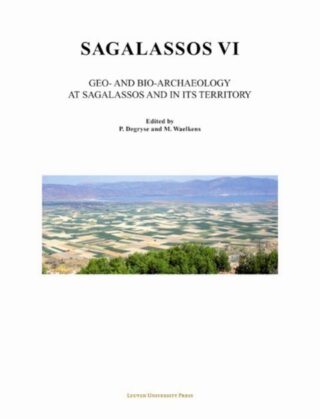
Since 1990, the ancient city of Sagalassos in southwestern Turkey has been the focus of an interdisciplinary archaeological research project coordinated by the Katholieke Universiteit Leuven. The papers collected in this volume reveal how the meticulous systematic and interdisciplinary reconstruction of the ecology and economy of the site and its territory has enhanced our understanding of the ancient settlement and its inhabitants beyond the traditional aspects of classical archaeology in Asia Minor. Highlighting geo-archaeological, archaeometrical, and bio-archaeological work performed within the framework of excavations and surveys between 1996 and 2006, this important book’s insights greatly enhance the promotion of real interdisciplinarity in classical archaeology.
PART I. THE GEOLOGICAL SETTING
- The geology of the area around the ancient city of Sagalassos
- Petrography, mineralogy and geochemistry of the rocks in the area of the archaeological site of Sagalassos
- Testing diagnostic geomorphological criteria of active normal faults in the Burdur-Isparta region (SW Turkey)
- Identifying active normal faults in the Burdur-Isparta region (SW Turkey): remote sensing, surface geology and near-surface geophysics
- An integrated neotectonic study of the à‡anakli basin (SW Turkey): remote sensing, surface geology and near-surface geophysics
PART II. THE GEOMORPHOLOGICAL SETTING
- Extracting archaeological features from very high resolution Quickbird-2 remote sensing imagery: A methodological approach based on the town of Sagalassos
- Tephra from the Minoan eruption of Santorini in the territory of Sagalassos
- Late Holocene sediment characteristics and sediment accumulation in the marsh of Gravgaz: Evidence for abrupt environmental changes
PART III. THE CLIMATIC SETTING
- Depositional environment of Holocene cool water travertines in the valley of BaÅŸköy
- Weathering of limestone in the historical buildings of Sagalassos
PART IV. EXPLOITATION OF LOCAL RESOURCES AND THE IMPORT OF SUBSISTENCE GOODS
- Clays for mass production of table and common wares, amphorae and architectural ceramics at Sagalassos
- Provenancing the slip of Sagalassos red slip ware
- The Sagalassos quarry landscape: bringing quarries in context
- Identifying remains of ancient food in the ceramics of Sagalassos: developing a method
- The 1997-1999 surveys of the Anatolian fish fauna and their relevance to the interpretation of trade at Sagalassos
Patrick Degryse
Patrick Degryse is Professor of Archaeometry at KU Leuven, studying the history and use of mineral resources in ancient technology.
Marc Waelkens
Marc Waelkens is Professor of Eastern Mediterranean Archaeology and director of the Sagalassos Archaeological Research Project and the Centre for Archaeological Sciences at KU Leuven.
This volume has much to recommend it. Copiously illustrated and clearly written the book has one great strength: Waelkens and Degryse as well as each individual author bridge the divide between raw scientific data and archaeological context, embedding tables, charts and figures right into the archaeological narrative, ultimately heightening our understanding of this unique Pisidian community.
Reviewed by Andrea U. De Giorgi, Case Western Reserve University, Bryn Mawr Classical Review 2010.12.03
Frequently Asked Questions
What is "Sagalassos VI" about?
Since 1990, the ancient city of Sagalassos in southwestern Turkey has been the focus of an interdisciplinary archaeological research project coordinated by the Katholieke Universiteit Leuven. The papers collected in this volume reveal how the meticulous systematic and interdisciplinary reconstruction of the ecology and economy of the site and its territory has enhanced our understanding of the ancient settlement and its inhabitants beyond the traditional aspects of classical archaeology in Asia Minor. Highlighting geo-archaeological, archaeometrical, and bio-archaeological work performed within the framework of excavations and surveys between 1996 and 2006, this important book's insights greatly enhance the promotion of real interdisciplinarity in classical archaeology.
Who edited "Sagalassos VI"?
"Sagalassos VI" was edited by Patrick Degryse and Marc Waelkens.
Patrick Degryse is Professor of Archaeometry at KU Leuven, studying the history and use of mineral resources in ancient technology.
Marc Waelkens is Professor of Eastern Mediterranean Archaeology and director of the Sagalassos Archaeological Research Project and the Centre for Archaeological Sciences at KU Leuven.
Is "Sagalassos VI" part of a series?
Yes, "Sagalassos VI" is part of the "Sagalassos" series.
What is the Table of Contents for "Sagalassos VI"?
PART I. THE GEOLOGICAL SETTING
- The geology of the area around the ancient city of Sagalassos
- Petrography, mineralogy and geochemistry of the rocks in the area of the archaeological site of Sagalassos
- Testing diagnostic geomorphological criteria of active normal faults in the Burdur-Isparta region (SW Turkey)
- Identifying active normal faults in the Burdur-Isparta region (SW Turkey): remote sensing, surface geology and near-surface geophysics
- An integrated neotectonic study of the à‡anakli basin (SW Turkey): remote sensing, surface geology and near-surface geophysics
PART II. THE GEOMORPHOLOGICAL SETTING
- Extracting archaeological features from very high resolution Quickbird-2 remote sensing imagery: A methodological approach based on the town of Sagalassos
- Tephra from the Minoan eruption of Santorini in the territory of Sagalassos
- Late Holocene sediment characteristics and sediment accumulation in the marsh of Gravgaz: Evidence for abrupt environmental changes
PART III. THE CLIMATIC SETTING
- Depositional environment of Holocene cool water travertines in the valley of BaÅŸköy
- Weathering of limestone in the historical buildings of Sagalassos
PART IV. EXPLOITATION OF LOCAL RESOURCES AND THE IMPORT OF SUBSISTENCE GOODS
- Clays for mass production of table and common wares, amphorae and architectural ceramics at Sagalassos
- Provenancing the slip of Sagalassos red slip ware
- The Sagalassos quarry landscape: bringing quarries in context
- Identifying remains of ancient food in the ceramics of Sagalassos: developing a method
- The 1997-1999 surveys of the Anatolian fish fauna and their relevance to the interpretation of trade at Sagalassos
Related titles
 German–Rapanui Entanglements
Cristián Moreno Pakarati (Editor), Diego Muñoz (Editor), Philipp Schorch (Editor),
August 2026

 Of Goblins and Gods
Andrew J. Shortland (Editor), Victoria Kemp (Editor), Lasse Hermansen Bjørnland (Editor), Patrick Degryse (Editor),
February 2026
 Modern Etruscans
Chiara Zampieri (Editor), Martina Piperno (Editor), Bart Van den Bossche (Editor),
October 2023
 The Elemental Analysis of Glass Beads
Laure Dussubieux (Editor), Heather Walder (Editor),
October 2022
 Mapping Landscapes in Transformation
Thomas Coomans (Editor), Bieke Cattoor (Editor), Krista De Jonge (Editor),
June 2019
 The Lower to Middle Palaeolithic Transition in Northwestern Europe
Ann Van Baelen (Author),
October 2017
 Minoan Earthquakes
Simon Jusseret (Editor), Manuel Sintubin (Editor), Jan Driessen (Preface by),
April 2017
 Handheld XRF for Art and Archaeology (paperback)
Aaron N. Shugar (Editor), Jennifer L. Mass (Editor),
November 2013
 Handheld XRF for Art and Archaeology
Aaron N. Shugar (Editor), Jennifer L. Mass (Editor),
March 2013
 Chert Quarrying, Lithic Technology, and a Modern Human Burial at the Palaeolithic Site of Taramsa 1, Upper Egypt
Philip Van Peer (Author), Pierre M. Vermeersch (Author), Etienne Paulissen (Author),
April 2010
 Isotopes in Vitreous Materials
Patrick Degryse (Editor), Julian Henderson (Editor), Greg Hodgins (Editor),
March 2013
 Etude anthropologique du squelette du Paléolithique supérieur de Nazlet Khater 2 (Egypte)
Isabelle Crevecoeur (Author),
December 2008
 A Holocene Prehistoric Sequence in the Egyptian Red Sea Area: The Tree Shelter
Pierre M. Vermeersch (Editor),
July 2008