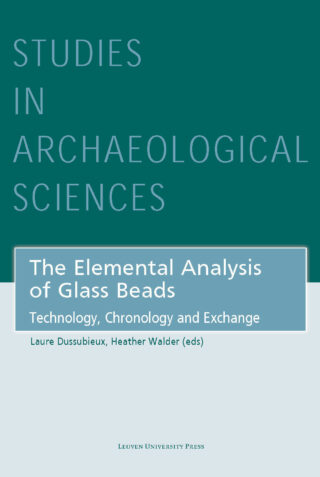

The Elemental Analysis of Glass Beads
Technology, Chronology and Exchange
Laure Dussubieux (Editor), Heather Walder (Editor),

Series: Studies in Archaeological Sciences 8
Category: Archaeology
Language: English
ISBN: 9789462703384
Publication date: October 13, 2022
€80.00 (including 6% VAT)
Buy NowNumber of pages: 392
Size: 234 x 156 x 25 mm
Number of illustrations: 116
Illustrations and other content description:
full colour

Funded by: KU Leuven Fund for Fair Open Access
Stock item: 149901
Standard delivery time for print books:
For Belgium: 5 to 8 working days
For EU: 2 to 3 weeks
For other countries: 4 to 5 weeks
Series: Studies in Archaeological Sciences 8
Category: Archaeology
Language: English
ISBN: 9789461664662
Publication date: October 17, 2022
Download Free EpubNumber of pages: 392
Number of illustrations: 116
Illustrations and other content description:
full colour
Funded by: KU Leuven Fund for Fair Open Access
Series: Studies in Archaeological Sciences 8
Category: Archaeology
Language: English
ISBN: 9789461664655
Publication date: October 10, 2022
Download Free PDFNumber of pages: 392
Number of illustrations: 116
Illustrations and other content description:
full colour
Funded by: KU Leuven Fund for Fair Open Access
Ancient glass beads as a window to the ancient world
Glass beads, both beautiful and portable, have been produced and traded globally for thousands of years. Modern archaeologists study these artifacts through sophisticated methods that analyze the glass composition, a process which can be utilized to trace bead usage through time and across regions. This book publishes open-access compositional data obtained from laser ablation – inductively coupled plasma – mass spectrometry, from a single analytical laboratory, providing a uniquely comparative data set. The geographic range includes studies of beads produced in Europe and traded widely across North America and beads from South and Southeast Asia traded around the Indian Ocean and beyond. The contributors provide new insight on the timing of interregional interactions, technologies of bead production and patterns of trade and exchange, using glass beads as a window to the past.
This volume will be a key reference for glass researchers, archaeologists, and any scholars interested in material culture and exchange; it provides a wide range of case studies in the investigation and interpretation of glass bead composition, production and exchange since ancient times.
Contributors: Bernard Gratuze (Institut de Recherche sur les ArchéoMATériaux, Centre Ernest-Babelon, UMR 5060 CNRS/Université d’Orléans), Alicia L. Hawkins (University of Toronto Mississauga), Elliot H. Blair (University of Alabama), Jessica Dalton-Carriger (Roane State Community College), Lee M. Panich (Santa Clara University), Thomas R. Fenn (The University of Oklahoma), Alison K. Carter (University of Oregon), Jennifer Craig (McGill University), Mark Aldenderfer (University of California, Merced), Mudit Trivedi (Stanford University), Lindsey Trombetta (The University of Texas at Austin), Jonathan R. Walz (The Field Museum / SIT-Graduate Institute), Akshay Sarathi (Florida Atlantic University), Carla Klehm (University of Arkansas), Marilee Wood (University of the Witwatersrand), Katherine A. Larson (Corning Museum of Glass), Heather Walder (The Field Museum / University of Wisconsin – La Crosse), Laure Dussubieux (The Field Museum)
Supplementary Material ‘The Elemental Analysis of Glass Beads’ >
Ebook available in Open Access.
This publication is GPRC-labeled (Guaranteed Peer-Reviewed Content).
List of Illustrations List of Tables Foreword
Chapter 1 Contextualizing this volume in the field of glass bead studies Laure Dussubieux and Heather Walder
Chapter 2 Glass beads and human pasts Alison Carter, Elliot H. Blair, Carla Klehm and Lee M. Panich
Part I: European Trade BeadsChapter 3 Characterizing glass recipes for distinctive polychrome glass bead types in Ontario, Canada Alicia Hawkins and Heather Walder
Chapter 4 Simple blue (IIa40) beads from 17th century Mission Santa Catalina de Guale: Dating, origins, and elemental composition Elliot H. Blair and Laure Dussubieux
Chapter 5 Glass trade bead analysis at Upper Hampton Farm (40RH41): A case study for 17th and 18th century Non-Cherokee habitation in East Tennessee Valley Jessica Dalton-Carriger and Elliot H. Blair
Chapter 6 Compositional analysis of compound drawn white glass beads from colonial California: Implications for chronology and dispersal Lee M. Panich, Laure Dussubieux, Tsim D. Schneider, Christopher Canzonieri, Irenne Zwierlein, Christopher Zimmer and Michelle Zimmer
Chapter 7 Glass beads and evidence for early “pre-contact” trade in Northwestern Alaska 137 Thomas R. Fenn, Laure Dussubieux, Heather Walder and Douglas D. Anderson
Part II: Glass Beads in South and Southeast Asia
Chapter 8 The exchange of beads in Central Thailand in the protohistoric period: Glass objects from Phromthin Tai Alison Carter, Laure Dussubieux, Thomas R. Fenn, Thanik Lertcharnrit and T.O. Pryce
Chapter 9 Shifting patterns of glass bead cargo of 15th – 17th century Philippines shipwrecks Jennifer Craig and Laure Dussubieux
Chapter 10 Sources of glass beads from the High Himalayas: 1200 BCE-CE 650 Mark Aldenderfer and Laure Dussubieux
Chapter 11 Inland from the sea: Rethinking the value of mineral soda alumina drawn glass beads from medieval North India Mudit Trivedi and Laure Dussubieux
Part III: Glass Beads in Africa and Western Indian Ocean
Chapter 12 Beads from the lowlands of Northwestern Ethiopia Lindsey Trombetta, Laure Dussubieux, Agazi Negash, Daniel Dalmas, Metasebia Endalamaw, Mulugeta Feseha, Lawrence Todd and John Kappelman
Chapter 13 Inland glass beads in Northeast Tanzania, 8th-17th centuries CE Jonathan R. Walz and Laure Dussubieux
Chapter 14 Glass beads at Unguja Ukuu in the late 1st millennium CE: Results of the 2018 excavation in Zanzibar Akshay Sarathi, Jonathan R. Walz and Laure Dussubieux
Chapter 15 Chemical analysis of precolonial Indian Ocean glass beads found in the southern African interior: linking global objects to local and regional change Carla Klehm and Laure Dussubieux
Chapter 16 Morphology and elemental composition: provenancing glass beads from 12th – 13th century Mayotte 323 Marilee Wood, Laure Dussubieux, Mudit Trivedi and Martial Pauly
Part IV: Glass Beads in the Middle-East
Chapter 17 Elemental composition of glass beads from the eastern Mediterranean region: Chronology and provenance of material from Tel Anafa, Israel Katherine A. Larson and Laure Dussubieux
Chapter 18 South Asian beads at the site of Kish, Iraq Laure Dussubieux
Chapter 19 Technology, chronology, and exchange examined through glass beads Heather Walder and Laure Dussubieux
AppendixSupplementary Materials >
Frequently Asked Questions
What is "The Elemental Analysis of Glass Beads" about?
Ancient glass beads as a window to the ancient world
Glass beads, both beautiful and portable, have been produced and traded globally for thousands of years. Modern archaeologists study these artifacts through sophisticated methods that analyze the glass composition, a process which can be utilized to trace bead usage through time and across regions. This book publishes open-access compositional data obtained from laser ablation – inductively coupled plasma – mass spectrometry, from a single analytical laboratory, providing a uniquely comparative data set. The geographic range includes studies of beads produced in Europe and traded widely across North America and beads from South and Southeast Asia traded around the Indian Ocean and beyond. The contributors provide new insight on the timing of interregional interactions, technologies of bead production and patterns of trade and exchange, using glass beads as a window to the past.
This volume will be a key reference for glass researchers, archaeologists, and any scholars interested in material culture and exchange; it provides a wide range of case studies in the investigation and interpretation of glass bead composition, production and exchange since ancient times.
Contributors: Bernard Gratuze (Institut de Recherche sur les ArchéoMATériaux, Centre Ernest-Babelon, UMR 5060 CNRS/Université d'Orléans), Alicia L. Hawkins (University of Toronto Mississauga), Elliot H. Blair (University of Alabama), Jessica Dalton-Carriger (Roane State Community College), Lee M. Panich (Santa Clara University), Thomas R. Fenn (The University of Oklahoma), Alison K. Carter (University of Oregon), Jennifer Craig (McGill University), Mark Aldenderfer (University of California, Merced), Mudit Trivedi (Stanford University), Lindsey Trombetta (The University of Texas at Austin), Jonathan R. Walz (The Field Museum / SIT-Graduate Institute), Akshay Sarathi (Florida Atlantic University), Carla Klehm (University of Arkansas), Marilee Wood (University of the Witwatersrand), Katherine A. Larson (Corning Museum of Glass), Heather Walder (The Field Museum / University of Wisconsin – La Crosse), Laure Dussubieux (The Field Museum)
Supplementary Material 'The Elemental Analysis of Glass Beads' >
Ebook available in Open Access.
This publication is GPRC-labeled (Guaranteed Peer-Reviewed Content).
Who edited "The Elemental Analysis of Glass Beads"?
"The Elemental Analysis of Glass Beads" was edited by Laure Dussubieux and Heather Walder.
Laure Dussubieux is a senior research scientist and manages the Elemental Analysis Facility of The Field Museum in Chicago.
Heather Walder is a research associate of The Field Museum and an assistant teaching professor at the University of Wisconsin – La Crosse. She co-directs Gete Anishinaabeg Izhichigewin, a community-based Indigenous archaeology project in Red Cliff, Wisconsin.
Is "The Elemental Analysis of Glass Beads" part of a series?
Yes, "The Elemental Analysis of Glass Beads" is part of the "Studies in Archaeological Sciences" series. It's book 8 in the series.
Studies in Archaeological Sciences presents state-of-the-art methodological, technical or material science contributions to Archaeological Sciences. The series aims to reconstruct the integrated story of human and material culture through time and testifies to the necessity of inter- and multidisciplinary research in cultural heritage studies. Studies in Archaeological Sciences aims to publish at least one volume a year and accepts monographs as well as coherent edited volumes in English. Contributions should be set up to be a specialist reference work for a broad audience of academic readers. Manuscript should be 80.000 to 120.000 words in length and may include graphs and tables in black and white. All contributions are submitted to international peer review.

Readership
Researchers and graduate students in fields such as Archaeology, Archaeological Sciences, History, Conservation and Cultural Heritage Studies and Museum Sciences.
Editor-in-Chief
Prof. Patrick Degryse, Centre for Archaeological Sciences, KU Leuven, Belgium
Editorial Board
Prof. Dennis Braeckmans, Department of Archaeological Sciences, Universiteit Leiden, The Netherlands
Prof. Ian Freestone, Institute of Archaeology, University College London, United Kingdom
Dr. Andrew Meek, Department of Scientific Research, The British Museum
Dr. Andrew Shortland, Centre for Archaeological and Forensic Analysis, Cranfield University, United Kingdom
Prof. Manuel Sintubin, Department of Earth & Environmental Sciences, KU Leuven, Belgium
Invitation to future Advisory Board members
Scholars interested to join the Advisory Board of this new series are cordially invited to contact Prof. Patrick Degryse (Editor-in-Chief) or one of the editorial board members.
Proposals
Proposals and inquiries can be sent to to editor-in- chief Patrick Degryse or one of the editorial board members. Please send a preliminary abstract (1-2 pp.) and a short bio. Upon approval of this abstract (average turnaround time of 4 weeks), the full manuscript will be submitted to international peer review. Two peer reviewers will be asked for expert advice, three in case of conflicting reports.
Please make use of the submission form to present your manuscript or proposal to our board.
Authors interested in Open Access can consult the available funding options.
Links & Resources
Is "The Elemental Analysis of Glass Beads" available Open Access?
Yes, "The Elemental Analysis of Glass Beads" is published Open Access. It is available under a BY-NC-ND license.
Who funded the publication of "The Elemental Analysis of Glass Beads"?
Publication of "The Elemental Analysis of Glass Beads" was funded by KU Leuven Fund for Fair Open Access
.
What is the Table of Contents for "The Elemental Analysis of Glass Beads"?
List of Illustrations List of Tables Foreword
Chapter 1 Contextualizing this volume in the field of glass bead studies Laure Dussubieux and Heather Walder
Chapter 2 Glass beads and human pasts Alison Carter, Elliot H. Blair, Carla Klehm and Lee M. Panich
Part I: European Trade BeadsChapter 3 Characterizing glass recipes for distinctive polychrome glass bead types in Ontario, Canada Alicia Hawkins and Heather Walder
Chapter 4 Simple blue (IIa40) beads from 17th century Mission Santa Catalina de Guale: Dating, origins, and elemental composition Elliot H. Blair and Laure Dussubieux
Chapter 5 Glass trade bead analysis at Upper Hampton Farm (40RH41): A case study for 17th and 18th century Non-Cherokee habitation in East Tennessee Valley Jessica Dalton-Carriger and Elliot H. Blair
Chapter 6 Compositional analysis of compound drawn white glass beads from colonial California: Implications for chronology and dispersal Lee M. Panich, Laure Dussubieux, Tsim D. Schneider, Christopher Canzonieri, Irenne Zwierlein, Christopher Zimmer and Michelle Zimmer
Chapter 7 Glass beads and evidence for early “pre-contact” trade in Northwestern Alaska 137 Thomas R. Fenn, Laure Dussubieux, Heather Walder and Douglas D. Anderson
Part II: Glass Beads in South and Southeast Asia
Chapter 8 The exchange of beads in Central Thailand in the protohistoric period: Glass objects from Phromthin Tai Alison Carter, Laure Dussubieux, Thomas R. Fenn, Thanik Lertcharnrit and T.O. Pryce
Chapter 9 Shifting patterns of glass bead cargo of 15th – 17th century Philippines shipwrecks Jennifer Craig and Laure Dussubieux
Chapter 10 Sources of glass beads from the High Himalayas: 1200 BCE-CE 650 Mark Aldenderfer and Laure Dussubieux
Chapter 11 Inland from the sea: Rethinking the value of mineral soda alumina drawn glass beads from medieval North India Mudit Trivedi and Laure Dussubieux
Part III: Glass Beads in Africa and Western Indian Ocean
Chapter 12 Beads from the lowlands of Northwestern Ethiopia Lindsey Trombetta, Laure Dussubieux, Agazi Negash, Daniel Dalmas, Metasebia Endalamaw, Mulugeta Feseha, Lawrence Todd and John Kappelman
Chapter 13 Inland glass beads in Northeast Tanzania, 8th-17th centuries CE Jonathan R. Walz and Laure Dussubieux
Chapter 14 Glass beads at Unguja Ukuu in the late 1st millennium CE: Results of the 2018 excavation in Zanzibar Akshay Sarathi, Jonathan R. Walz and Laure Dussubieux
Chapter 15 Chemical analysis of precolonial Indian Ocean glass beads found in the southern African interior: linking global objects to local and regional change Carla Klehm and Laure Dussubieux
Chapter 16 Morphology and elemental composition: provenancing glass beads from 12th – 13th century Mayotte 323 Marilee Wood, Laure Dussubieux, Mudit Trivedi and Martial Pauly
Part IV: Glass Beads in the Middle-East
Chapter 17 Elemental composition of glass beads from the eastern Mediterranean region: Chronology and provenance of material from Tel Anafa, Israel Katherine A. Larson and Laure Dussubieux
Chapter 18 South Asian beads at the site of Kish, Iraq Laure Dussubieux
Chapter 19 Technology, chronology, and exchange examined through glass beads Heather Walder and Laure Dussubieux
AppendixSupplementary Materials >
What is the DOI for "The Elemental Analysis of Glass Beads"?
The Digital Object Identifier (DOI) for "The Elemental Analysis of Glass Beads" is 10.11116/9789461664655.
Related titles
 German–Rapanui Entanglements
Cristián Moreno Pakarati (Editor), Diego Muñoz (Editor), Philipp Schorch (Editor),
August 2026
 Of Goblins and Gods
Andrew J. Shortland (Editor), Victoria Kemp (Editor), Lasse Hermansen Bjørnland (Editor), Patrick Degryse (Editor),
February 2026
 Modern Etruscans
Chiara Zampieri (Editor), Martina Piperno (Editor), Bart Van den Bossche (Editor),
October 2023
 Mapping Landscapes in Transformation
Thomas Coomans (Editor), Bieke Cattoor (Editor), Krista De Jonge (Editor),
June 2019
 The Lower to Middle Palaeolithic Transition in Northwestern Europe
Ann Van Baelen (Author),
October 2017
 Minoan Earthquakes
Simon Jusseret (Editor), Manuel Sintubin (Editor), Jan Driessen (Preface by),
April 2017
 Handheld XRF for Art and Archaeology (paperback)
Aaron N. Shugar (Editor), Jennifer L. Mass (Editor),
November 2013
 Handheld XRF for Art and Archaeology
Aaron N. Shugar (Editor), Jennifer L. Mass (Editor),
March 2013
 Chert Quarrying, Lithic Technology, and a Modern Human Burial at the Palaeolithic Site of Taramsa 1, Upper Egypt
Philip Van Peer (Author), Pierre M. Vermeersch (Author), Etienne Paulissen (Author),
April 2010
 Isotopes in Vitreous Materials
Patrick Degryse (Editor), Julian Henderson (Editor), Greg Hodgins (Editor),
March 2013
 Etude anthropologique du squelette du Paléolithique supérieur de Nazlet Khater 2 (Egypte)
Isabelle Crevecoeur (Author),
December 2008
 A Holocene Prehistoric Sequence in the Egyptian Red Sea Area: The Tree Shelter
Pierre M. Vermeersch (Editor),
July 2008