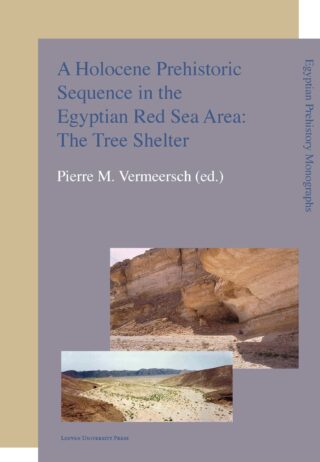
A Holocene Prehistoric Sequence in the Egyptian Red Sea Area: The Tree Shelter
Pierre M. Vermeersch (Editor),
The prehistory of the Eastern Desert of Egypt is not well understood. A Holocene Prehistoric Sequence in the Egyptian Red Sea Area: The Tree Shelter is an important contribution to our knowledge of the Epi-Palaeolithic, Neolithic and Predynastic occupation of the area. It presents the results of an excavation of a small rock shelter near Quseir, Egypt, which is one of the rare stratified sites in the Eastern Egyptian desert. The stratigraphic sequence starts around 8000 bp and continues until about 5000 bp. The archaeological material attests clear connections with the Nile Valley and the Western Desert during the wet Holocene period. Topics covered in the book include the site’s lithics and ceramics, microwear analysis of the lithic artefacts, and the woody vegetation of the Neolithic period.
1. FIELD WORK
1.1 Research history
1.2 Physical environmental context
1.3 Stratigraphy
1.4 Raw material
1.5 Archaeological stratigraphy
1.6 Charcoal and 1C dating
2. MICROWEAR ANALYSIS OF SOME ARTEFACTS FROM ARCHAEOLOGICAL HORIZON 5
2.1 Microwear Experimentation and Observation
2.2 Observation results
2.3 Comparison with contemporaneous Elkabian tools
2.4 Conclusion
3. WOODY VEGETATION AND ITS USE DURING THE NEOLITHIC AT THE TREE SHELTER
3.1 Methods and materials
3.2 Results
3.3 Reconstruction of the vegetation based on the wood charcoal assemblages
3.4 What can wood charcoal assemblages say about the palaeoenvironmental conditions?
3.5 Palaeoeconomic implications of the boanical materials studied from the site
3.3 Conclusion
4. FAUNAL REMAINS FROM THE TREE SHELTER
4.1 The Elkabian (AH5) – hunting and gathering
4.2 The Neolithic (AH2 and AH3) and the younger period (AH1) – early African small liverstock
5. DISCUSSION AND CONCLUSION
5.1 The timing of depositional and erosional events
5.2 The palaeoenvironmental context of the Tree shelter
5.3 Local and regional comparison
5.4 General conclusion
6. REFERENCES
All in all, this is a very solid piece of work and useful to anyone with an interest in Egyptian Prehistory. It also fleshes out the history of the Eastern Desert, and links it to the Nile Valley as well as the Western Desert, filling in holes in the mosaic of Egypt's early history.
PalArch's Journal of Archaeology of Egypt/Egyptology, 6(3) (2009)
The synthetic discussions in this book provide ample information on the current research issues in this area, making this volume valuable not only to specialists in this area but also to a wider range of prehistorians.
The Holocene 20,2 (2010)
All in all, this is a very solid piece of work and useful to anyone with an interest in Egyptian Prehistory. It also fleshes out the history of the Eastern Desert, and links it to the Nile Valley as well as the Western Desert, filling in holes in the mosaic of Egypt's early history.
PalArch's Journal of Archaeology of Egypt/Egyptology, 6(3) (2009)
The synthetic discussions in this book provide ample information on the current research issues in this area, making this volume valuable not only to specialists in this area but also to a wider range of prehistorians.
The Holocene 20,2 (2010)
Frequently Asked Questions
What is "A Holocene Prehistoric Sequence in the Egyptian Red Sea Area: The Tree Shelter" about?
The prehistory of the Eastern Desert of Egypt is not well understood. A Holocene Prehistoric Sequence in the Egyptian Red Sea Area: The Tree Shelter is an important contribution to our knowledge of the Epi-Palaeolithic, Neolithic and Predynastic occupation of the area. It presents the results of an excavation of a small rock shelter near Quseir, Egypt, which is one of the rare stratified sites in the Eastern Egyptian desert. The stratigraphic sequence starts around 8000 bp and continues until about 5000 bp. The archaeological material attests clear connections with the Nile Valley and the Western Desert during the wet Holocene period. Topics covered in the book include the site’s lithics and ceramics, microwear analysis of the lithic artefacts, and the woody vegetation of the Neolithic period.
Who edited "A Holocene Prehistoric Sequence in the Egyptian Red Sea Area: The Tree Shelter"?
"A Holocene Prehistoric Sequence in the Egyptian Red Sea Area: The Tree Shelter" was edited by Pierre M. Vermeersch.
Pierre Vermeersch is Professor of Prehistory at KU Leuven.
Is "A Holocene Prehistoric Sequence in the Egyptian Red Sea Area: The Tree Shelter" part of a series?
Yes, "A Holocene Prehistoric Sequence in the Egyptian Red Sea Area: The Tree Shelter" is part of the "Egyptian Prehistory Monographs" series. It's book 7 in the series.
What is the Table of Contents for "A Holocene Prehistoric Sequence in the Egyptian Red Sea Area: The Tree Shelter"?
1. FIELD WORK
1.1 Research history
1.2 Physical environmental context
1.3 Stratigraphy
1.4 Raw material
1.5 Archaeological stratigraphy
1.6 Charcoal and 1C dating
2. MICROWEAR ANALYSIS OF SOME ARTEFACTS FROM ARCHAEOLOGICAL HORIZON 5
2.1 Microwear Experimentation and Observation
2.2 Observation results
2.3 Comparison with contemporaneous Elkabian tools
2.4 Conclusion
3. WOODY VEGETATION AND ITS USE DURING THE NEOLITHIC AT THE TREE SHELTER
3.1 Methods and materials
3.2 Results
3.3 Reconstruction of the vegetation based on the wood charcoal assemblages
3.4 What can wood charcoal assemblages say about the palaeoenvironmental conditions?
3.5 Palaeoeconomic implications of the boanical materials studied from the site
3.3 Conclusion
4. FAUNAL REMAINS FROM THE TREE SHELTER
4.1 The Elkabian (AH5) - hunting and gathering
4.2 The Neolithic (AH2 and AH3) and the younger period (AH1) - early African small liverstock
5. DISCUSSION AND CONCLUSION
5.1 The timing of depositional and erosional events
5.2 The palaeoenvironmental context of the Tree shelter
5.3 Local and regional comparison
5.4 General conclusion
6. REFERENCES
Related titles
 German–Rapanui Entanglements
Cristián Moreno Pakarati (Editor), Diego Muñoz (Editor), Philipp Schorch (Editor),
August 2026

 Of Goblins and Gods
Andrew J. Shortland (Editor), Victoria Kemp (Editor), Lasse Hermansen Bjørnland (Editor), Patrick Degryse (Editor),
February 2026
 Modern Etruscans
Chiara Zampieri (Editor), Martina Piperno (Editor), Bart Van den Bossche (Editor),
October 2023
 The Elemental Analysis of Glass Beads
Laure Dussubieux (Editor), Heather Walder (Editor),
October 2022

 Mapping Landscapes in Transformation
Thomas Coomans (Editor), Bieke Cattoor (Editor), Krista De Jonge (Editor),
June 2019
 The Lower to Middle Palaeolithic Transition in Northwestern Europe
Ann Van Baelen (Author),
October 2017
 Minoan Earthquakes
Simon Jusseret (Editor), Manuel Sintubin (Editor), Jan Driessen (Preface by),
April 2017
 Handheld XRF for Art and Archaeology (paperback)
Aaron N. Shugar (Editor), Jennifer L. Mass (Editor),
November 2013

 Handheld XRF for Art and Archaeology
Aaron N. Shugar (Editor), Jennifer L. Mass (Editor),
March 2013
 Chert Quarrying, Lithic Technology, and a Modern Human Burial at the Palaeolithic Site of Taramsa 1, Upper Egypt
Philip Van Peer (Author), Pierre M. Vermeersch (Author), Etienne Paulissen (Author),
April 2010
 Isotopes in Vitreous Materials
Patrick Degryse (Editor), Julian Henderson (Editor), Greg Hodgins (Editor),
March 2013
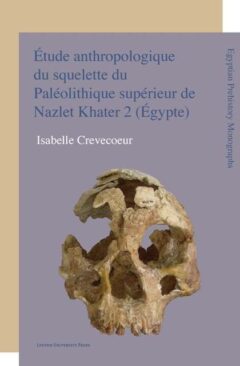 Etude anthropologique du squelette du Paléolithique supérieur de Nazlet Khater 2 (Egypte)
Isabelle Crevecoeur (Author),
December 2008