

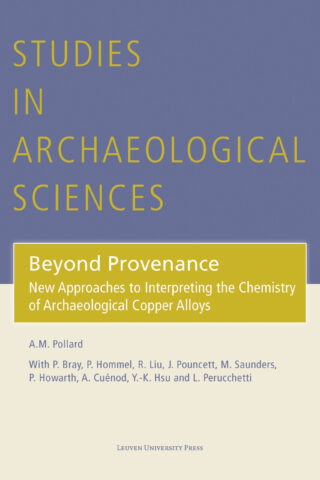

Beyond Provenance
New Approaches to Interpreting the Chemistry of Archaeological Copper Alloys
Mark Pollard (Editor),

Series: Studies in Archaeological Sciences 6
Category: Archaeology, Science, Engineering and Technology
Language: English
ISBN: 9789462701625
Publication date: December 4, 2018
€41.50 (including 6% VAT)
Buy NowNumber of pages: 234
Size: 234 x 156 x 17 mm
Number of illustrations: 90
Illustrations and other content description:
full colour

Stock item: 125486
Standard delivery time for print books:
For Belgium: 5 to 8 working days
For EU: 2 to 3 weeks
For other countries: 4 to 5 weeks
Series: Studies in Archaeological Sciences 6
Category: Archaeology, Science, Engineering and Technology
Language: English
ISBN: 9789461662668
Publication date: November 20, 2018
Download Free PDFNumber of pages: 234
Number of illustrations: 90
Illustrations and other content description:
full colour
Human intentionality in chemical patterns in Bronze Age metals
For the last 180 years, scientists have been attempting to determine the ‘provenance’ (geological source) of the copper used in Bronze Age artefacts. However, despite advances in analytical technologies, the theoretical approach has remained virtually unchanged over this period, with the interpretative methodology only changing to accommodate the increasing capacity of computers. This book represents a concerted effort to think about the composition of Bronze Age metal as the product of human intentionality as well as of geology. It considers the trace element composition of the metal, the alloying elements, and the lead isotopic composition, showing how a combination of these aspects, along with archaeological context and typology, can reveal much more about the life history of such artefacts, expanding considerably upon the rather limited ambition of knowing where the ore was extracted.
Beyond Provenance serves as a ‘how-to handbook’ for those wishing to look for evidence of human intentionality in the chemical patterning observed in bronzes.
Ebook available in Open Access.
This publication is GPRC-labeled (Guaranteed Peer-Reviewed Content).
Table of Contents
Chapter 1Previous Approaches to the Chemistry and Provenance of Archaeological Copper Alloys
Chapter 2Developing a New Interpretative Framework
Chapter 3Legacy Datasets and Chemical Data Quality
Chapter 4Trace Elements and ‘Copper Groups’
Chapter 5Alloying Elements and ‘Alloy Types’
Chapter 6Lead Isotope Data from Archaeological Copper Alloys
Chapter 7The FLAME GIS-Database
Chapter 8Summary: Beyond Provenance?
References
Bibliography of Sources of Chemical and Isotopic Data Used in the FLAME Database
Index
Frequently Asked Questions
What is "Beyond Provenance" about?
Human intentionality in chemical patterns in Bronze Age metals
For the last 180 years, scientists have been attempting to determine the ‘provenance’ (geological source) of the copper used in Bronze Age artefacts. However, despite advances in analytical technologies, the theoretical approach has remained virtually unchanged over this period, with the interpretative methodology only changing to accommodate the increasing capacity of computers. This book represents a concerted effort to think about the composition of Bronze Age metal as the product of human intentionality as well as of geology. It considers the trace element composition of the metal, the alloying elements, and the lead isotopic composition, showing how a combination of these aspects, along with archaeological context and typology, can reveal much more about the life history of such artefacts, expanding considerably upon the rather limited ambition of knowing where the ore was extracted.
Beyond Provenance serves as a ‘how-to handbook’ for those wishing to look for evidence of human intentionality in the chemical patterning observed in bronzes.
Ebook available in Open Access.
This publication is GPRC-labeled (Guaranteed Peer-Reviewed Content).
Who edited "Beyond Provenance"?
"Beyond Provenance" was edited by Mark Pollard.
Mark Pollard is Edward Hall Professor of Archaeological Science at the Research Laboratory for Archaeology, School of Archaeology, University of Oxford, and PI on the ERC Advanced Grant ‘FLAME’.
Is "Beyond Provenance" part of a series?
Yes, "Beyond Provenance" is part of the "Studies in Archaeological Sciences" series. It's book 6 in the series.
Studies in Archaeological Sciences presents state-of-the-art methodological, technical or material science contributions to Archaeological Sciences. The series aims to reconstruct the integrated story of human and material culture through time and testifies to the necessity of inter- and multidisciplinary research in cultural heritage studies. Studies in Archaeological Sciences aims to publish at least one volume a year and accepts monographs as well as coherent edited volumes in English. Contributions should be set up to be a specialist reference work for a broad audience of academic readers. Manuscript should be 80.000 to 120.000 words in length and may include graphs and tables in black and white. All contributions are submitted to international peer review.

Readership
Researchers and graduate students in fields such as Archaeology, Archaeological Sciences, History, Conservation and Cultural Heritage Studies and Museum Sciences.
Editor-in-Chief
Prof. Patrick Degryse, Centre for Archaeological Sciences, KU Leuven, Belgium
Editorial Board
Prof. Dennis Braeckmans, Department of Archaeological Sciences, Universiteit Leiden, The Netherlands
Prof. Ian Freestone, Institute of Archaeology, University College London, United Kingdom
Dr. Andrew Meek, Department of Scientific Research, The British Museum
Dr. Andrew Shortland, Centre for Archaeological and Forensic Analysis, Cranfield University, United Kingdom
Prof. Manuel Sintubin, Department of Earth & Environmental Sciences, KU Leuven, Belgium
Invitation to future Advisory Board members
Scholars interested to join the Advisory Board of this new series are cordially invited to contact Prof. Patrick Degryse (Editor-in-Chief) or one of the editorial board members.
Proposals
Proposals and inquiries can be sent to to editor-in- chief Patrick Degryse or one of the editorial board members. Please send a preliminary abstract (1-2 pp.) and a short bio. Upon approval of this abstract (average turnaround time of 4 weeks), the full manuscript will be submitted to international peer review. Two peer reviewers will be asked for expert advice, three in case of conflicting reports.
Please make use of the submission form to present your manuscript or proposal to our board.
Authors interested in Open Access can consult the available funding options.
Links & Resources
Is "Beyond Provenance" available Open Access?
Yes, "Beyond Provenance" is published Open Access. It is available under a BY-NC-ND license.
What is the Table of Contents for "Beyond Provenance"?
Table of Contents
Chapter 1Previous Approaches to the Chemistry and Provenance of Archaeological Copper Alloys
Chapter 2Developing a New Interpretative Framework
Chapter 3Legacy Datasets and Chemical Data Quality
Chapter 4Trace Elements and ‘Copper Groups’
Chapter 5Alloying Elements and ‘Alloy Types’
Chapter 6Lead Isotope Data from Archaeological Copper Alloys
Chapter 7The FLAME GIS-Database
Chapter 8Summary: Beyond Provenance?
References
Bibliography of Sources of Chemical and Isotopic Data Used in the FLAME Database
Index
Related titles
 German–Rapanui Entanglements
Cristián Moreno Pakarati (Editor), Diego Muñoz (Editor), Philipp Schorch (Editor),
August 2026
 Of Goblins and Gods
Andrew J. Shortland (Editor), Victoria Kemp (Editor), Lasse Hermansen Bjørnland (Editor), Patrick Degryse (Editor),
February 2026
 Characterisation of Fermented Grain-based Raw Materials and Foods
Arno G. B. Wouters (Editor), Yamina De Bondt (Editor), Kati Katina (Editor), Christophe M. Courtin (Editor),
February 2026
 Wiskunde voor economen: concepten en technieken uit de wiskundige analyse – tweede editie
Johan Quaegebeur (Author), Walter Van Assche (Author), Naci Tanrıöven (Author), Paulien Vandereyt (Author),
July 2024
 Modern Etruscans
Chiara Zampieri (Editor), Martina Piperno (Editor), Bart Van den Bossche (Editor),
October 2023
 The Elemental Analysis of Glass Beads
Laure Dussubieux (Editor), Heather Walder (Editor),
October 2022
 Wiskunde voor economen: concepten en technieken uit de lineaire algebra – Tweede editie
Johan Quaegebeur (Author), Wim Schoutens (Author), Naci Tanrıöven (Author), Paulien Vandereyt (Author),
June 2022
 Mapping Landscapes in Transformation
Thomas Coomans (Editor), Bieke Cattoor (Editor), Krista De Jonge (Editor),
June 2019
 The Lower to Middle Palaeolithic Transition in Northwestern Europe
Ann Van Baelen (Author),
October 2017
 Minoan Earthquakes
Simon Jusseret (Editor), Manuel Sintubin (Editor), Jan Driessen (Preface by),
April 2017
 Handheld XRF for Art and Archaeology (paperback)
Aaron N. Shugar (Editor), Jennifer L. Mass (Editor),
November 2013
 Handheld XRF for Art and Archaeology
Aaron N. Shugar (Editor), Jennifer L. Mass (Editor),
March 2013
 Chert Quarrying, Lithic Technology, and a Modern Human Burial at the Palaeolithic Site of Taramsa 1, Upper Egypt
Philip Van Peer (Author), Pierre M. Vermeersch (Author), Etienne Paulissen (Author),
April 2010
 Isotopes in Vitreous Materials
Patrick Degryse (Editor), Julian Henderson (Editor), Greg Hodgins (Editor),
March 2013