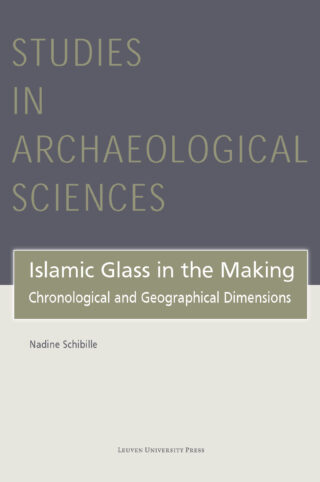

Islamic Glass in the Making
Chronological and Geographical Dimensions
Nadine Schibille (Author),

Series: Studies in Archaeological Sciences 7
Category: Archaeology
Language: English
ISBN: 9789462703193
Publication date: March 7, 2022
€75.00 (including 6% VAT)
Buy NowNumber of pages: 270
Size: 234 x 156 x 18 mm
Number of illustrations: 78
Illustrations and other content description:
Illustrated in colour

Funded by: ERC
Stock item: 147099
Standard delivery time for print books:
For Belgium: 5 to 8 working days
For EU: 2 to 3 weeks
For other countries: 4 to 5 weeks
Series: Studies in Archaeological Sciences 7
Category: Archaeology
Language: English
ISBN: 9789461664426
Publication date: March 3, 2022
Download Free EpubNumber of pages: 270
Number of illustrations: 78
Illustrations and other content description:
Illustrated in colour
Funded by: ERC
Series: Studies in Archaeological Sciences 7
Category: Archaeology
Language: English
ISBN: 9789461664419
Publication date: February 21, 2022
Download Free PDFNumber of pages: 270
Number of illustrations: 78
Illustrations and other content description:
Illustrated in colour
Funded by: ERC
New insights into the history of Islamic glassmaking
The ancient glass industry changed dramatically towards the end of the first millennium. The Roman glassmaking tradition of mineral soda glass was increasingly supplanted by the use of plant ash as the main fluxing agent at the turn of the ninth century CE. Defining primary production groups of plant ash glass has been a challenge due to the high variability of raw materials and the smaller scale of production. Islamic Glass in the Making advocates a large-scale archaeometric approach to the history of Islamic glassmaking to trace the developments in the production, trade and consumption of vitreous materials between the eighth and twelfth centuries and to separate the norm from the exception. It proposes compositional discriminants to distinguish regional production groups, and provides insights into the organisation of the glass industry and commerce during the early Islamic period. The interdisciplinary approach leads to a holistic understanding of the development of Islamic glass; assemblages from the early Islamic period in Mesopotamia, Central Asia, Egypt, Greater Syria and Iberia are evaluated, and placed in the larger geopolitical context. In doing so, this book fills a gap in the present literature and advances a large-scale approach to the history of Islamic glass.
Ebook available in Open Access.
This publication is GPRC-labeled (Guaranteed Peer-Reviewed Content).
Preface: GlassRoutes and the systems of change
Acknowledgements
List of Illustrations
List of Tables
Introduction
Chapter 1
Islamic glassmaking in Egypt contingent on local administration 27
• Primary glass workshops in Egypt – the archaeological evidence 28
• Roman and late antique glass groups of Egyptian origin 32
Roman antimony-decoloured glass 32
High iron, manganese and titanium (HIMT) glass 36
HIMT2 & Foy 3.2 (série 3.2) 38
Glass group Foy 2.1 (série 2.1) 40
Magby – a high Mg Byzantine glass type 42
Compositions and working properties over time 45
• The beginnings of Islamic glass production 47
Natron type Egypt 1A-C & Egypt 2 49
Natron type Egypt 1Ax – glass mosaics from the Great Mosque in Damascus 56
• The earliest plant ash glasses from Egypt 62
Plant ash glasses E1 – E4 63
Recycling and chronological evolution 66
Tin-oxide opacified glass weights 68
• Trace element discriminants of Egyptian glass 71
• Egyptian glass and its market 72
10 Table of Contents
Chapter 2
Islamic glassmaking in Greater Syria (Bilâd al-Shâm): distribution patterns 77
• Glassmaking and glass-working in the Bilâd al-Shâm –
the archaeological evidence 78
• Roman and late antique glass groups of Levantine origin 80
Roman manganese-decoloured and naturally coloured glass 80
The glass from fourth-century Jalame 83
Late antique Apollonia glass – Levantine I 84
• The beginnings of Islamic glass production 88
Early Islamic natron glass from Bet Eli‘ezer – Levantine II 88
The early Islamic mosaic tradition in Greater Syria 93
An interlude – the gold in gold leaf tesserae 97
Colours and opacifiers of the mosaic tesserae 99
• The last hurrah of natron-type glass in the Levant 105
• The earliest plant ash glasses from the Bilâd al-Shâm 108
Raqqa group 1 & Raqqa group 4 108
Glass from the primary production site of Tyre 113
Glass from the Serçe Limani shipwreck and the secondary workshop at Banias 115
• Ruptures and shifts in the production of glass in the Levant 119
• Distribution patterns and the glass market 121
Chapter 3
Glass production in Mesopotamia: preservation of plant ash recipes 125
• Sasanian glassmaking tradition – Veh Ardašīr et al. 126
• The transition to Islamic glassmaking in Mesopotamia 135
Mesopotamian group Raqqa 4 135
Two early Islamic glass groups from Mesopotamia: Samarra 1 and Samarra 2 138
Colourless glass from Nishapur 140
Millefiori tiles from Samarra and the ‘missing link’ 144
Message in a bottle 150
The port city of Siraf – a trading hub 155
• Glass from Iran and Central Asia – multiple origins of the glass
at Nishapur and Merv 157
• Mesopotamian versus Central Asian glass productions 163
Table of Contents 11
Chapter 4
“From Polis to Madina” and the flux of glass in Spain 173
• Late Roman and Visigothic glass from Hispania 176
The glass from Recópolis – exception to the rule or genuine trend? 177
• The first local production of glass in Islamic al-Andalus 183
The ‘invention’ of glassmaking – the case of Šaqunda 183
The glass workshop in Pechina (Almería) 189
The glass from Madīnat al-Zahrā’ – the Brilliant City 194
Domestic assemblages in Córdoba and the advent of Iberian plant ash glass 203
• Mosaics from Madīnat al-Zahrā’ and the Great Mosque of Córdoba 207
• The glass supply in eighth- to tenth-century al-Andalus 217
• Glass and the processes of Islamisation 221
• Western expansion: Sicily and the Maghreb 222
Byzantine, Islamic and Swabian Sicily 222
Islamic glass in the Maghreb 226
Emancipation of western Islamic glassmaking 226
Chapter 5
In conclusion – geographical and chronological dimensions 229
References 237
Preface: GlassRoutes and the systems of change
Acknowledgements
List of Illustrations
List of Tables
Introduction
Chapter 1
Islamic glassmaking in Egypt contingent on local administration
• Primary glass workshops in Egypt – the archaeological evidence
• Roman and late antique glass groups of Egyptian origin
Roman antimony-decoloured glass High iron, manganese and titanium (HIMT) glass HIMT2 & Foy 3.2 (série 3.2) Glass group Foy 2.1 (série 2.1) Magby – a high Mg Byzantine glass type Compositions and working properties over time
• The beginnings of Islamic glass production
Natron type Egypt 1A-C & Egypt 2
Natron type Egypt 1Ax – glass mosaics from the Great Mosque in Damascus
• The earliest plant ash glasses from Egypt
Plant ash glasses E1 – E4
Recycling and chronological evolution
Tin-oxide opacified glass weights
• Trace element discriminants of Egyptian glass
• Egyptian glass and its market
Chapter 2
Islamic glassmaking in Greater Syria (Bilâd al-Shâm): distribution patterns
• Glassmaking and glass-working in the Bilâd al-Shâm –
the archaeological evidence
• Roman and late antique glass groups of Levantine origin
Roman manganese-decoloured and naturally coloured glass
The glass from fourth-century Jalame
Late antique Apollonia glass – Levantine I
• The beginnings of Islamic glass production
Early Islamic natron glass from Bet Eli‘ezer – Levantine II
The early Islamic mosaic tradition in Greater Syria
An interlude – the gold in gold leaf tesserae
Colours and opacifiers of the mosaic tesserae
• The last hurrah of natron-type glass in the Levant
• The earliest plant ash glasses from the Bilâd al-Shâm
Raqqa group 1 & Raqqa group 4
Glass from the primary production site of Tyre
Glass from the Serçe Limani shipwreck and the secondary workshop at Banias
• Ruptures and shifts in the production of glass in the Levant
• Distribution patterns and the glass market
Chapter 3
Glass production in Mesopotamia: preservation of plant ash recipes
• Sasanian glassmaking tradition – Veh Ardašīr et al.
• The transition to Islamic glassmaking in Mesopotamia
Mesopotamian group Raqqa 4
Two early Islamic glass groups from Mesopotamia: Samarra 1 and Samarra 2
Colourless glass from Nishapur
Millefiori tiles from Samarra and the ‘missing link’
Message in a bottle
The port city of Siraf – a trading hub
• Glass from Iran and Central Asia – multiple origins of the glass
at Nishapur and Merv
• Mesopotamian versus Central Asian glass productions
Chapter 4
“From Polis to Madina” and the flux of glass in Spain
• Late Roman and Visigothic glass from Hispania
The glass from Recópolis – exception to the rule or genuine trend?
• The first local production of glass in Islamic al-Andalus
The ‘invention’ of glassmaking – the case of Šaqunda
The glass workshop in Pechina (Almería)
The glass from Madīnat al-Zahrā’ – the Brilliant City
Domestic assemblages in Córdoba and the advent of Iberian plant ash glass
• Mosaics from Madīnat al-Zahrā’ and the Great Mosque of Córdoba
• The glass supply in eighth- to tenth-century al-Andalus
• Glass and the processes of Islamisation
• Western expansion: Sicily and the Maghreb
Byzantine, Islamic and Swabian Sicily
Islamic glass in the Maghreb
Emancipation of western Islamic glassmaking
Chapter 5
In conclusion – geographical and chronological dimensions
References
Chapter 1
Islamic glassmaking in Egypt contingent on local administration
• Primary glass workshops in Egypt – the archaeological evidence
• Roman and late antique glass groups of Egyptian origin
Roman antimony-decoloured glass
High iron, manganese and titanium (HIMT) glass
HIMT2 & Foy 3.2 (série 3.2)
Glass group Foy 2.1 (série 2.1)
Magby – a high Mg Byzantine glass type
Compositions and working properties over time
• The beginnings of Islamic glass production
Natron type Egypt 1A-C & Egypt 2Natron type Egypt 1Ax – glass mosaics from the Great Mosque in Damascus
• The earliest plant ash glasses from Egypt
Plant ash glasses E1 – E4
Recycling and chronological evolution
Tin-oxide opacified glass weights
• Trace element discriminants of Egyptian glass
• Egyptian glass and its market
Chapter 2
Islamic glassmaking in Greater Syria (Bilâd al-Shâm): distribution patterns
• Glassmaking and glass-working in the Bilâd al-Shâm –
the archaeological evidence
• Roman and late antique glass groups of Levantine origin
Roman manganese-decoloured and naturally coloured glass
The glass from fourth-century Jalame
Late antique Apollonia glass – Levantine I
• The beginnings of Islamic glass production
Early Islamic natron glass from Bet Eli‘ezer – Levantine II
The early Islamic mosaic tradition in Greater Syria
An interlude – the gold in gold leaf tesserae
Colours and opacifiers of the mosaic tesserae
• The last hurrah of natron-type glass in the Levant
• The earliest plant ash glasses from the Bilâd al-Shâm
Raqqa group 1 & Raqqa group 4
Glass from the primary production site of Tyre
Glass from the Serçe Limani shipwreck and the secondary workshop at Banias
• Ruptures and shifts in the production of glass in the Levant
• Distribution patterns and the glass market
Chapter 3
Glass production in Mesopotamia: preservation of plant ash recipes
• Sasanian glassmaking tradition – Veh Ardašīr et al.
• The transition to Islamic glassmaking in Mesopotamia
Mesopotamian group Raqqa 4
Two early Islamic glass groups from Mesopotamia: Samarra 1 and Samarra 2
Colourless glass from Nishapur
Millefiori tiles from Samarra and the ‘missing link’
Message in a bottle
The port city of Siraf – a trading hub
• Glass from Iran and Central Asia – multiple origins of the glass
at Nishapur and Merv
• Mesopotamian versus Central Asian glass productions
Chapter 4
“From Polis to Madina” and the flux of glass in Spain
• Late Roman and Visigothic glass from Hispania
The glass from Recópolis – exception to the rule or genuine trend?
• The first local production of glass in Islamic al-Andalus
The ‘invention’ of glassmaking – the case of Šaqunda
The glass workshop in Pechina (Almería)
The glass from Madīnat al-Zahrā’ – the Brilliant City
Domestic assemblages in Córdoba and the advent of Iberian plant ash glass
• Mosaics from Madīnat al-Zahrā’ and the Great Mosque of Córdoba
• The glass supply in eighth- to tenth-century al-Andalus
• Glass and the processes of Islamisation
• Western expansion: Sicily and the Maghreb
Byzantine, Islamic and Swabian Sicily
Islamic glass in the Maghreb
Emancipation of western Islamic glassmaking
Chapter 5
In conclusion – geographical and chronological dimensions
References
Cette recherche, par son approche à grande échelle, tant numérique que géographique et chronologique, était une gageure renforcée par la grande variabilité des matières premières (et particulièrement du fondant aux cendres de plantes) et la petite échelle de production des centres islamiques, par rapport aux centres antiques. Un des apports importants de l'ouvrage est de synthétiser, ou de proposer, les seuils de discrimination entre groupes de composition et les meilleurs diagrammes binaires à établir pour différencier les six zones de productions primaires de verres aux cendres de plantes (K2O/P2O5 - MgO/CaO ; B/Na2O - Li/Na2O ; Th/Zr - La/TiO2 ; et AL2O - Cr/La (5)) (voir fig. 78) qui illustrent les différences dans le fondant, dans la source de silice et dans la manière de travailler. L'autre apport, dont il faut savoir grand gré à N. Schibille, est d'avoir effectué le délicat exercice de synthèse qui a conduit à ce volume, plutôt que de se contenter de produire des articles dans des revues d'archéométrie, rendant, ainsi, lisibles, pour un plus vaste public, les résultats de sa recherche novatrice qui touchent tant à l'archéologie qu'à l'histoire. - Marie-Dominique Nenna, Bulletin critique des Annales islamologiques, 38 | 2024, DOI : https://doi.org/10.4000/bcai.7012
Frequently Asked Questions
What is "Islamic Glass in the Making" about?
New insights into the history of Islamic glassmaking
The ancient glass industry changed dramatically towards the end of the first millennium. The Roman glassmaking tradition of mineral soda glass was increasingly supplanted by the use of plant ash as the main fluxing agent at the turn of the ninth century CE. Defining primary production groups of plant ash glass has been a challenge due to the high variability of raw materials and the smaller scale of production. Islamic Glass in the Making advocates a large-scale archaeometric approach to the history of Islamic glassmaking to trace the developments in the production, trade and consumption of vitreous materials between the eighth and twelfth centuries and to separate the norm from the exception. It proposes compositional discriminants to distinguish regional production groups, and provides insights into the organisation of the glass industry and commerce during the early Islamic period. The interdisciplinary approach leads to a holistic understanding of the development of Islamic glass; assemblages from the early Islamic period in Mesopotamia, Central Asia, Egypt, Greater Syria and Iberia are evaluated, and placed in the larger geopolitical context. In doing so, this book fills a gap in the present literature and advances a large-scale approach to the history of Islamic glass.
Ebook available in Open Access.
This publication is GPRC-labeled (Guaranteed Peer-Reviewed Content).
Who wrote "Islamic Glass in the Making"?
"Islamic Glass in the Making" was written by Nadine Schibille.
Nadine Schibille is a senior researcher in art history and archaeometry in the Institut de recherche sur les archéomatériaux (IRAMAT-CEB) at the French National Centre for Scientific Research (CNRS).
Is "Islamic Glass in the Making" part of a series?
Yes, "Islamic Glass in the Making" is part of the "Studies in Archaeological Sciences" series. It's book 7 in the series.
Studies in Archaeological Sciences presents state-of-the-art methodological, technical or material science contributions to Archaeological Sciences. The series aims to reconstruct the integrated story of human and material culture through time and testifies to the necessity of inter- and multidisciplinary research in cultural heritage studies. Studies in Archaeological Sciences aims to publish at least one volume a year and accepts monographs as well as coherent edited volumes in English. Contributions should be set up to be a specialist reference work for a broad audience of academic readers. Manuscript should be 80.000 to 120.000 words in length and may include graphs and tables in black and white. All contributions are submitted to international peer review.

Readership
Researchers and graduate students in fields such as Archaeology, Archaeological Sciences, History, Conservation and Cultural Heritage Studies and Museum Sciences.
Editor-in-Chief
Prof. Patrick Degryse, Centre for Archaeological Sciences, KU Leuven, Belgium
Editorial Board
Prof. Dennis Braeckmans, Department of Archaeological Sciences, Universiteit Leiden, The Netherlands
Prof. Ian Freestone, Institute of Archaeology, University College London, United Kingdom
Dr. Andrew Meek, Department of Scientific Research, The British Museum
Dr. Andrew Shortland, Centre for Archaeological and Forensic Analysis, Cranfield University, United Kingdom
Prof. Manuel Sintubin, Department of Earth & Environmental Sciences, KU Leuven, Belgium
Invitation to future Advisory Board members
Scholars interested to join the Advisory Board of this new series are cordially invited to contact Prof. Patrick Degryse (Editor-in-Chief) or one of the editorial board members.
Proposals
Proposals and inquiries can be sent to to editor-in- chief Patrick Degryse or one of the editorial board members. Please send a preliminary abstract (1-2 pp.) and a short bio. Upon approval of this abstract (average turnaround time of 4 weeks), the full manuscript will be submitted to international peer review. Two peer reviewers will be asked for expert advice, three in case of conflicting reports.
Please make use of the submission form to present your manuscript or proposal to our board.
Authors interested in Open Access can consult the available funding options.
Links & Resources
Is "Islamic Glass in the Making" available Open Access?
Yes, "Islamic Glass in the Making" is published Open Access. It is available under a BY-NC-ND license.
Who funded the publication of "Islamic Glass in the Making"?
Publication of "Islamic Glass in the Making" was funded by ERC
.
What is the Table of Contents for "Islamic Glass in the Making"?
Preface: GlassRoutes and the systems of change
Acknowledgements
List of Illustrations
List of Tables
Introduction
Chapter 1
Islamic glassmaking in Egypt contingent on local administration 27
• Primary glass workshops in Egypt – the archaeological evidence 28
• Roman and late antique glass groups of Egyptian origin 32
Roman antimony-decoloured glass 32
High iron, manganese and titanium (HIMT) glass 36
HIMT2 & Foy 3.2 (série 3.2) 38
Glass group Foy 2.1 (série 2.1) 40
Magby – a high Mg Byzantine glass type 42
Compositions and working properties over time 45
• The beginnings of Islamic glass production 47
Natron type Egypt 1A-C & Egypt 2 49
Natron type Egypt 1Ax – glass mosaics from the Great Mosque in Damascus 56
• The earliest plant ash glasses from Egypt 62
Plant ash glasses E1 – E4 63
Recycling and chronological evolution 66
Tin-oxide opacified glass weights 68
• Trace element discriminants of Egyptian glass 71
• Egyptian glass and its market 72
10 Table of Contents
Chapter 2
Islamic glassmaking in Greater Syria (Bilâd al-Shâm): distribution patterns 77
• Glassmaking and glass-working in the Bilâd al-Shâm –
the archaeological evidence 78
• Roman and late antique glass groups of Levantine origin 80
Roman manganese-decoloured and naturally coloured glass 80
The glass from fourth-century Jalame 83
Late antique Apollonia glass – Levantine I 84
• The beginnings of Islamic glass production 88
Early Islamic natron glass from Bet Eli‘ezer – Levantine II 88
The early Islamic mosaic tradition in Greater Syria 93
An interlude – the gold in gold leaf tesserae 97
Colours and opacifiers of the mosaic tesserae 99
• The last hurrah of natron-type glass in the Levant 105
• The earliest plant ash glasses from the Bilâd al-Shâm 108
Raqqa group 1 & Raqqa group 4 108
Glass from the primary production site of Tyre 113
Glass from the Serçe Limani shipwreck and the secondary workshop at Banias 115
• Ruptures and shifts in the production of glass in the Levant 119
• Distribution patterns and the glass market 121
Chapter 3
Glass production in Mesopotamia: preservation of plant ash recipes 125
• Sasanian glassmaking tradition - Veh Ardašīr et al. 126
• The transition to Islamic glassmaking in Mesopotamia 135
Mesopotamian group Raqqa 4 135
Two early Islamic glass groups from Mesopotamia: Samarra 1 and Samarra 2 138
Colourless glass from Nishapur 140
Millefiori tiles from Samarra and the ‘missing link’ 144
Message in a bottle 150
The port city of Siraf – a trading hub 155
• Glass from Iran and Central Asia – multiple origins of the glass
at Nishapur and Merv 157
• Mesopotamian versus Central Asian glass productions 163
Table of Contents 11
Chapter 4
“From Polis to Madina” and the flux of glass in Spain 173
• Late Roman and Visigothic glass from Hispania 176
The glass from Recópolis – exception to the rule or genuine trend? 177
• The first local production of glass in Islamic al-Andalus 183
The ‘invention’ of glassmaking – the case of Šaqunda 183
The glass workshop in Pechina (Almería) 189
The glass from Madīnat al-Zahrā’ – the Brilliant City 194
Domestic assemblages in Córdoba and the advent of Iberian plant ash glass 203
• Mosaics from Madīnat al-Zahrā’ and the Great Mosque of Córdoba 207
• The glass supply in eighth- to tenth-century al-Andalus 217
• Glass and the processes of Islamisation 221
• Western expansion: Sicily and the Maghreb 222
Byzantine, Islamic and Swabian Sicily 222
Islamic glass in the Maghreb 226
Emancipation of western Islamic glassmaking 226
Chapter 5
In conclusion – geographical and chronological dimensions 229
References 237
Preface: GlassRoutes and the systems of change
Acknowledgements
List of Illustrations
List of Tables
Introduction
Chapter 1
Islamic glassmaking in Egypt contingent on local administration
• Primary glass workshops in Egypt – the archaeological evidence
• Roman and late antique glass groups of Egyptian origin
Roman antimony-decoloured glass High iron, manganese and titanium (HIMT) glass HIMT2 & Foy 3.2 (série 3.2) Glass group Foy 2.1 (série 2.1) Magby – a high Mg Byzantine glass type Compositions and working properties over time
• The beginnings of Islamic glass production
Natron type Egypt 1A-C & Egypt 2
Natron type Egypt 1Ax – glass mosaics from the Great Mosque in Damascus
• The earliest plant ash glasses from Egypt
Plant ash glasses E1 – E4
Recycling and chronological evolution
Tin-oxide opacified glass weights
• Trace element discriminants of Egyptian glass
• Egyptian glass and its market
Chapter 2
Islamic glassmaking in Greater Syria (Bilâd al-Shâm): distribution patterns
• Glassmaking and glass-working in the Bilâd al-Shâm –
the archaeological evidence
• Roman and late antique glass groups of Levantine origin
Roman manganese-decoloured and naturally coloured glass
The glass from fourth-century Jalame
Late antique Apollonia glass – Levantine I
• The beginnings of Islamic glass production
Early Islamic natron glass from Bet Eli‘ezer – Levantine II
The early Islamic mosaic tradition in Greater Syria
An interlude – the gold in gold leaf tesserae
Colours and opacifiers of the mosaic tesserae
• The last hurrah of natron-type glass in the Levant
• The earliest plant ash glasses from the Bilâd al-Shâm
Raqqa group 1 & Raqqa group 4
Glass from the primary production site of Tyre
Glass from the Serçe Limani shipwreck and the secondary workshop at Banias
• Ruptures and shifts in the production of glass in the Levant
• Distribution patterns and the glass market
Chapter 3
Glass production in Mesopotamia: preservation of plant ash recipes
• Sasanian glassmaking tradition - Veh Ardašīr et al.
• The transition to Islamic glassmaking in Mesopotamia
Mesopotamian group Raqqa 4
Two early Islamic glass groups from Mesopotamia: Samarra 1 and Samarra 2
Colourless glass from Nishapur
Millefiori tiles from Samarra and the ‘missing link’
Message in a bottle
The port city of Siraf – a trading hub
• Glass from Iran and Central Asia – multiple origins of the glass
at Nishapur and Merv
• Mesopotamian versus Central Asian glass productions
Chapter 4
“From Polis to Madina” and the flux of glass in Spain
• Late Roman and Visigothic glass from Hispania
The glass from Recópolis – exception to the rule or genuine trend?
• The first local production of glass in Islamic al-Andalus
The ‘invention’ of glassmaking – the case of Šaqunda
The glass workshop in Pechina (Almería)
The glass from Madīnat al-Zahrā’ – the Brilliant City
Domestic assemblages in Córdoba and the advent of Iberian plant ash glass
• Mosaics from Madīnat al-Zahrā’ and the Great Mosque of Córdoba
• The glass supply in eighth- to tenth-century al-Andalus
• Glass and the processes of Islamisation
• Western expansion: Sicily and the Maghreb
Byzantine, Islamic and Swabian Sicily
Islamic glass in the Maghreb
Emancipation of western Islamic glassmaking
Chapter 5
In conclusion – geographical and chronological dimensions
References
Chapter 1
Islamic glassmaking in Egypt contingent on local administration
• Primary glass workshops in Egypt – the archaeological evidence
• Roman and late antique glass groups of Egyptian origin
Roman antimony-decoloured glass
High iron, manganese and titanium (HIMT) glass
HIMT2 & Foy 3.2 (série 3.2)
Glass group Foy 2.1 (série 2.1)
Magby – a high Mg Byzantine glass type
Compositions and working properties over time
• The beginnings of Islamic glass production
Natron type Egypt 1A-C & Egypt 2Natron type Egypt 1Ax – glass mosaics from the Great Mosque in Damascus
• The earliest plant ash glasses from Egypt
Plant ash glasses E1 – E4
Recycling and chronological evolution
Tin-oxide opacified glass weights
• Trace element discriminants of Egyptian glass
• Egyptian glass and its market
Chapter 2
Islamic glassmaking in Greater Syria (Bilâd al-Shâm): distribution patterns
• Glassmaking and glass-working in the Bilâd al-Shâm –
the archaeological evidence
• Roman and late antique glass groups of Levantine origin
Roman manganese-decoloured and naturally coloured glass
The glass from fourth-century Jalame
Late antique Apollonia glass – Levantine I
• The beginnings of Islamic glass production
Early Islamic natron glass from Bet Eli‘ezer – Levantine II
The early Islamic mosaic tradition in Greater Syria
An interlude – the gold in gold leaf tesserae
Colours and opacifiers of the mosaic tesserae
• The last hurrah of natron-type glass in the Levant
• The earliest plant ash glasses from the Bilâd al-Shâm
Raqqa group 1 & Raqqa group 4
Glass from the primary production site of Tyre
Glass from the Serçe Limani shipwreck and the secondary workshop at Banias
• Ruptures and shifts in the production of glass in the Levant
• Distribution patterns and the glass market
Chapter 3
Glass production in Mesopotamia: preservation of plant ash recipes
• Sasanian glassmaking tradition - Veh Ardašīr et al.
• The transition to Islamic glassmaking in Mesopotamia
Mesopotamian group Raqqa 4
Two early Islamic glass groups from Mesopotamia: Samarra 1 and Samarra 2
Colourless glass from Nishapur
Millefiori tiles from Samarra and the ‘missing link’
Message in a bottle
The port city of Siraf – a trading hub
• Glass from Iran and Central Asia – multiple origins of the glass
at Nishapur and Merv
• Mesopotamian versus Central Asian glass productions
Chapter 4
“From Polis to Madina” and the flux of glass in Spain
• Late Roman and Visigothic glass from Hispania
The glass from Recópolis – exception to the rule or genuine trend?
• The first local production of glass in Islamic al-Andalus
The ‘invention’ of glassmaking – the case of Šaqunda
The glass workshop in Pechina (Almería)
The glass from Madīnat al-Zahrā’ – the Brilliant City
Domestic assemblages in Córdoba and the advent of Iberian plant ash glass
• Mosaics from Madīnat al-Zahrā’ and the Great Mosque of Córdoba
• The glass supply in eighth- to tenth-century al-Andalus
• Glass and the processes of Islamisation
• Western expansion: Sicily and the Maghreb
Byzantine, Islamic and Swabian Sicily
Islamic glass in the Maghreb
Emancipation of western Islamic glassmaking
Chapter 5
In conclusion – geographical and chronological dimensions
References
Related titles
 German–Rapanui Entanglements
Cristián Moreno Pakarati (Editor), Diego Muñoz (Editor), Philipp Schorch (Editor),
August 2026
 Of Goblins and Gods
Andrew J. Shortland (Editor), Victoria Kemp (Editor), Lasse Hermansen Bjørnland (Editor), Patrick Degryse (Editor),
February 2026
 Modern Etruscans
Chiara Zampieri (Editor), Martina Piperno (Editor), Bart Van den Bossche (Editor),
October 2023
 The Elemental Analysis of Glass Beads
Laure Dussubieux (Editor), Heather Walder (Editor),
October 2022

 Mapping Landscapes in Transformation
Thomas Coomans (Editor), Bieke Cattoor (Editor), Krista De Jonge (Editor),
June 2019

 The Lower to Middle Palaeolithic Transition in Northwestern Europe
Ann Van Baelen (Author),
October 2017
 Minoan Earthquakes
Simon Jusseret (Editor), Manuel Sintubin (Editor), Jan Driessen (Preface by),
April 2017
 Handheld XRF for Art and Archaeology (paperback)
Aaron N. Shugar (Editor), Jennifer L. Mass (Editor),
November 2013
 Handheld XRF for Art and Archaeology
Aaron N. Shugar (Editor), Jennifer L. Mass (Editor),
March 2013
 Chert Quarrying, Lithic Technology, and a Modern Human Burial at the Palaeolithic Site of Taramsa 1, Upper Egypt
Philip Van Peer (Author), Pierre M. Vermeersch (Author), Etienne Paulissen (Author),
April 2010
 Isotopes in Vitreous Materials
Patrick Degryse (Editor), Julian Henderson (Editor), Greg Hodgins (Editor),
March 2013
 Etude anthropologique du squelette du Paléolithique supérieur de Nazlet Khater 2 (Egypte)
Isabelle Crevecoeur (Author),
December 2008
 A Holocene Prehistoric Sequence in the Egyptian Red Sea Area: The Tree Shelter
Pierre M. Vermeersch (Editor),
July 2008